
Introduction
The results of testing geographical knowledge and skills are among the basic techniques considered in geographical education (Lane & Bourke 2019). They provide valuable feedback tools at all levels of education and are critical in preparing future geographers. We can approach the results of testing such knowledge and skills from different points of view. This includes the pedagogical–psychological context, that is, causes of success and failure from the point of view of learning and the progress of solving tasks; the social context, including the influence of an individual's social status on their test results, and the spatial perspective as a key factor influencing test results (Fonseca et al. 2011). However, at the level of basic research, with some exceptions (Niemz & Stoltman 1993; Lambert & Purnell 1994), to date, there have been relatively few studies on spatial differentiation of the level of knowledge and skills in geography. Although several international knowledge and skills tests have been developed and applied, they have not been primarily focused on geography. Therefore, their usefulness for applying the results to the training of geographers is limited. The results of such tests are related to spatial factors but do not consider the social, economic and cultural characteristics of specific regions (PISA and TIMSS testing; Shen 2005; Fonseca et al. 2011; Eklöf et al. 2014).
Among existing types of geographical testing is the International Geography Olympiad, hereafter referred to as iGeo, which is attended by students from several countries worldwide (van der Schee 2007). iGeo is an annual competition for students with a high level of geographical knowledge and skills and includes a long testing series (Artvinli & Dönmez 2023). The concept of the competition tries to approach testing from the viewpoints of various geographical knowledge and skills, considering the breadth of geography as a scientific field. Students with strong geographical knowledge and skills participate in the competition based on national testing, such as in Estonia, Mexico or Russia (Liiber & Roosaare 2007; Naumov 2007; Garcia-Garcia 2007). The iGeo first took place in 1996 with only five participating states. Previous studies have analysed only partial results from this competition, including the initial years of the competition and without a spatial context (van der Schee & Kolkman 2010; Chalmers & Berg 2014).
This study addresses the following research question: How does spatial differentiation in iGeo results manifest across countries participating in the competition? In this study, we aimed to determine the spatial differentiation of the results of the iGeo competition and find its determinant iGeo. The aim of the article is important because the spatial comparison of iGeo results can show regional differences in the quality of geographical education. This represents a valuable resource for the formulation of targeted didactic interventions and regional development strategies. This approach critically analyzes the influence of socioeconomic and regional factors on the level of geographical knowledge and skills, contributing to a more detailed understanding of educational trends.
Theoretical framework
Theoretical approaches to the analysis of geographical space have shifted from the traditional division of the world into continents towards the creation of socio-economically and culturally homogeneous macroregions (Huntington 1996; Getis et al. 2008). Although we have directly compared the results of individual countries, we have used the regionalization proposed by Anděl et al. (2018) as a theoretical framework as a basis to explain the spatial differentiation of geographical knowledge and skills.
The results of spatial differentiation of knowledge and skills, such as geographical, as presented, for example, in the international competition iGeo (van der Schee 2007; Liiber & Roosaare 2007; Naumov 2007; Garcia-Garcia 2007; van der Schee & Kolkman 2010; Balint et al. 2018; Trahorsch & Svobodová 2023), are influenced by several factors. In this study, we selected several socioeconomic and educational indicators, specifically GDP per capita, education expenditure, length of schooling, level of urbanization, proportion of students in private schools, selected indicators upper secondary school and harmonized standardized test scores, as key variables that have the potential to influence student performance in iGeo. These indicators were based on previous studies that show that economic status and investment in education can, under certain conditions, contribute to improved educational outcomes (Vegas & Coffin 2015; Boateng 2014). Schooling duration was selected based on the hypothesis that longer periods of formal education promote knowledge accumulation and cognitive development. However, this relationship has been critically debated (Cliffordson & Gustafsson 2008; Ritchie & Tucker-Drob 2018). The level of urbanization has been included as an indicator of the availability of better methodological and organizational support in education, which can positively affect the preparation of competitors (Gross 2003; Hodges et al. 2018). Meanwhile, potentially gifted students also appear in less urbanized areas (Carman & Taylor 2010; Plucker et al. 2010; Callahan & Azano 2021). Because all iGeo tasks are administered in English, we further included a measure of national English-language proficiency, namely, the EF English Proficiency Index, given evidence that the language of testing can systematically advantage competitors from countries with higher English skills (Lane & Bourke 2019). We retained the share of students enrolled in private secondary schools as a proxy for the intensity of academic competition. Cross-national analyses show that a larger private-school sector is positively associated with student achievement in international assessments (West & Wößmann 2010). To characterise the institutional context of secondary schooling we also include four UNESCO-UIS indicators, that is, the upper secondary enrolment rate, the share of students in general (academic) programmes, expected years of secondary schooling and the upper secondary completion rate. Broad enrolment and high completion enlarge the pool from which Olympiad contestants are selected and are positively associated with national achievement in international assessments (Pritchett & Viarengo 2015). Education systems in which most students remain in general rather than vocational tracks record higher PISA scores, reflecting the payoff of academically oriented curricula for test-relevant skills (Hanushek & Wößmann 2006). Cross-country evidence from 21 countries shows that each additional expected year of secondary schooling yields substantial gains in literacy and numeracy proficiency (Cappellari, Checchi, & Ovidi 2023). This selection of variables reflects traditional socioeconomic determinants and considers the specifics of the iGeo competition selection mechanism. Here, competitors are selected based on their exceptional level of geographical knowledge and skills. This ensured that this study has captured the complex interaction of factors that can influence the spatial differentiation of competition results.
The specifics of the iGeo competition, which consists of a written test, a field part and a multimedia test, emphasize the need for a more in-depth approach to testing. This means that the tasks should be focused on solving open-ended and problem-oriented tasks that require both factual knowledge and spatial reasoning skills (International Geography Olympiad n.d.; Svobodová & Trahorsch 2024). The experience of competitors with testing significantly affects the results achieved (Urhahne et al. 2012; Shankar 2019), which highlights the importance of support mechanisms in student preparation.
Methods, data collection and analysis
This research is quantitative in nature. Therefore, data collection, analysis and interpretation were subject to quantitative research procedures. We used iGeo results from 2015–2023. The datasets used contain information about the competitor's affiliation to the given state, their score from the written, fieldwork and multimedia tests, in addition to their overall score. These data were supplemented with relative data with the success rate in % and the standardized score (z-score). A total of 1,387 data points (students) were considered. Figure 1 shows the spatial distribution of the data analyzed.
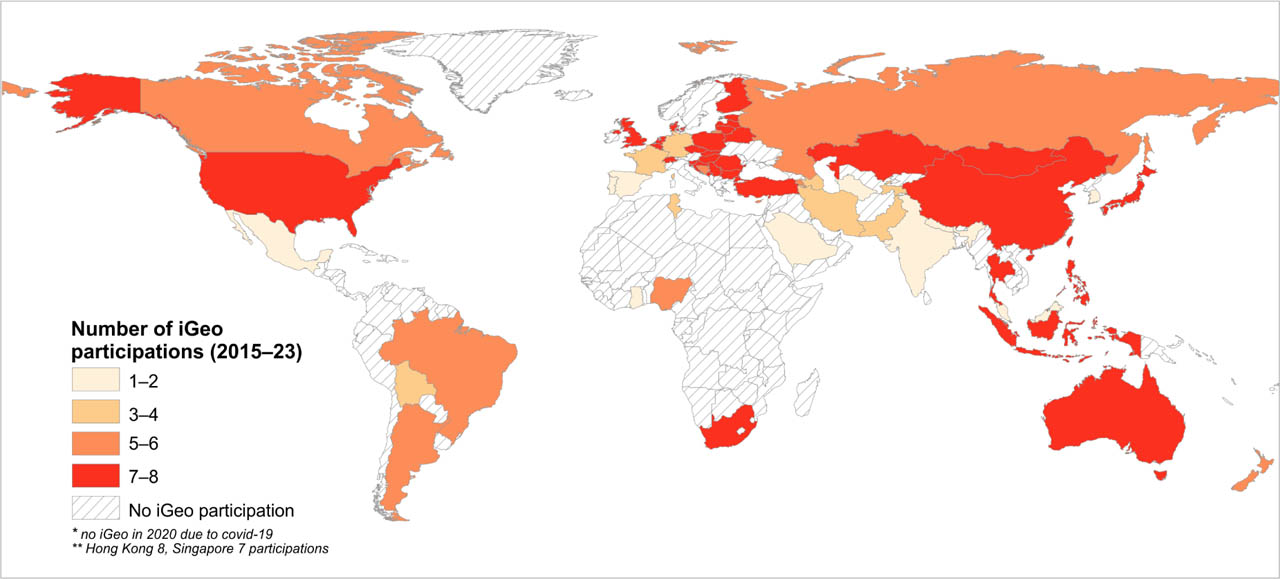
Figure 1.
Number of countries participating in iGeo in 2015–2023 (note: each country is usually represented by four contestants in one year)
Source: own elaboration
As part of the quantitative procedures, descriptive statistics, including the average and standard deviation, and parametric inductive static procedures were used. In all cases, the dataset shows signs of a normal data distribution, including histogram, skewness and kurtosis. We did not use normality tests due to their disadvantages with higher numbers of respondents. Therefore, it was possible to use parametric statistical procedures.
The statistical procedures used include Pearson's product-moment coefficient and Spearman's rank correlation coefficient analysis, depending on the nature of the data. This indicates the closeness of the relationship between two variables. This calculation was supplemented with the coefficient of determination, the result of which for the monitored set indicates the degree of explained dispersion (variability). To compare the averages of several groups, the Analysis of Variance (ANOVA) test with addition of effect size (eta squared, η2) was used to supplement the results with the possibility of comparing several tests and indicating the percentage of explained variance. This analysis was performed for the results of individual parts of iGeo.
Results
Spatial differentiation of the results of the competition and its parts
The results presented here compare the successes of states. A total of 63 countries participated in the iGeo competition during the monitoring period. The average success rate of competitors from the participating countries is shown in Figs. 2–5. The top ten performing countries include Indonesia, Latvia, Poland, Romania, Russia, Singapore, Taiwan and the USA (sorted alphabetically), all of which achieved greater than 60% success rates in iGeo. The least successful countries included Azerbaijan, Bolivia, Ghana, Montenegro, Nigeria, Portugal, Saudi Arabia, South Korea and Tajikistan (sorted alphabetically), each of which achieved a success rate of less than 33%. Differences in the ranking of individual states in iGeo sub-sections exist mainly for the best states. The countries of Southeast Asia show worse results than other countries in the multimedia test, such as Singapore and Indonesia. In contrast, no significant differences were observed in the placement of the least successful states in the individual parts of the competition. They achieved similar rankings and similar success rates compared to other states in the individual parts of the competition.
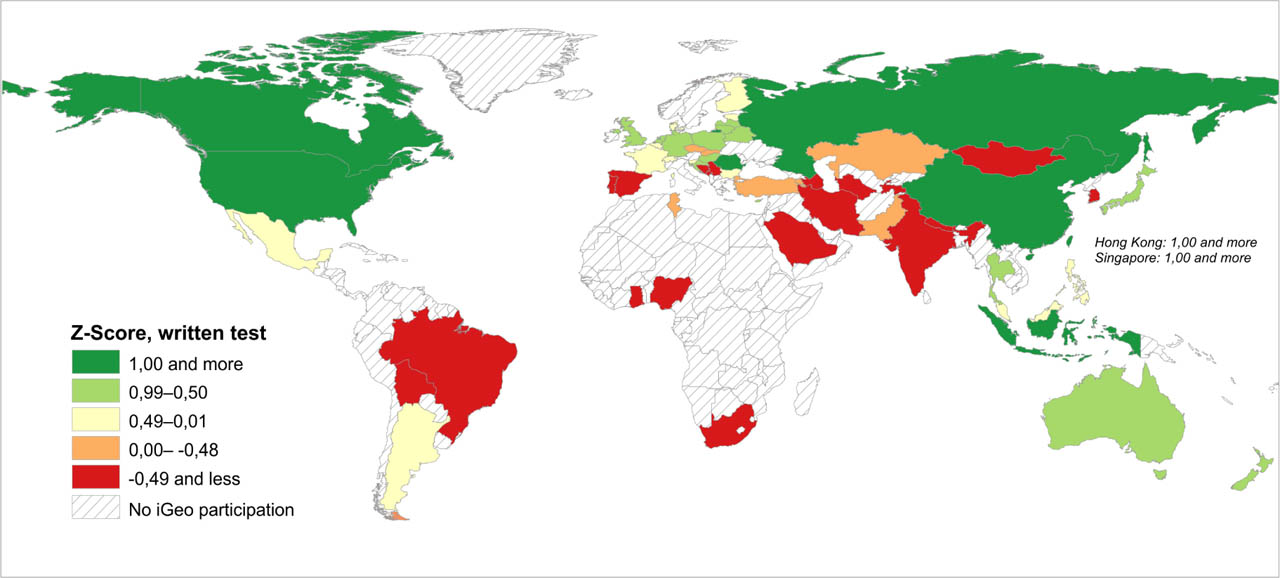
Figure 2.
Standardized success score of participating countries in the written test for the period 2015–2023
Source: own elaboration
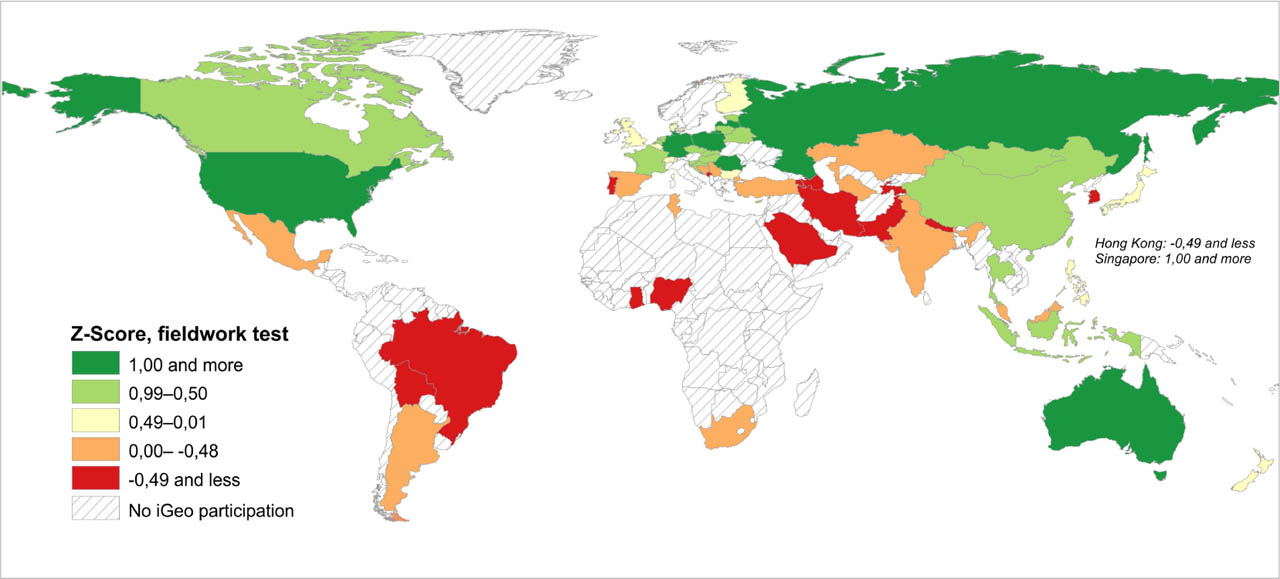
Figure 3.
Standardized success score of participating countries in the fieldwork exercise for the period 2015–2023
Source: own elaboration
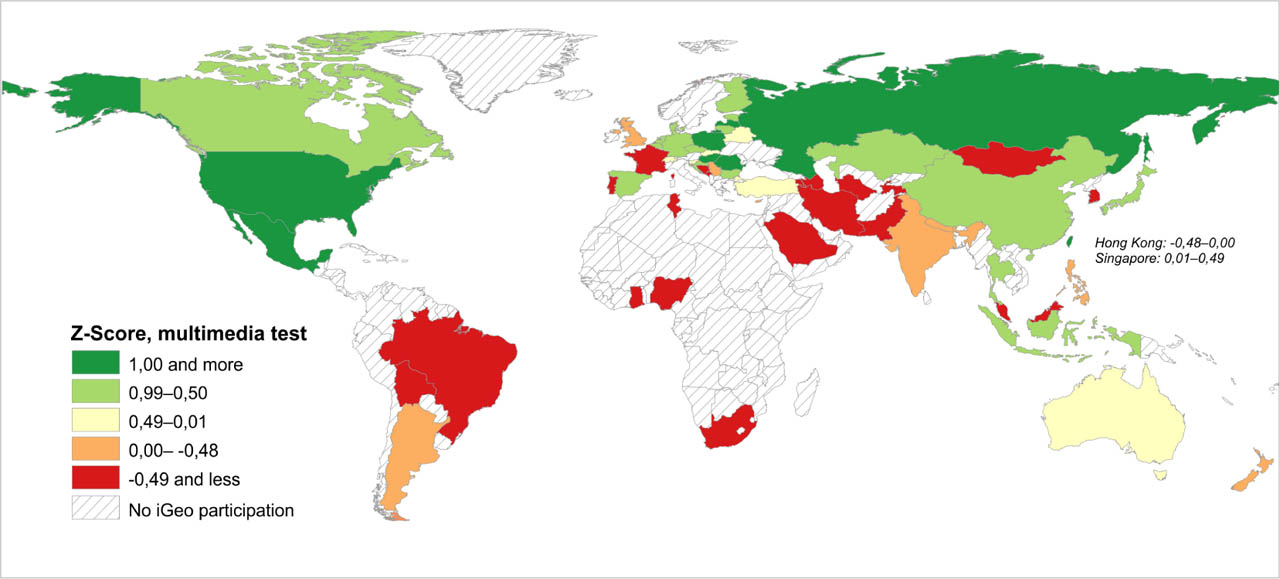
Figure 4.
Standardized success score of participating countries in the multimedia test for the period 2015–2023
Source: own elaboration
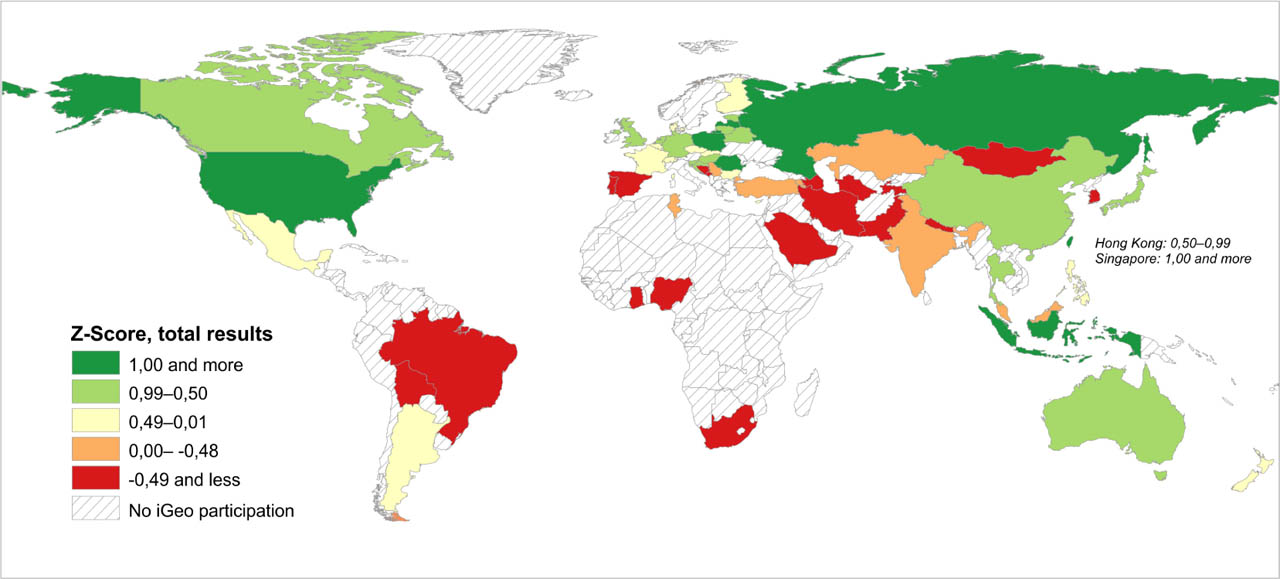
Figure 5.
Standardized success score of participating countries in the individual iGeo tests for the period 2015–2023
Source: own elaboration
The analysis has shown pronounced disparities in national performance across the individual competition components. The mean success rate in the multimedia test is approximately 55%, which is higher than in both the written test (~46%) and the fieldwork component (~45%). This finding indicates the distinctive nature of the multimedia test in that it comprises closed single-choice items, in contrast to the predominantly open-ended tasks in the fieldwork and written sections. This allows contestants to accrue comparatively more points, partly through guessing, with an a priori probability of success of 1:4. In contrast, the outcomes of the written and fieldwork tests are highly congruent. Countries that excel in the written examination are generally successful in fieldwork as well, and their rankings in these two disciplines differ only marginally. However, the multimedia test substantially reshuffles the order: most countries (54 out of 63) achieved their highest score of the three sections precisely in the multimedia test. This pattern also extends to otherwise less successful nations. For instance, Nepal obtained approximately 55% in the multimedia test, placing 33rd in that section. Meanwhile, it scored approximately 30% in both the written and fieldwork parts and ranked among the lowest overall. Conversely, certain countries that excel in written tests lag in the multimedia domain. Singapore, which was the top performer in the written test (≈72%), fell to ~57% in the multimedia test (31st place), a decline mirrored by Hong Kong. Other countries recorded better results specifically in the multimedia test. For example, Mexico achieved the highest multimedia score at ≈76%; compared with only 40% in fieldwork. Spain advanced from near last in the written test (28%) to a substantially higher position in the multimedia section (64%). The fieldwork component largely mirrors the performance profile of the written test and does not show such extreme deviations. Only in exceptional cases, such as France, is fieldwork the most successful discipline. France scored ~54% in fieldwork versus 50% in the multimedia test. These findings show that national success is strongly differentiated by task type. Sections dominated by open, problem-oriented items, such as the written test and, to a large extent, fieldwork, favour a similar cohort of countries. Meanwhile, the multimedia test rearranges the rankings and enables nations that are otherwise less competitive to excel.
Potential factors influencing the success of states in iGeo
We tried to determine the potential factors that influence the success of states, focusing primarily on basic (general) indicators of the educational system (socioeconomic variables) with the potential to influence the results of geographical knowledge and skills. For a more in-depth analysis, a theoretical framework of the analysis and selection of variables is missing. However, we considered theoretical analyses of tests from other fields and research using gifted students as shown in the theoretical framework. We considered the connection between the results of the competition and the number of participants from the given states in the competition. Since the competition requires specific geographical knowledge and skills, it can be assumed that the experience of the guarantors of the given state with the competition can help them to better prepare students for subsequent years, for example, during training courses. Correlation analysis (Table 1) showed that there may be a connection between the number of participations of the given state and their competition results. All the calculated values were significant at the p < 0.01 significance level. The relationship between the number of students participating and the frequency of state participation and the competition results has a medium dependence. The coefficient of determination (R2 ≈ 0.30–0.40) shows that the number of participants explains approximately 30% to 40% of the variance in the aggregate scores and their individual components. According to conventional benchmarks (Cohen 1988), this proportion constitutes a substantive, rather than negligible, influence of cohort size on performance, although most of the variability is still driven by other, unmeasured factors.
Table 1.
Pearson's product–moment coefficient of success in individual parts of iGeo as a function of the number of times individuals and states participate
| Written test | Fieldwork test | Multimedia test | Overall successrate | |
|---|---|---|---|---|
| Number of participants from a given state | **0.665 | **0.659 | **0.587 | **0.685 |
| Number of times individual states participate | **0.548 | **0.546 | **0.604 | **0.584 |
We then considered the selected factors (Table 2) that could influence the iGeo results. The correlation analysis showed that the correlation coefficients of the observed variables do not reach high values. Instead, they reached a maximum of moderate dependence with the overall iGeo results. For some indicators, a zero correlation is apparent, such as spending on education and share of pupils in private schools. The coefficient of determination (r2) shows that most observed variables cannot show a significant proportion of the variability of the results. Average learning outcomes explain the largest share of iGeo results, that is, 35%, followed by state GDP per capita. This can explain 21% of the iGeo results. In contrast, spending on education and share of pupils in private schools have zero influence on the iGeo results. The level of English proficiency has a moderate effect on the results, explaining approximately 14% of the variance in the overall results. The influence of English proficiency is most pronounced in the field part (r = 0.42), least in the multimedia test (r = 0.26) and is statistically insignificant here.
Table 2.
Product correlation coefficient of overall iGeo results and selected socio-economic variables
| Indicator | Pearson's product-moment coefficient with total iGeo results | r2 |
|---|---|---|
| GDP per capita of the country | **0.463 | 0.21 |
| expenditure on education (in % of GDP) | −0.043 | 0.00 |
| length of schooling | **0.439 | 0.19 |
| urbanization | *0.299 | 0.09 |
| share of students in private schools | −0.034 | 0.00 |
| share of students enrolled in the upper sec. ed. | **0.423 | 0.18 |
| share of students studying general education in upper sec. school | *−0.232 | 0.05 |
| expected length of schooling in secondary education | *0.263 | 0.07 |
| average learning outcomes, 2020 | **0.594 | 0.35 |
| upper secondary school completion rate (%) | **0.377 | 0.14 |
| English proficiency level (EF EPI) | **0.374 | 0.14 |
Discussion
The analysis shows spatial patterns in iGeo performance, with the most successful countries located predominantly in Europe, North America and East and Southeast Asia. This result aligns with previous work suggesting that geographical knowledge at the international level is not evenly distributed and reflects broader educational and socioeconomic differences between countries (van der Schee 2007; Naumov 2007). However, this general pattern is modified when individual components of the competition are considered. Countries often vary in their relative success across written, fieldwork and multimedia tests. While the results of the written and fieldwork parts tend to correlate strongly, the rankings in the multimedia test differ significantly and result in a partial reordering of positions. This suggests that multimedia tests emphasise skills, such as visual literacy and intuitive reasoning, that may not necessarily overlap with traditional forms of academic preparation. It also highlights the importance of curriculum design that includes digital and spatial competencies, as previously suggested by van der Schee & Kolkman (2010).
Among the tested determinants, the strongest association was found for average learning outcomes as measured by international standardized assessments, explaining approximately one third of the total variance in iGeo results. This confirms findings from Vegas & Coffin (2015) and Boateng (2014), which emphasise that systemic educational effectiveness is a major driver of students' academic performance. A similarly strong influence was found for cumulative national participation in iGeo. This may reflect the effects of accumulated experience, increased institutional support, and more structured preparation strategies over time. The influence of GDP per capita, although slightly weaker, remains consistent with the assumption that more affluent countries have better access to learning resources and can invest more in both general education, to search for potential talents and competition-specific training (Gross 2003).
Other variables showed only partial or limited explanatory value. English-language proficiency was moderately correlated with the results, particularly in tasks requiring extensive text comprehension. This supports the findings of Lane & Bourke (2019), who identified language as a factor that can influence performance in international assessments conducted in English. In contrast, this effect was far less pronounced in the multimedia test, where the role of language is minimised. The assumed influence of the share of students in private schools was not confirmed. However, private institutions may have better resources (Vegas & Coffin 2015). This discrepancy may be due to the nature of the competition itself, where participants represent highly specific national subpopulations selected through separate procedures.
The effect of structural secondary education indicators was less substantial than hypothesized. Although access to and completion of upper secondary education are necessary conditions for participation, their aggregated national values were only weakly correlated with success in iGeo. This may reflect Olympiad participants representing the upper tail of the distribution and are not necessarily shaped by average structural parameters. Similarly, education expenditure and expected length of schooling were not significant predictors. This resonates with earlier findings that resource availability alone does not automatically lead to better learning outcomes (Vegas & Coffin 2015).
While macro-level conditions such as cognitive achievement, economic capacity and repeated national participation matter, individual-level factors such as motivation, support systems and specific preparation practices remain beyond the scope of this study. Nevertheless, the results suggest that the profile of iGeo success is shaped less by broad educational access or funding, and more by quality of learning, curricular alignment with competition requirements, and the accumulation of competition-specific experience. Also, the motivation and proactive preparation of the individual may be the stronger aspects as the participation in the competition brings the contestants recognition in the professional community, international experience and contacts and the possibility of getting to know another country.
Study limitations
The primary limitation of this research is the limited number of states that are included in the analysis. However, this is due to the participation of individual countries in iGeo, which is often influenced by the financial impact of participation, such as the high costs of travel and accommodation for the team. We have not included the influence of pre-competition preparation, which some countries organize centrally for varying lengths of time and with varying content, while others do not organize it at all. Another limitation is the correlation analysis performed, which could not include other variables, for example, the amount of financial support for gifted people and PISA results. This is because of the absence of socioeconomic data for some states that participated in iGeo. However, this highlights the limits inherent to international testing, such as determining validity, reliability, comparability and testing aims by focusing primarily on selected geographical concepts. Lastly, the argumentation of the selection of tested geographical concepts, curricular and socio-cultural differences between countries or the language barrier when assigning tasks (Lane & Bourke 2019), which should form the subject of a future international comparative study, is absent.
Conclusion
Spatial differentiation of the results of the international geography competition iGeo and identified which macroregions and states are successful or less successful in this competition. In terms of spatial structure, iGeo success rates are dominated by countries from the Anglo-American, Australian-Oceanic and European macroregions, with exceptions. Conversely, countries from the African and Islamic macroregions achieve worse success rates.
The spatial structure is not directly related to the socioeconomic development of the state, such as GDP per capita, nor to general indicators of the education system, including e.g. the length of schooling. The spatial structure of the results does not correspond to these general trends. This is because this competition mainly tests potentially gifted individuals, whose support can vary considerably across individual states. Nevertheless, the results have a similar spatial structure to standardised TIMSS testing results. Further consideration of the spatial structure would require a closer analysis of the curricula of individual states, an analysis of individual test items and participants' answers to them, and/or qualitative research focused on the motivation of competitors in iGeo. It would be appropriate to analyse students' results depending on the type of individual items, such as cognitive demand and thematic focus. Such research is time-consuming and would ideally require the co-operation of researchers from several states or macroregions to ensure the accuracy of the interpretation of the results. Overall, our analysis has shown a distinctive spatial differentiation in iGeo outcomes that challenges conventional assumptions by demonstrating that academic excellence in geography is not strictly aligned with traditional socioeconomic or educational indicators. These insights provide a robust basis for targeted didactic interventions and regionally informed policies, making a strong contribution to the interdisciplinary dialogue on regional development and academic performance.