
Introduction
The idea of cross-border cooperation was born in Western Europe after World War II (De Sousa 2012; Perkmann 2003). It has become an important stimulator of the socio-economic development of peripheral areas located near state borders (Zabielska 2020; Decoville & Durand 2018; Sarmiento-Mirwaldt & Roman-Kamphaus 2013). It has had a positive impact on neighbourly relations and integration, has led to increased security in Europe and has contributed to a reduction in prejudice and national antagonism (Sokolovskyy 2022; Deiana, Komarova & McCall 2019; Szmigiel-Rawska & Dołzbłasz 2012; Scott & van Houtum 2009).
The institutional and legal framework for cross-border cooperation was developed by the Council of Europe. On its initiative, the “European Outline Convention on Transfrontier Co-operation between Territorial Communities or Authorities” (1980) was adopted. In Article No. 2 of this document, cross-border cooperation is defined as “any coordinated initiative aimed at enhancing and promoting neighbourly relations between territorial communities or authorities falling under the jurisdiction of two or more Contracting Parties.”
The EU cohesion policy, which, through INTERREG programmes, provided financing for projects implemented by partners located in cross-border areas, played an important role in the dynamisation of cross-border cooperation (Turnock 2002; Medeiros 2009; Gwizdała 2016; Żuk 2018). Initially, financial support concerned only the internal borders of the EU but, with the emergence of the neighbourhood policy, it became possible to finance similar cooperation at the external borders of the EU (Sklenková 2012; Buchko 2020).
The development of cooperation in cross-border areas required the establishment of cross-border organisations (Fejes 2023; Kurowska-Pysz et al. 2018a). The most popular structures became Euroregions (Telle 2017; Kurowska-Pysz et al. 2018b; Greta 2015). These did not have legal personality to allow for an appropriate status enabling efficient resource management (Studzieniecki, Jakubowski & Meyer 2022). At the beginning of the 20th century, a new EU instrument appeared – the European Grouping of Territorial Cooperation (EGTC) (Janczak 2016). However, this instrument was not completely perfect; its functioning in Eastern Europe encountered political and formal legal barriers (Studzieniecki 2016), which is why the European Commission was looking for new solutions. In 2021, with the support of the European Commission, a Cross-Border Functional Area (CFA) was established on the Polish–Lithuanian border (Studzieniecki, Jakubowski & Kurowska-Pysz 2024). Unlike the Euroregion and EGTC, the CFA was delimited based on functional connections and not administrative boundaries (Jakubowski et al. 2022). The main statutory task of the aforementioned CFA was the development of the tourist function (Kurowska-Pysz et al. 2021).
The scope of cross-border cooperation includes numerous activities, among which tourism plays a special role (Sofield 2006; Studzieniecki 2010; Więckowski 2010; Stverkova et al. 2018; Greta & Tomczak-Woźniak 2018; Gwizdała 2015). Numerous studies have shown that tourism leads to the sustainable development of cross-border areas (Candia et al. 2020; Maráková & Dzúriková 2022; Mayer et al. 2019; Malkowski et al. 2022).
Cross-border cooperation structures such as Euroregions and EGTCs are effectively used in activities for the development of tourism (Studzieniecki 2005; Malkowska 2015; Potocki 2009; Krawczyszyn 2014; Sala 2017; Dobrowolski & Łata 2001; Bielecka 2019; del Canto García 2012). Only the Cross-border Functional Area, as a completely new structure without appropriate legal regulations, encountered problems related to obtaining funds. Therefore, it did not fully prove itself as an instrument for the development of tourism (Studzieniecki, Jakubowski & Kurowska-Pysz 2023). The development of tourism in border areas is determined by a number of internal and external factors (Kozak & Buhalis 2019; Gardzińska 2016; Studzieniecki, Jakubowski & Kurowska-Pysz 2024). The former are primarily related to tourism potential and the governance of the cross-border area, while the latter are related to national and EU regulations.
The area of cross-border cooperation often becomes a destination (Studzieniecki 2010); therefore, the creation of common tourist products often appears in the activities of cross-border cooperation institutions (Gardzińska 2014). These institutions support the development of tourism directly and indirectly. Direct support comes from actively participating in marketing and investment activities (Greta & Tomczak-Woźniak 2014; Hadrian 2014; Ruszkowski 2014), working on development strategies and obtaining funds (Studzieniecki 2015). Indirect activity is primarily related to supporting the implementation of tourism projects by members of these organisations. Research conducted in Poland by Dołzbłasz and Raczyk (2022) has shown that tourism is the most popular form of cooperation within cross-border cooperation projects. Greta and Otto (2018) are convinced that if Euroregions did not function, tourism projects would be undertaken to a limited extent and their implementation would be slower.
Study Area
The research covers cross-border cooperation areas in Poland, with a total area of 189,130 square kilometres, with a total length of 3,572.69 kilometres, located along seven state land borders and the sea border (Border Guard 2024).
Theoretical framework
The author assumes that one of the key factors supporting the development of tourism in border areas is the institutional system that facilitates cross-border cooperation, which has been in place for over thirty years. Central to this system are the cross-border cooperation institutions, which use funds from cross-border cooperation programmes to support the implementation of projects. This article attempts to provide a concise overview of the development and evolution of the cross-border cooperation system, with particular emphasis on the institutional solutions that have influenced the development of tourism in cross-border areas. The analysis of the impact of cross-border cooperation on the development of tourism was carried out using a model (Fig. 1), which takes into account the borders, areas of cross-border cooperation, cross-border cooperation programmes, cross-border cooperation entities and cross-border cooperation projects in the period 2014–2020.
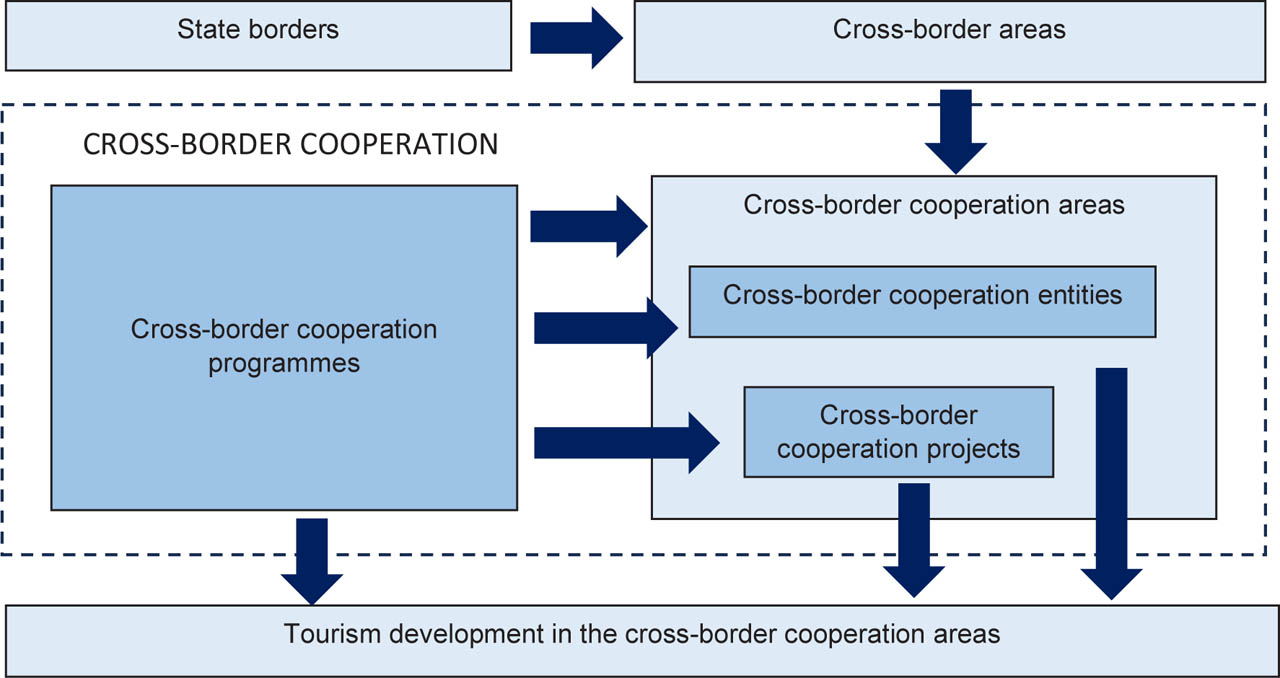
Figure 1.
Research concept
Source: own study
The organisations coordinating cross-border cooperation were identified, the spatial scope of their activities was delimited and their activities in the field of tourism development were indicated. In addition, cross-border cooperation projects in the field of tourism were analysed. The work used secondary sources, including EU documents, strategies and information materials of cross-border cooperation entities and the Keep.eu database containing information on cross-border projects that support the development of tourism.
Cross-border cooperation programmes and areas
In the border areas of Poland over the 2014–2020 period, there were nine cross-border cooperation programmes, including seven on internal borders and two on the external borders of the EU. On the Polish–German border, there were as many as three cross-border cooperation programmes (Fig. 2). Most of the programmes covered two countries. The support area included three NUTS 3 regions, located in eleven border voivodeships in Poland. Among the NUTS 3 regions, there were seventeen regions covered by two programmes and two covered by three programmes. The number of NUTS 3 regions included in the support areas ranged from two to twelve. The largest area was covered by the Poland–Belarus–Ukraine programme (75,702 km2), while the smallest was covered by the Poland–Saxony programme (6,964 km2).
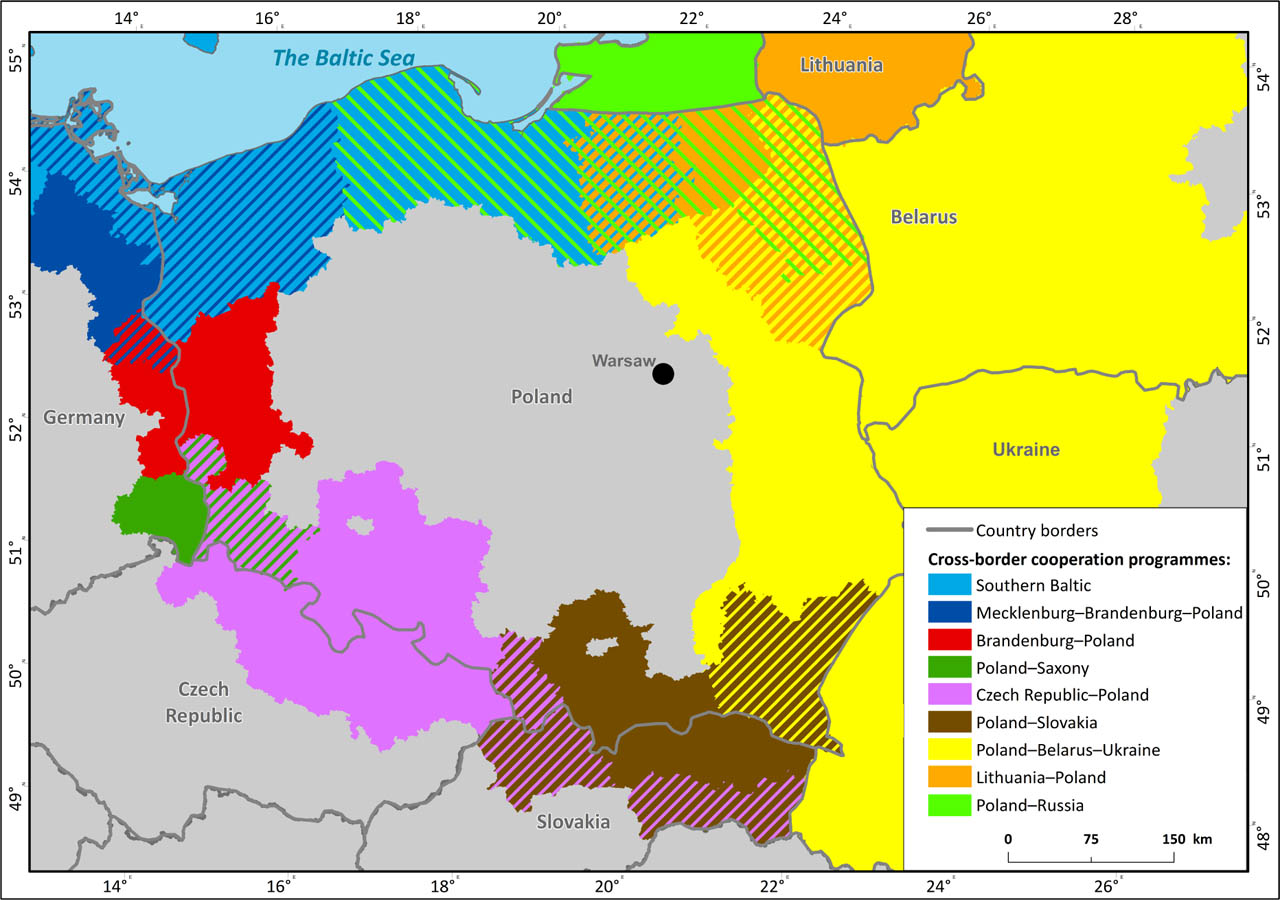
Figure 2.
Cross-border cooperation programmes on the borders of the Republic of Poland in the 2014–2020 period
Source: own study based on the internet sites of the cross-border cooperation programmes
All programmes assumed the development of tourism cooperation. They enabled the financing of tourism cooperation primarily in such areas as:
development of joint tourism products, mainly based on natural and cultural heritage;
joint marketing activities, including brand creation;
construction and modernisation of tourist infrastructure;
joint training and exchange of staff.
The programmes recommended the development of sustainable tourism with particular emphasis on biking, water and mountain tourism.
Institutions of cross-border cooperation
Institutionalised cross-border cooperation began in Poland in 1991 with the establishment of the Euroregion Nysa. Currently (2024), there are twenty-three cross-border cooperation organisations operating along the borders of the Republic of Poland (Fig. 3).
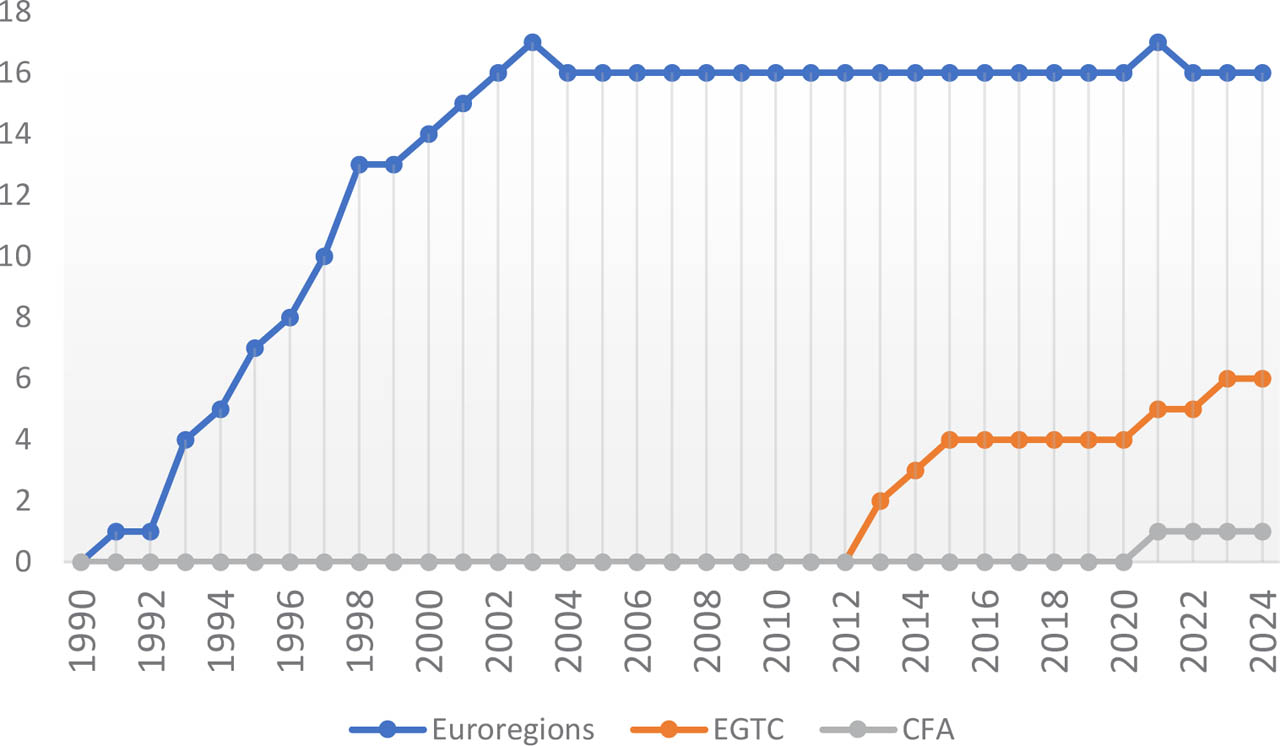
Figure 3.
Development of cross-border cooperation organisations in Poland
Source: own study
Cross-border organisations were predominantly represented by Euroregions (Fig. 4).
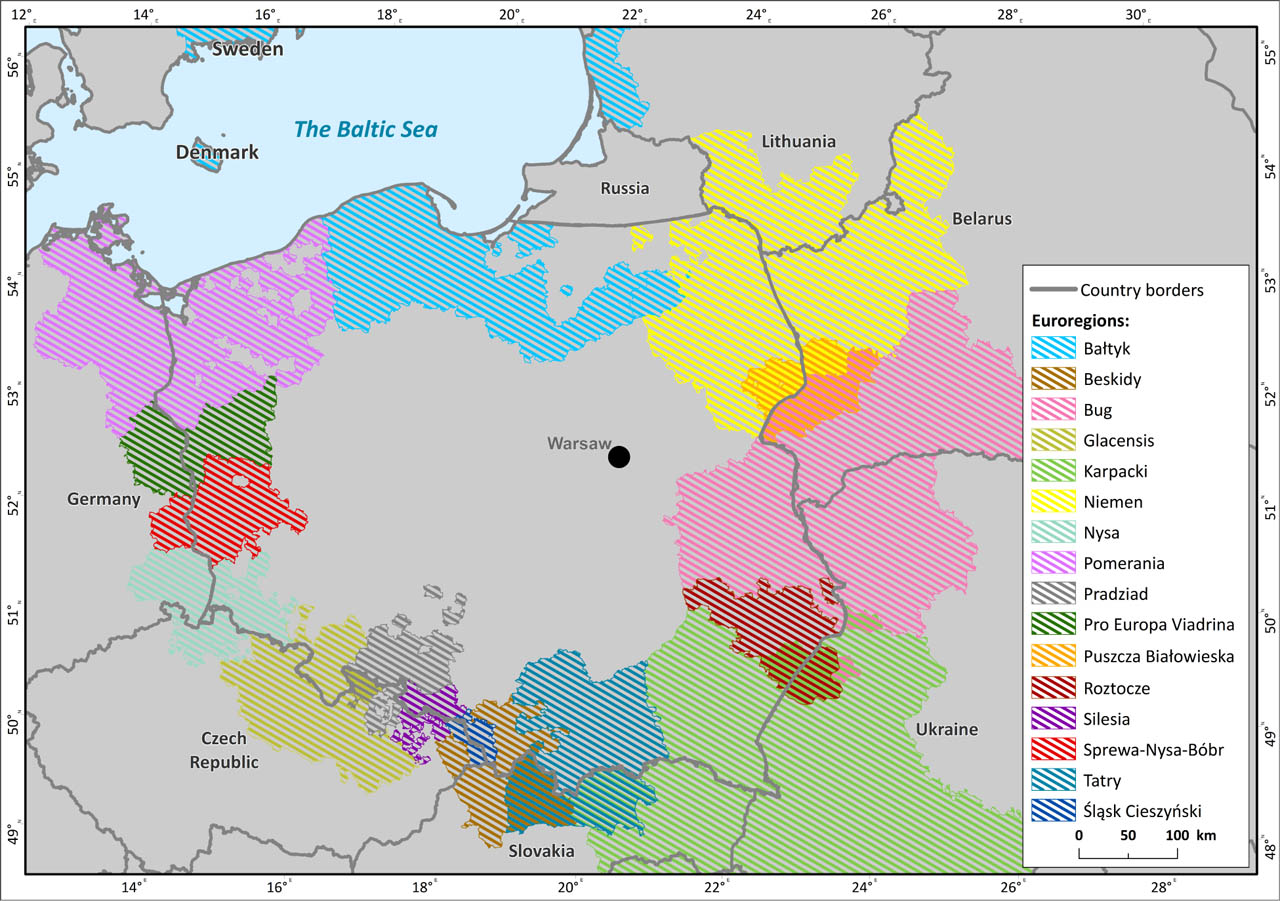
Figure 4.
Euroregions on Polish borders
Source: own study
It should be noted that the areas with many Euroregions within Poland have been systematically decreasing since their establishment. This results primarily from the decreasing number of members (mainly communes) that are included in the associations of local government units. The current map of Euroregions is presented in Figure 1. This map was based on information collected from all Euroregions. The youngest Euroregion, Roztocze, was established in 2020. The Łyna–Ława Euroregion, which had been inactive for several years, was liquidated. Furthermore, six European Groupings of Territorial Cooperation (Fig. 5) and one Cross-border Functional Area operate within the borders of the Republic of Poland.
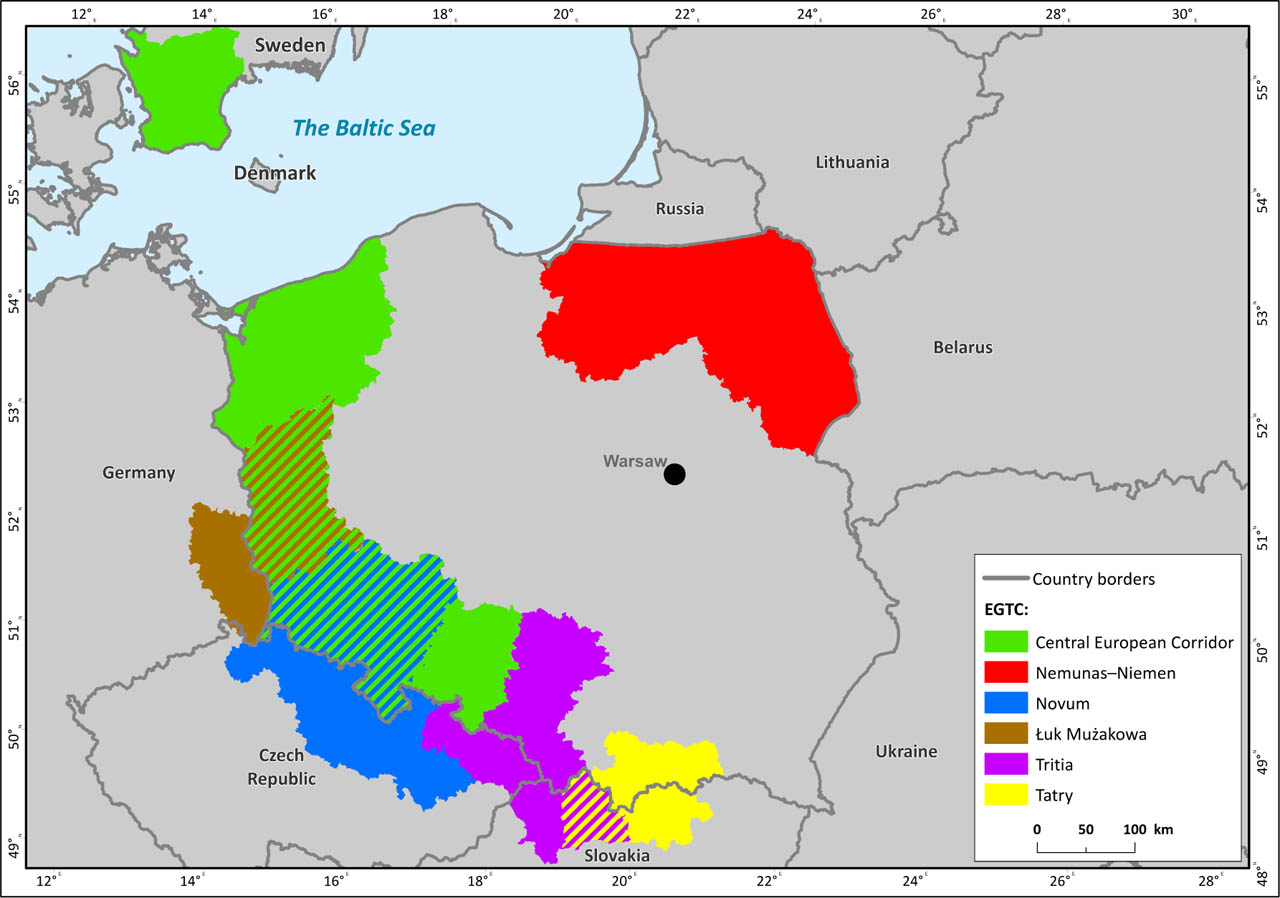
Figure 5.
European Groupings of Territorial Cooperation
Source: own study
Following the outbreak of the war in Ukraine, the European Union suspended funding for cross-border cooperation with Russia and Belarus, prompting Euroregions to terminate their partnerships with these countries; in some cases, such as the Baltic Euroregion, Russian partners were formally removed from organisational structures. Euroregions such as the Puszcza Białowieska found themselves in an even more challenging position, as their sole partners were located in Belarus; as a result, they effectively lost their raison d'être and shifted from cross-border cooperation to national cooperation. In turn, the Niemen Euroregion, after ceasing cooperation with Belarus, focused exclusively on collaboration with Lithuania.
An analysis of the statutes and regulations of all cross-border cooperation organisations has revealed that they have all recognised tourism development as one of their primary objectives (Table 1). Most organisations have prepared development strategies and programmes that assume cooperation in tourism.
Table 1.
Issues related to tourism in the activities of territorial cooperation organisations
| No. | Euroregion | Tourism in statutes | Strategies & programmes | Promotion on website | Tourist projects financed by EU funds |
|---|---|---|---|---|---|
| 1. | Euroregion Bałtyk | + | + | − | + |
| 2. | Euroregion Niemen | + | + | − | + |
| 3. | Euroregion Puszcza Białowieska | + | +/− | − | + |
| 4. | Euroregion Bug | + | + | − | + |
| 5. | Euroregion Karpacki | + | + | + | + |
| 6. | Euroregion Roztocze | + | − | + | − |
| 7. | Euroregion Tatry | + | + | + | + |
| 8. | Euroregion Beskidy | + | + | + | + |
| 9. | Euroregion Śląsk Cieszyński | + | + | + | + |
| 10. | Euroregion Silesia | + | + | + | + |
| 11. | Euroregion Pradziad | + | + | + | + |
| 12. | Euroregion Glacensis | + | + | + | + |
| 13. | Euroregion Nysa | + | + | + | + |
| 14. | Euroregion Sprewa Nysa Bóbr | + | + | + | + |
| 15. | Euroregion Pro Europa Viadrina | + | + | + | + |
| 16. | Euroregion Pomerania | + | + | + | + |
| 17. | EGTC Tritia | + | + | + | + |
| 18. | EGTC Tatry | + | + | + | + |
| 19. | EGTC CETC | + | − | − | − |
| 20. | EGTC Novum | + | + | − | + |
| 21. | EGTC Geopark Muskau Arch | + | − | + | − |
| 22. | EGTC Niemen | + | − | − | − |
| 23. | CFA Jatvingia | + | − | − | − |
Among the Euroregions, Roztocze does not have a development strategy. It intends to develop one soon. Some strategies (e.g. the Bug Euroregion) require updating. Most organisations promote tourism on their websites and implement tourism projects.
Euroregions in Poland seem to be more effective in implementing cross-border tourism cooperation than EGTCs as they have many years of experience, strong local roots and flexible funding mechanisms such as Microproject Funds (Studzieniecki 2010; Studzieniecki, Jakubowski & Meyer 2022). Their flexibility is also due to the fact that they operate in Poland as associations of local government units. They work closely with local communities (Greta & Otto 2018), better understand the tourism potential of border regions and are more accessible to smaller partners, making it easier to quickly implement promotional projects. In contrast, EU regulations limit EGTCs to implementing only selected activities, which means they tend to focus on more complex and strategic tasks and are less involved in tourism projects (Studzieniecki 2016; Janczak 2016).
Cross-border functional areas have not proven effective as structures supporting tourism development, as they were conceptual in nature, lacked legal personality and had no capacity to independently obtain funding for project implementation (Studzieniecki, Jakubowski & Kurowska-Pysz 2023; Studzieniecki, Jakubowski & Kurowska-Pysz 2024).
Cross-border cooperation projects
A total of 878 projects were implemented within nine cross-border cooperation programmes, including 241 tourism projects (Table 2). The share of tourism projects in all projects was 27.45%. The highest share of tourism projects, 37.63%, was recorded in the Czech Republic–Poland programme. The lowest was in the Poland–Saxony programme, which amounted to only 17.74%. Some 568 partners participated in tourism-related projects, which constituted 33.15% of the population.
Table 2.
Tourist projects and partners participating in tourist projects
| No. | Programme | Number of projects | Number of tourism projects | Number of partners | Number of partners in tourism projects |
|---|---|---|---|---|---|
| 1. | South Baltic | 90 | 20 | 315 | 106 |
| 2. | Lithuania–Poland | 132 | 34 | 189 | 64 |
| 3. | Poland–Russia | 31 | 7 | 78 | 24 |
| 4. | Poland–Belarus–Ukraine | 157 | 45 | 333 | 104 |
| 5. | Poland–Slovakia | 78 | 27 | 149 | 45 |
| 6. | Czech Republic–Poland | 194 | 73 | 375 | 155 |
| 7. | Poland–Saxony | 62 | 11 | 115 | 35 |
| 8. | Brandenburgia–Poland | 72 | 13 | 63 | 13 |
| 9. | Meckl–Vorpom.–Branden.–PL | 62 | 11 | 96 | 22 |
| TOTAL | 878 | 241 | 1713 | 568 | |
Most of the tourism projects (180 projects) were related to other topics of cooperation. Those related to culture and art were dominant, at 87.22% of projects. The next topic related to tourism was transport (3.88% of projects). The rest of the projects were related to education, agriculture, entrepreneurship and ecology, among others.
The thematic scope of cross-border projects supporting the development of tourism aligned with the four identified objectives of cross-border cooperation programmes. Table 3 presents examples of projects in this area. The Polish–Czech border region was particularly active in developing cross-border tourism.
Table 3.
Examples of cross-border cooperation projects in the field of tourism
| No. | Area | Programme | Title of project | Budget [EUR] | Coordinator |
|---|---|---|---|---|---|
| 1. | Development of joint tourism products | NTERREG PL-CZ 2014–2020 | Castles and Chateaux Connect Us | 268 499 | Eastern Bohemia Destination Company |
| 2. | Brand creation | NTERREG PL-CZ 2014–2020 | Cross-border Tourism Brand “Beskidy” | 59 825 | Association Region “Beskidy” |
| 3. | Construction of tourist infrastructure | NTERREG PL-CZ 2014–2020 | Singletrack Glacensis | 1 553 353 | Region Orlicko–Třebovsko |
| 4. | Joint training and exchange of staff | INTERREG South Baltic 2014–2020 | JOHANNA | 1 631 250 | Hanseatic and University City of Rostock |
Each of the analysed projects had its own logo (Fig. 6), which was used in promotional activities. This was done, among other means, through social media and websites dedicated to the projects.
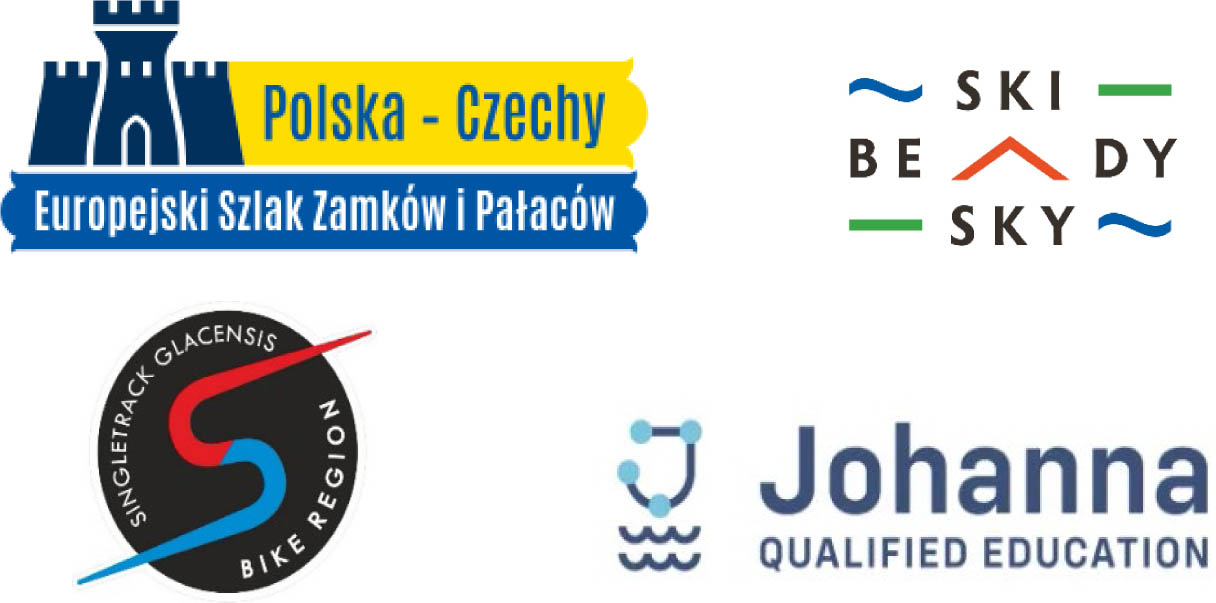
Figure 6.
Logos of selected cross-border cooperation projects
Source: websites of cross-border cooperation projects
One notable example of a tourism product created and promoted within the framework of cross-border cooperation is the European Route of Castles and Palaces. This initiative included, among other things, the organisation of exhibitions and events, the publication of a map, and the promotion of culinary heritage.
The “Beskidy Region” Association, together with a Czech partner, implemented a project entitled “Cross-border Tourism Brand Beskidy”, aimed at jointly promoting the region as a common tourist destination.
The “Singletrack Glacensis” project enabled the construction of four singletrack route complexes in the Orlickie and Bystrzyckie Mountains, their connection via marked sections and the creation of the Singletrack Glacensis mobile application and map.
An educational project called “JOHANNA” was also implemented, aiming to enhance professional qualifications in cruise tourism through guide training and university-level education in cruise management.
Conclusions
Cross-border cooperation has significantly contributed to the development of tourism over the last thirty years. This applies primarily to areas covered by EU support programmes. All programmes for the 2014–2020 period contained provisions for the development of tourism and this was reflected in tourism projects, which constitute 28.4% of all cross-border projects. As part of the cooperation, 568 partnerships were established. Studies have shown that cross-border cooperation enables the development of investments and staff training, the creation of tourism products and the implementation of planning and promotional activities. In the context of the war in Ukraine, cross-border cooperation with Russia and Belarus was suspended, which significantly limited the development of cross-border tourism in the border areas of these countries.
An important role in the development of tourism was played by twenty-three cross-border cooperation organisations. The paper presents their current areas of activity. Euroregions distinguished themselves in the development of tourism. They included tourism in their statutes and came up with development strategies. European Groupings of Territorial Cooperation began to play a greater role. They have legal personality but their registration is time-consuming; their current activity, due to organisational and legal conditions, is not as flexible as the activity of Euroregions. The Only Cross-Border Functional Area was established primarily to develop tourism. As a new and innovative structure, it did not have the appropriate status to guarantee the acquisition of funds, so the initiators decided that it would be transformed into an EGTC. The conditions for cross-border cooperation, in the context of an unstable situation, are changing dynamically. Therefore, it is advisable to conduct research, the results of which will be used by the appropriate institutions.