
Introduction
The global increase in average air temperature, which has been observable for several decades and is probably the most significant warming period in the past 2,000 years (Luterbacher et al. 2016), brings with it various implications, one of which is the increasing occurrence of tropical nights (TNs), sometimes also called hot nights. In climatic zones located at low latitudes, definitions of TNs differ from those commonly used in Europe. Temperatures of 23°C (Nastos & Matzarakis 2008) and even 28°C (Observatory 2024) are cited as the threshold for the definition of a TN. For most European countries, a TN is defined as one in which the lowest air temperature measured during the day (UTC 06–UTC 06) is greater than or equal to 20°C (Tmin ≥20°C) (Fischer & Schär 2010; Gröger et al. 2021). It is even believed that the daily minimum temperature is increasing faster than the daily mean temperature, especially during the summer season (Ballester et al. 2010), and an increase in the former has been recognized as a factor describing climate change (Alexander et al. 2006; Davy et al. 2017). In Europe, the occurrence of TNs is quite common, mainly in the Mediterranean Sea area (Correa et al. 2024) or on the Balkan Peninsula (Tasić 2016; Pecelj 2024), but ongoing studies show that the number of TNs in these areas is growing rapidly, and the range of TNs is shifting to higher and higher latitudes (Babin et al. 2021; Yeh et al. 2021). Back in the 20th century, TNs were such an incidental phenomenon that the issue was rarely addressed, especially in the Polish literature. The main reason for this was the occurrence of TNs in individual Polish cities only once every few years (Chełchowski 1963, 1967). Since the mid-1980s, a significant intensification in the occurrence of TNs has been observed in Poland, both in terms of the number of cases and the extent of their occurrence (Bielec-Bąkowska & Piotrowicz 2013), which corresponds to the observed sharp increase in average air temperature both in Poland (Ustrnul et al. 2021; Twardosz 2023) and worldwide (Luterbacher et al. 2016). High air temperatures persisting overnight are observed far more often within urbanized areas than without (Kuchcik 2006; Chapman et al. 2017), and are often associated with the so-called urban heat island (Park et al. 2022). This is a serious problem for humans, as the human body, especially its cardiovascular system, is heavily stressed and unable to recover properly during TNs (Yavaşlı & Erlat 2024). For this reason, TNs are one of the causes of the higher number of summer deaths (Royé 2017; Hagen & Weihs 2023; Jaagus et al. 2024).
The primary aim of this study was to determine the temporal and spatial variability in the occurrence of TNs during the multiannual period 1951–2024 in Warsaw, and, as a comparison, in Legionowo, located nearby. The analysis also aimed to answer the question of how the location of the measurement site affects the variation in the occurrence of TNs.
Study area and methodology
With an area of 517.24 square kilometres, Warsaw is the capital – and also the most populous – city in Poland, with a population of 1,861,599 (Statistics 2023). One synoptic station (Okęcie) and two climatological stations (Bielany and Obserwatorium) are located on its territory (Fig. 1), which met the criteria necessary for the analysis carried out in this paper – namely, having an uninterrupted sequence of measurement data for the years 1951–2024. For comparison, the analysis also includes data from the climatological station in Legionowo, a small city (13.54 square kilometres) that lies 14 km north of the Warsaw-Bielany station and 22 km from the centre of Warsaw, with a population of 52,497.
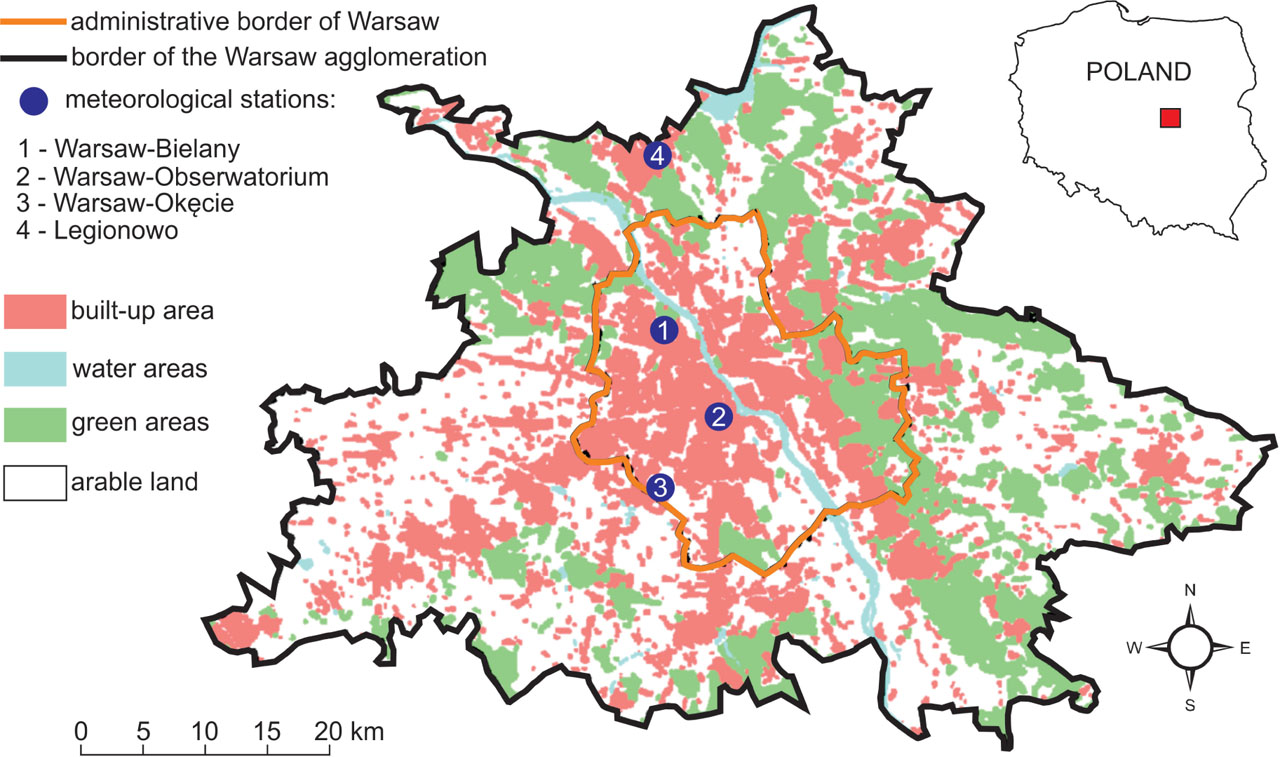
Figure 1.
Map of the Warsaw agglomeration with meteorological stations that were included in the analysis indicated
Source: own elaboration based on ‘Obszar aglomeracji warszawskiej wg Swaniewicza’
Among the four stations analysed, the Obserwatorium station is located closest to the centre of Warsaw; however, it is located within a park, so its immediate surroundings consist of green areas, which have a beneficial effect on lowering the air temperature. The Bielany station is surrounded mainly by low and high buildings, with a forested area a short distance away on the north side. The Okęcie station is located in the area of the main Warsaw airport and, therefore, at a considerable distance from high buildings. In Legionowo, the station's surroundings are dominated by low-rise buildings and a large share of green areas.
Data on minimum daily temperatures were obtained from the resources of the Institute of Meteorology and Water Management – National Research Institute (IMWM – NRI). All data series were checked and verified positively for their completeness. Preliminary analysis showed the occurrence of TNs only from May to August. All observed TNs were characterized in terms of their total sum at each station, the length of the sequences – namely, the number of nights in a row in which they occurred, the simultaneous occurrence at more than one station, the pattern of occurrence in each month, and the changes that occurred in successive years and decades. A linear regression method was also used to analyse changes in the number of TNs over the analysed multi-year period, and the results are shown in Table 1.
Table 1.
Basic parameters of the stations included in the analysis and linear regression results
| Station | λ | ϕ | Altitude (m a.s.l.) | TNs/10 years growth |
|---|---|---|---|---|
| Warsaw-Bielany | 20°57′48″E | 52°16′53″N | 98 | 0.49 |
| Warsaw-Obserwatorium | 21°01′43″E | 52°13′04″N | 110 | 0.37 |
| Warsaw-Okęcie | 20°57′40″E | 52°09′46″N | 106 | 0.33 |
| Legionowo | 20°57′22″E | 52°24′28″N | 94 | 0.32 |
Results
Between 1951 and 2024, a total of 335 incidents of TNs were recorded at the four analysed stations (Table 2). The largest number, 132 TNs, occurred at the Warsaw-Bielany station, and the smallest, 46 TNs, in Legionowo. By decade, the fewest cases of nights with air temperature of ≥20°C were observed in 1961–1970, when there were only eight, while the highest number occurred in 2011–2020, when a total of 109 TNs were recorded. When broken down by year, the highest number, 28 TNs, occurred in 2010 (Fig. 2). Over the entire measurement period, TNs were recorded for 46 of the 74 years analysed. Twenty-eight years without TNs were identified, of which only four occurred in the 21st century (2004, 2005, 2008, and 2020).
Table 2.
Number of TNs at individual stations over decades 1951–2020 and years 2021–2024 and their mean values
| Decades/Stations | 1951–1960 | 1961–1970 | 1971–1980 | 1981–1990 | 1991–2000 | 2001–2010 | 2011–2020 | 2021–2024 | Total | TNs mean/1 year |
|---|---|---|---|---|---|---|---|---|---|---|
| Warszawa-Bielany | 11 | 2 | 5 | 12 | 22 | 24 | 34 | 22 | 132 | 1.78 |
| Warszawa-Obserwatorium | 4 | 3 | 4 | 7 | 21 | 23 | 27 | 9 | 98 | 1.32 |
| Warszawa-Okęcie | 0 | 2 | 2 | 0 | 4 | 12 | 31 | 8 | 59 | 0.80 |
| Legionowo | 3 | 1 | 1 | 2 | 8 | 5 | 17 | 9 | 46 | 0.62 |
| Total | 18 | 8 | 12 | 21 | 55 | 64 | 109 | 48 | 335 | 4.53 |
| TNs mean/1 year | 1.80 | 0.80 | 1.20 | 2.10 | 5.50 | 6.40 | 10.90 | 12.00 | 4.53 |
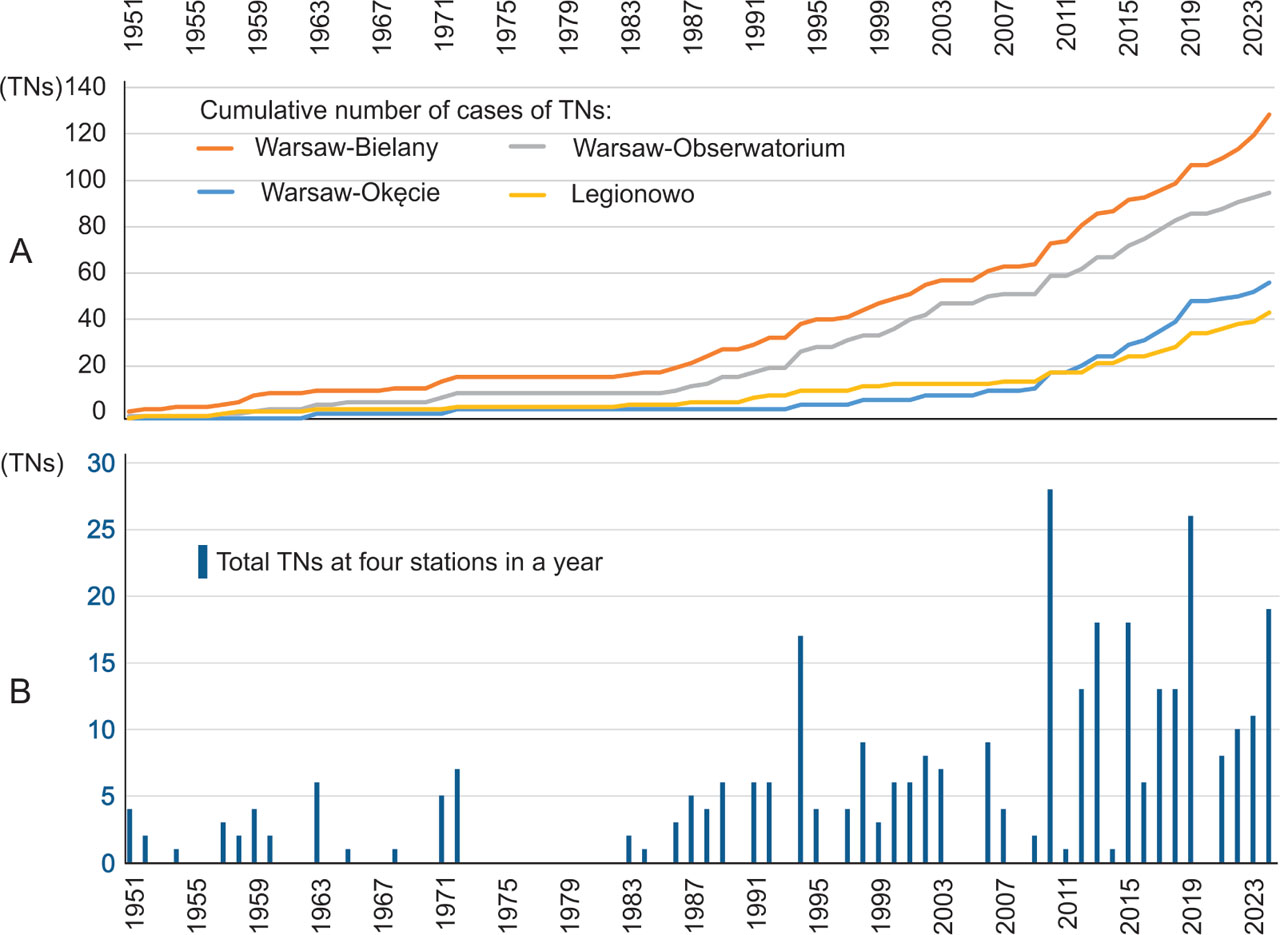
Figure 2.
Cumulative number of TNs at individual stations (A) and total TNs at four stations in each year (B)
Source: own elaboration
When broken down by month, TNs occurred mainly in July (156 TNs) and August (126 TNs), accounting for 46.6% and 37.6% of all cases, respectively (Table 3). There were 51 TNs in June (15.2% of all cases), and two TNs in May (0.6%). The highest recorded minimum temperature was 26.0°C and this occurred on 1 July 2012 at the Warsaw-Bielany station, while in 38 cases it was 20.0°C, the lower limit for the definition of TNs. The TN recorded at the earliest point in a year was 28 May; which occurred in 1958. In contrast, the latest TN was recorded on 30 August in both 1992 and 2019. During 14 of the 74 years analysed, TNs occurred at each of the four stations. The first year this occurred was 1972; as many as 10 of those 14 years have already been recorded in the 21st century. During the entire 1951–2024 period, 20 nights were observed when Tmin ≥20°C occurred simultaneously at all four analysed stations (Table 4).
Table 3.
TNs presented by month in individual decades 1951–2020 and years 2021–2024
| Decades/Months | May | June | July | August | Total |
|---|---|---|---|---|---|
| 1951–1960 | 2 | 1 | 11 | 4 | 18 |
| 1961–1970 | 0 | 0 | 2 | 6 | 8 |
| 1971–1980 | 0 | 0 | 9 | 3 | 12 |
| 1981–1990 | 0 | 2 | 16 | 3 | 21 |
| 1991–2000 | 0 | 12 | 15 | 28 | 55 |
| 2001–2010 | 0 | 6 | 47 | 11 | 64 |
| 2011–2020 | 0 | 23 | 35 | 51 | 109 |
| 2021–2024 | 0 | 7 | 21 | 20 | 48 |
| Total | 2 | 51 | 156 | 126 | 335 |
| Percentage | 0.60 | 15.22 | 46.57 | 37.61 | 100.00 |
All TNs were divided into time sequences at a given station, showing a single night, two nights in a row, and so forth. Of the 335 TNs recorded at all stations in total, a TN was identified as a single occurrence 209 times, two TNs in a row were recorded 42 times, and three TNs in a row 11 times. There was also one case of four TNs in a row (Bielany) and one case of five TNs in a row (Obserwatorium) (Fig. 3).
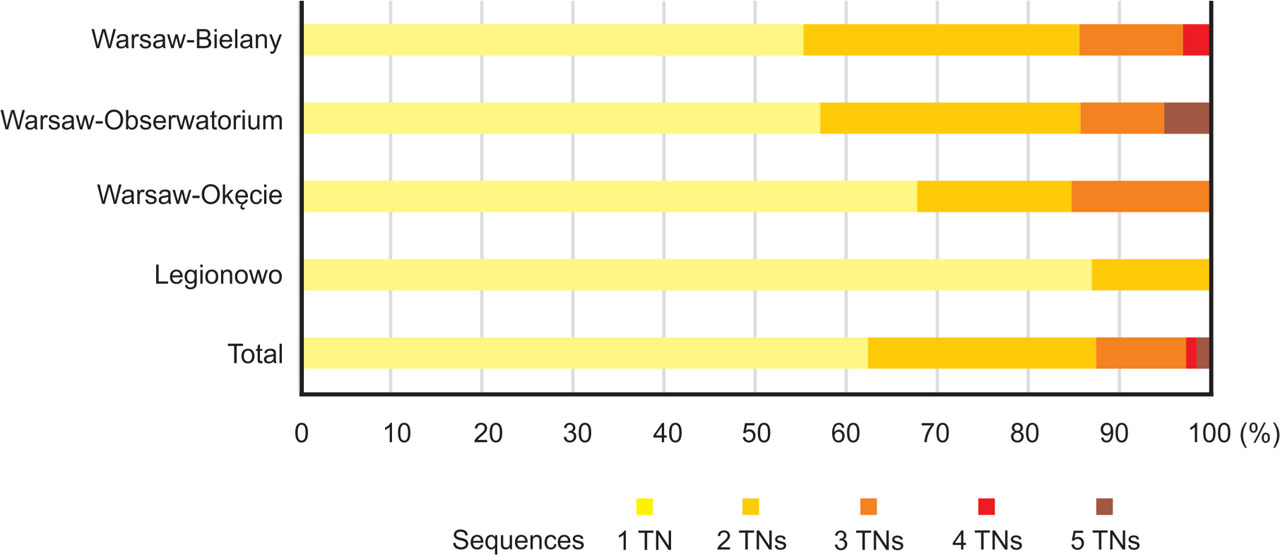
Figure 3.
Percentage share of TN sequences at individual stations and in total
Source: own elaboration
The linear regression method showed an increase in the number of TNs at all the analysed stations (Table 1). The largest increase was at the Warsaw-Bielany station (an increase of 0.49 TN per 10 years), while the smallest was at the Legionowo station (an increase of 0.32 TN per 10 years).
Discussion
Analysing the structure of TNs in Warsaw and Legionowo between 1951 and 2024, a huge increase in their number can be observed over the decades (Table 2). This is a trend that is also reflected in other regions of Poland (Bielec-Bąkowska & Piotrowicz 2013; Graczyk et al. 2017; Mąkosza et al. 2024). The lowest number of TNs was recorded in the 1960s, and each subsequent decade was characterized by an increase in the number of TNs compared to the previous one. In the analysed multi-year period, there was a 10-year period without any TNs (1973–1982), while the sum of TNs began to increase significantly from 1986, which is almost exactly in line with the change in the thermal regime over the European area, which began in 1987 (Marsz & Styszyńska 2023). Broken down by year, the highest number of TNs was recorded in 2010 (Fig. 2). It was very specific in Poland because, despite a very hot summer (Kossowska-Cezak & Twardosz 2012; Bartoszek et al. 2014), air temperature during the other seasons remained significantly lower than the norms of the 1991–2020 period, making 2010 an extremely cold year overall (IMGW-PIB 2024). In the 21st century, there were only four years among the studied period in which TNs did not occur, which shows that TNs are becoming an increasingly common phenomenon that, according to climate model predictions, by the end of the 21st century, will occur throughout Poland in virtually every subsequent year (Jędruszkiewicz & Wibig 2019).
Over the years, the frequency of TNs in sequences of several days has also increased. At the Bielany station, single TNs account for only 55.3% of all cases (Fig. 3). In the 1990s, sequences of four or even five TNs appeared for the first time; this is similar to other stations in Poland (Bielec-Bąkowska & Piotrowicz 2013). Until 1987, except in a few cases, TNs occurred only in July and August. Since then, they have begun to occur as early as June, and are now a common and increasingly frequent phenomenon (Mąkosza et al. 2024).
Heavily urbanized areas are characterized by a large range of fluctuations and spatial variability of air temperature (Adamczyk 2011). At night, it is warmest at points located in the centre of the city where there are compact buildings; here, heat accumulates during the day (Adamczyk 2011) and is returned to the environment during the night. Hence, the frequency of TNs in city centres is higher than in their outskirts (Park et al. 2022; Mąkosza et al. 2024). The largest number – as many as 132 TNs between 1951 and 2024 – was recorded at the Warsaw-Bielany station, which is located in the area directly influenced by the urban heat island. The Warsaw-Obserwatorium station, where 98 TNs were recorded, is also located in the central part of the city, but the lower total sum of cases is influenced by its location in the Łazienki Royal Park, where the presence of vegetation causes less heat absorption during the day in summer and, thus, lower minimum temperatures during the night. In Kraków, in the Botanical Garden located in the city centre, measurements were conducted at two different heights above ground level. At a height of 12 metres above ground level, 68 TNs were recorded in the period 1958–2006, while at the standard height for meteorological measurements of two metres above ground level, only 15 TNs were recorded in the same period (Piotrowicz 2007). These results show how strongly an increase in height above ground level corresponds to an increase in air temperature, especially at night. A significantly smaller number of TNs was recorded at the Kraków-Balice station, located in the grounds of the airport; in the 1971–2020 period, there were only 5 TNs recorded here (Mąkosza et al. 2024). The situation is similar for Warsaw in the case of Okęcie station, also located in the airport area, where 59 TNs were recorded during the analysed period. The smallest number of TNs was recorded in Legionowo (46); among all the stations studied, it is influenced by its location – away from the direct centre of Warsaw – and by the significantly lower building intensity index of the station's immediate surroundings (Błażejczyk et al. 2014). Similar correlations were observed, for example, in Lublin, where as many as seven (Krzyżewska 2015) and six TNs (Krzyżewska et al. 2016) in a row were recorded during the hot summer seasons in 1994 and 2015, respectively, while a station located in the airport area, away from the centre, did not register a single TN (Mąkosza et al. 2024).
In view of the strict definition, where the classification of a given night as a TN is often determined by as little as 0.1°C, and the differences in the spatial distribution of temperatures across a large city such as Warsaw, the simultaneous occurrence of TNs across the entire study area is not common. In the entire measurement period of 1951–2024, there were only 20 cases of simultaneous TNs at all four stations (Table 4). Until 2009, there were only four such situations, while, since 2010, there have already been 16 such nights. On most of these 20 nights, the highest minimum temperature was recorded at Bielany or Obserwatorium stations – namely, those located in the centre of Warsaw. The maximum amplitude of the minimum temperatures that occurred during one night between the analysed stations was 2.6°C.
Table 4.
Cases of simultaneous occurrence of TNs at all stations along with recorded minimum air temperatures (in °C). The highest temperature of individual nights is marked in red
| Case number | Date | Warsaw-Bielany | Warsaw-Obserwatorium | Warsaw-Okęcie | Legionowo | Max | Min | Temperature amplitude between synoptic stations |
|---|---|---|---|---|---|---|---|---|
| 1 | 16.07.1972 | 20.3 | 20.3 | 20.1 | 20.2 | 20.3 | 20.1 | 0.2 |
| 2 | 07.08.1994 | 20.5 | 20.2 | 20.2 | 20.1 | 20.5 | 20.1 | 0.4 |
| 3 | 08.06.1998 | 22.1 | 21.5 | 20.0 | 21.1 | 22.1 | 20.0 | 2.1 |
| 4 | 03.08.1998 | 21.2 | 20.0 | 20.5 | 20.2 | 21.2 | 20.0 | 1.2 |
| 5 | 16.07.2010 | 21.5 | 21.0 | 21.6 | 20.2 | 21.6 | 20.2 | 1.4 |
| 6 | 18.07.2010 | 20.8 | 21.7 | 20.9 | 21.1 | 21.7 | 20.8 | 0.9 |
| 7 | 23.07.2010 | 21.7 | 20.8 | 20.0 | 20.4 | 21.7 | 20.0 | 1.7 |
| 8 | 29.07.2013 | 22.7 | 21.2 | 22.1 | 21.6 | 22.7 | 21.2 | 1.5 |
| 9 | 30.07.2013 | 20.0 | 20.8 | 21.0 | 21.0 | 21.0 | 20.0 | 1.0 |
| 10 | 05.08.2013 | 20.3 | 21.1 | 20.8 | 20.1 | 21.1 | 20.1 | 1.0 |
| 11 | 09.08.2013 | 20.9 | 21.8 | 21.4 | 20.9 | 21.8 | 20.9 | 0.9 |
| 12 | 07.08.2015 | 20.2 | 20.8 | 21.1 | 20.6 | 21.1 | 20.2 | 0.9 |
| 13 | 09.08.2015 | 22.9 | 22.4 | 22.8 | 22.5 | 22.9 | 22.4 | 0.5 |
| 14 | 13.08.2015 | 20.7 | 21.0 | 20.8 | 20.9 | 21.0 | 20.7 | 0.3 |
| 15 | 02.08.2017 | 23.2 | 21.8 | 21.7 | 24.0 | 24.0 | 21.7 | 2.3 |
| 16 | 04.08.2017 | 20.4 | 21.0 | 20.6 | 20.1 | 21.0 | 20.1 | 0.9 |
| 17 | 13.06.2019 | 22.9 | 20.3 | 21.2 | 21.3 | 22.9 | 20.3 | 2.6 |
| 18 | 16.06.2019 | 22.0 | 21.5 | 20.9 | 21.9 | 22.0 | 20.9 | 1.1 |
| 19 | 01.07.2019 | 22.9 | 22.9 | 22.4 | 22.2 | 22.9 | 22.2 | 0.7 |
| 20 | 17.08.2023 | 23.5 | 21.9 | 22.2 | 21.9 | 23.5 | 21.9 | 1.6 |
The number of TNs recorded in the Warsaw area is still far below those observed in other regions in Europe. In Spain, especially in the southern and eastern part of the country, the number of TNs per year reaches up to 80, while in the Canary Islands, where, in the 1980s, some stations recorded an average of about 20 TNs per year, in 2023, over 100 TNs were recorded (Correa et al. 2024). In Lisbon, in the years 2006–2013, an average of 34 TNs were recorded per year (Royé & Ezpeleta 2015), while in Vienna, in the last 25 years, there was an average of seven TNs per year (Hagen & Weihs 2023). Despite the fact that the TN sums observed at individual stations in the Warsaw area are much lower, the lengthening period of the occurrence of TNs during the year and the increasingly frequent sequences of several TNs in a row have negative consequences for human health and are the cause of increased mortality in the summer, as confirmed by studies conducted in other European cities (Royé 2017; Hagen & Weihs 2023; Jaagus et al. 2024). To identify potential strategies for improving thermal comfort during TNs, further comparative analyses are necessary, both in other Polish cities and elsewhere in Europe.
Conclusions
The frequency of TNs in the Warsaw area, as well as in nearby Legionowo, has multiplied significantly from 1951 to 2024. In the 21st century, there have only been four years without TNs. The season of TNs is beginning more often as early as June, TNs increasingly occur in sequences of several days, and the frequency of their simultaneous occurrence at all analysed stations has also increased. In particular, this rise in all the above-mentioned parameters began in the late 1980s. TNs are significantly influenced by the phenomenon of the urban heat island; this is particularly evident in the fact that the largest total sum of TNs was at stations in the centre of Warsaw and a much smaller sum was recorded outside the centre. This is also confirmed by the highest minimum air temperatures recorded in the centre of Warsaw during the simultaneous occurrence of TNs at all analysed stations. Based on the results of the upward trends in the minimum air temperature, a further increase in the total sum of TNs in the coming years, an increase in their duration during the year, and an increasingly frequent simultaneous occurrence of TNs at all stations, can be expected.