
Introduction
As integral components of urban ecosystems, urban green habitats play a crucial role in urban ecology by supporting diverse plant and animal communities that interact within their environments through the flow of energy and matter (Farinha-Marques et al. 2017; Niemelä 1999). Effective management and conservation strategies for urban ecosystems require detailed mapping and understanding of specific urban habitats. Such mapping has been performed in many cities worldwide and effectively integrated with spatial planning systems (Jalkanen et al. 2020; Mansuroglu et al. 2006; Nilon et al. 2017; Sukopp & Weiler 1988; Werner 1999; Zhao et al. 2022). Vegetation plays a fundamental role in habitat identification (Sukopp & Weiler 1988; Werner 1999). However, approaches to vegetation classification and delineation vary, taking into account natural aspects with different levels of detail (Mansuroglu et al. 2006; Zhao et al. 2022).
Initially, the aim of urban habitat mapping was to safeguard valuable natural areas and protect rare and endangered species (Werner 1999). This has evolved into an integral component of modern environmental management strategies, focusing on nature conservation, public health promotion, and addressing global environmental changes (Boehnke et al. 2022; Jalkanen et al. 2020). Habitats serve as units for planners to identify areas that provide ecosystem services (Ahern et al. 2014; Haase et al. 2014) and support nature-based solutions (Castellar et al. 2021). Green spaces within urban areas can positively impact residents’ physical and mental health, strengthen social bonds, and contribute to crime reduction (Barton & Pretty 2010; Bogar & Beyer 2016; Fuller et al. 2007). Strategies for enhancing the natural properties of green spaces include the restoration of specific areas with high biological diversity in residential areas (Karvonen & Yocom 2011; Qiu et al. 2010). Such approaches lead to residents having frequent contact with nature, which can engage people in conservation efforts, increase ecological awareness, and enhance the sense of belonging in their local area (Fuller et al. 2010).
Effective management of urban natural resources requires accurate recognition of habitats and their status in spatial development plans (Gaston et al. 2013; Pan et al. 2021). Substantial gaps in data collection and the limited use of the data in local plans often impede this process (Evans 2006; Evans 2004). To date, relatively few planners have access to sufficiently detailed and quantified data to meet their green planning needs (Chan et al. 2021). This lack of specific information can undermine the effectiveness of plans to protect local biodiversity (Nilon et al. 2017). Insufficiently detailed identification and habitat representation in urban plans can result in the destruction of valuable ecological areas despite legal protections. The main challenge of contemporary urban planning is navigating between growing demographic pressures and nature conservation. In recent decades, the ecosystem-based model has become an increasingly recognized approach to urban planning, which can address environmental degradation and biodiversity loss (Bai 2018; Chan et al. 2021). Supported by years of scientific research, this strategy has demonstrated synergistic benefits for residents’ health and quality of life, and for urban ecosystems (MacDougall et al. 2013; Turchin & Denkenberger 2018; Zywert 2017). Implementing such strategies is crucial in the context of climate change and efforts to protect urban biodiversity.
Poland’s extensive history of urban vegetation studies (Chytrý et al. 2016; Sowa & Olaczek 1978) has provided a robust foundation for our research. This has ensured that the methods used have been grounded in complete local datasets using established practices. This rich background has allowed for an integrated analysis of urban habitats within densely populated regions. Using Poland as a case study, we aimed to evaluate the integration of urban habitat data in spatial development documents across Poland’s 28 largest cities and assess implications for urban environmental management and biodiversity conservation. The specific goals are: 1) Analyze the incorporation of habitat data from scientific publications into urban planning documents; 2) Identify gaps between habitat information in scientific literature and urban planning documentation; 3) Highlight the importance of precise habitat mapping for effective urban environmental management, biodiversity conservation, public health, and sustainable development.
Study area
This study was conducted in Poland, focusing on the 28 largest cities, each with a population exceeding 100,000 (GUS 2022; Table 1). These cities were selected to ensure a complete understanding of urban habitats across diverse urban environments. The city boundaries were defined using official administrative borders (GUGiK 2024). Agglomerations such as the Tricity, comprising Gdańsk, Gdynia, and Sopot, and the Upper Silesian Urban Area, comprising cities such as Gliwice, Katowice, Zabrze, and others were aggregated according to the concept of spatial development policy of the country from 2001 (M.P. 2001 nr 26 poz. 432 n.d.).
Table 1.
List of studied cities with area, population and number of identified habitats in literature and planning documents
| Lp | City | Area [km2] | Population [thous.] | Number of types of habitats found in research articles | Number of types of habitats in plans | Percentage of habitats found in the literature and included in planning documents |
|---|---|---|---|---|---|---|
| 1 | Białystok | 102,1 | 296,958 | 210 | 154 | 73,3 |
| 2 | Bielsko Biała | 124,4 | 169,756 | 125 | 28 | 22,4 |
| 3 | Bydgoszcz | 176,0 | 344,091 | 214 | 0 | 0,0 |
| 4 | Częstochowa | 159,7 | 217,53 | 114 | 52 | 45,6 |
| 5 | Elbląg | 79,8 | 118,582 | 144 | 14 | 9,7 |
| 6 | Gorzów Wielkopolski | 85,7 | 122,589 | 82 | 14 | 17,1 |
| 7 | Kielce | 109,6 | 193,415 | 208 | 163 | 78,4 |
| 8 | Upper Silesian Urban Area | 1468,6 | 1487,792 | 331 | 119 | 36,0 |
| 9 | Koszalin | 98,3 | 106,235 | 145 | 144 | 99,3 |
| 10 | Kraków | 326,8 | 779,966 | 122 | 62 | 50,8 |
| 11 | Lublin | 147,5 | 338,586 | 215 | 51 | 23,7 |
| 12 | Łódź | 293,3 | 672,185 | 92 | 58 | 63,0 |
| 13 | Olsztyn | 88,3 | 171,249 | 118 | 12 | 10,2 |
| 14 | Opole | 149,0 | 127,839 | 71 | 40 | 56,3 |
| 15 | Płock | 88,0 | 118,268 | 76 | 7 | 9,2 |
| 16 | Poznań | 261,9 | 532,062 | 311 | 0 | 0,0 |
| 17 | Radom | 111,8 | 217,53 | 127 | 12 | 9,4 |
| 18 | Rybnik | 148,3 | 137,128 | 84 | 78 | 92,9 |
| 19 | Rzeszów | 126,6 | 197,863 | 132 | 44 | 33,3 |
| 20 | Szczecin | 300,6 | 398,255 | 172 | 0 | 0,0 |
| 21 | Tarnów | 72,4 | 107,498 | 108 | 0 | 0,0 |
| 22 | Toruń | 115,7 | 198,613 | 131 | 19 | 14,5 |
| 23 | Tricity | 418,4 | 751,06 | 137 | 47 | 34,3 |
| 24 | Wałbrzych | 84,7 | 109,971 | 48 | 29 | 60,4 |
| 25 | Warszawa | 517,2 | 1794,166 | 283 | 92 | 32,5 |
| 26 | Włocławek | 84,3 | 108,561 | 151 | 11 | 7,3 |
| 27 | Wrocław | 292,8 | 641,928 | 161 | 37 | 23,0 |
| 28 | Zielona Góra | 278,3 | 140,892 | 71 | 20 | 28,2 |
| Mean | 149,0 | 47,0 | 33,2 |
Methods
In this study, we recorded habitats across 28 cities in Poland using literature review and spatial planning documents. For the purposes of this study, a habitat was defined as an area identified by the presence of representative vegetation (Sukopp & Weiler 1988) that has been described using phytosociological units at association rank. To identify and analyze habitats included in scientific publications and planning documents, we used the plant community system proposed by Matuszkiewicz (Matuszkiewicz 2017). This is a uniform system widely recognized and used in Poland. When reviewing sources, we also encountered newer phytosociological units belonging to the system proposed by the team from Poznań and Bydgoszcz (Ratyńska et al. 2010). These two systems are mutually compatible and were combined for the analysis. This has allowed for the comparison of habitat types across all surveyed areas. The analysis only included data from a given plant community, presented in line with one of the mentioned systems. Unstable communities were included as unidentified higher-order units. We recorded habitat types from the literature and planning documents and categorized them for each city and source type.
Data on habitats was obtained from publicly available sources, primarily scientific publications. Research articles were systematically searched in global article catalogues such as Elsevier, Springer, MDPI, and national databases, including platforms such as Biblioteka Nauki, Śląska Biblioteka Nauki, and RCIN. Key phrases such as “vegetation”, “plant communities”, “city name”, “reserve and ecological area’s name’ in the respective city, and “environmental impact assessment report” were used during the search. Content lists of Polish botanical journals, including Monographiae Botanicae, Phytocoenosis, Acta Societas Botanicorum Polonae, and regionally-focused journals published by local research centres were analyzed. Vegetation types were catalogued from each publication. For the cities of Warsaw, Poznań, and Elbląg, although we retrieved information on vegetation locations, the lack of detailed location data necessitated verification in 2023 through field observations. In these cases, direct field observations were crucial to confirm habitat information when the literature provided unclear location details within the administrative boundaries.
From each source, we recorded the date of publication and the type of documentation: 1) phytosociological surveys, 2) delineations on vegetation maps, or 3) identifications in the form of textual mentions. We searched urban planning documents to obtain information about various habitat types. Data searches were conducted in the most current documents, such as “Environmental Impact Forecasts”, “Environmental Protection Programmes”, “Urban Adaptation Plans”, “Eco-physiographic Studies”, and “Studies on Conditions and Directions of Spatial Development” for the studied cities. Data comparisons of communities recorded in research articles and those contained in current planning documentation used only data from 1980 onwards. In the overall data characterization, we used all the available data.
Results
In the 278 research articles and 94 planning documents for 28 cities collected, data on 467 habitat types and 144 unspecified units, that is, higher-level units, omitted in the statistics were found.
Data on city habitats
The most extensive habitat datasets found in the literature are phytosociological surveys. Over the last 100 years, a total of 148 publications containing phytosociological surveys as a form of documentation on urban habitats have been recorded in the studied cities (Figure 1). The number of these publications steadily increased until the second decade of the 21st century, reaching a maximum of 50 publications per decade. However, in the subsequent decade, it declined to 36 publications. Another type of habitat data derived from textual sources totalled 93 publications. The number has been steadily increasing since the 1990s, reaching 44 publications in the 2020s. The least represented type of data on habitats is maps, with a total of 37 sources. However, their number has been growing since the 1980s, reaching 13 publications in the 2020s.
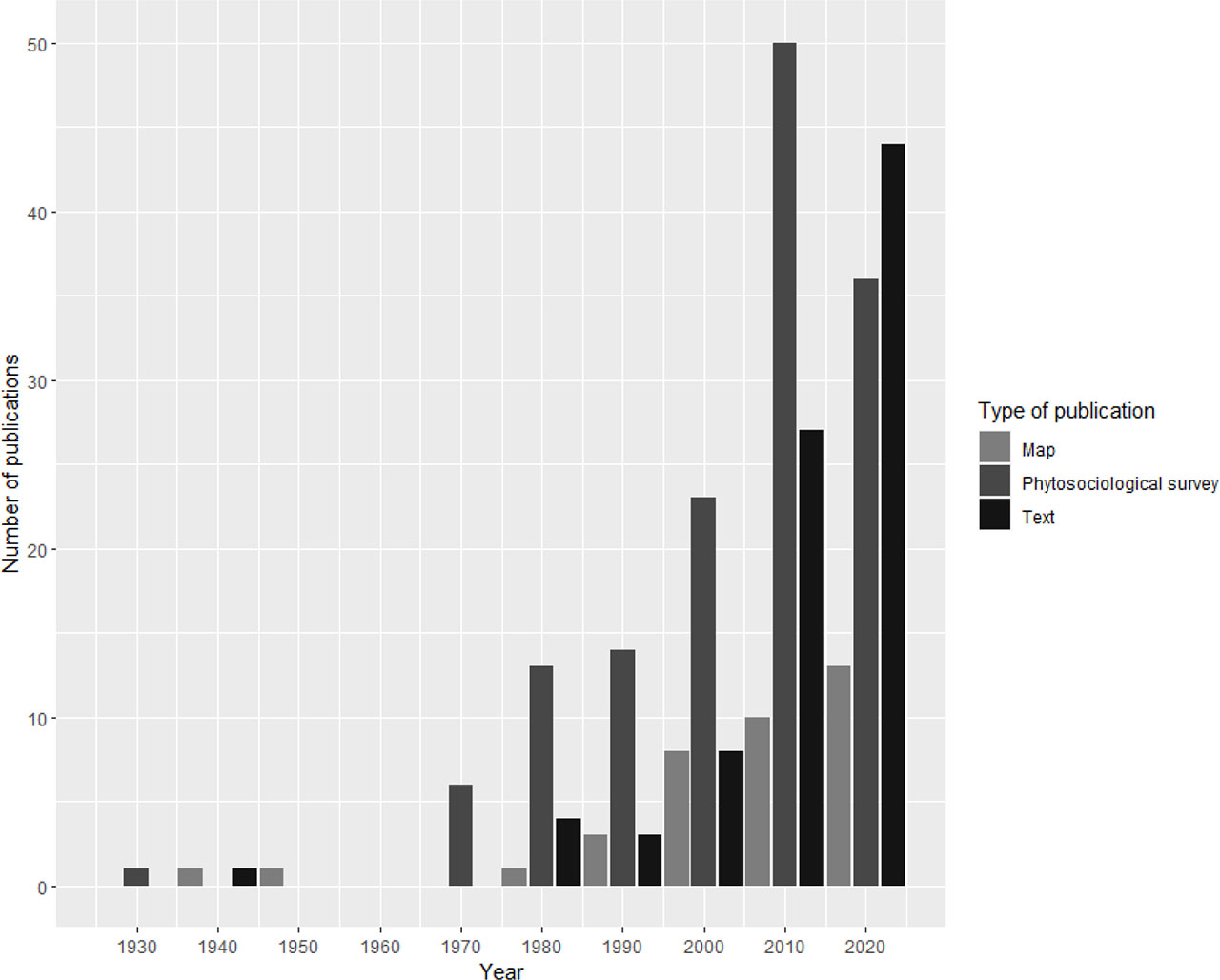
Figure 1.
Number of publications containing data on urban habitats in respective years
Source: own elaboration
The number of habitats identified in individual cities varies considerably. The richest source is the Upper Silesian Urban Area, where 331 units were recorded. Meanwhile, the smallest is in Wałbrzych – 48 (Table 1). Among the cities distinguished by the highest number of identified habitats, in addition to the Upper Silesian Urban Area, are also Poznań and Warsaw. Here, 311 and 283 habitats were recorded, respectively. These values considerably exceed the average for all cities – 149.
Data on urban vegetation in cities versus data in planning documents
The number of habitats specified in the planning documentation of cities is considerably lower than the number of identified habitats from the literature searches (Table 1). On average, 33.2% of habitats identified in research articles appear in planning documentation. This proportion only exceeds 90% in two cities, namely, Koszalin and Rybnik. For four cities, that is, Bydgoszcz, Poznań, Szczecin, and Tarnów, no habitat was recorded in the planning documentation. For over half of the cities, the number of habitats recorded in planning documents is under half that of the number identified based on literature.
All the habitat types identified in the cities belong to 29 classes according to plant community system (Table 2). The most common habitat types were Querco–Fagetea and Molinio–Arrhenatheretea, with each class containing 28 distinct habitats. These classes were also the most accurately represented in urban planning documents, with Querco–Fagetea appearing in 78.5% and Molinio–Arrhenatheretea in 64.3% of cases (Table 2). Conversely, habitat types from the classes Ammophilletea, Asteretea, Charetea, and Oxycocco–Sphagnetea were absent from the planning documentation.
Table 2.
Number of habitat types at the class level identified from research articles and included in planning documents
| Habitat type (vegetation class) | Number of types of habitats found in the research articles | Number of types of habitats in plans | Percentage of habitats found in the literature and included in planning documents |
|---|---|---|---|
| Agropyretea | 17 | 2 | 11,8 |
| Alnetea | 21 | 13 | 61,9 |
| Ammophilletea | 1 | 0 | 0,0 |
| Artemisietea | 28 | 11 | 39,3 |
| Asplenietea | 8 | 1 | 12,5 |
| Asteretea | 2 | 0 | 0,0 |
| Bidentea | 18 | 7 | 38,9 |
| Cakiletea maritimae | 1 | 1 | 100,0 |
| Charetea | 2 | 0 | 0,0 |
| Epilobietea | 24 | 6 | 25,0 |
| Festuco–Brometea | 18 | 8 | 44,4 |
| Isoeto–Nanojuncetea | 8 | 1 | 12,5 |
| Koeleria–Corynephoretea | 24 | 10 | 41,7 |
| Lemnetea | 19 | 11 | 57,9 |
| Litoirelletea | 3 | 1 | 33,3 |
| Molinio–Arrhenatheretea | 28 | 18 | 64,3 |
| Montio–Cardaminetea | 5 | 1 | 20,0 |
| Nardo–Callunetea | 15 | 8 | 53,3 |
| Oxycocco–Sphagnetea | 9 | 0 | 0,0 |
| Phragmitetea | 27 | 15 | 55,6 |
| Potametea | 21 | 13 | 61,9 |
| Querceta robori-petraeae | 9 | 6 | 66,7 |
| Querco–Fagetea | 28 | 22 | 78,6 |
| Rhamno–Prunetea | 20 | 7 | 35,0 |
| Salicetea purpureae | 22 | 14 | 63,6 |
| Scheuchzerio–Caricetea | 24 | 9 | 37,5 |
| Stellarietea | 26 | 8 | 30,8 |
| Trifolio–Geranietea | 14 | 2 | 14,3 |
| Vaccinio–Picetea | 25 | 16 | 64,0 |
| Mean | 38,8 |
The most common group mentioned in planning documents is forest habitats (Figure 2). They best reflect the actual state of knowledge, representing 62.4% of the habitats identified in the literature. Meanwhile, the synanthropic habitat group is the least frequently documented in planning documents. It is also the least represented, accounting for only 28.4% compared to the state identified in the literature.
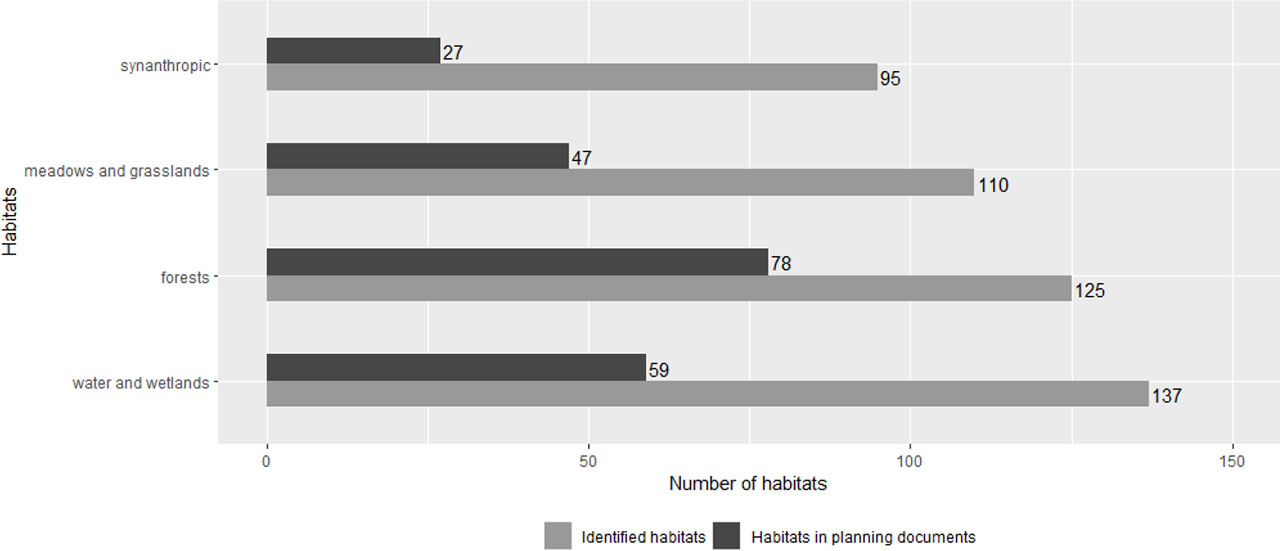
Figure 2.
Habitat groups identified in the literature and included in planning documents, analyzing the period from 1980 to the present
Source: own elaboration
Discussion
Between paper and plan
The amount of habitat data available in literature on Poland’s largest cities has been steadily increasing since the early 20th century. In the last decade, there has been a slight decrease in the proportion of phytosociological survey data. There has also been a slight increase in the proportion of maps. The most prominent increase has been observed in compilations, tables, and textual summaries. The number of cartographic and textual data is increasing the most rapidly. This is associated with the dissemination of conservation programmes based on formalized documentation and especially Natura 2000. Their introduction has resulted in the largest current database on nature across European countries (Mücher et al. 2009).
Studies containing phytosociological surveys typically focus on smaller parts of cities, often protected areas of less than a square kilometre. Their number increased until 2010, after which a decline occurred. It is challenging to definitively determine whether this is a lasting trend or a short term dip. Additionally, studies encompassing habitats throughout the city are extremely rare. This is due to the time-consuming nature and high cost of such studies (Jarvis & Young 2005). In Poland, there are relatively few examples of such studies, including Białystok, Kraków, and Warsaw (Sudnik-Wójcikowska 1987; Wołkowycki 2019; Zając et al. 2006).
Habitat recognition in individual cities is uneven and any cities have limited documentation. The degree of habitat recognition in urban areas depends on the natural characteristics of each city and the focus and capabilities of local research institutions. The best-researched ones are those with higher education institutions and research institutes with a long tradition in phytosociology. Cities such as Poznań, Warsaw, the Upper Silesian Urban Area, Białystok, Lublin, and Bydgoszcz stand out here (Table 1). For example, Warsaw benefits from comprehensive cartographic data, facilitating accurate habitat mapping. In contrast, Poznań has detailed information about specific habitats, offering in-depth insights into their ecology. This has highlighted how local research priorities and resources influence the quality and extent of habitat data available for urban planning and conservation.
Disproportionate habitat type recognition in planning documents
Our study has indicated that disparities are not only present between habitats identified in literature and those documented in planning documents. These disparities are also evident in the inclusion of different habitat groups in planning documentation, particularly for forest habitats. Their frequent inclusion in plans is because of their historical connection with the urban fabric (Forrest & Konijnendijk 2005). Due to urban development, forests and woodlands have often been transformed into parks or urban forests which have high cultural and historical importance for local communities (McBride 2017). Another factor is the role of forests in maintaining biodiversity and protecting natural resources, making them key to city ecological sustainability. Spatial planning often prioritizes the protection and integration of forested areas into the urban fabric (Muller et al. 2010). Urban forests also perform essential ecosystem functions, such as air purification, microclimate regulation, and water retention, further enhancing their value in the eyes of urban planners (Nowak 2006). All these factors make forest habitats the most frequently documented and included in urban planning documents. This has highlighted their position in the context of city spatial management and nature conservation.
The underrepresentation of synanthropic habitats in planning documentation
Synanthropic habitats are one of the most transformed and degraded areas within city boundaries (Kowarik 2011; Manyani et al. 2021). They mainly contain plants that have adapted to unfavourable urban conditions. However, due to their frequent location in dense urban fabric, they can also become habitats for many invasive species (Aronson et al. 2017; Culley et al. 2022). This combination of native and invasive species can lead to the formation of new, stable communities unknown to phytosociologists/botanists. These communities align with the concept of so-called novel ecosystems (Hobbs et al. 2013; Kowarik 2011). In urban areas, novel ecosystems can occupy up to half of the entire city, encompassing wastelands, city parks, and neighbourhood greenery (Kowarik 2011; Rupprecht & Byrne 2014).
Our study has shown that synanthropic habitats are the most overlooked group in planning documents. This is caused by several interconnected factors. For a long time, synanthropic city habitats were only of interest to a small group of researchers (Yeremenko 2019). Historically, these habitats were viewed as unstable and transitional, with the assumption that they would eventually develop to resemble natural habitats. The low recognition of these areas resulted in white spots on vegetation maps of cities. These habitats often occupy degraded, postindustrial areas, leading them to be treated not as suitable green spaces, but rather as vacant lots available for further urban development. This has resulted in a systematic overlooking of them as areas requiring recognition as green spaces, instead focusing planners on developing these areas. Moreover, there has been a longstanding belief that residents negatively assess these areas in terms of aesthetics and their usefulness as urban green spaces (Nassauer 1995).
Synanthropic habitats provide numerous ecosystem services in the urban fabric, such as air purification, water management or recreation, and their value is relatively high (Luo & Patuano 2023). Wastelands seem to be a crucial group of these ecosystems. Due to the almost total lack of human interference in these areas, vegetation undergoes natural succession processes (Bonthoux et al. 2014), where vegetation develops spontaneously (Schadek et al. 2009; Yuan et al. 2023). Therefore, a single area may exhibit high habitat diversity at different successional stages with different floristic compositions. Therefore, wastelands become specific urban biodiversity hotspots. Considering their high diversity value, it is disconcerting that they are so minimally considered in planning documents, especially in the face of trends such as resilience and sustainable cities. This is alarming, especially considering that, on average, they can comprise up to 15% of a city’s total green space (Sikorska et al. 2020).
Mapping habitats using remote sensing methods
There is a considerable need for a better understanding of the role of habitats in urban areas and their more precise identification in space (Table 1). With the increasing use of remote sensing in urban habitat mapping (Neyns & Canters 2022; Yan et al. 2018), the potential of such tools is growing. Remote sensing data are successfully used to assess habitat quality (Lakes & Kim 2012). Their usefulness can be high considering the high costs associated with habitat mapping using traditional methods. Along with geographic information systems, these technologies have provided new possibilities for accurate and rapid mapping. Further, the obtained data are more reliable and easier to update than paper records. Given that remote sensing is based on ground-validated data, there is a risk of omitting unknown data. Mapping techniques are often adapted to individual types of greenery (Neyns & Canters 2022). Therefore, it is essential to coordinate the collection of field data with remote sensing techniques to maximize the remote sensing accuracy (Chan et al. 2021).
Summary
- Complete lists and maps of habitats covering the entire city area and are suitable for biodiversity management needs. However, they are rarely included in urban planning documents.
- On average, urban planning documentation encompasses 38.8% of habitats recorded in literature.
- Forest habitats are the most well-identified, while non-forest synanthropic habitats are the least frequently identified.
- There is a strong need to enhance efforts in coordinating field data collection and using remote sensing techniques for urban habitat mapping.