
Table 1.
Definition of capital and their evaluation aspects
| Capital | Concept | Research selection aspects |
|---|---|---|
| Human | The ability of individuals to develop and improve resources through access to external resources and knowledge transfer. |
|
| Social | Related to the interaction between people and organisations to obtain positive or negative results. |
|
| Natural | Natural resources associated with ecosystem goods and services. |
|
| Physical | Infrastructure which supports the production of goods or contributes to improving the quality of life. |
|
| Financial | Availability of financial resources to invest in the development of capacities for the consolidation of business units and accumulation of wealth for the future. |
|
1 Source: adapted from Declerck et al. (2015) and Hernández-Núñez et al. (2021)
Table 2.
Indicators of empowerment
| Item | Category | Subcategory |
|---|---|---|
| Diagnostic evaluation | Economic resources | Economic capital |
| Economic income | ||
| Land owned | ||
| Human resources | Management knowledge (generational relief) | |
| Technical knowledge (especially in agriculture and administration) | ||
| Analysis capacity | ||
| Self-esteem | ||
| Socio-political resources | Ability to organise resources | |
| Participation in solidarity entities | ||
| Participation in social policy | ||
| Contribution of interventions | Economic resources | Technology availability |
| Task relief | ||
| Buildings | ||
| Human resources | Accompaniment by family members | |
| Tangible support from family members | ||
| Exchange of knowledge | ||
| Socio-political resources | Organisational support | |
| Structural support | ||
| Network support | ||
| Results | Have | Profit increase |
| Technology booster | ||
| Family time optimisation | ||
| Know | Critical capabilities | |
| Conflict resolution | ||
| Training level | ||
| Want | Self-esteem increase | |
| Mastering fears | ||
| Reinforcement of values | ||
| Can | Capacity for organisation | |
| Administrative capacity | ||
| Capacity for negotiation | ||
| Impact | Have | Economic activities |
| Family benefits | ||
| Know | Ability to choose | |
| Local politics | ||
| Want | Increased self-esteem | |
| Achievement of family projects | ||
| Can | Increased capacity for expression | |
| Increased participation |
1 Source: Adapted from Charlier et al. (2007)
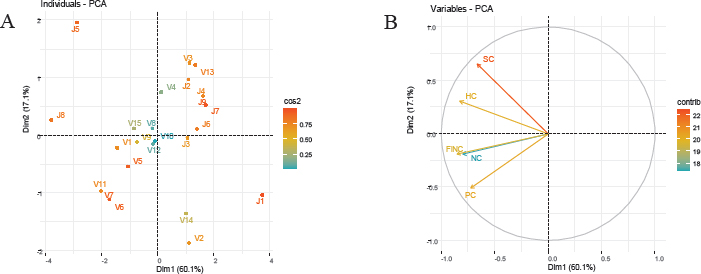
Figure 1.
A: Correlation of the livelihoods of the families from Ventaquemada (V) and Jericó (J). B: human capital (HC), social capital (SC), financial capital (FINC), natural capital (NC), and physical capital (PC)
Source: own study
Table 3.
Contribution of capital to components 1 and 2
| CAPITAL | Component 1 | Component 2 |
|---|---|---|
| Human | 20.24 | 7.64 |
| Social | 14.26 | 56.19 |
| Natural | 20.57 | 0.75 |
| Physical | 19.59 | 28.62 |
| Financial | 25.34 | 6.81 |
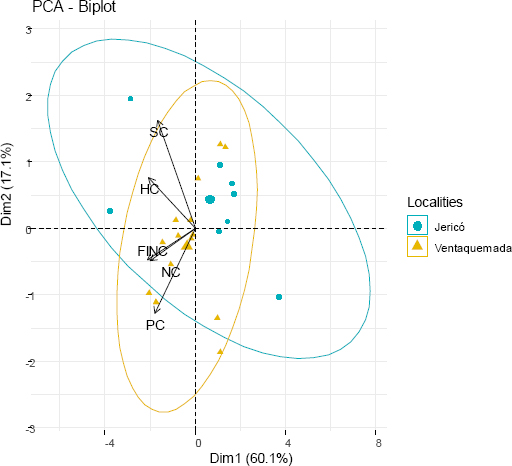
Figure 2.
Principal component analysis (PCA) of livelihoods in Ventaquemada (V) and Jericó (J)
Source: own study
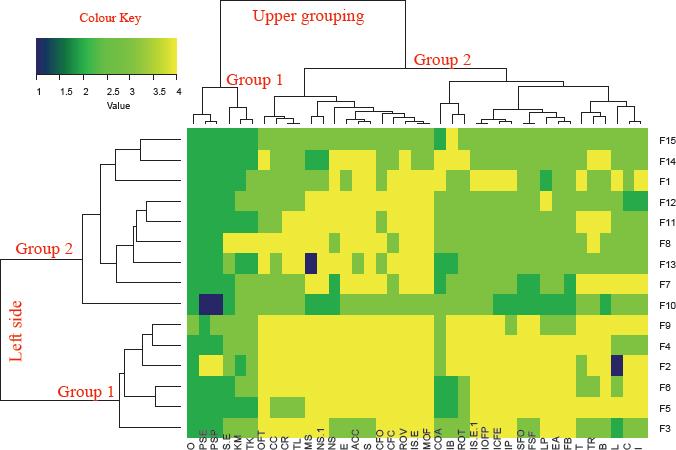
Figure 3.
Bootstrap analysis of empowerment in Ventaquemada according to Ward’s method. Organisation (O), participation in solidarity entities (PSE), participation in social policy (PSP), self-esteem (S/E), knowledge of management (KM), technical knowledge (TK), optimisation of family time (OFT), critical capacities (CC), conflict resolution (CR), training level (TL), management skills (MS), negotiation skills (NS), network support (NS), exchange (E), accompaniment (ACC), support (S), capacity for organisation (CFO), capacity for choice (CFC), reinforcement of values (ROV), increase in self-esteem (IS/E), mastery of fears (MOF), capacity for analysis (COA), increase in benefits (IB), reinforcement of technology (ROT), implementation of family projects (IOFP), increased capacity for expression (ICFE), increased participation (IP), support for organisation (SFO), support for structure (SFS), local policies ( LP), economic activities (EA), family benefits (FB), technology (T), task relief (TR), buildings (B), land (L), capital (C), income (I), increased self-esteem (IS/E)
Source: own study
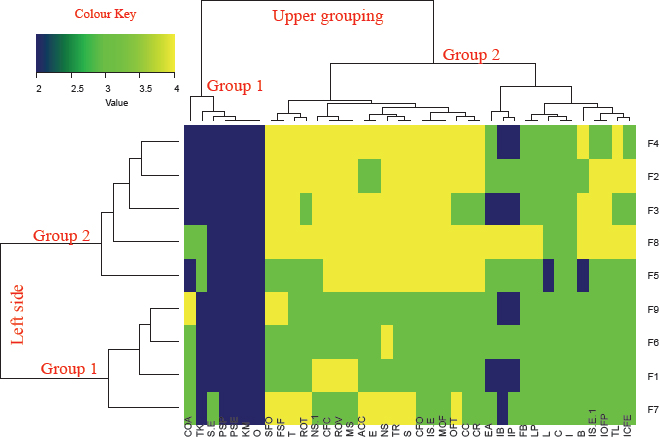
Figure 4.
Bootstrap analysis of the empowerment of the families of Jericó according to Ward’s method
Source: own study