
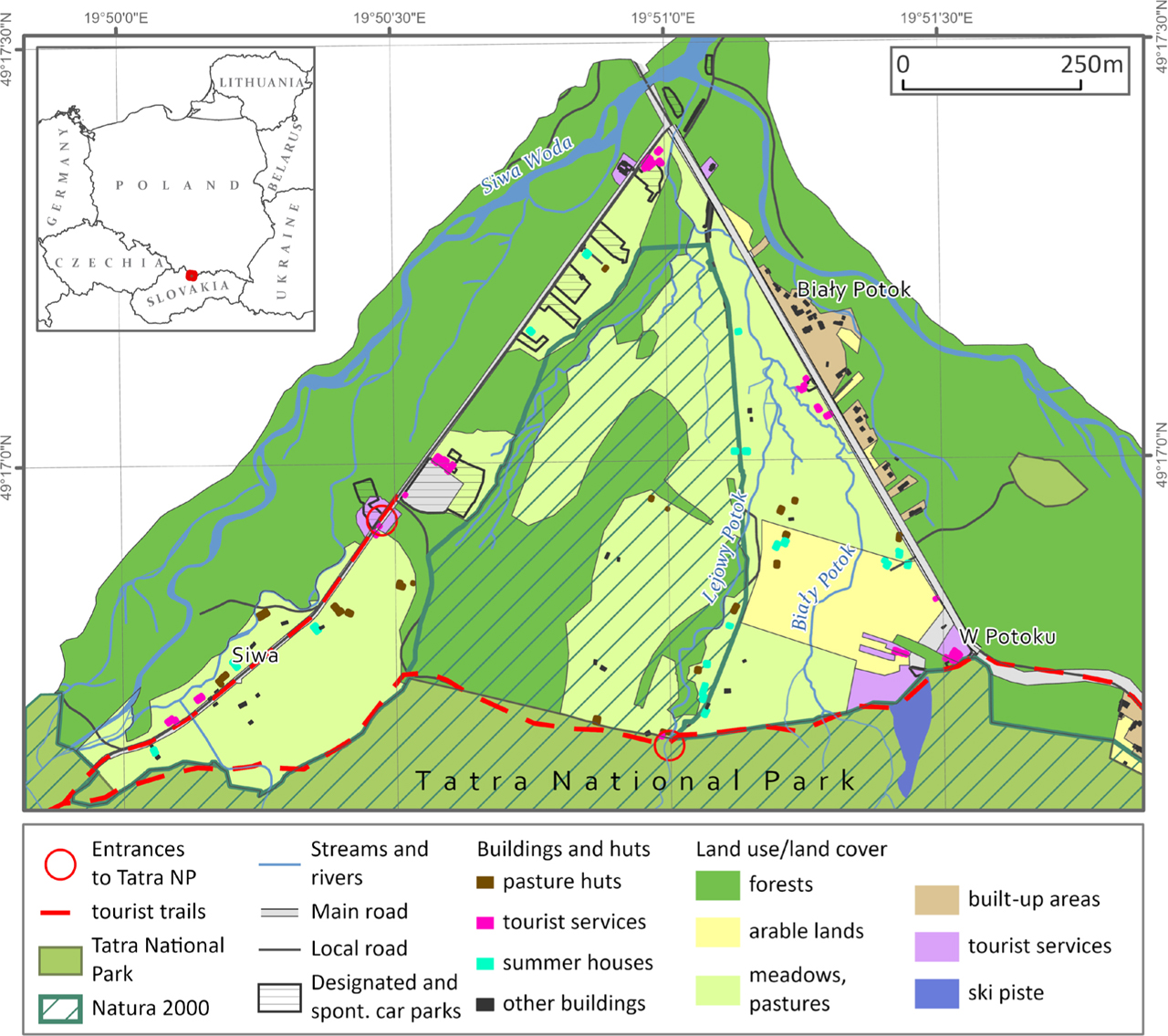
Figure 1
Land use and major issues in the study area
Source: own elaboration.
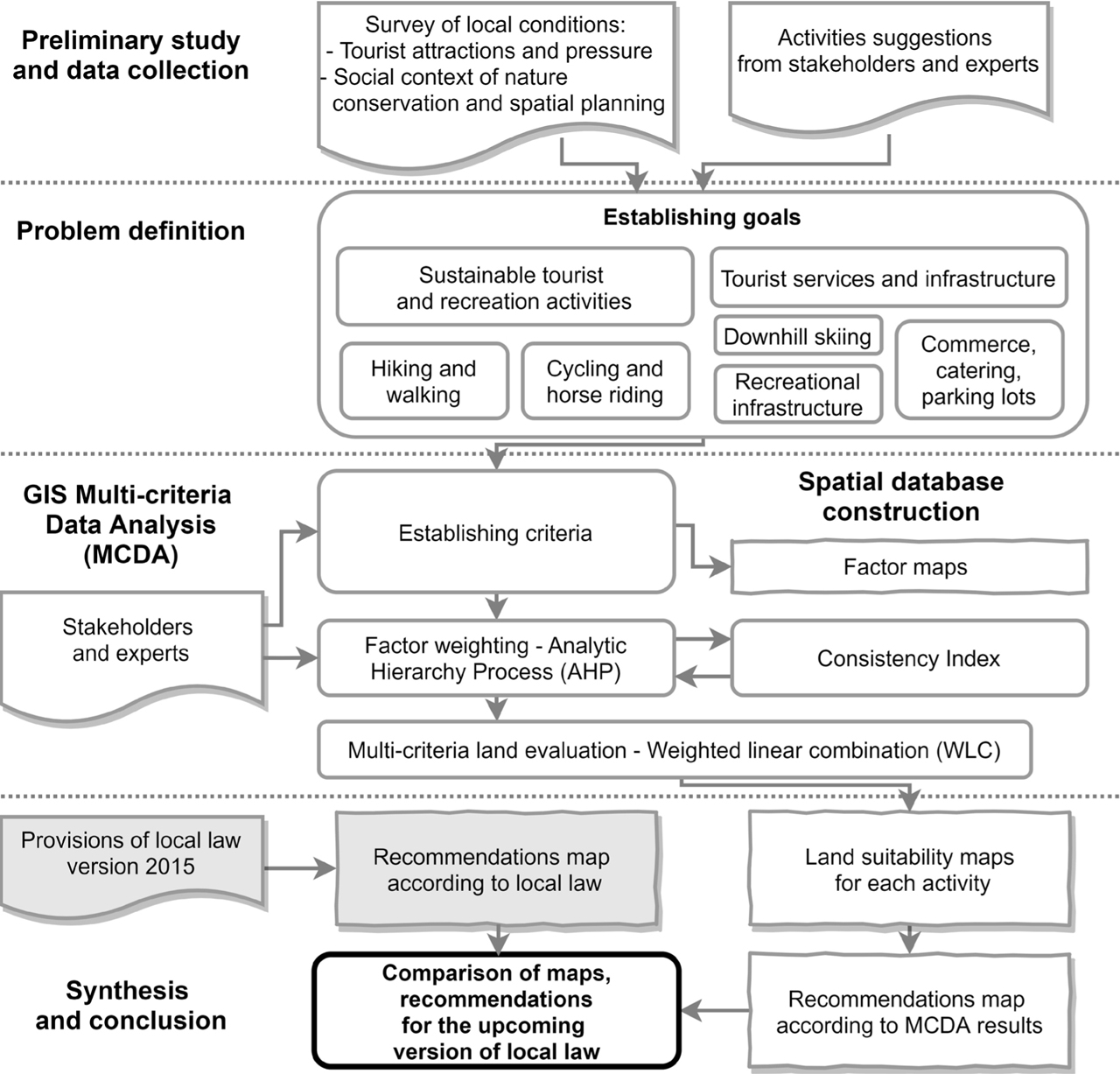
Figure 2
The analysis workflow
Source: own elaboration
Table 1
Decision criteria value scaling: benefit criteria: 0–1 – the closer to 1 the more positive the meaning of the criterion, 0 – the irrelevant criterion; cost criteria: 0–1 – the closer to 1 the greater the restriction caused by the criterion; EXCL – criterion excluded from the analysis due to the nature of the discipline; NE – not evaluated in the case of downhill skiing. The numbers (1–6) refer to the categories listed in Table 2
| Sustainable activities | Projects requiring investments | ||||||
|---|---|---|---|---|---|---|---|
| Groups | Criteria | Hiking and walking | Cycling and horseback riding | Downhill skiing | Recreational infrastructure | Commerce, catering, parking lots | |
| Land attractiveness and suitability for tourism and investment projects (benefit) | |||||||
| Tourism attractions (1) | Environmental: crocus scepusiensis – frequent and widespread appearance | 1 | 1 | 0 | 1 | 0.2 | |
| Scenic values: visibility of the Tatra peaks | 1 | 1 | 0.8 | 1 | 0.4 | ||
| Scenic values – contrasting land cover: zone of 150m between forest and lower land cover | 0.8 | 0.8 | 0.8 | 1 | 0.2 | ||
| Cultural: occurrence of traditional architecture | 1 | 1 | 0.8 | 1 | 1 | ||
| Land cover/use suitability (2) | Forest | 1 | 1 | 0 | 1 | 0.2 | |
| Meadows and pastures | 1 | 1 | 0.8 | 1 | 0.2 | ||
| Arable lands | 0.8 | 0.8 | 1 | 0 | 0.2 | ||
| Built-up areas and tourism services | 0.6 | 0.6 | EXCL | 1 | 1 | ||
| Proximity of roads 6–20 m | 0.8 | 0.8 | EXCL | 1 | 1 | ||
| Proximity of roads up to 6 m | 0.6 | 0.6 | EXCL | 0 | 0.8 | ||
| Flat areas (6) | Flat areas and slight terrain slope (< 2.9°) | 1 | 1 | EXCL | 1 | 1 | |
| Limitations on the development of tourism and investment (cost) | |||||||
| 3. Nature and landscape protection (3) | Natura 2000 – ecological corridor protection | 0.2 | 0 | 1 | 0 | 1 | |
| Preservation of traditional land uses: meadows and pastures, forests outside the Natura 2000 area, arable lands | 0 | 0 | 0.4 | 0 | 0.8 | ||
| 4. Scenic value (4) | Areas with landform and traditional use, creating scenic value | areas visible from 10–32 observer points | 0 | 0 | 0.6 | 0.2 | 0.6 |
| 32+ observer points | 0 | 0 | 0.8 | 0.4 | 0.8 | ||
| 5. Erosion and flooding risk (5) | Faint (2.9 – 9°) and moderate (>9°) slope | 0.2 | 0.6 | NE | 0.6 | 0.8 | |
| Main rivers valley floors | 0.2 | 0.2 | EXCL | 0.4 | 1 | ||
| Stream valleys with a surrounding of 15 m | 0.4 | 0.8 | EXCL | 1 | 1 | ||
[i] Source: own elaboration
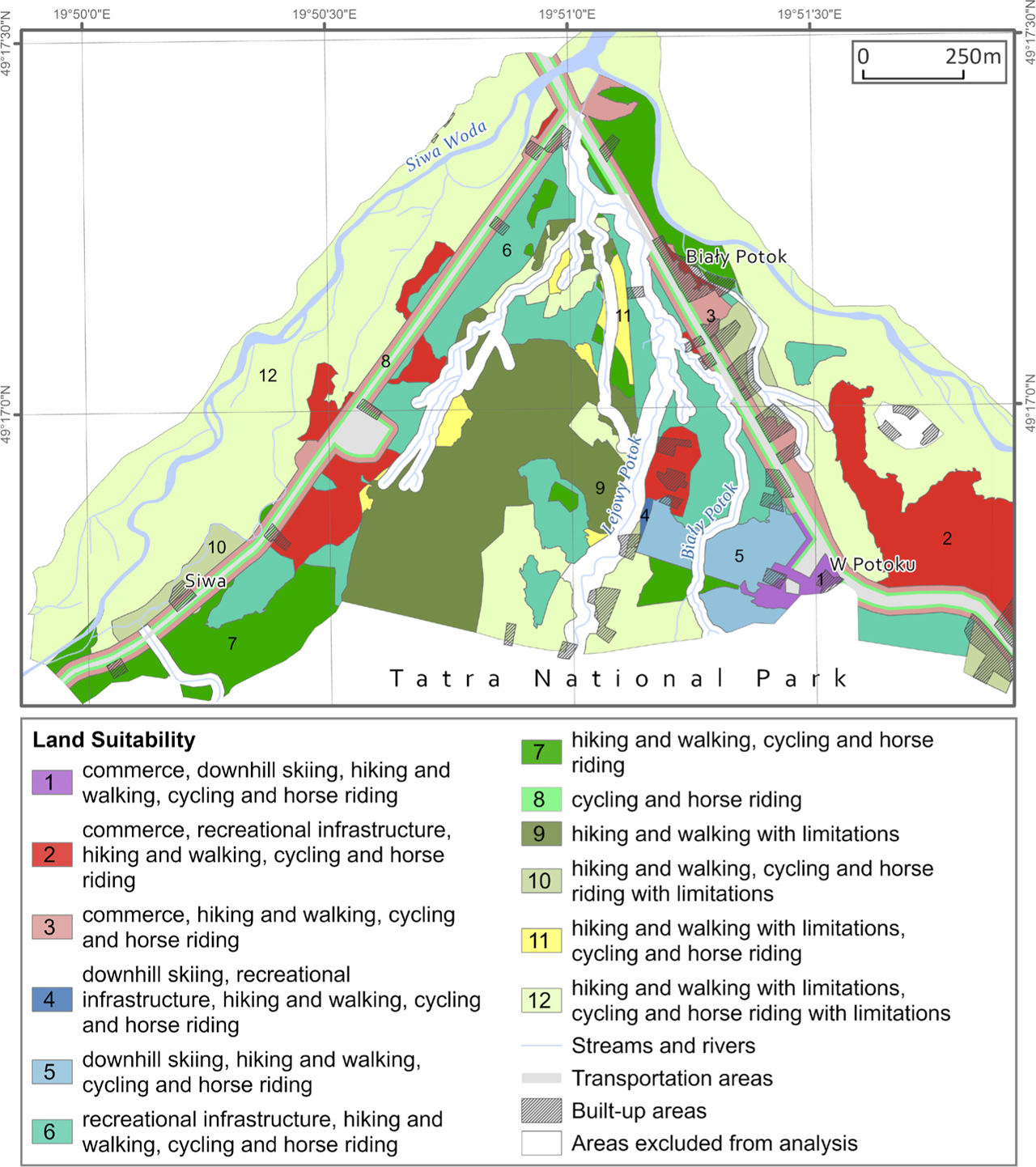
Figure 3
Land suitability analysis results shown for analyzed activities
Source: own elaboration
Table 2
Criteria weights matrix: 1, 2, 3 – judgment values, 1/2, 1/3 – reverse values. Numbers 1–6 refer to the categories presented in Table 1
| Criteria groups | 1. | 2. | 3. | 4. | 5. | 6. | Factor weights |
|---|---|---|---|---|---|---|---|
| 1. Tourism attractions | 1 | 2 | 1 | 3 | 2 | 3 | 0.27 |
| 2. Land cover/use suitability | 1/2 | 1 | 1/2 | 2 | 1 | 2 | 0.14 |
| 3. Nature and landscape protection | 1 | 2 | 1 | 3 | 2 | 2 | 0.27 |
| 4. Scenic value | 1/3 | 1/2 | 1/2 | 1 | 1/3 | 1 | 0.08 |
| 5. Erosion and flooding risk | 1/2 | 1 | 1/2 | 2 | 1 | 3 | 0.14 |
| 6. Flat areas | 1/3 | 1/2 | 1/2 | 1 | 1/3 | 1 | 0.08 |
[i] Source: own elaboration
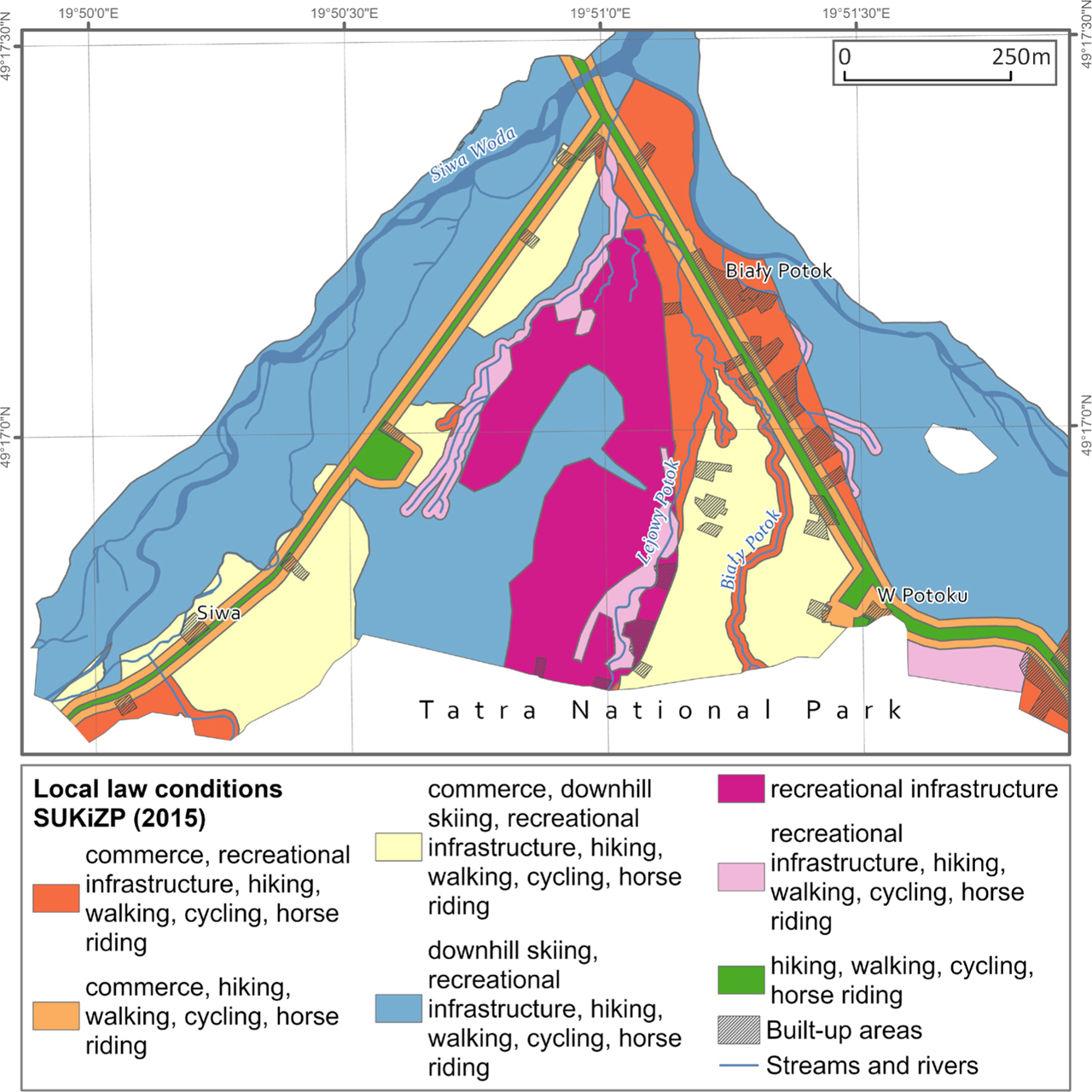
Figure 4
Land suitability maps showing spatially related provisions of local law.
Source: own elaboration based on Local Plan of Spatial Development (SUIKZP 2015)