Have a personal or library account? Click to login
Intensity of heat stress in 2015 and 2018 summer seasons in the region of the Lower Silesia (Poland) Cover

Intensity of heat stress in 2015 and 2018 summer seasons in the region of the Lower Silesia (Poland)

Open Access
|Jul 2020

Figures & Tables

Figure 1

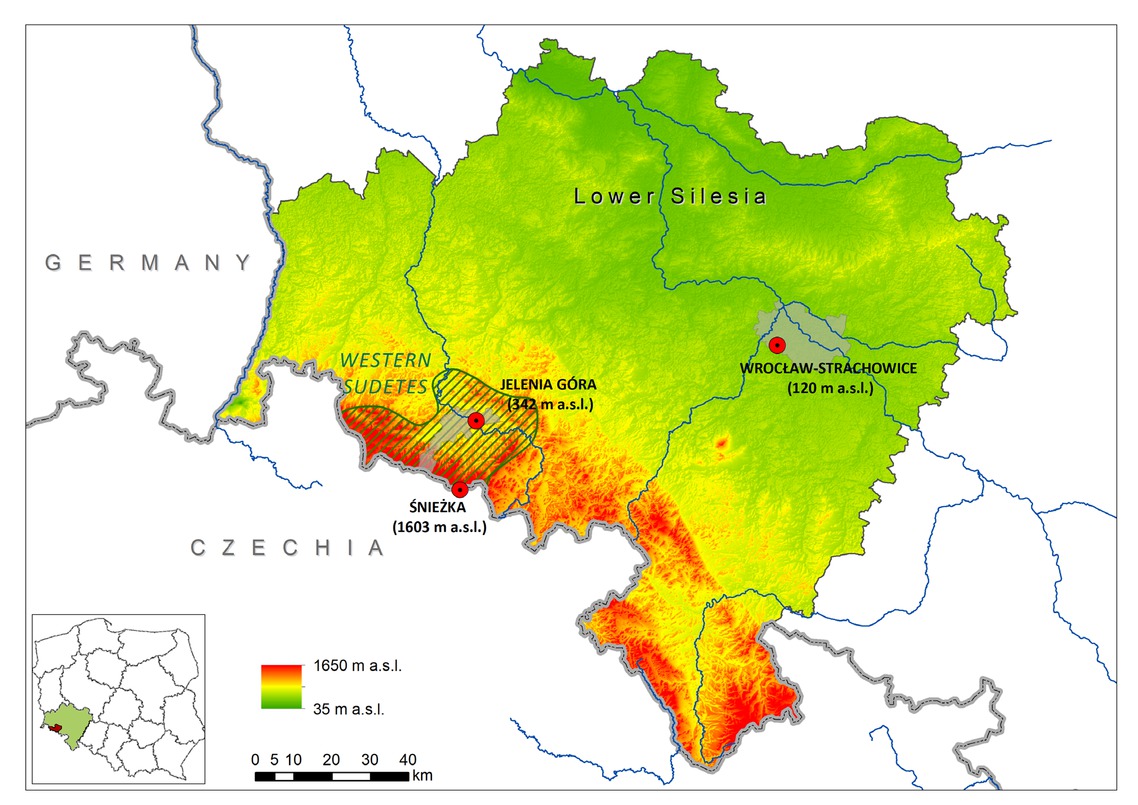
Location of the Wrocław-Strachowice, Jelenia Góra and Śnieżka meteorological stations. Source: own study.

Figure 2

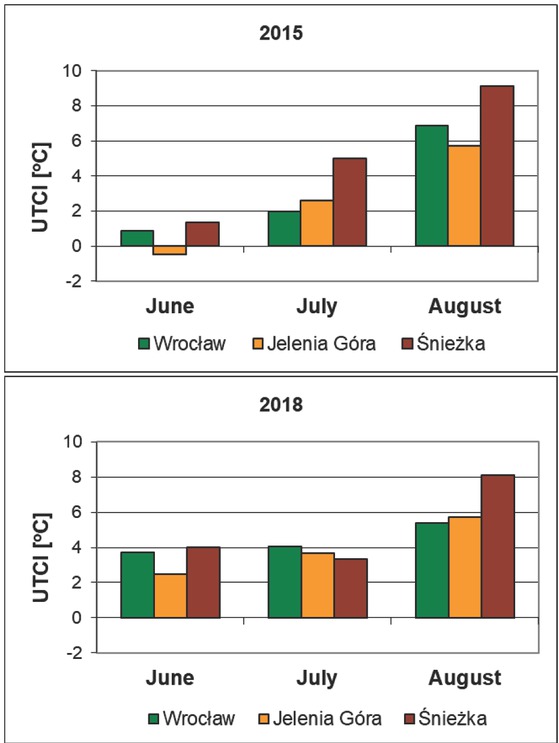
Differences in UTCI for 12.00 UTC between 2015, 2018 and the 1971–2018 period for June, July and August in Wrocław, Jelenia Góra and Śnieżka. Source: own study
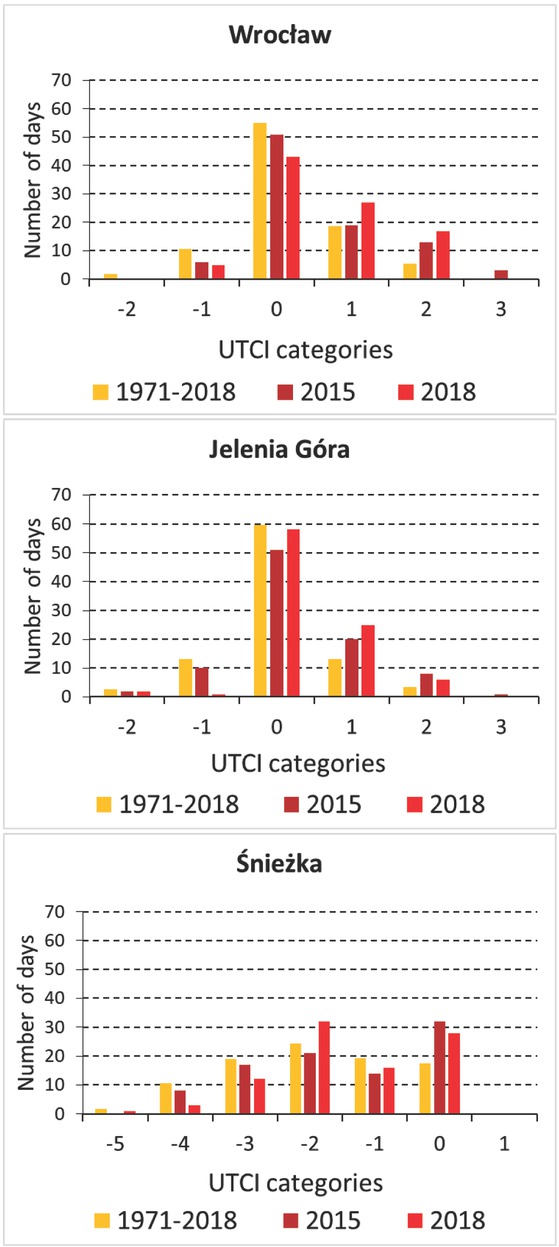

Figure 3

Frequency of thermal stress in the summer season (June–August) for 12.00 UTC in 1971–2018, 2015 and 2018 in Wrocław, Jelenia Góra and on Śnieżka, according to UTCI categories: extreme cold stress (-5), very strong cold stress (-4), strong cold stress (-3), moderate cold stress (-2), slight cold stress (-1), no thermal stress (0), moderate heat stress (1), strong heat stress (2), very strong heat stress (3). Source: own study
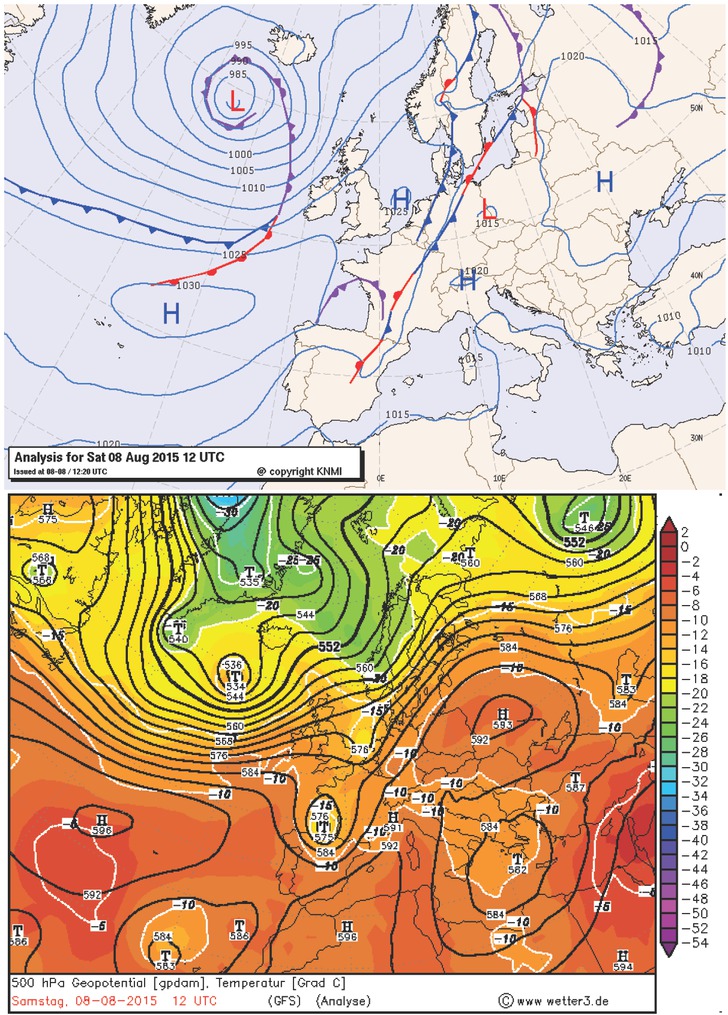

Figure 4

Synoptic situation over Europe on 8 August 2015, including sea level pressure field (left) and isobaric surface of 500 hPa (right). Source: The Royal Netherlands Meteorological Institute ; www.wetter3.de (R. Behrendt, H. Mahlke) (according to the conditions given by the map’s authors)
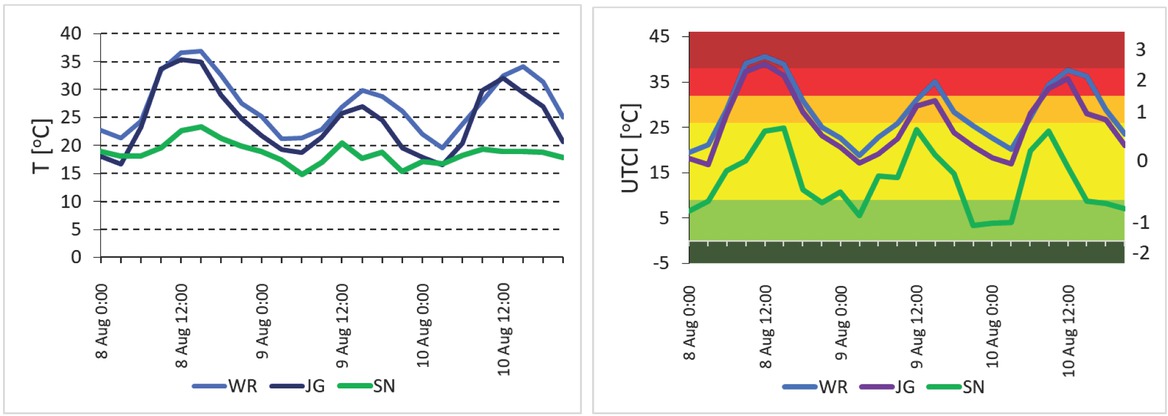

Figure 5

Course of air temperature (left) and UTCI (right) on 8–10 August 2015 in Wrocław (WR), Jelenia Góra (JG) and on Śnieżka (SN); UTCI categories: moderate cold stress (-2), slight cold stress (-1), no thermal stress (0), moderate heat stress (1), strong heat stress (2), very strong heat stress (3). Source: own study
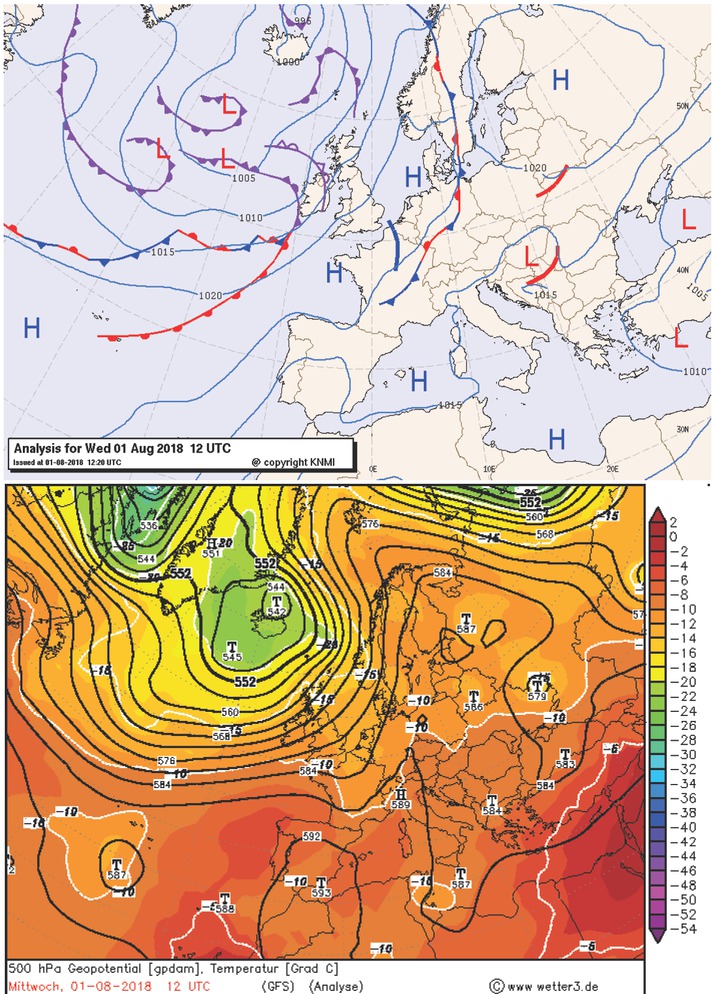

Figure 6

Synoptic situation over Europe on 1 August 2018, including sea level pressure field (left) and isobaric surface of 500 hPa (right). Source: The Royal Netherlands Meteorological Institute ; www.wetter3.de (R. Behrendt, H. Mahlke) (according to the conditions given by the map’s authors)
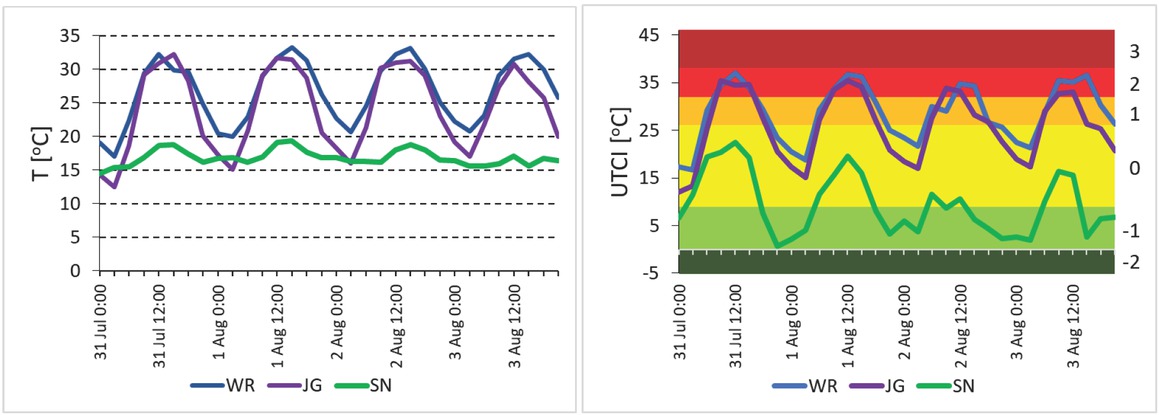

Figure 7

Course of air temperature (left) and UTCI (right) on 31 July – 3 August 2018 in Wrocław (WR), Jelenia Góra (JG) and on Śnieżka (SN); UTCI categories: moderate cold stress (-2), slight cold stress (-1), no thermal stress (0), moderate heat stress (1), strong heat stress (2), very strong heat stress (3). Source: own study

Stress category according to UTCI

Stress categoryUTCI [°C]
Extreme heat stressabove 46
Very strong heat stress38 to 46
Strong heat stress32 to 38
Moderate heat stress26 to 32
No thermal stress9 to 26
Slight cold stress0 to 9
Moderate cold stress-13 to 0
Strong cold stress-27 to -13
Very strong cold stress-40 to -27
Extreme cold stressbelow -40
DOI: https://doi.org/10.2478/mgrsd-2020-0020 | Journal eISSN: 2084-6118 | Journal ISSN: 0867-6046
Language: English
Page range: 138 - 146
Submitted on: Mar 17, 2020
Accepted on: Jun 23, 2020
Published on: Jul 31, 2020
Published by: Faculty of Geography and Regional Studies, University of Warsaw
In partnership with: Paradigm Publishing Services
Publication frequency: 4 issues per year

© 2020 Bartłomiej Miszuk, published by Faculty of Geography and Regional Studies, University of Warsaw
This work is licensed under the Creative Commons Attribution-NonCommercial-NoDerivatives 3.0 License.