
Table 1
Variables describing particular areas of the smart villages concept
| Smart village area | Variable | |
|---|---|---|
| number | Name and time (range) | |
| Management | X1 | The percentage of councillors representing professionals out of the total number of councillors (2016) |
| X2 | The total value of qualified expenditure of completed projects co-financed from EU funds under the programmes: IE, HC, IaE, DEP, ROP of the Lublin Province per inhabitant (2015) | |
| X3 | The percentage of the commune area covered by local spatial development plans out of the total area of the commune (2016) | |
| Quality of Life | X4 | The number of business entities of R section per 100 inhabitants (2016) |
| X5 | The number of specialist laboratories per 10,000 inhabitants (2016) | |
| X6 | The number of residential premises completed per 1,000 inhabitants (2014–2016) | |
| Economy | X7 | The percentage of new-registered entities in the agro-food processing sector out of the total number of new-registered entities (2015–2016) |
| X8 | The percentage of entities from sections J, K, L, M out of the total number of entities (2016) | |
| X9 | The percentage of new-registered creative sector entities out of the total number of new-registered entities (2015–2016) | |
| X10 | The share of registered unemployed people out of the working age population (2016) | |
| Society | X11 | The number of foundations, associations and social organizations per 1,000 inhabitants (2016) |
| X12 | The number of participants in mass events of municipality institutions per 1,000 inhabitants (2014– 2016) | |
| X13 | The number of borrowings of public library collections per 1,000 inhabitants | |
| X14 | The percentage of additional foreign language learning in primary schools (2014–2016) | |
| X15 | The number of Third Age University members per 1,000 inhabitants (2016) | |
| Natural Environment | X16 | The percentage of population connected to wastewater treatment facilities (2016) |
| X17 | The length of the sewerage network in relation to the length of the water supply network (%, 2016) | |
| X18 | The percentage of protected areas (landscape and national parks and nature reserves) out of the total area of the commune (2016) | |
| Mobility | X19 | The percentage of residential premises in the commune within the scope of the NGA Internet out of the total number of residential premises in the commune (2016) |
| X20 | The number of vehicles registered in the commune per 1,000 inhabitants (2016) | |
| X21 | The percentage of budget expenditure on transport and communication out of total commune expenditure (2014–2016) | |
| X22 | The length of bicycle paths per 10,000 km2 | |
[i] Source: own study based on BDL GUS (2018), UKE (2018) and CEPiK (2018) data
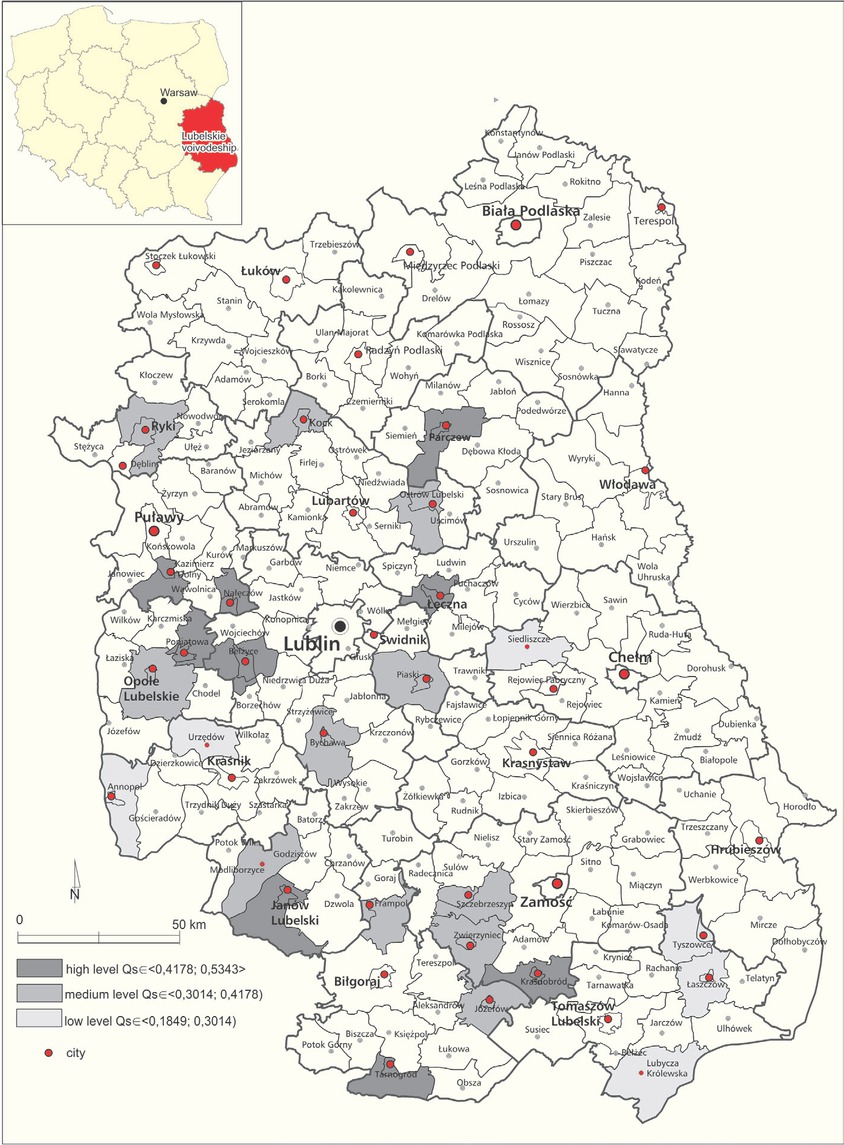
Figure 1
Urban-rural communes in the Lublin Province according to the level of the synthetic indicator of the potential for smart development.
Source: own study
Table 2
The structure of urban-rural communes of the Lublin Province in terms of the level of the synthetic indicator of the potential for smart development
| The level of potential smart development | The range of values of the synthetic index Qs | The number of communes in the class | Share of communes in the class (%) |
|---|---|---|---|
| High | Qs∈<0.4178; 0.5343> | 8 | 30.77 |
| Average | Qs∈<0.3014; 0.4178) | 12 | 46.15 |
| Low | Qs∈<0.1849; 0.3014) | 6 | 23.08 |
| Total | 26 | 100.00 |
[i] Source: own study based on BDL GUS (2018), UKE (2018) and CEPiK (2018) data