
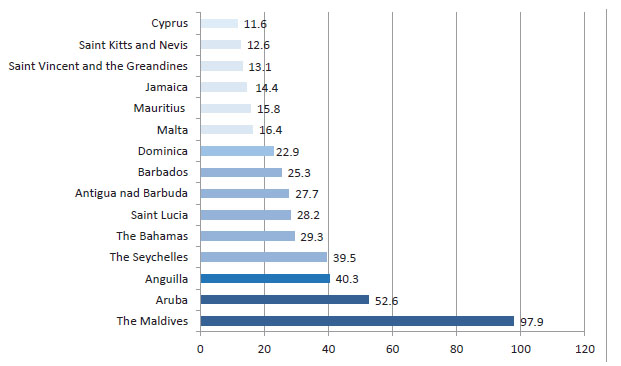
Figure 1
Selected island territories with more than 10% of GDP coming from tourism expenditure in 2012. 4 Source: author’s calculations based on UNWTO data 3 Anguilla (www.unwto.org).
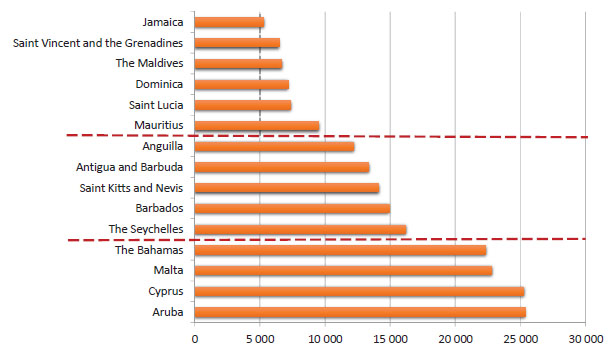
Figure 2
Gross domestic product per capita in 2012 for selected island territories. Source: author’s calculations based on data from The World Bank Website 2014 (www.data.worldbank.org), www.indexmundi.com.
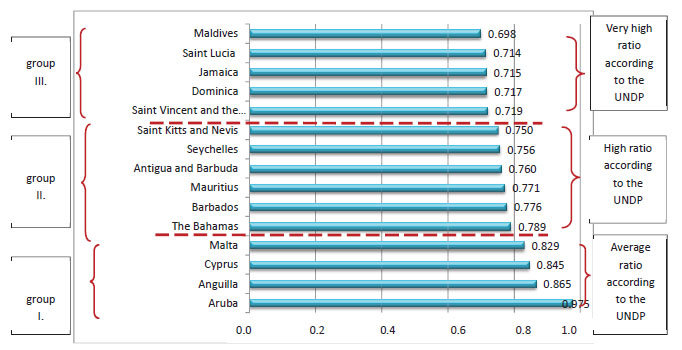
Figure 3
Human Development Index for selected island territories in 2013. Source: author’s elaboration based on data from www.hdr.undp.org/en/data, http://hdr.undp.org/sites/default/files/Country-Profiles/ATG.pdf, Aruba - www.cbs.aw/index.php.
Table 1
Division of island territories according to the magnitude of the crisis in tourist and one-day visitor arrivals
| Type | Change in tourist arrivals 2011/2008 | Magnitude of the crisis in tourist and one-day visitor arrivals | Selected island territories | Number of countries |
|---|---|---|---|---|
| A | More than 20% | Island territories with no crisis in tourist arrivals | The Seychelles, the Bahamas, the Maldives, Saint Kitts and Nevis | 4 |
| B | Between 20% and 2% | Island territories with a small decrease in tourist arrivals tourist in 2009, followed by an increase | Jamaica, Malta, Aruba, island Saint Lucia | 4 |
| C | Between 2% and 0% | Island territories that saw a decrease in tourist arrivals, but did not reach the levels of tourist arrivals in 2008 | Barbados, Mauritius, Cyprus | 3 |
| D | Decrease Based from 17% to 2% | Island territories that saw a long-term decrease in tourist arrivals | Antigua and Barbuda, Anguilla, Dominica, Saint Vincent and the Grenadines | 4 |
Table 2
Division of island territories according to crises connected with the number of tourist arrivals and divided according to the relationship of tourism expenditures as a proportion of GDP
| Type | I – tourism expenditure is a significant proportion of GDP (from 10% to 20% of GDP) | II – tourism expenditure is a big proportion of GDP (from 20.1% to 40%) | III – tourism expenditure is a very big proportion of GDP (over 40%) | Number of countries |
|---|---|---|---|---|
| A | Saint Kitts and Nevis | The Seychelles, the Bahamas | The Maldives | 4 |
| B | Jamaica, Malta | Saint Lucia | Aruba | 4 |
| C | Mauritius, Cyprus | Barbados | 3 | |
| D | Saint Vincent and the Grenadines | Antigua and Barbuda, Dominica | Anguilla | 4 |
| Total | 6 | 6 | 3 |
Table 3
Coefficient of variation for tourist and one-day visitor arrivals during the periods 2000-2013 and 2008-2012
| Island territories | Coefficient of variation 2000-2013 | Coefficient of variation 2008-2012 | |
|---|---|---|---|
| 1 | Anguilla | 15% | 12.9% |
| 2 | Antigua and Barbuda | 16% | 7.0% |
| 3 | Aruba | 10% | 5.3% |
| 4 | Barbados | 6% | 4.3% |
| 5 | Cyprus | 4% | 4.4% |
| 6 | Dominica | 29% | 19.7% |
| 7 | Jamaica | 14% | 6.8% |
| 8 | The Maldives | 30% | 15.7% |
| 9 | Malta | 18% | 7.0% |
| 10 | Mauritius | 15% | 3.5% |
| 11 | Saint Kitts and Nevis | 37% | 18.4% |
| 12 | Saint Lucia | 14% | 3.9% |
| 13 | Saint Vincent and the Grenadines | 14% | 17.4% |
| 14 | The Seychelles | 21% | 9.3% |
| 15 | The Bahamas | 13% | 11.1% |
| Average for all island territories | 11% | 4.4% |
Table 4
Spearman correlation ratio between changes in foreign tourist arrivals and changes in GDP during the period 2000‑2013 (in %)
| Island territories | Spearman correlation ratio | Tourism expenditures as a proportion of GDP (in %) | |
|---|---|---|---|
| 1 | Anguilla | 0.480 | 40.3 |
| 2 | Antigua and Barbuda | 0.433 | 27.7 |
| 3 | Aruba | −0.095 | 52.6 |
| 4 | Barbados | 0.403 | 25.3 |
| 5 | Cyprus | 0.336 | 11.6 |
| 6 | Dominica | 0.378 | 22.9 |
| 7 | Jamaica | 0.440 | 14.4 |
| 8 | The Maldives | 0.670** | 97.9 |
| 9 | Malta | 0.420 | 16.4 |
| 10 | Mauritius | 0.438 | 15.8 |
| 11 | Saint Kitts and Nevis | 0.125 | 12.6 |
| 12 | Saint Lucia | 0.284 | 28.2 |
| 13 | Saint Vincent and the Grenadines | 0.301 | 13.1 |
| 14 | The Seychelles | 0.868** | 39.5 |
| 15 | The Bahamas | −0.119 | 29.3 |
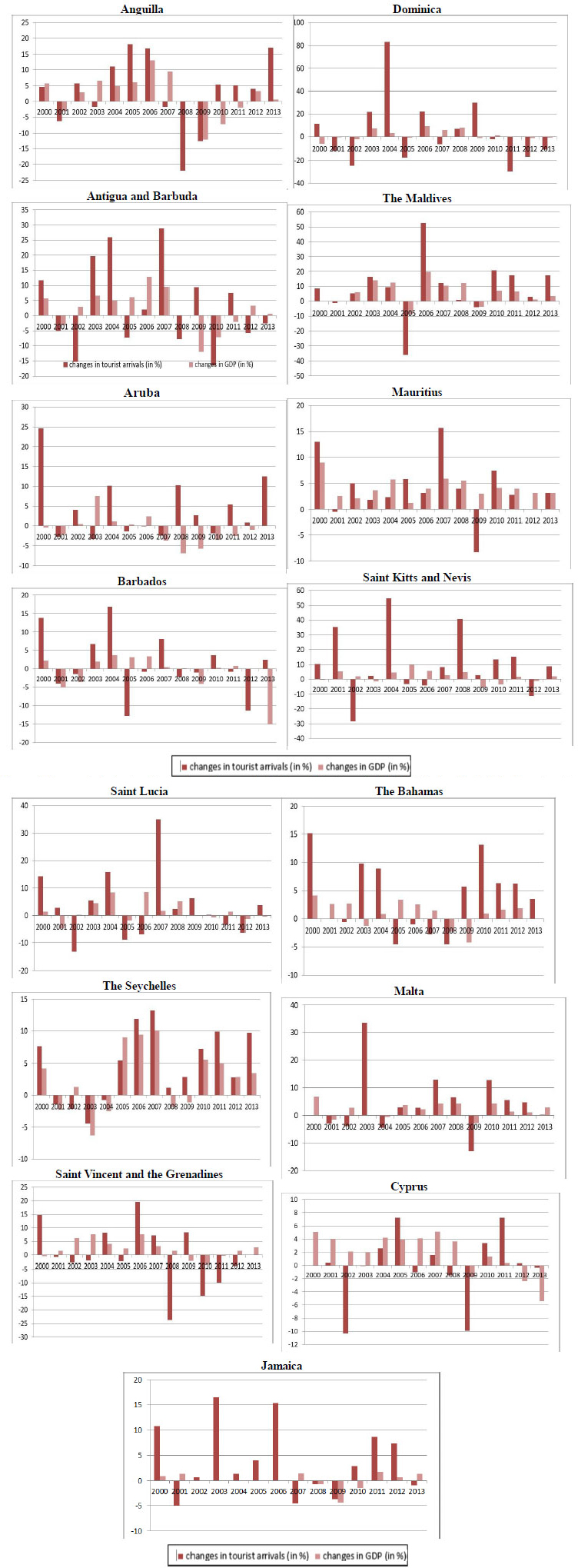
Figure 4
Changes in foreign tourist arrivals and changes in GDP growth for the period 2000-2013. Anguilla Statistics Department / ECCB, http://www.gov.ai/statistics/NA_Publi_12.htm. Source: authors composition based on the UNWTO database, World Bank data and www.indexmundi.com.
Table 5
Division of island territories according to crises connected with the number of tourist arrivals and divided according to the relationship of tourism expenditures as a proportion of GDP*
| Type | I – tourism expenditure is a significant proportion of GDP (from 10% to 20% of GDP) | II – tourism expenditure is a big proportion of GDP (from 20.1% to 40%) | III – tourism expenditure is a very big proportion of GDP (over 40%) |
|---|---|---|---|
| No correlation (3) | Saint Kitts and Nevis (0.125) | The Bahamas (−0.119) | Aruba (−0.095) |
| Weak correlation (4) | Cyprus (0.336), Saint Vincent and the Grenadines (0.301) | Saint Lucia (0.284), Dominica (0.378) | |
| Average or strong positive correlation (8) | Jamaica (0.440), Malta (0.420), Mauritius (0.438) | Barbados (0.403), Antigua and Barbuda (0.433), the Seychelles (0.868) | Anguilla (0.480), the Maldives (0.670) |
| Total (15) | 6 | 6 | 3 |
* No correlation: below 0.2; weak correlation: greater than 0.2 but less than 0.4; average correlation: greater than 0.4 but less than 0.7; strong correlation: greater than 0.7 but less than 0.9; very strong correlation: greater than 0.9 (Ostasiewicz, Rusnak & Siedlecka 1999). Source: author’s composition.
Table 6
Division of island territories according to the size of the crisis in tourist and one-day visitor arrivals
| Type | Number of countries | Size of the crisis in tourist and one-day visitor arrivals | No correlation | Weak correlation | Average or strong positive correlation |
|---|---|---|---|---|---|
| A | 4 | The Seychelles (0.868), the Bahamas (−0.119), Saint Kitts and Nevis (0.125) the Maldives (0.670) | 2 | 0 | 2 |
| B | 4 | Jamaica (0.440), Malta (0.420) Saint Lucia (0.284), Aruba (−0,095) | 1 | 1 | 2 |
| C | 3 | Mauritius (0.438), Cyprus (0.336) Barbados (0.403) | 0 | 1 | 2 |
| D | 4 | Saint Vincent and the Grenadines (0.301), Anguilla (0.480)Antigua and Barbuda (0.433), Dominica (0.378) | 0 | 2 | 2 |