

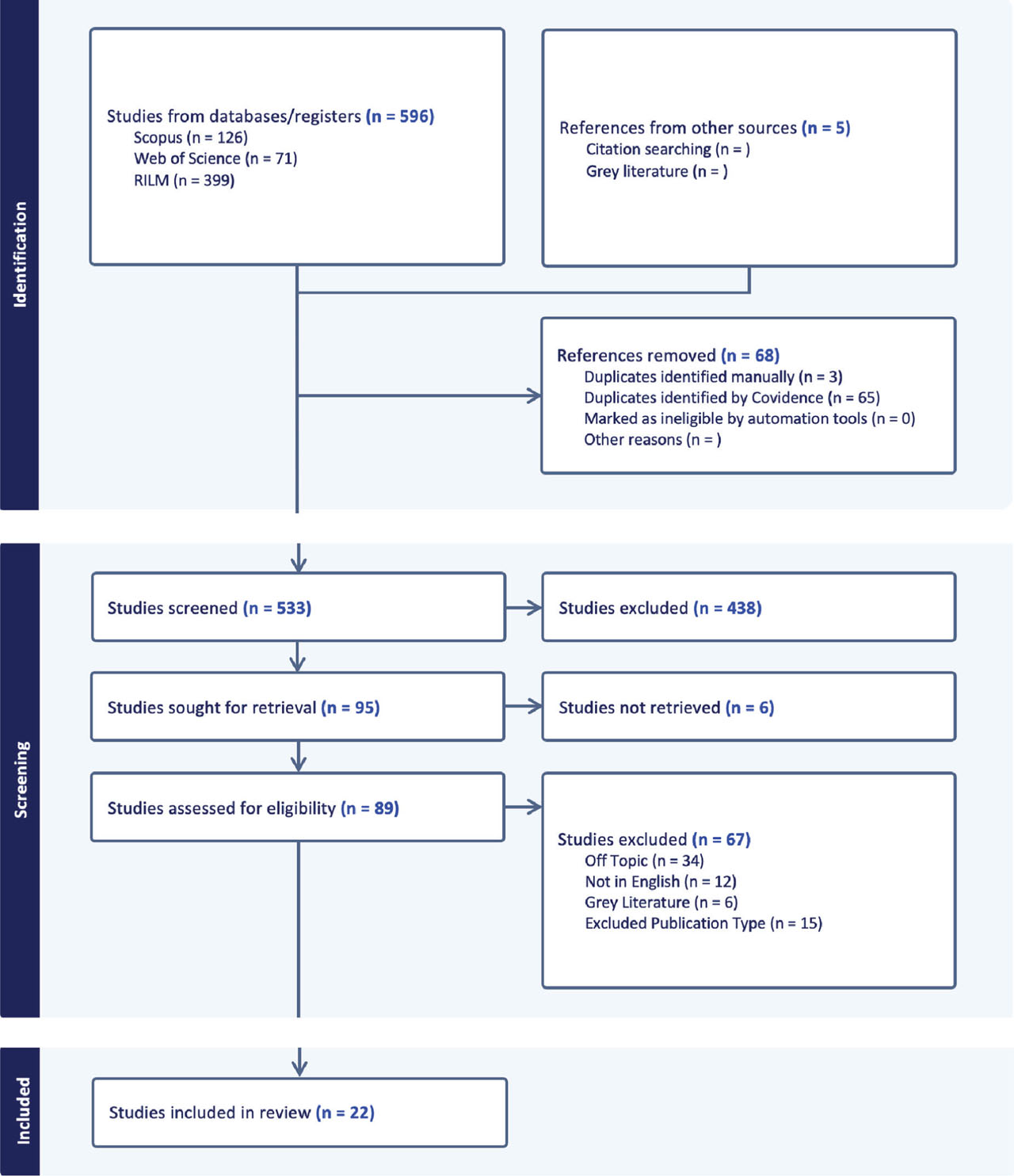
Figure 1.
PRISMA-ScR Diagram.

Figure 2.
Distribution of papers in established themes.
Table 1.
Music discovery impact areas.
| Impact Area | Description |
|---|---|
| Content production | How music videos are made, including but not limited to the technology and devices used to create them, including AI. Also known as content creation (Choi 2017; Galuszka 2024; Harper 2020; Holt 2011; Negus 2019; O’Hara 2022; Viñuela 2020; Vizcaíno-Verdú et al. 2021). |
| Fan engagement | How fans interact with artists or their social media accounts. Also known as user engagement or fan community (Galloway 2020; Liikkanen and Salovaara 2015; Negus 2019; Park et al. 2018; Viñuela 2020). |
| Homogenization of music | A lack of diversity in “danceability, speechiness, valence, liveness, acousticness, energy, instrumentation, loudness, tempo, duration” in music (Bourreau et al. 2022, 428). |
| Songwriting | The art of writing a song (Carter 2024). |
Table 2.
Monetization impact areas.
| Impact Area | Description |
|---|---|
| Royalties | How music makes money through mandated payments from DSPs in exchange for the privilege of allowing access to their users and the resulting value gap established after the digitization of music (Carter 2024; Darias de las Heras 2018; Heuguet 2019; Holt 2011; McIntosh 2016; Negus 2019; Park et al. 2018; Rahimi and Park 2020; Renard et al. 2013). |
| Copyright infringement | The unauthorized use of copyrighted material as well as YouTube’s internal system (Content ID) for cataloging copyrighted material uploaded by users and allowing copyright owners to either monetize, track, or block it (Darias de las Heras 2018; Galuszka 2024; Heuguet 2019; Liikkanen and Salovaara 2015). |
Table 3.
Data impact areas.
| Impact Area | Description |
|---|---|
| Music as data | With the integration of big tech into the music industry, the music itself has become reduced to data by way of video views, streams, etc. (Airoldi et al. 2016; Carter 2024; Negus 2019; Oh and Choeh 2022). |
| Consumer data | Unlike in a medium such as radio or TV, artists can collect specific data about their fans using platforms such as YouTube (Oh and Lee 2013). |