
Introduction
In today’s volatile, complex, and highly uncertain business environment, access to up-to-date, high-quality information is a critical organizational asset (Costa et al., 2023). In response to rapid changes, information systems (IS) and information technology (IT) have become essential for organizational growth, survival, and the pursuit of competitive advantage (Peppard & Ward, 2004; Yang et al., 2020). Competitive advantage arises when organizations deliver the same benefits as competitors at lower cost or provide superior benefits through differentiation or innovation (Rose et al., 2010; Wen-Cheng et al., 2011). Strategic investments in IT are now recognized as fundamental for long-term organizational sustainability (Arvidssona et al., 2014).
Historically, the relationship between information systems and corporate strategy received limited attention from top management. IS were largely seen as back-office tools for routine data processing, rather than as instruments of strategic value. However, since the 1980s and 1990s, there has been growing awareness of the need to integrate information systems into organizational strategy to enhance competitive positioning (Pant & Hsu, 1995). Strategic information systems (SIS) play a central role by providing mechanisms for efficient data collection, processing, and analysis (Hera et al., 2024). They support decision-making, innovation, and the development of business models that allow organizations to outperform competitors (Hemmatfar et al., 2010; Mwithiga et al., 2017). Consequently, organizations that successfully leverage SIS can improve cost allocation, operational efficiency, and overall reputation (Alharafsheh & Ezmigna, 2023).
In the maritime transport sector, ports are increasingly adopting SIS and digital technologies to become smart, agile, and sustainable hubs. By integrating internal and external information, facilitating collaboration with stakeholders, and monitoring sustainability indicators, SIS enhance operational efficiency, innovation, and competitive positioning (Durán et al., 2021; Jiang et al., 2021; Yau et al., 2020; Zeng et al., 2020). Smart port initiatives, such as automated vessel and container management, and decision support systems, empower port managers to make data-driven decisions, ooptimize resources, and sustain long-term competitiveness (Djalic et al., 2021; Navarro et al., 2023; Owusu et al., 2024).
Despite the growing importance of SIS, several challenges remain, including barriers to system integration, lack of standardized protocols, organizational resistance, and the risk of imitation by competitors (Durán et al., 2021; Zeng et al., 2020). Moreover, although research has explored SIS in business organizations broadly, empirical studies focusing on their contribution to competitive advantage within Algerian ports remain scarce. This represents a clear research gap, particularly given the strategic role of Algerian ports in regional trade and economic development.
Therefore, this study aims to investigate the role of strategic information systems in enhancing the competitive advantage of the Port of Ténès, one of Algeria’s key maritime institutions. It addresses the following research question: To what extent do strategic information systems contribute to achieving competitive advantage in the Port of Ténès?
Literature review
One of the main key factors that enhance the performance of organizations in a highly competitive environment is knowledge management, as all organizations to achieve competitive advantages must focus on their information system. (Lemma Chuma, 2020), one of the central concerns of the Information Systems (IS) strategy is to understand how organizations create value using information technology (Bhatt, 2003). Information systems are a relatively new discipline, as information systems were introduced in the 1950s when computers began to be used to process data (Avison & Pries-Heje, 2005).
A large number of previous studies have shown that there are important and positive relationships between information systems and competitive advantage (Altamony et al., 2012; Arici et al., 2022; Berisha-Shaqiri, 2015; Clemons, 1986; Galliers et al., 1995; Issa-Salwe & Aloufi, 2011; Madonsela, 2020; Mahfoud, 2024; Setiawan, 2013; Susanto & Bong, 2019; Zhang & Lado, 2001), the primary goal of business organizations in particular is to achieve and enhance a competitive advantage over their competitors in the market (Ismail et al., 2012).
Information systems and strategic information systems
“Information” is a buzzword for corporate senior management and stakeholders because they believe it is where the return on investment (ROI) lies or is guaranteed. From another perspective, the global market environment is constantly changing and challenges corporate managers regarding the formulation of a new business strategy (Madonsela, 2020). Information is defined as data that has been processed for the purpose of achieving a specific goal and is considered an essential resource in decision-making processes and enhancing the performance of business organizations in various aspects (Lemma Chuma, 2020).
Information systems (IS) are strategic insofar as they are used to achieve strategic intentions (Arvidssona et al., 2014), Information Systems (IS) has focused on “integrating IT solutions and business processes to meet the information needs of other companies and organizations (Zeng et al., 2020). An information system is defined as: “An integrated human/machine system for providing information to support operational, management, and decision-making functions in an organization. The system uses computers, software, system manual procedures, management and decision-making models, and a database” (Costa et al., 2023).
Further, strategy is an important factor in the success of the implementation of an effective information system. Its implementation within the organization requires strategic development and the ability to overcome change (Costa et al., 2023). The Strategic Information System (SMIS) is a support system for the organization’s activities as well as enabling operations to reach the best by providing senior management with sufficient strategic information that is reliable and makes the organization work smoothly and is used for analysis purposes in order to set new directions (Yoshikuni & Albertin, 2018).
According to Whittington (2014), strategic information systems are used to enhance strategy as a practice to support thoughtful management planning for strategic positioning and performance. Strategic information systems through IS planning also establish an integrated, communicative and key organizational mechanism for strategic decision-making (Yoshikuni & Albertin, 2018). They play a pivotal role in strategic management by providing decision-makers with tools to analyze internal and external environments, enhance creativity and innovation, and optimize resource allocation (Alharafsheh & Ezmigna, 2023; Mwithiga et al., 2017). In port institutions, SIS integrate internal and external data, facilitate collaboration among stakeholders, and support sustainable practices (Durán et al., 2021; Jiang et al., 2021; Yau et al., 2020; Zeng et al., 2020).
Competitive advantage
The pursuit of competitive advantage is indeed an idea that is at the heart of strategic management literature (Barney, 2001a, 2001b, 2007; Burden & Proctor, 2000; Cousins, 2005; Fahy, 2000; Liao & Hu, 2007; Lin, 2003; Fahy et al., 2004; Ismail et al., 2012; Ma, 2000, 2004; Porter & Kramer, 2006). Competitive advantage is defined as the extent to which an organization is competent to create a defensible position over its competitors as a result of critical management decisions based on established strategies that differentiate itself from its competitors (Marinagi et al., 2014), also competitive advantage refers to a company’s ability to outperform competitors in similar industries (Almajali et al., 2025). According to Barney (1986), a company has a competitive advantage when creating more economic value than its competitors and Turban et al. (2005) believe that any organization seeks a competitive advantage in its industries, in other words an advantage over competitors in some metrics such as cost, quality, or speed (Hemmatfar et al., 2010). According to Porter, competitive advantage is the core of a company’s success or failure (Ma & Turban, 2003) and in the field of information systems, competitive advantage refers to the use of information to gain influence in the market (Susanto & Bong, 2019).
Michael Porter proposed three general strategies in 1985: cost leadership strategy, differentiation strategy, and focus strategies (Siti, 2024). In the maritime transport sector, competitive advantage depends on delivering services more efficiently, reliably, and innovatively than competitors. Key dimensions include cost efficiency, service quality, timely delivery, flexibility, and innovation (Al-Awawdeh, 2019; Alharafsheh & Ezmigna, 2023; Arioua et al., 2022; Hemmatfar et al., 2010). Digital technologies and information systems strengthen these dimensions by enabling proactive risk management (Jegan Joseph Jerome et al., 2023), enhancing organizational flexibility in turbulent markets (Pratono, 2023), and supporting real-time decision-making and sustainability in ports (Gonçalves et al., 2025).
Relationship between strategic information systems and competitive advantage in ports
Strategic information systems (SIS) are recognized as essential tools for aligning information technology with organizational strategy, thereby enhancing competitive advantage through improved decision-making, operational efficiency, and innovation (Hemmatfa et al., 2010; Mwithig et al., 2017). In the maritime transport sector, port institutions operate in highly dynamic and competitive environments, making SIS crucial for maintaining strategic positioning and responsiveness (Bohari, 2013; Nicolae et al., 2018). These systems enable the integration of internal and external information, allowing for accurate decision-making, enhanced coordination, and optimized operational performance (Heilig et al., 2019; Jiang, et al., 2021; Zeng et al., 2020).
By facilitating collaboration among multiple stakeholders, SIS reduce inefficiencies, minimize vessel turnaround times, and improve end-to-end supply chain management, contributing directly to cost reduction and service reliability (Bocayuva, 2021; Durán et al., 2021; Yau et al., 2020). Furthermore, SIS foster innovation and service differentiation through the implementation of smart port technologies, such as predictive maintenance, automated terminal management, and real-time cargo tracking, enhancing customer satisfaction and strengthening competitive positioning (Bae, 2021; Basulo-Ribeiro et al., 2024; Oyewole & Olufemi, 2020). These systems also support sustainability objectives by monitoring environmental performance, optimizing resource usage, and reducing ecological impacts, which are increasingly considered important dimensions of competitive advantage in modern port management (Durán et al., 2021; Heilig et al., 2019; Stroumpoulis et al., 2021).
Additionally, business intelligence and real-time operational data provided by SIS empower port managers to make timely, data-driven strategic decisions, aanticipate operational disruptions, and maintain service quality (Gonçalves et al., 2025; González-Cancelas et al., 2020; Jafari et al., 2023). Empirical evidence indicates that ports leveraging SIS achieve measurable benefits, including cost efficiency, enhanced service reliability, and improved overall performance (Jouad & Hamri, 2020; Nicolae et al., 2018; Oyewole & Olufemi, 2020). However, the realization of these advantages requires overcoming technological integration challenges, organizational resistance, and the risk of imitation by competitors, emphasizing the need for strategic investment, policy supportt, and cultural adaptation (Durán et al., 2021; Zeng et al., 2020).
Despite the growing body of research on SIS and competitive advantage, empirical studies specifically addressing Algerian ports remain scarce, particularly regarding the impact of SIS on multiple dimensions of competitive advantage such as cost, quality, flexibility, on-time delivery, and innovation. As noted, this highlights clear research gap and underscores the importance of focused case studies, such as the current investigation of the Port of Ténès, to provide both academic and practical insights into how SIS can enhance competitiveness in the Algerian maritime sector. Based on the arguments above, the study presents the following hypotheses and sub-hypotheses:
H1: There is a positive and significant effect of the dimensions of strategic information systems on the competitive advantage of the Tenes Port Foundation.
H1(a): There is a positive and significant impact of the dimensions of strategic information systems on the cost advantage as one of the dimensions of competitive advantage in the Tenes Port Foundation.
H1(b): There is a positive and significant impact of the dimensions of strategic information systems on the quality advantage as one of the dimensions of competitive advantage in the Tenes Port Foundation.
H1(c): There is a positive and significant impact of the dimensions of strategic information systems on the on-time delivery of products and services as one of the dimensions of competitive advantage in the Tenes Port Corporation.
H1(d): There is a positive and significant impact of the dimensions of strategic information systems on flexibility as one of the dimensions of competitive advantage in the Tenes Port Foundation.
H1(e): There is a positive and significant impact of the dimensions of strategic information systems on creativity and development as one of the dimensions of competitive advantage in the Tenes Port Foundation.
Based on these hypotheses, the following framework was developed (Figure 1):
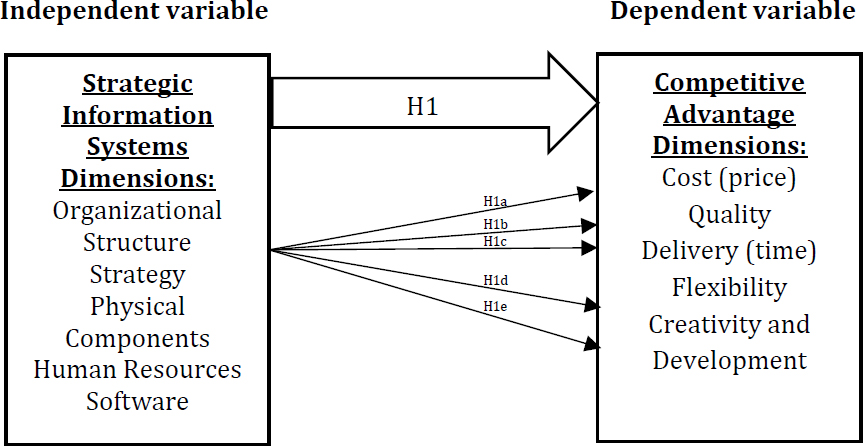
Figure 1.
Conceptual model
Source: own processing
Research methodology
This study was carried out at the level of the Port of Tenes, which was established by the Presidential Decree for the Management and Administration of Port Affairs No. 85-187 of July 1985 after being restructured from a socialist institution (so that the Port of Mostaganem Corporation was in charge of managing the Port of Tenes in the state of Chlef), became in July 2014 an institution with a capital of 500,000,000,000 DZD, and in February 2016 04 public complexes of the transport sector were inaugurated within the framework of the reorganization and restructuring of the public maritime sector decided by the authorities. General Assembly of 2014, and the Port of Tenes Corporation became under the control of the Porte Services Complex (Groupe Services Portuaires SERPORT SPA).
The study adopted quantitative research design using a questionnaire as the primary data collection instrument, which is suitable for analysing relationships between variables and identifying trends. The questionnaire was developed based on an in-depth review of the literature and the theoretical framework of the study, with reference to prior research on strategic information systems (SIS) and competitive advantage (Al-Awawdeh, 2019; Arioua et al., 2022; Hemmatfar et al., 2010; Mwithiga et al., 2017; Osman el al., 2023). To ensure ccontent validity, a panel of experts was consulted to provide feedback on the clarity, relevance, and structure of the items, resulting in minor modifications, rephrasing of certain items, and adjustments to the dimensions of the constructs. A preliminary pilot test was conducted to check the clarity and reliability of the questionnaire, and further refinements were made based on the pilot results.
The questionnaire was organized in two parts, the first part was dedicated to collecting personal information about the characteristics of the participants, and included five items aimed at determining gender, age group, educational level, duration of experience, and job position. The second part of the questionnaire dealt with the main themes of the study, the axis of strategic information systems and the axis of competitive advantage (see Table 1 and Table 2).
Table 1.
Dimensions of the strategic information systems axis
| Focus of the study: strategic information systems | Items |
|---|---|
| Organizational structure | From items 1 to 5 |
| Strategy | From items 6 to 10 |
| Material resources | From items11 to 15 |
| Human resources | From items 16 to 20 |
| Software | From items 21 to 25 |
Table 2.
Dimensions of the competitive advantage Axis
| Focus of the study: competitive advantage | Items |
|---|---|
| Cost | From items 26 to 30 |
| Quality | From items 31 to 35 |
| Deliverable | From items 36 to 40 |
| Flexibility | From items 41 to 45 |
| Innovation & Development | From items 46 to 50 |
In order to accommodate the variation in the participants’ opinions about the questionnaire statements, a five-point Likert scale was adopted, and to determine the range represented by each dimension of the five-point Likert scale (Pearson et al., 2024) used in analyzing the study axes represents, as shown in Table 3.
Table 3.
Minimum and Upper Limits of the Pentagonal Likert Scale
| Degree of approval | Strongly agree | Agree | Neutral | Disagree | Strongly disagree |
|---|---|---|---|---|---|
| Arithmetic average | (1.00-1.80) | (1.81-2.60) | (2.61-3.40) | (3.41-4.20) | (4.21-5.00) |
The study population consisted of 382 employees working at the Port of Ténès, including administrative staff, maintenance workers, and fishermen. However, since the research focuses on strategic information systems, the questionnaire was directed exclusively to the administrative staff, who represent the group most directly engaged in the use and management of information systems. This sub-population comprised 150 individuals, and questionnaires were distributed to all of them. Data collection was conducted during the month of Ramadan, within a relatively short internship period, which imposed practical constraints. In addition, some administrative staff were on leave, which limited the retrieval rate. Out of the 150 questionnaires distributed, 128 were returned, and after excluding 31 incomplete responses lacking essential information, the final sample consisted of 97 valid questionnaires. Recent methodological studies confirm that a sample size close to 100 remains acceptable in quantitative research when it ensures representativeness and reliability (Anokye, 2020; Rahman, 2023).
In exploratory studies or when practical constraints exist (such as time or resources), samples of 50-100 may be acceptable, especially if the population is homogeneous and adequate representation is achieved (Adhikari, 2021; Ahmed, 2024; Andrade, 2020; Lakens, 2022; Polas, 2024). More important than the number is achieving the conditions of validity and reliability, and the ability to generalize the results to the original population (Lakens, 2022; Nanjundeswaraswamy & Divakar, 2021; Polas, 2024; Sharma & Bhattarai, 2024).
Survey reliability analysis
Cronbach’s alpha coefficient was used to measure the reliability of the internal consistency of the Questionnaire Cronbach’s alpha reliability is one of the most widely used reliability measures in the social and organizational sciences, Table 4 shows the reliability of (Bonett & Wright, 2014) questionnaire.
Table 4.
Cronbach’s Alpha Overall Test
| Axles | Number of phrases | Alpha Cronbach |
|---|---|---|
| Strategic Information Systems | 25 | 0.831 |
| Competitive advantage | 25 | 0.882 |
| Questionnaire | 50 | 0.909 |
From the results of Table No. (4), we see that the value of Cronbach’s alpha coefficient for the strategic information systems axis reached 0.831, while it reached 0.882 for the competitive advantage axis with all its dimensions. As for the value of Cronbach’s alpha coefficient for the questionnaire, it reached (0.909), which is a value that far exceeds the minimum required for statistical analysis (0.7) (Bland & Altman, 1997). Also, the alpha value reflects the excellent reliability of internal consistency and indicates that the questionnaire statements enjoy a high degree of consistency and are acceptable for the purposes of conducting the study.
Results and discussion
Study data analysis
We firstly analyze the demographic characteristics of the studied sample in Table 5, then the data related to the Strategic Information Systems variable (Table 6) and finally the responses of the sample members to the statements of the competitive advantage variable (Table 7).
Table 5.
Demographic characteristics of the study sample
| Personality variables | Duplicate | Percentage % | |
|---|---|---|---|
| Sex | Male | 62 | 63.9 |
| Female | 35 | 36.1 | |
| Age group | 25 to 35 | 15 | 15.5 |
| 36 to 50 | 74 | 76.3 | |
| More than 50 years | 8 | 8.2 | |
| Current position | Frame | 39 | 40.2 |
| Controller | 22 | 22 .7 | |
| Executive Assistant | 19 | 19.6 | |
| Other position | 17 | 17 .5 | |
| Educational qualification | Secondary education | 9 | 9. 3 |
| Baccalaureate | 4 | 4 .1 | |
| Senior Technician | 16 | 16.5 | |
| Bachelor | 54 | 55.7 | |
| Master | 11 | 11.3 | |
| Master | 1 | 1.0 | |
| Doctor | 2 | 2.1 | |
| Years of experience in the foundation | Less than 5 years old | 5 | 5.2 |
| 5 years to 15 years | 48 | 49.5 | |
| More than 15 years | 44 | 45.4 | |
Table 6.
Computational averages and standard deviations of the strategic information systems variable
| Dimension | Arithmetic mean | Standard deviation | Degree of approval |
|---|---|---|---|
| Organizational structure | 2.32 | 0.769 | High |
| Strategy | 2.21 | 0.707 | High |
| Infrastructure | 1.85 | 0.643 | High |
| Human resources | 2.56 | 0.922 | High |
| Software | 1.90 | 0.648 | High |
Table 7.
Computational averages and standard deviations of the competitive advantage variable
| Dimension | Arithmetic average | Standard deviation | Degree of approval |
|---|---|---|---|
| Cost | 1.99 | 0.638 | High |
| Quality | 2.13 | 0.688 | High |
| Deliverable | 1.97 | 0.645 | High |
| Flexibility | 2.29 | 0.783 | High |
| Creativity and Development | 2.02 | 0.589 | High |
The above table shows that the percentage of males reached 63.9% of the total sample studied and the percentage of females came to record 36.1%, it is noted here that most of the frames of the Mina Tanis Corporation are male, and the results indicate that the sample consists mainly of individuals between the ages of 36 and 50 years, where the number of employees reached 76.3%, followed by the category of workers between 25-35 years old, which amounted to 15 workers by a percentage of 15.5%, followed by the last group over 50 years old, represented by 8 individuals, with a small percentage of 8.2%. Through these statistics, we find that most of the respondents belong to the age group between 36 and 50 years old, and this is due to the nature of the port jobs that require administrative experience while accumulated skills come with age. Over time, employees get promotions and greater responsibilities within the organization. These positions are often filled by more experienced individuals, who fall within this age group.
By distributing the sample members according to educational qualification, we find that most of the respondents have a bachelor’s degree, where their percentage is estimated at (55.7%) of the study sample, while (16.5%) of those who hold a high technician, compared to (11.3%) of those who hold a master’s degree, compared to (9.3%) of those who hold a certificate of secondary education, while the holders of a baccalaureate degree represented an estimated percentage of (4.1%) of the study sample, followed by (2.1%)of Ph.D. holders, and finally, holders of a master’s degree recorded the lowest percentage (1.0%). Through this statistical reading, we find that the studied sample of the workers of the Port of Tenes Foundation, most of whom are university students with bachelor’s degrees, indicates that the nature of jobs in the Port of Tenes may require a university level of education in many fields. We note that the percentage of senior technicians (16.5%) is a significant category, which indicates that there is a need for specific technical and applied skills in the operation and management of some aspects of the work at the port. Table 5, the distribution of years of experience for Tenes port workers shows that most of the sample has medium-to-long-term experience in the organization. About 49.5% of the employees have 5 to 15 years of experience, while 45.4% of them have more than 15 years of experience. In contrast, the percentage of new workers with less than 5 years of experience constitutes only 5.2% of the total sample, and therefore we conclude that the high proportions of experienced workers ranging from 5 to 15 years and more than 15 years indicate that there is relative job stability in the port of Tenes.
The current distribution of job positions in the Port of Tenes shows in the table above that the ‘Frame’ category constitutes the largest percentage of the workers representing the study sample, representing about 40.2% of the total sample. It is followed by the category of ‘Controller Assistant’ with 22.7%. The ‘Executive Assistant’ category represents 19.6% of the workforce, while the ‘Other Position’ category accounts for 17.5%. Through these results, we conclude that the current distribution of job positions in the port of Tennis has contributed to the existence of a relatively balanced job structure, with the predominance of the tire category due to its high reliance on senior and middle managerial and executive competencies. The data on the strategic information systems variable is presented in Table 6.
The results of the study show that there is a high agreement among the sample members on the dimensions of strategic information systems, but to varying degrees, for the dimension of organizational structure, the arithmetic average of this dimension reached 2.32 with a standard deviation of 0.769, where the sample members agreed that the organizational structure supports the flow of information, and that the tasks and responsibilities are clear. This reflects a high degree of approval for the participation of all employees in the design and development of information systems. After the strategy, the arithmetic mean reached 2.21 with a standard deviation of 0.707, which confirms that the organization’s information systems strategies are in line with its general objectives, and that there is a clear plan to monitor and evaluate these strategies. As for the organizational structure, this dimension came with an arithmetic average of 1.85 and a standard deviation of 0.643, the sample members acknowledged that the institution has a physical infrastructure that keeps pace with developments, provides sufficient resources, and facilitates communication between work teams. After human resources, the arithmetic average reached 2.56 with a standard deviation of 0.922, which is a high agreement, as the sample members indicated that the organization provides continuous training, and that strategic information systems have a predictive ability. However, the agreement was moderate that the organization has a team specialized in the management and development of information systems, as well as that human resources are evaluated in accordance with strategic objectives. After the software, the arithmetic mean was 1.90 and a standard deviation of 0.648, where the sample members agree that the software used is compatible with the organization’s goals, provides analytical reports that help in decisionmaking, and contributes to improving work efficiency and customer experience.
In Table 7, we can see that the responses of the sample members came in agreement with a high degree of agreement on the impact of strategic information systems on all dimensions of competitive advantage.
The arithmetic mean of cost was 1.99 with a standard deviation of 0.638, which indicates that strategic information systems contribute to improving the ability to compare costs with competitors, predict future costs and also reduce operational costs. As for the quality dimension, the arithmetic average reached 2.13 with a standard deviation of 0.688, with the sample emphasizing the role of strategic information systems in improving control and inspection processes, ensuring compliance with standards, and improving interaction with customers. For delivery, the arithmetic mean was 1.97 with a standard deviation of 0.645, demonstrating strong agreement on the contribution of strategic information systems to meeting customer needs on time, improving logistical efficiency, and speeding up decision-making. For flexibility, the arithmetic mean was 2.29 with a standard deviation of 0.783, reflecting the consensus of the sample that strategic information systems enhance the organization’s ability to respond to market and crisis variables. The arithmetic average of innovation and development reached 2.02 with a standard deviation of 0.589, which confirms the contribution of strategic information systems in accelerating research and development processes, providing innovative services, and enhancing cooperation between work teams.
Testing hypotheses and discussing results
In order to validate the hypotheses, either by accepting or rejecting them, we rely on the coefficient of determination, multiple regression, Pearson’s correlation coefficient and ANOVA test (Table 8).
Table 8.
Pearson correlation coefficient between strategic information systems and competitive advantage
| Variable | Test | Strategic Information Systems | Competitive advantage |
|---|---|---|---|
| Strategic Information Systems | Pearson correlation | 1 | 0.332** |
| Sig. | 0.001 | ||
| Pearson correlation | 0.332** | 1 | |
| Competitive advantage | Sig. | 0.001 | |
| Number | N | 97 | 97 |
Table 8 shows the results of the Pearson correlation coefficient test between strategic information systems and competitive advantage. The value of the correlation coefficient between the two variables was 0.332, which is a positive value, which indicates that there is a moderate strong direct relationship between strategic information systems and competitive advantage, and the value of statistical significance (Sig.) was 0.001, which is lower than the approved significance level (0.05), which indicates that the relationship between the two variables is statistically significant. Tables 9, 10 and 11 illustrate the complementary statistical tests.
Table 9.
Determination coefficient
| Hypotheses | Correlation coefficient R | R2 | R2 adjusted | Standard error of estimation |
|---|---|---|---|---|
| H1 | 0.332a | 0.110 | 0.101 | 0.34115 |
| H1(a) | 0.272a | 0.074 | 0.064 | 0.47379 |
| H1(b) | 0.151a | 0.023 | 0.013 | 0.45346 |
| H1(c) | 0.068a | 0.005 | -0.006 | 0.48273 |
| H1(d) | 0.189a | 0.036 | 0.025 | 0.63983 |
| H1(e) | 0.506a | 0.256 | 0.248 | 0.41088 |
Table 10.
Analysis of variance Anova
| Hypotheses | Total squares | The degree of freedom | Average squares | F value | P value |
|---|---|---|---|---|---|
| H1 | 1.367 | 1 | 1.367 | 11.745 | 0.001b |
| H1(a) | 1.708 | 1 | 1.708 | 7.610 | 0.007b |
| H1(b) | 0.456 | 1 | 0.456 | 2.219 | 0.140b |
| H1(c) | 0.102 | 1 | 0.102 | 0.436 | 0.511b |
| H1(d) | 1.434 | 1 | 1.434 | 3.502 | 0.064b |
| H1(e) | 5.509 | 1 | 5.509 | 32.630 | 0.000b |
Table 11.
Regression coefficient
| Prototype | Type | (Non-Standard transactions B) | (Standard error) | (Beta Standard coefficients | t | Sig |
|---|---|---|---|---|---|---|
| (Fixed) | 1.458 | 0.186 | 7.861 | 0.000 | ||
| 1 (H1) | (SIS) | 0.278 | 0.081 | 0.332 | 3.427 | 0.001 |
| (Fixed) | 1.294 | 0.258 | 5.021 | 0.000 | ||
| 1 H1(a) | (SIS) | 0.311 | 0.113 | 0.272 | 2.759 | 0.007 |
| (Fixed) | 1.771 | 0.247 | 7.183 | 0.000 | ||
| 1 H1(b) | (SIS) | 0.161 | 0.108 | 0.151 | 1.489 | 0.140 |
| (Fixed) | 1.859 | 0.262 | 7.081 | 0.000 | ||
| 1 H1(c) | (SIS) | 0.076 | 0.115 | 0.068 | 0.660 | 0.511 |
| (Fixed) | 1.859 | 0.262 | 7.081 | 0.000 | ||
| 1 H1(d) | (SIS) | 0.076 | 0.115 | 0.068 | 0.660 | 0.511 |
| (Fixed) | 0.715 | 0.223 | 3.201 | 0.002 | ||
| 1 H1(e) | (SIS) | 0.559 | 0.098 | 0.506 | 5.712 | 0.000 |
Based on the results illustrated above, several major insights can be provided for each hypothesis as follows.
H1: There is a positive and significant effect of the dimensions of strategic information systems on the competitive advantage of the Tennis Port Foundation.
In Table 9, the results showed that there is a weak direct correlation between strategic information systems and competitive advantage, where the correlation coefficient (R) = 0.332, which is a value that indicates a positive but not strong relationship. The coefficient of determination (R2) = 0.11 indicates that strategic information systems explain only 11% of the change in the level of competitive advantage. In Table 10, Analysis of variance (ANOVA), the results confirmed that the statistical model used was significant, as the value of F = 11.745 with a statistical significance (Sig = 0.001), which is much lower than 0.05. This supports the rejection of the null hypothesis and the acceptance of the alternative hypothesis. In Table 11, the results of regression showed that strategic information systems have a significant effect on competitive advantage, as the non-standard coefficient of B = 0.278 with the significance value of Sig = 0.001, indicating that each increase in information systems leads to a direct increase in competitive advantage by 0.278 units. The main hypothesis, which proposed a positive and significant relationship between strategic information systems (SIS) and competitive advantage, was confirmed. This result aligns with previous research (Al-Awawdeh, 2019; Altamony et al., 2012; Arioua et al., 2022; Djalic et al., 2021; Hemmatfar et al., 2010; Mahfoud, 2024; Osman Mohamed & Khalfalla, 2023), which emphasized the strategic role of SIS in enhancing organizational compositiveness. The findings suggest that investing in SIS contributes to strengthening the Port of Ténès’ overall market position and long-term sustainability.
H1(a): There is a positive and significant impact of the dimensions of strategic information systems on the cost advantage as one of the dimensions of competitive advantage in the Tenes Port Foundation.
The results of the coefficient of determination analysis showed that the value of R was 0.272, indicating a weak direct relationship between the two variables, while the coefficient of determination was R2 = 0.074, which means that strategic information systems explain only 7.4% of the changes in cost advantage. Through Table 10, the analysis of variance (ANOVA) confirmed the significance of the model, where the value of F = 7.610, and the value of P = 0.007, which is less than the level of significance (0.05), which indicates that the effect is not random but real and influential. Regression analysis through Table 11 also showed that the coefficient of B = 0.311 and Beta = 0.272, with a t-value = 2.759 and a statistical significance of Sig. = 0.007. These results indicate that there is a statistically significant positive effect between the two variables.
The first sub-hypothesis, which examined the impact of strategic information systems (SIS) on cost advantage, was supported. This outcome is in line with earlier studies (Al-Awawdeh, 2019; Almajali et al., 2025; Alharafsheh & Ezmigna, 2023; Bhatt, 2003; Hemmatfar et al., 2010; Lemma Chuma, 2020; Marinagi et al., 2014; Mwithiga et al., 2017), which showed that SIS enable organizations to reduce operating costs through automat ion, improved information flows, and enhanced resource allocation. In the context of the Port of Ténès, SIS contributed to lowering operational inefficiencies, thus reinforcing cost advantage as a key dimension of competitiveness.
H1(b): There is a positive and significant impact of the dimensions of strategic information systems on the quality advantage as one of the dimensions of competitive advantage in the Tenes Port Foundation.
The results showed a weak correlation between the two variables in Table 9, with a correlation coefficient of (R) = 0.151, which reflects a very weak correlation. The coefficient of determination (R2) = 0.023 indicates that strategic information systems explain only 2.3% of the variation in the quality of services or operations, which is a small percentage that does not reflect a real statistically significant impact. This weakness was confirmed by the results of analysis of variance (ANOVA) shown in Table 10, where the value of F = 2.219 and the value of the accompanying statistical significance (Sig.) = 0.140, which is higher than the approved level of significance (0.05). This means that there are no statistically significant differences in the effect. Linear regression analysis (Table 11) also showed that the non-standard coefficient (B) = 0.161 was not statistically significant, with a significant value (Sig.) = 0.140.
The second sub-hypothesis, which proposed a positive relationship between strategic information systems (SIS) and quality advantage, was not supported. This finding contrasts with prior studies (Al-Awawdeh, 2019; Alharafsheh & Ezmigna, 2023; Almajali et al., 2025; Altamony et al., 2012; Arioua et al., 2022), which emphasized the role of SIS in improving service quality and customer satisfaction. A possible explanation in the case of the Port of Ténès may relate to the limited integration of SIS in quality management practices, suggesting that while SIS support efficiency and cost reduction, their direct impact on quality remains underdeveloped in this context.
H1(c): There is a positive and significant impact of the dimensions of strategic information systems on the on-time delivery of products and services as one of the dimensions of competitive advantage in the Tenes Port Corporation.
The results of the analysis of the coefficient of determination (Table No. 9) showed a severe weakness in the relationship between the two variables, as the correlation coefficient (R) = 0.068, which indicates an almost non-existent direct relationship, and the coefficient of determination (R2) = 0.005, and the ANOVA test confirmed this result through Table No. 10, where the value of F = 0.436, and the value of P = 0.511, which is higher than the level of significance 0.05, which means that the model is not statistically significant, and the alternative hypothesis cannot be accepted. The results of regression analysis (Table 11) showed a non-standard impact factor (B) = 0.076 and a standard coefficient (Beta) = 0.068, which are very weak values, in addition to the significance value of Sig = 0.511 was not statistically significant
The third sub-hypothesis, which assumed a positive relationship between strategic information systems (SIS) and timely delivery, was rejected. This outcome diverges from findings in previous research (Al-Awawdeh, 2019; Arioua et al., 2022; Mahfoud, 2024), which highlighted the role of SIS in streamlining logistics and enhancing delivery performance. In the case of the Port of Ténès, this result may be attributed to contextual constraints such as infrastructure limitations and external dependencies that restrict the ability of SIS to significantly influence delivery schedules.
H1(d): There is a positive and significant impact of the dimensions of strategic information systems on flexibility as one of the dimensions of competitive advantage in the Tenes Port Foundation
The results of the coefficient of determination analysis (Table 9) showed that the relationship between strategic information systems and enterprise resilience is weak, as the correlation coefficient R = 0.189, indicating a very weak direct relationship. The coefficient of determination was R2 = 0.036, and the results of analysis of variance (ANOVA) through Table 10 showed that the value of F = 3.502, which is relatively average, but the value of probability Sig. = 0.064 exceeded the approved limit of significance (0.05), which indicates that the model is not statistically significant, as the regression analysis through Table 11 showed that the coefficient of B Non-standard = 0.076 and beta = 0.068, reflecting a slight effect that could not be considered practical, especially since the value of Sig. = 0.511 was insignificant.
The fourth sub-hypothesis, which suggested a positive association between strategic information systems (SIS) and organizational flexibility, was not supported by the data.
This outcome diverges from earlier findings (Al-Awawdeh, 2019; Altamon et al., 2012; Arioua et al., 2022; Mahfoud, 2024; Susanto & Bong, 2019), where SIS were shown to enhance adaptability and responsiveness. In the case of the Port of Ténès, the lack of support for this relationship may be attributed to contextual constraints, such as bureaucratic structures, centralized decision-making, and regulatory frameworks, which reduce the potential of SIS to effectively foster organizational flexibility.
H1(e): There is a positive and significant impact of the dimensions of strategic information systems on creativity and development as one of the dimensions of competitive advantage in the Tenes Port Foundation
In Table 9, the analysis of the coefficient of determination showed that there is a relatively moderate and strong correlation (R = 0.506) between strategic information systems and the dimension of innovation and development, and the value of the coefficient of determination R2 = 0.256, which indicates a moderate explanatory ability of the model. This also reinforces the adjusted coefficient of determination = 0.248 which reflects stability in the interpretation of the results. The results of the analysis of variance (ANOVA) in Table 10 showed that the value of F = 32.630, which is high, and the value of Sig = 0.000, which indicates that the statistical model is strongly indicated, i.e. the independent variable (strategic information systems) has a significant effect on the dependent variable (innovation and development). Regression analysis also confirms this relationship (Table 11), where the coefficients of B = 0.559 and Beta = 0.506, which reflect a direct effect of moderate strength. The value of t = 5.712 and Sig. = 0.000 reinforce the significance of this effect.
The results confirmed a significant positive relationship between strategic information systems and creativity and development This finding aligns with prior studies emphasizing that SIS can act as enablers of creativity, process improvement, and the introduction of new services (Al-Awawdeh, 2019; Alharafsheh & Ezmigna, 2023; Almajali et al., 2025, Arioua et al., 2022, Marinagi et al., 2014; Stroumpoulis et al., 2021). In the context of the Port of Ténès, this suggests that the effective use of SIS contributes to fostering innovative practices and sustaining long-term competitiveness.
By corroborating the findings above, Table 12 illustrates a summary of the hypothesis testing.
Table 12.
Hypothesis testing summary
| Hypotheses | Relationship test | Analysis of variance + regression coefficient and determination |
|---|---|---|
| H1 | Medium | Accept |
| H1(a) | Medium | Accept |
| H1(b) | Weak | Reject |
| H1(c) | Weak | Reject |
| H1(d) | Weak | Reject |
| H1(e) | Medium | Accept |
In light of the results of the field study of the Tenes Port Corporation, it is clear that strategic information systems constitute an active element in achieving some dimensions of competitive advantage, especially in the fields of quality, creativity and development, as these dimensions showed strong statistically significant relationships with the level of adoption of these systems. In contrast, the relationship was weak and non-significant in terms of on-time delivery and organizational flexibility, suggesting that there are other organizational and operational factors that limit the effectiveness of information systems in these aspects. The main hypothesis of the study has also been shown to be correct, reinforcing the idea that information systems are no longer just technical tools, but have become a strategic lever that must be integrated into the overall vision of the organization.
Conclusions and implications
The present study set out to explore how strategic information systems (SIS) contribute to strengthening the competitive positioning of the Port of Ténès. The analysis confirmed that SIS play a decisive role in shaping competitiveness, though their impact is not evenly distributed across all dimensions. More specifically, the findings revealed that SIS are effective in generating cost efficiencies and fostering creativity and development initiatives, thereby supporting long-term innovation and resource optimization. Conversely, their contribution to improving quality, ensuring timely delivery, and enhancing operational flexibility appeared limited in this context. This divergence indicates that while SIS can provide substantial advantages, their benefits are closely linked to the organizational processes they directly support and to the way these systems are embedded within managerial practices.
From a broader perspective, this study makes a dual contribution. On the one hand, it adds to the theoretical body of knowledge by providing empirical evidence from the maritime sector, a domain where the interplay between SIS and competitive advantage remains relatively underexplored. The findings suggest that the impact of SIS cannot be assumed to be universal but instead depends on sectoral and institutional realities. On the other hand, the study generates practical insights for port authorities and decision-makers. By demonstrating that SIS enhance cost control and innovation capacity, it underscores the necessity of aligning system functionalities with strategic objectives, investing in training, and ensuring the active involvement of administrative staff. These measures not only improve the efficiency of existing processes but also prepare organizations to adapt more effectively to the digital transformation of maritime logistics.
While the study provides relevant insights, certain limitations should be acknowledged. The research was confined to a single case study the Port of Ténès and relied on a sample limited to administrative staff, which may restrict the generalizability of the results. Additionally, the relatively modest sample size reflects contextual constraints, such as data collection during the month of Ramadan and the short internship period.
Future research could broaden the scope by examining multiple ports at national or international levels, thus allowing comparative analysis of SIS adoption and effectiveness. Expanding the sample to include other categories of employees, such as maintenance staff or operational teams, would also offer a more holistic view of system integration within port activities. Furthermore, employing mixed-method approaches that combine quantitative surveys with qualitative interviews or case-based observations could provide richer and more nuanced insights into how SIS shape various dimensions of competitive advantage.