
Introduction
Financial Technology (Fintech) has recently become a disruptive paradigm that has changed the global financial landscape over the last twenty years. Initially, it was created to enhance back-end processes in the financial industry. Today, it is a socio-economic driver that touches every layer of the financial services industry 1, 2. The rapid digital transformation of the financial industry has been accelerated by the COVID-19 pandemic 3. This role has also been recognised by international organisations such as the World Economic Forum and the Financial Stability Board, which acknowledge both the efficiency-enhancing potential of fintech and its disruptive implications. Moreover, the emergence of fintech is also a cause of apprehension in the contexts of financial reporting and earnings management, with similar concerns about the transparency and control of algorithm-driven systems of financial decision-making 4.
In the literature, the meaning of fintech is clarified as the use of novel technology to provide financial services more effectively, transparently, and inclusively. According to Schueffel 5, it is a portmanteau of the term financial technology, which encompasses developments in the field such as blockchain, artificial intelligence, and machine learning used in financial services and operations. The development of fintech can be divided into three stages: Fintech 1.0 (1866–1967), Fintech 2.0 (1967–2008), and Fintech 3.0 (2008 onwards), to demonstrate how it is increasingly evolving towards digitisation and the disruption of existing systems. The more recent typologies have been extended to cover sub-categories such as RegTech (regulatory technology), InsurTech (insurance technology), and DeFi (decentralised finance), and broaden the scope and application of fintech in modern financial discussions 6, 7. In addition to the technological underpinnings of fintech, there are regulatory, ethical, and governance issues that must be examined through academic analysis on an ongoing basis. The fintech scholarship has grown more in recent years (2022–2024) to include central bank digital currencies (CBDCs), green fintech, cybersecurity resilience, ethical artificial intelligence and digital regulatory frameworks. Further evidence attesting to the role of fintech in mitigating climate risks, advancing financial inclusion, and fostering responsible innovation in the financial ecosystem is the expanding literature on green fintech and sustainable digital finance 8, 9. These emerging streams indicate that fintech research is still rapidly changing, and a more recent and comprehensive mapping needs to be developed to reflect the latest intellectual advances.
Recent empirical evidence also reflects the accelerated diversification of fintech research in central bank digital currencies, sustainable fintech technologies, and artificial intelligence-powered financial decision-making 10, 11, 12. These pieces indicate that fintech is no longer a technological breakthrough but has become a socio-economic infrastructure that affects regulatory, environmental, and governance systems. The relevance of research on fintech lies in its broad applicability to global economies, regulatory provisions, and societal equality. According to KPMG 13, global fintech investment exceeded 210 billion dollars in 2021, and significant activity has been observed in blockchain, mobile banking, and online lending. The element of the harm that this explosive development can bring is that, on the one hand, fintech opens more opportunities to the financial realm of people and offers lower costs of transactions, and, on the other hand, fintech can impose the risk of the lack of privacy of the data, integrity of systems, and even manipulation of the market 14.
Simultaneously, the literature highlights that the concepts of cybersecurity governance, algorithmic transparency, and ethical AI are even more important in fintech infrastructure, especially for consumer protection and systemic financial stability 15, 16. These new institutional evaluations also highlight the sense of urgency in the constantly evolving academic analysis of fintech trends to capture both innovation trends and regulatory issues. Automation of credit scoring, artificial intelligence-driven investment decisions, and blockchain-based auditing are just some of the opportunities and threats posed by fintech innovations. An opportunistic point of view explains that Fintech has sometimes been used to obscure or manipulate financial metrics 17. In contrast, the informational perspective holds that fintech can serve as a strategic measure to enhance efficiency and signal the ability to compete. Therefore, fintech requires a complex, evidence-based perception of its development course. Importantly, the present study does not evaluate the operational performance of the fintech industry itself, but rather examines the evolution of academic publications and intellectual discourse surrounding fintech as a research domain.
Studies on fintech span a wide range of academic and professional fields; nonetheless, the literature remains highly fragmented. It has an interdisciplinary character, so coherent patterns are difficult to identify, and the field’s evolution is difficult to track through the traditional narrative reviews. In response to this challenge, bibliometric analysis represents a very sound quantitative survey that organises scholarly contributions, networks of authors and thematic groups, and intellectual influence. VOSviewer and Biblioshiny (R packages-based tools) allow researchers to see how terms are used together, trace the way of citations, and understand the organisation of influence in academia over time and space 18. Such methods lend objectivity to literature reviews, uncover themes, and reveal glaring research gaps that might be missed in classic studies. Bibliometric studies also offer a data-driven perspective for assessing the maturity and diversification of fintech scholarship by focusing on journal performance metrics such as h-index, number of citations, and network density. Recent bibliometric investigations confirm that fintech research has experienced exponential growth after 2020, particularly in areas such as digital payments, decentralised finance, and AI-enabled financial services 19, 20. These trends reinforce the necessity of an updated longitudinal mapping of the field. Particularly in fast-evolving domains such as fintech, bibliometric analysis provides an objective mechanism for synthesising dispersed knowledge, detecting structural shifts in scholarly attention, and identifying emerging research frontiers over time.
Although the literature on fintech has grown, there are still no large-scale bibliometric evaluations that provide an overall picture of the field’s development, especially in a longitudinal view. The available literature is restricted in its coverage, where a single subtopic, like blockchain or mobile payments, is considered without bringing together the knowledge in different regions, writers, and approaches. To illustrate, in recent studies, it is common to focus on a specific area, including blockchain adoption, mobile banking ecosystems, or AI-driven credit scoring, without considering the global knowledge and understanding of how the sector has developed 21, 22. Thus, the proposed study seeks to conduct a systematic bibliometric review of the literature on fintech published between 2006 and 2025 by synthesizing the existing body of knowledge and taking a broad thematic, geographical, and institutional perspective on the Furthermore, the number of similar previous review studies was lower than the rate of acceleration in the number of publications related to fintech, which was observed after 2020, so the recent events are not sufficiently incorporated into a longitudinal evaluation. In this attempt, the study will provide a big-picture view of the intellectual and social constructs of fintech research and help scholars, practitioners, and policymakers navigate the growing and increasingly intricate fintech world. The findings can help policy-makers identify regulatory blind spots, assist financial institutions in emerging technology pathways, and enable academic institutions to understand collaboration networks and high-impact research streams in the fintech ecosystem.
The current studies answer five important questions: the development and geographical spread of fintech publications; the most influential researchers in the field; the major thematic categories with high research activity; the historical and institutional changes in fintech literature; and the new trends that define its further course. These goals are accomplished using bibliographic methods, such as citation analysis, author impact measurement, thematic mapping, co-authorship networks, and clustering models. The study presents several unique contributions. To the best of our knowledge, this study is among the most comprehensive longitudinal bibliometric mappings of fintech research, integrating thematic, geographical, and institutional dimensions into a unified analytical framework. As such, this paper is a foundational resource for advancing Fintech knowledge and guiding future academic and policy-oriented inquiry.
Literature Review
The growth of fintech from marginal innovation to a core feature of contemporary financial systems has been the focus of an increasing number of academic studies. However, coherent scholarly attempts to map the realm of fintech remain piecemeal. Although fundamental work by Arner et al. 23, Schueffel 24, and Gomber et al. 25 established a basis to comprehend the multidimensional effects of fintech. The literature on fintech has since developed in many varied directions thematically and disciplinary-wise. Recent empirical studies have further expanded fintech research into areas such as green finance, digital identity systems, and AI-enabled financial governance, reflecting the field’s rapid evolution 26, 27, 28. Financial technology is becoming increasingly sophisticated regarding blockchain, artificial intelligence, financial inclusion, and regulatory technologies, prompting a need for a regularly organised assessment effort beyond narrative synthesis. Based on this, the present research responds to five central research questions.
RQ1: Numbers of articles on this topic, and what is their development trend? Regional distribution of the fintech?
RQ2: Most influential Author in fintech literature?
RQ3: What areas of study have had the most significant impact in this field?
RQ4: How have Fintech publications evolved across time, authors, sources, fields, affiliated nations and institutions, research types, and economies?
RQ5: What has evolved, and what are the current research trends in this field?
An emerging literature has tried to address these questions, albeit fragmentarily. Literature such as that of Tapscott and Tapscott 29 highlights the transformative potential of blockchain in terms of recasting trust in transactions and the decentralisation of power. In contrast, Zetzsche et al. 30 address the legal and ethical implications of decentralised finance (DeFi) in a fintech context. In the meantime, other researchers focused on regulatory technologies (RegTech) and supervisory technologies (SupTech), in which they use big data as well as AI to enhance risk surveillance and compliance 31. All of the above contributions point to an expansion of the thematic scope of Fintech. Identifying and monitoring emerging subdomains such as e-finance, mobile banking, algorithmic lending, and financial inclusion is important. In this regard, RQ3 and RQ5 are particularly relevant, and they attempt to define the high-impact domains and comprehend the temporal drift within the research themes.
Nevertheless, even though methodological fragmentation can be considered a problem. Despite the growing body of fintech research, existing studies remain fragmented and often limited to specific subdomains, leaving a lack of comprehensive bibliometric analyses that integrate thematic, geographical, and institutional perspectives over time. This gap highlights the necessity for a longitudinal and integrative bibliometric assessment. The abundance of individual research, most contributions are based on country-specific case studies or discovery structures, which are of great help in understanding the context but restrain the extent of reproducibility of results 32. Moreover, a meaningful part of studies either have a qualitative nature or are devoted to technological performance outcomes, and the number of studies devoted to the longitudinal and cross-country synthesis is quite small. This limitation is directly reflected in RQ4, which focuses on the evolution in fintech research with time, region, and institutional affiliations. Unless such bibliometrics are considered on a large scale and systematically, the intellectual edifice of the subject and the net of intellectual influence of writers and institutions can hardly be identified.
Another underrepresented field in fintech literature is the geographic distribution. Current literature indicates that most research is gathered in the United States, the United Kingdom, and China 33, 34, whereas the research levels in Sub-Saharan Africa, South Asia, and Latin America are severely limited. Beyond thematic diversification, fintech research also reveals significant geographical disparities in scholarly attention. However, this discrepancy is particularly troubling, especially in locations where there is compelling evidence of fintech’s transformative potential with respect to financial inclusion and leapfrogging infrastructural obstacles 35, 36. The acquisition of RQ1 and RQ4 will allow this research to identify publication trends, geographic distribution, and a lack of scholarly focus that may shape future policy and funding patterns.
In addition to thematic and geographical considerations, ethical and socio-technical dimensions have emerged as critical areas of inquiry in fintech research. Moreover, the moral and socio-technical aspects of fintech remain in the early stages of academic development. Unless properly regulated, as noted by Berg et al. 37, the process of algorithmic decision-making might reinforce societal biases, especially in industries such as credit scoring. Although there has been a drastic adoption of technology, little literature has focused on the governing structures and ethics that introducing fintech into the main financial system has. This leaves a meaningful gap that meets RQ5 by revealing as much about what has evolved as it does about what is critically unaddressed.
With this background, this paper provides a topical bibliometric analysis of the global literature on fintech available from 2006 to 2025. The study gauges the publication trends and topical and intellectual categories using instruments like VOSviewer, Biblioshiny, and others to draw opportunities and connections, as well as co-authorship overviews and referencing networks. Combining fragmented research streams and dealing with current gaps, the study offers a profound bibliometric mapping of fintech literature and reflects its intellectual development, its major contributors, and trends in the research.
Research Methodology
Analytical Instrument
To address the aims of the present study, a sequence of bibliometric tools and procedures will be employed to provide a general and numeric overview of the fintech research landscape. The bibliometric analysis will be based mainly on the Scopus database, which is regarded as the largest in terms of peer-reviewed scholarly literature, and, generally, it is regarded as very trustworthy in scientometric assessment 38. Scopus was also not considered a potentially more comprehensive source for interdisciplinary and emerging research topics like fintech, including conference papers and regional journals, which Web of Science does not include. Moreover, Scopus offers more comprehensive citation and keyword metadata that improves the strength of bibliometric and network analysis. The sample size will consist of published articles on fintech from 2006 to 2025. It will correspond to the temporal scope of the study.
The Bibliometric Methodology
This paper uses a quantitative approach to bibliometric methodology, which enables the systematic assessment and analysis of research trends, thematic evolution, and intellectual impact in fintech literature. Bibliometric analysis can ultimately be adapted to large quantities of academically related statistics and reveal latent structures within scholarly communications 39. In contrast to narrative reviews, which are limited by authorial focus and trapped within the confines of their lexicon, bibliometric methods utilise statistical and network modelling approaches to review the intellectual infrastructure of a research field objectively. This will involve Scopus through a query string consisting of specific keywords expected to pull certain data through search items or phrases like: fintech, financial technology, blockchain, financial information systems, e-finance, transformation, and financial inclusion. This will make the analysis more comprehensive by incorporating mainstream and peripheral studies of fintech. After the data extraction, it shall be preprocessed by standardising the keywords, filtering the types of documents of interest (e.g., journal articles, reviews), and eliminating duplicates to guarantee data quality. The approach will be a combination of science mapping and performance analysis. The preprocessing stage includes keyword normalisation, removal of duplicate records, and verification of author and institutional affiliations to ensure data accuracy and consistency. Performance analysis considers multiple factors, i.e. publication and citation metrics, to determine prolific authors, effective documents, and significant journals 40.
The research will list and prioritise the most mentioned documents and impactful journals in terms of citation estimates and impact measures, which points to the high influence and a valid publication source. This will be complemented by a detailed analysis of the conceptual relationships of documents by a factorial analysis with Keywords Plus. It will rely on geographical analysis to determine how many publications are produced by countries, which would indicate the distribution of Fintech research globally, as well as the best and up-and-coming contributors.
Results and Discussion
Table 1 gives a descriptive bibliometric background of the Fintech-linked bibliographical dataset between 2006 and 2025 and presents the information on patterns of publication, partnership weightings, and citation patterns. This debate will be critical in identifying the scope, scale, and degree of collaboration in this field of study in academia, namely, financial technology. The dataset includes 159 studies in research (99 sources, e.g. journals and other academic publications). Scholarly writings on fintech have increased an average of 8.84 per cent every decade over the decades. The mean age of 4.12 years documents that the sphere is quite young and quickly developing, and much of the research is published several years ago. The number of citations per document is 64.64, which implies the high academic weight of the given field as well as its visibility in the general scientific community. The data set has 455 particular authors, which is an active research base of scholarly production and composition. The published amounts of single-authored papers are also small, just 15, which reflects that the Fintech study represents organisational work. The mean of 3.08 co-authors per document is a positive indication of the tendency towards multi-authored and interdisciplinary work.
Table 1.
Main Information of Data.
| Description | Results |
|---|---|
| Timespan | 2006:2025 |
| Sources (Journals, Books, etc) | 99 |
| Documents | 159 |
| Annual Growth Rate % | 8.84 |
| Document Average Age | 4.12 |
| Average citations per doc | 64.64 |
| References | 10512 |
| DOCUMENT CONTENTS | |
| Keywords Plus (ID) | 874 |
| Author’s Keywords (DE) | 518 |
| AUTHORS | |
| Authors | 455 |
| Authors of single-authored docs | 15 |
| AUTHORS COLLABORATION | |
| Single-authored docs | 17 |
| Co-Authors per Doc | 3.08 |
| International co-authorships % | 44.03 |
| DOCUMENT TYPES | |
| Article | 159 |
In addition, the rate of international co-authorship (44.03) is an attestation of the internationalised nature of Fintech studies, since scientists are increasingly cooperating on an international level. As far as the document content is concerned, the data set is represented by 874 Keywords Plus (ID) and 518 Author Keywords (DE), indicating the range and depth of the Fintech sphere. Also, the number of more than 10,000 references (10,512) in the whole data set implies that the literature was developed, referenced and founded on substantial research precedents. Good evidence that has been put in this table is that fintech is now a global, active, and interdisciplinary domain of scholarship. Its effectiveness in terms of high level of citation, the pace at which it is developing, and the number of people that write in it, indicates its significance in knowing what is to come in the field of research on finance, technology and economic growth.
Key word Analysis
Table 2 presents the most frequently occurring keywords in the dataset. The prominence of terms such as “finance,” “financial inclusion,” and “financial system” indicates the central focus of fintech research on improving financial access, institutional development, and technological integration.
Table 2.
Keywords Analysis.
| Keywords | Frequency |
|---|---|
| Finance | 47 |
| Financial inclusions | 44 |
| Financial system | 36 |
| Technology adoption | 25 |
| Financial services | 23 |
| Innovation | 22 |
| Economic development | 21 |
| Sustainable development | 21 |
| Developing world | 18 |
| Developing countries | 17 |
| Banking | 16 |
| Electronic money | 16 |
| China | 14 |
| Information and communication technology | 14 |
| Financial market | 13 |
| Mobile phone | 12 |
| Sustainability | 12 |
| Carbon dioxide | 11 |
| India | 11 |
| Economic growth | 10 |
The topical hierarchy of the research field is represented by the VOSviewer Figure 1 network visualisation. The keywords will be arranged in clusters using different colours, where the size of the node indicates the frequency of a particular word, and the density of the connection between a word and another word indicates the strength of co-occurrence. These three keywords (i.e., financial inclusion, financial institutions, and financial system) are the most frequent features, and these interrelated keywords are located in the central part of the map, suggesting that they constitute the basic messages in the corpus. These are the connected terms, such as sustainable development, economic development, and information and communication technologies, which imply that finances, development, and digitalisation are of great interest. The terms chosen by the green cluster include such ones as technology adoption, mobile phones, electronic money, and the developing world, which leads to a shift towards a technological and regional focus and, to a larger degree, the digital financial services in the developing markets. Concomitantly, the red cluster focuses on bigger developmental and policy-based themes, such as economic growth, environmental sustainability, carbon emission, and energy policy. Smaller clusters (blue (education, health, technology) and orange (youth)) are niche yet new topics, which proves the growing interdisciplinary quality of knowledge. In general, this visualisation indicates that the study is grounded in the concepts of financial inclusion and development, yet is closely related to the dimensions of technology adoption, sustainability, and economic policy, making the discourse rather complex.
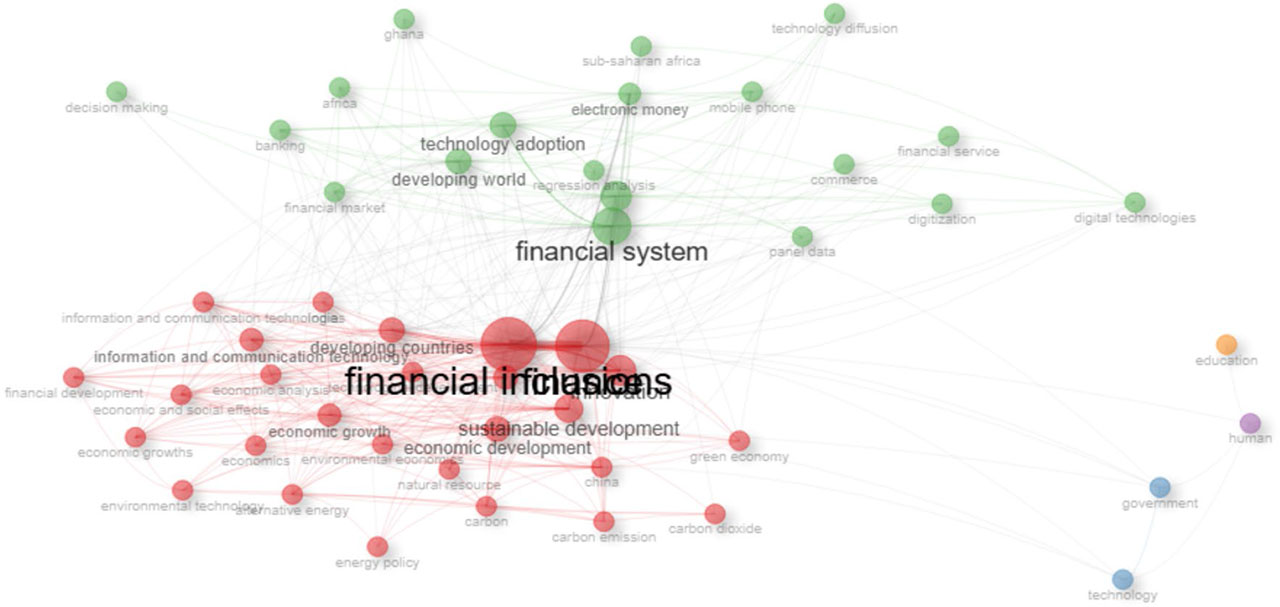
Figure 1.
Themes of Research Publication Through Keywords.
Most Productive Authors
Table 3 reports the result of a ranked table of the most productive authors in fintech research, with published article count and an added column of “Articles Fractionalized,” adjusting the count to reflect individual contribution after the effect of co-authorship. Top of the list is ASONGU S.A., which has contributed five articles with an insufficient fractionalization of 1.75, indicating that the person may have contributed to multiple research projects, and their share of the research has been lumped together with others. Among all the other authors, Ozili P.K. is both highly productive (4 articles) and his fractionalized score is the highest (3.5), which means that even on the papers he was a sole or primary author on most or all of them. This indicates a robust body of independent research and makes Ozili a key academic stakeholder in the Fintech sector, especially the digital financial system and financial inclusion topics, consistent with his prolific citation record in previous Fintech researchers 41. Other contributors include Al-Okaily M. and Cassimon D, who have 4 and 3 articles but relatively low fractionalized scores, suggesting a more diverse co-authorship behaviour. Osabutey Elc and Senyo PK are additionally listed among the contributors, as they have published three articles and have similar scores for fractionalized metrics (1.33 and 1.08), indicating moderate involvement in their publications.
Table 3.
Most Productive Author.
| Authors | Articles | Articles Fractionalised |
|---|---|---|
| ASONGU S.A. | 5 | 1.75 |
| AL-OKAILY M. | 4 | 0.75 |
| OZILI P.K. | 4 | 3.50 |
| CASSIMON D | 3 | 1.00 |
| OSABUTEY ELC | 3 | 1.33 |
| SENYO PK | 3 | 1.08 |
| AHMAD AH | 2 | 0.67 |
| AL-QUDAH AA | 2 | 0.41 |
| BERNARDS N | 2 | 1.50 |
| BIEKPE N | 2 | 0.67 |
| CHATTERJEE A | 2 | 1.50 |
| CHEN P | 2 | 0.83 |
| COFFIE CPK | 2 | 0.70 |
| GABOR D | 2 | 1.00 |
| HONGJIANG Z | 2 | 0.70 |
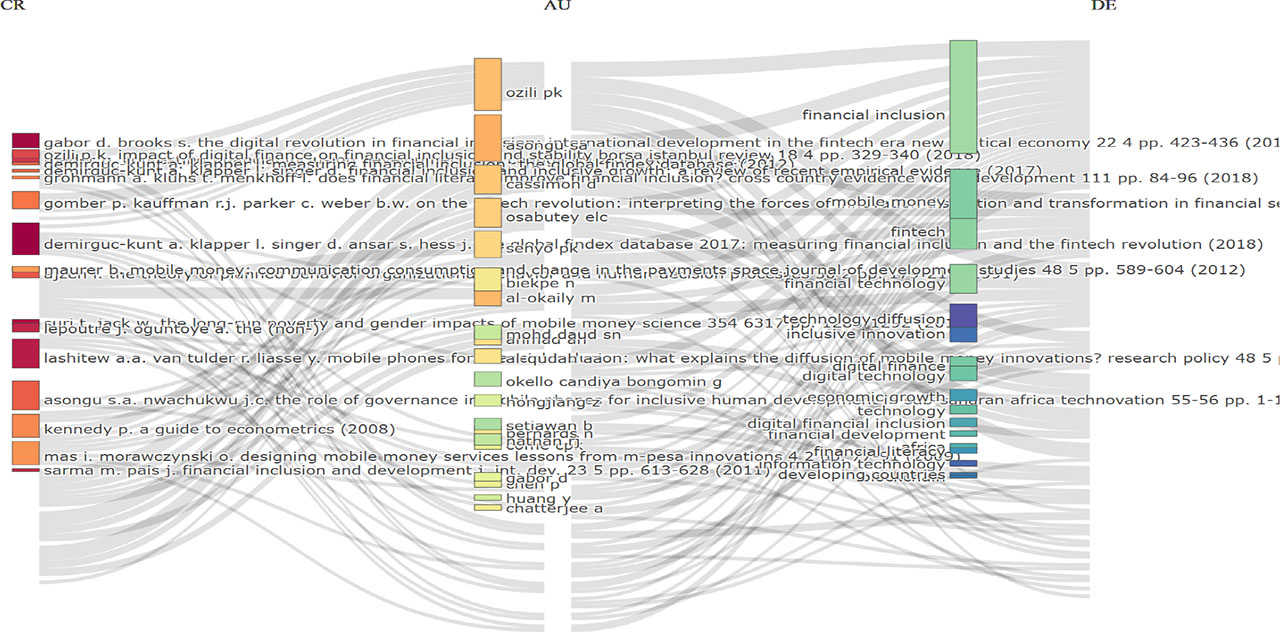
Figure 2.
Three field plot method: Author, Source and Keywords.
The other authors in this category, including Ahmad Ah, Al-Qudah Aa, and Chen P, present another two articles and different variant fractions of contributions, which characterise the authors as significantly involved in the support of the research on Fintech but with a moderate impact (the number of publications or the position of authorship in joint works). This contribution indicates the cooperative spirit underpinning Fintech research, even as it serves to identify some of the researchers who are continually moving the discussion in novel and creative directions, whether as heads of multiple-author essays or as independent talents. It is also useful for identifying influential researchers and potential research/citation partners within the discipline. Research Question 2 (RQ2) examines the rise and impact of renowned scholars in Fintech literature, to be studied through an analysis of productive authors.
Three-Fold Plot
The three-field plot therein offers an ordered visual representation of the intellectual relationships among the cited material (CR), authors (AU), and research topics or keywords (DE) in the fintech and financial inclusion literature. This kind of analysis is important to see the flow of influence in the research ecosystem of academia, beginning with foundational contributions, moving through the active influence, and leading into thematic areas of current interest.
The most influential cited references are shown on the left side of the plot. Most seminal works is that of Gabor and Brooks, who address the digital revolution in financial inclusion, and Ozili, who addresses the effects of digital finance on financial stability. Furthermore, the studies by Demirguc-Kunt and Klapper in 2012 and 2017, based on the Global Findex Database created by the World Bank, should be mentioned as important empirical sources often referred to by the researchers of Fintech. Discussion of mobile money and Fintech innovations is also notable in Gomber et al. and Maurer. These sources have consistently defined the empirical and theoretical foundations of digital financial research and inclusive economic structures.
The main strands of the plot feature the authors who have referred to these early studies in their writing. Particularly prominent authors include Ozili P.K., Al-Okaily M, and Asongu S.A. as intellectual vehicles between the traditional literature and new developing themes. The fact that they are regularly present means a great deal of academic activity. It is the essence of developing new models and frameworks in Fintech and digital inclusion. The variety of geography and research traditions of these authors implies that Fintech discourse is worldwide. They often relate the sphere of digital finance to the local usage in Africa, Asia, and emerging countries in general. The right side of the plot represents the key areas or keywords of the research according to the literature. The themes of financial inclusion, Fintech, digital finance, mobile money, and financial technology that reign supreme underscore the need to recognise the importance of how technological innovations are reshaping how we access and offer financial services. Other emerging themes include: inclusive innovation, technology diffusion and economic growth, which highlight the growing connection between technology, equity and development. These points of research suggest a more multi-disciplinary engagement where all are more integrated, as policy, economics, technology, and social impact all come together in the broader context. Such connections among the three regions would reflect how groundbreaking research, such as that conducted by Demirguc-Kunt et al. and Ozili, has spread the richness of the research across a number of authors around the world, thereby contributing to diverse themes and advancing topics in the Fintech literature.
This paradigm shows how dynamic the field is since knowledge is already permanently found in seminal works, spread to active centres of research, and to new fields of problems. Despite trends toward multi-thematic, collaborative, and global studies, the 3-field plot indicates that fintech studies are a valuable resource for researchers and policymakers who want to learn more about or explore this fast-growing field.
4.4 Most Globally Cited Documents
Figure 3 is a depiction of the most influential publications with maximum citations globally. The study by Gabor D., published in New Political Economy and having 480 citations, is listed there because it is relevant and has an influence on the discourse of scholarship. It is closely seconded by Tchamyou VS in Technological Forecasting and Social Change, which has earned 457 citations, indicating its relevance and extensive academic coverage. The other articles related to the topic that can be highlighted are Schuetz S and Senyo PK, with more than 290 and 270 references, respectively, indicating that much effort is made in research on digital transformation, information management, and technological innovation. The mid-range, as referred to by authors such as Mushtaq R., Leong C., and Ozili P.K., promotes interdisciplinary issues in technology, society, and economics. Newer articles and books like Aziz A and Pradhan RP are reported in among the most frequently used documents, also clearly pointing to the increasing role of recent studies in the development of the socio-economic and digital finance spheres. The chart shows a certain movement towards economic theory and technology applied to literature and the change of society. The fact that these documents are more frequently cited indicates their significance in further research and policy debate, especially in areas where finance, innovation, and social transformation intersect.
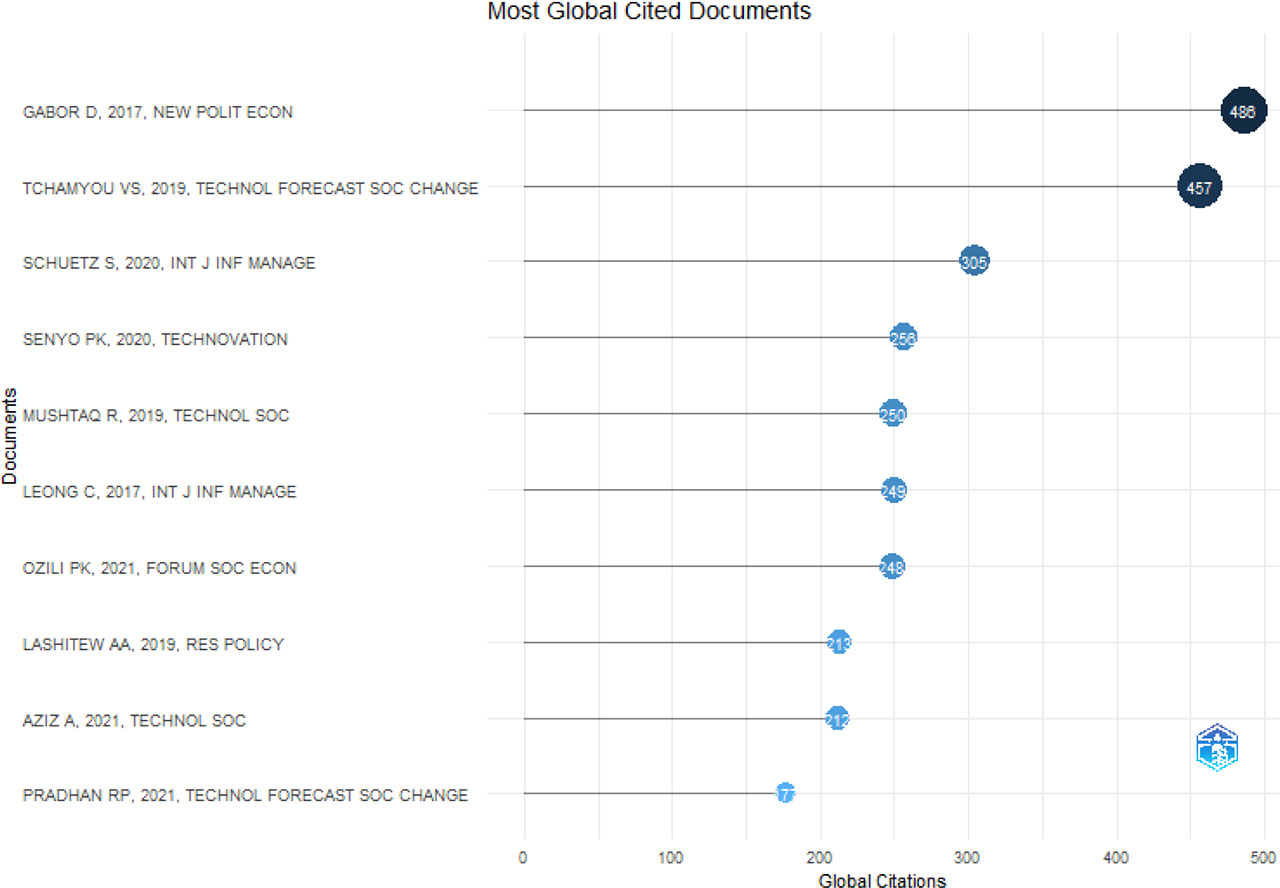
Figure 3.
Global Cited Documents.
Table 4 lists the most globally cited documents in fintech research, highlighting foundational studies that have shaped the intellectual development of the field.
Table 4.
Most Global Documents.
| Paper | DOI | Total Citations | TC per Year | Normalized TC |
|---|---|---|---|---|
| GABOR D, 2017, NEW POLIT ECON | 10.1080/13563467.2017.1259298 | 486 | 54.00 | 2.110 |
| TCHAMYOU VS, 2019, TECHNOL FORECAST SOC CHANGE | 10.1016/j.techfore.2018.11.004 | 457 | 65.285 | 3.325 |
| SCHUETZ S, 2020, INT J INF MANAGE | 10.1016/j.ijinfomgt.2019.04.009 | 305 | 50.833 | 3.603 |
| SENYO PK, 2020, TECHNOVATION | 10.1016/j.technovation.2020.102155 | 256 | 42.667 | 3.024 |
| MUSHTAQ R, 2019, TECHNOL SOC | 10.1016/j.techsoc.2019.101154 | 250 | 35.714 | 1.819 |
| LEONG C, 2017, INT J INF MANAGE | 10.1016/j.ijinfomgt.2016.11.006 | 249 | 27.667 | 1.081 |
| OZILI P.K., 2021, FORUM SOC ECON | 10.1080/07360932.2020.1715238 | 248 | 49.600 | 3.563 |
| LASHITEW AA, 2019, RES POLICY | 10.1016/j.respol.2018.12.010 | 213 | 30.428 | 1.550 |
| AZIZ A, 2021, TECHNOL SOC | 10.1016/j.techsoc.2020.101509 | 212 | 42.400 | 3.045 |
| PRADHAN RP, 2021, TECHNOL FORECAST SOC CHANGE | 10.1016/j.techfore.2021.120758 | 177 | 35.400 | 2.543 |
| ORWAT C, 2008, BMC MED INFORMATICS DECIS MAK | 10.1186/1472-6947-8-26 | 175 | 9.722 | 1.483 |
| MÜNZEL C, 2019, ENERGY ECON | 10.1016/j.eneco.2019.104493 | 168 | 24.00 | 1.222 |
| DINIZ E, 2012, ELECT COMMER RES APPL | 10.1016/j.elerap.2011.07.006 | 164 | 11.714 | 1.789 |
| TRUBY J, 2020, SUSTAINABLE DEV | 10.1002/sd.2048 | 146 | 24.333 | 1.724 |
Prominent Journals
Table 5 shows the most noticeable journals in terms of the number of articles published in various journals worldwide. Technological Forecasting and Social Change, which has 15 published articles topping the list, underscores its hegemonic position as a favourite source of interdisciplinary research within the apex of technology, society and economics. The high frequency of this journal indicates that it is leading the agenda in the policy and study of innovation in the future. Then there is Sustainability (Switzerland), with eight articles that suggest a high correspondence of the research area with the themes of sustainable development and environmental economics. The other interesting journals are Technology in Society (6 articles), Resources Policy (5 articles), and Environmental Science and Pollution Research (4 articles), all demonstrating the wide scope of this field in terms of technological change, environmental issues, and the effect of policy on these issues. The existence of several topics, including Information Technology for Development, Telecommunications Policy and Applied Economics, implies the use of a multidisciplinary approach to the literature about communication technologies, applied economic research, etc. Moreover, the journals, including Journal of Cleaner Production, Research Policy and International Journal of Social Economics, are concerned with the issues of environmental performance, innovation policy and socio-economic implications of technological and financial decisions as well.
Table 5.
Prominent Journals.
| Sources | Articles |
|---|---|
| TECHNOLOGICAL FORECASTING AND SOCIAL CHANGE | 15 |
| SUSTAINABILITY (SWITZERLAND) | 8 |
| TECHNOLOGY IN SOCIETY | 6 |
| RESOURCES POLICY | 5 |
| ENVIRONMENTAL SCIENCE AND POLLUTION RESEARCH | 4 |
| INFORMATION TECHNOLOGY FOR DEVELOPMENT | 4 |
| TELECOMMUNICATIONS POLICY | 4 |
| APPLIED ECONOMICS | 3 |
| INTERNATIONAL JOURNAL OF SOCIAL ECONOMICS | 3 |
| JOURNAL OF CLEANER PRODUCTION | 3 |
| RESEARCH POLICY | 3 |
| APPLIED ECONOMICS LETTERS | 2 |
| BEHAVIOUR AND INFORMATION TECHNOLOGY | 2 |
| FINANCE RESEARCH LETTERS | 2 |
| INFORMATION TECHNOLOGY AND PEOPLE | 2 |
Multi Correspondence Analysis
Table 6 shows the countries’ contribution in terms of research papers, i.e. shows research contributions of various countries. China has 70 documents, the highest among them, and it has become the most active participant in the studied sphere. It ranks second after Indonesia (38) and the United Kingdom (36) with a good academic presence. Likewise, India (28) and the USA (27) play important roles, reflecting healthy research output in Asian and Western countries. Additionally, Malaysia, Ghana, Jordan, and Australia are also significant participants, all of them having more than 13 documents. The need to include emerging economies such as Nigeria, South Africa, and Pakistan in the research on fintech also contributes to the global and inclusive nature of the research environment.
Table 6.
Country-Wise Documents.
| Region | Frequency |
|---|---|
| CHINA | 70 |
| INDONESIA | 38 |
| UK | 36 |
| INDIA | 28 |
| USA | 27 |
| MALAYSIA | 17 |
| GHANA | 16 |
| JORDAN | 16 |
| AUSTRALIA | 13 |
| GERMANY | 13 |
| FRANCE | 12 |
| ITALY | 11 |
| NIGERIA | 11 |
| SOUTH AFRICA | 11 |
| PAKISTAN | 10 |
The geographic distribution of publications highlights several active centres of fintech research, particularly in China, the United Kingdom, and Indonesia. These regions demonstrate strong institutional support and collaborative networks, contributing significantly to the global development of fintech scholarship.
Figure 4 illustrates the geographic distribution of fintech research output across countries, identifying both leading and emerging contributors.
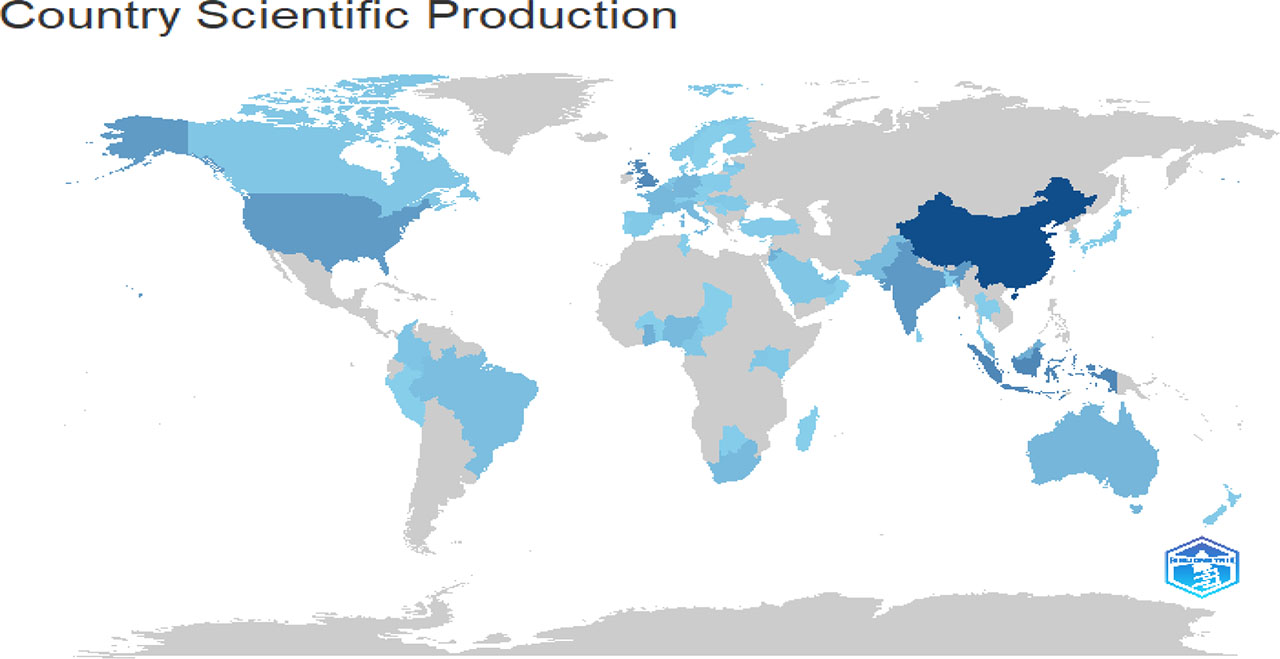
Figure 4.
Country-Specific Production.
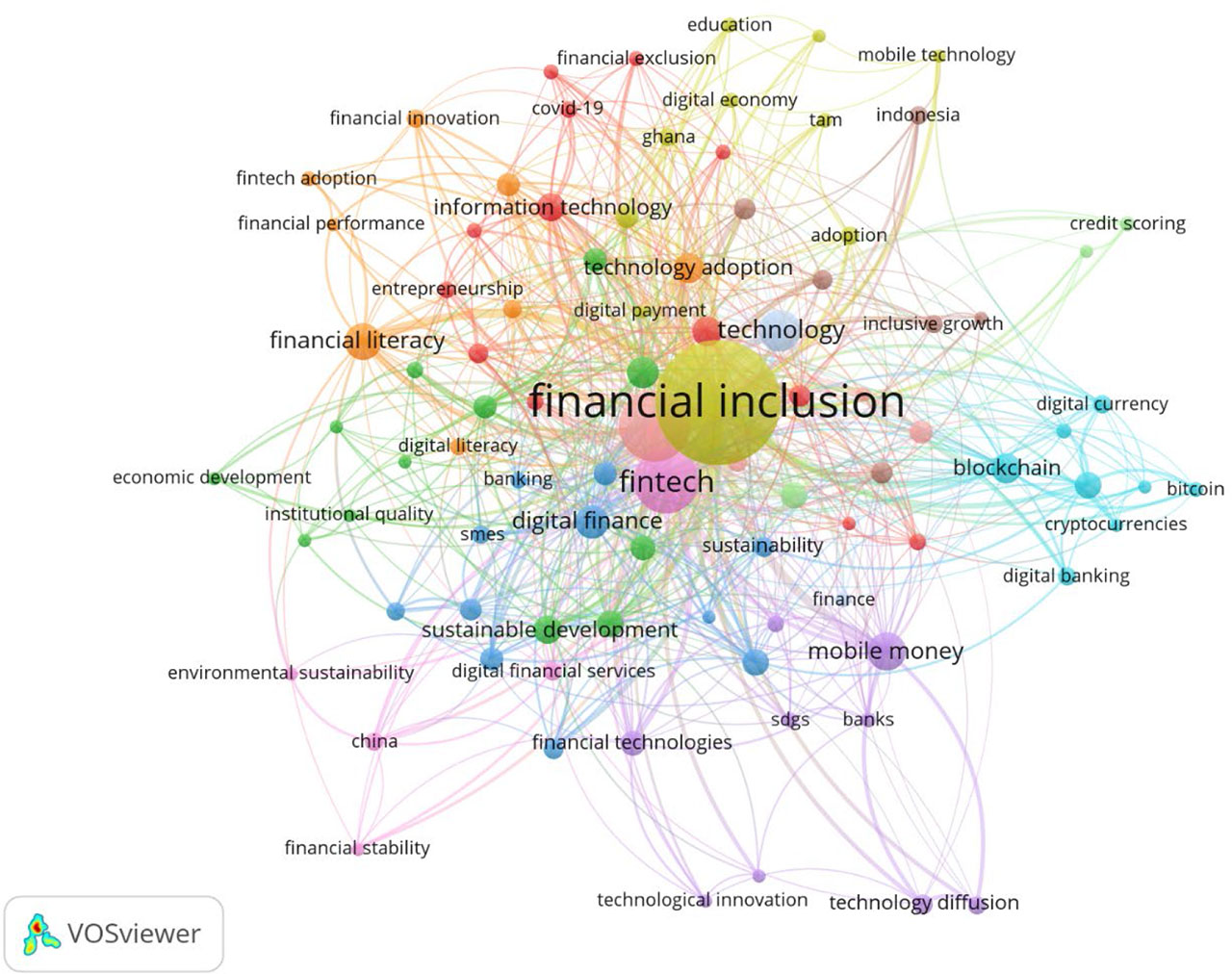
Figure 5.
Keyword co-occurrence network.
Table 7 provides country-specific total citations (TC) and average article citations, which provide information on the research volume and the impact of the research. The United Kingdom has the highest number of total citations (1,480), and its average (105.7) is the largest per article, which is a sign of productivity and influence. Belgium and the Netherlands, with lower total citations, demonstrate high averages (179.3 and 169, respectively), which is testimony to the high-impact research. China is second in overall citations (1,279), and the average (55.6) indicates a high volume with a relatively low impact of citations per article. In the same way, countries such as the USA, Germany, Australia, and Brazil achieve good results in both the citation counts and averages, which reflect their high scholarly impact. In general, the information highlights the prevalence of Western and emerging economies in terms of high-quantity and high-impact research.
Keywords co-occurrence network
The two visualisations, one a VOSviewer-constructed network of keyword co-occurrences and the other a frequency table of author keywords, together provide a strong thematic analysis of Fintech literature and the related constructs. Those assist in representing the intellectual and thematic structure of the field that allows one to see the prevailing research patterns and identify the new tendencies in the academic discourse. The search query co-occurrence map shows that the most central and commonly recurring word in the literature of Fintech is financial inclusion. Its high-ranking and good connectivity to numerous other terms highlight the importance of the given concept as a central big idea in the existing Fintech literature. Similar words like Fintech, digital finance, technology adoption, mobile money, and blockchain indicate the interdisciplinary aspect of the term Fintech, which cuts across the areas of technological innovation, access to finance, and socio-economic development. The visualisation makes it clear that Fintech is a financial mechanism and an instrument of facilitating more general developmental purposes, such as sustainable development, education, and digital transformation 42, 43. The clusters in the map are colour-coded: the blue cluster highlights blockchain and digital banking technologies, while the green cluster highlights inclusion-based research streams, i.e., education, mobile technology, and inclusive growth. This analysis is supplemented by the frequency table, which measures the frequency of the appearance of keywords provided by authors. On top of the list are “finance” (47), “financial inclusion” (44), and “financial system” (36), which suggests that the key areas of interest of the previous research were on the place of Fintech in a larger financial ecosystem. The prevalence of two terms: technology adoption (25) and innovation (22) highlights the significance of technological change in defining the financial services and customer behaviour 44.
Furthermore, the consistent presence of such words as sustainable development (21), economic development (21), developing countries (17), and China (14) hint at an increased emphasis on the role of Fintech in supporting the development of the emerging economies, in particular, countries that aim to skip the equitable development of the banking infrastructure and directly move to the digital one 45, 46. What is interesting to note is that the keywords such as mobile phone, carbon dioxide and sustainability appear in the lower half of the table. These trends suggest a new trend of environmental and technological implications of Fintech adoption. For example, blockchain technologies have been characterised by their energy consumption and carbon footprint, so current research interest focuses on sustainable Fintech systems 47.
Conclusion and Implication
This paper employs the maximum analysis method and offers a detailed roadmap on the current research environment on a global scale of financial technology (Fintech), analysing how it has evolved, structured intellectually, and framed over the last decade. The research presents the most important contributions to institutions and knowledge clusters that are shaping the field through the analysis of a large collection of academic publications with the help of such tools as VOSviewer and Scopus-based metrics. The increasing scholarly interest in fintech, particularly after 2015, indicates the significance of the phenomenon as a disruptive development in the financial systems, technological innovation, and inclusive development. The results indicate that Fintech has moved beyond the technological realm and has firmly established itself in the interdisciplinary environment, cutting across economics, sustainability, corporate governance, and digital transformation. The fact that the majority of the most prevalent keywords chosen include the term of financial inclusion, blockchain, digital banking, and technology adoption suggests that there is a growing scholarly interest in learning about how fintech can empower socio-economically, particularly in developing economies. Similarly, the network visualisations and author collaboration maps have indicated lively academic ecosystems with robust research hubs being held in developing and developed economies, i.e. China, India, Indonesia and the United Kingdom, indicating a global involvement in this emerging discussion. The redefinition of access, trust, and performance in financial services by Fintech is one of the most significant implications of this research. The identified thematic clusters include the rising popularity of decentralised finance (DeFi), mobile money and AI-based financial systems, all addressing the needs of a digitising world economy.
Findings of the study indicate that fintech is not merely a technological innovation but a structural facilitator of financial change, which is in line with the findings of previous conceptual research 48, 49 and supports the notion that financial inclusion and Fintech adoption are co-evolutionary. The paper has practical implications for various stakeholders, i.e. policy-makers, industries, and development agencies. First, the governments of the emerging markets can rely on the insights of the study in order to design the policies that will encourage the development of the digital financial ecosystems, and at the same time provide regulatory control over risks. Second, the leading trends, including the adoption of blockchains, contactless payments, and the use of mobile credit scoring, can be utilised by financial institutions to be innovative and target underserved populations. Third, this is also beneficial in supplying the research insights to academic institutions and entities involved in research. These institutions ought to align with the most vibrant subjects in fintech in this study, namely those associated with sustainability, digital identity, and consumer trust, and define curricula and training programs that are future-ready.
As a research approach, this bibliometric study presents essential research gaps that can be filled. Although the literature on Fintech and fintech applications in finance and development is growing, the research on cybersecurity of decentralised systems, gender inclusion in digital finance, and green Fintech solutions has not been represented. Longitudinal and comparative studies, which allow us to peel back the regional layers of Fintech adoption and its socio-economic effects, are still required. Moreover, the reduced co-authoring density of certain clusters implies a disjointed scholarly network, which would be helped by cross-border and inter-institutional collaboration. To conclude, the paper confirms that Fintech has reached the stage of a multidisciplinary research field that is both theoretically rich and practical. It is one of the pillars of the future economic environment as it overlaps with financial access, technological development, and socio-economic development.
Limitations
This paper would provide important information on the trends of publications, the development of themes and collaboration patterns in the field. However, the research is not free from limitations. Since Scopus is a total database, it misses the literature of other indexing databases such as Web of Science or IEEE Xplore, particularly that which is not in the English language or local literature. This restrains the representativeness and global inclusivity of findings of other sources 50. In addition, this research has a time-based citation bias. The older studies in other countries have been cited longer than the recent ones, which may overestimate their value and underrepresent new and valuable work 51. The second limitation is that it only deals with quantitative metrics that are not always measures of conceptual quality and practical value of the research. Third, citation counts give valuable information, though at times they fail to show subtle, policy-relevant discoveries or theoretical breakthroughs 52. Fourth, limited keywords are also a problem to be standardised. Their inappropriate and excessive use of such terms as Fintech and financial technology may disintegrate thematic clusters, and it may also influence the topic mapping process 53. Moreover, author disambiguation and affiliation anomalies could alter the pattern of co-authorship and collaboration practice among the international community, and this results in potential discrepancies 54.