
Table 1.
Cattle footbath disinfectants evaluated by flow cytometry as a complementary method to European standard EN 1656 dilution–neutralisation
| Disinfectant | Main antimicrobial agent | Characteristics and spectrum of activity | Composition | Concentration (%) |
|---|---|---|---|---|
| A | Oxidising compounds | crystalline, blue, odourless, pH 3.5–4.5 (at 20°C); unspecified spectrum of activity | CuSO4(pentahydrate) | 5 |
| B | Oxidising compounds | crystalline, white, odourless, pH 4–6 (at 20°C), unspecified spectrum of activity | ZnSO4(heptahydrate) | 10 |
| C (no longer available) | Oxidising compounds | crystalline, green, unspecified spectrum of activity | a mixture of organic acids, copper and zinc salts | 1 |
| D | Oxidising compounds | liquid, brown, pH 2 (at 20°C), bactericidal, fungicidal, sporicidal and virucidal | sodium iodide ≤7%, phosphoric acid ≤5%, sulfuric acid ≤5%, aqueous solution of sodium salt of fatty alcohol ethoxy sulphate ≤5%, iodine ≤3% | 1 |
| E (no longer available in the original composition) | Chelating complexes | No longer available in the original composition | copper-chelating complex 55%, zinc-chelating complex 55%, N-(3-aminopropyl)-N-dodecyl propane-1,3-diamine | 1 |
| F | Oxidising compounds | liquid, dark green, solvent odour, pH 2.6 (at 20°C), unspecified spectrum of activity | L – lactic acid (2-hydroxy propionic acid) 15–30%, citric acid 1–5%, octanoic acid 1–5%, 2(2-butoxy ethoxy) ethanol 1–5%, anionic surfactants 1–5% | 3 |
| G | Oxidising compounds | liquid, green, peroxide odour, pH 4.8 (at 20°C), bactericidal | hydrogen peroxide 11%, alkyl (C12–16) dimethyl benzyl ammonium chloride 2.8%, didecyldimethylammonium chloride 2%, guanidine, N, N'''-1,3-propanediylbis-, N-coco alkyl derivatives, diacetates <5%, ethoxylated (EO 8) C10 alcohol <5%, propane-2ol 1.5% | 1 |
| H | Aldehydes | liquid, colourless, pungent odour, pH 2.8–4.0 (at 20°C), unspecified spectrum of activity | formaldehyde 36–38% | 2 |
| I | Aldehydes, alcohols | liquid, clear orange/red, pungent glutaraldehyde odour, pH 1.7, bactericidal, fungicidal and virucidal | glutaraldehyde 10–15%, ethoxylated alcohol C12–C15 5–10%, dodecyl-(dimethyl)ammonium chloride 3–5%, isopropanol 1–3%, methanol 0.1–1%, phosphoric acid 0.1–1% | 5 |
| J | Aldehydes | liquid, green, characteristic odour, pH 1.1–1.7, unspecified spectrum of activity | glutaraldehyde <10%, alkyldimethyl-benzylammonium chloride <5%, copper sulfate pentahydrate <5%, zinc sulphate <5%, phosphoric acid <3% | 1 |
| K | Aldehydes | liquid, colour, aldehyde odour, pH 2.5 (at 20°C), biocidal | glutaraldehyde 10–25%, alkyldimethyl-benzylammonium chloride 1–5%, copper sulphate 1–5%, aluminium sulphate 1–5% | 2 |
| L | Anionic detergent (foaming agent), Alcohols | liquid, blue-green, indistinct odour, pH 3.2–3.6 (at 20°C), broad-spectrum bactericidal, fungicidal | sodium laureth sulphate <8.0%, glyoxal ≤8.0%, ethane-1,2diol 0.5%, glutaral (1,5-pentandial) ≤2.5%, oxirane, 2-methyl-, polymer with oxirane, mono (2-propyheptyl) ether ≤2.8%, copper sulphate <1.5% | 5 |
| M | Oxidising compounds | liquid, clear dark brown, weak iodine odour, surface active, pH 0, bactericidal, fungicidal, virucidal and sporicidal | alcohol (C9–11) ethoxylate (8EO) 20–25%, sulfuric acid 5–10%, orthophosphoric acid 5–10%, iodine 1–3% | 0.5 |
1 The concentration column indicates the manufacturer’s recommended working concentration for practical on-farm use. It was used for all flow cytometry and dilution–neutralisation experiments. Each disinfectant was additionally tested in dilution–neutralisation at two lower concentrations (typically 50% and 25% of the listed value) to assess a broader efficacy range
Table 2.
Suitable neutralisers for cattle footbath disinfectants according to their composition
| Antimicrobial ingredient | Neutraliser |
|---|---|
| Quaternary ammonium compounds and fatty amines; amphoteric compounds; biguanides and similar compounds; alcohols; phenolic and related compounds: orthophenylphenol, phenoxyethanol, triclosan, phenyl ethanol, etc.; and anilides | Polysorbate 80, 30g/L+ saponin 30 g/L + lecithin 3 g/L |
| Oxidising compounds (chlorine, iodine, hydrogen peroxide, peracetic acid, hypochlorites, etc.) | Sodium thiosulphate 3 g/L+ polysorbate 80, 30 g/L + lecithin 3 g/L |
| Aldehydes | Polysorbate 80, 30 g/L+ lecithin 3 g/L + L-histidine 1 g/l or glycine 1 g/L |

Fig. 1.
Flow cytometry analysis of Staphylococcus aureus viability before and after disinfectant treatment. (A) Dot plot of an untreated control sample showing a predominantly viable propidium-iodide (PI)– population characterised by low fluorescence in the phycoerythin (PE) channel. (B) Dot plot of a sample treated with an effective disinfectant, demonstrating a shift to a non-viable PI+ population with high PE fluorescence. The horizontal line in both plots represents the threshold used to distinguish between PI- and PI+ cells. PE-H – PE pulse height; SSC-H – side-scatter pulse height
Table 3.
Comparison of bactericidal efficacy of the tested cattle footbath disinfectants assessed by the dilution–neutralisation method and flow cytometry for individual disinfectant–bacterium combinations
| Disinfectant | Staphylococcus aureus PI+ (%) | Staphylococcus aureus LogR | Enterococcus hirae PI+ (%) | Enterococcus hirae LogR | Pseudomonas aeruginosa PI+ (%) | Pseudomonas aeruginosa LogR | Proteus hauseri PI+ (%) | Proteus hauseri LogR |
|---|---|---|---|---|---|---|---|---|
| A | 79.36 | 3.87 | 13.02 | 3.73 | 93.03 | ≥ 5.19 | 27.18 | ≥ 5.27 |
| B | 8.62 | 4.12 | 8.39 | 4.35 | 24.58 | 4.32 | 27.17 | 3.82 |
| C | 99.30 | 3.87 | 70.18 | 3.73 | 90.98 | ≥ 5.19 | 95.02 | ≥ 5.19 |
| D | 99.80 | ≥ 5.45 | 99.19 | ≥ 5.48 | 98.98 | ≥ 5.12 | 98.43 | ≥ 5.20 |
| E | 9.06 | 3.03 | 11.6 | 4.01 | 35.04 | ≥ 5.26 | 43.55 | 3.78 |
| F | 98.42 | ≥ 5.15 | 99.83 | ≥ 5.32 | 98.50 | ≥ 5.18 | 99.35 | ≥ 5.59 |
| G | 99.68 | ≥ 5.43 | 99.48 | ≥ 5.65 | 97.24 | ≥ 5.62 | 99.22 | ≥ 5.12 |
| H | 35.45 | 4.58 | 5.25 | 3.73 | 85.68 | ≥ 5.19 | 69.34 | ≥ 5.27 |
| I | 99.90 | ≥ 5.40 | 99.52 | ≥ 5.75 | 99.54 | ≥ 6.18 | 98.20 | ≥ 5.87 |
| J | 99.71 | ≥ 5.12 | 95.90 | ≥ 5.15 | 98.74 | ≥ 5.05 | 99.08 | ≥ 5.60 |
| K | 98.90 | ≥ 5.40 | 99.76 | ≥ 5.75 | 87.81 | ≥ 6.18 | 80.99 | ≥ 5.87 |
| L | 99.72 | ≥ 5.40 | 99.53 | ≥ 5.75 | 98.62 | ≥ 6.18 | 98.92 | ≥ 5.87 |
| M | 99.71 | ≥ 5.57 | 99.57 | ≥ 5.73 | 99.89 | ≥ 5.18 | 99.77 | ≥ 5.22 |
1 A – CuSO44 (pentahydrate) at 5%; B – ZnSO4 (heptahydrate) at 10%; C – mixture of organic acids, copper and zinc salts at 1%; D – sodium iodide ≤7%, phosphoric acid ≤5%, sulfuric acid ≤5%, aqueous solution of sodium salt of fatty alcohol ethoxy sulphate ≤5%, iodine ≤3% at 1%; E – copper-chelating complex 55%, zinc-chelating complex 55%, N-(3-aminopropyl)-N-dodecyl propane-1,3-diamine at 1%; F – lactic acid (2-hydroxy propionic acid) 15–30%, citric acid 1–5%, octanoic acid 1–5%, 2(2-butoxy ethoxy) ethanol 1–5%, anionic surfactants 1–5% at 3%; G – hydrogen peroxide 11%, alkyl (C12-–16) dimethyl benzyl ammonium chloride 2.8%, didecyldimethylammonium chloride 2%, guanidine, N, N'''-1,3-propanediylbis-, N-coco alkyl derivatives, diacetates <5%, ethoxylated (EO 8) C10 alcohol <5%, propane-2ol 1.5% at 1%; H – formaldehyde 36–38% at 2%; I – glutaraldehyde 10–15%, ethoxylated alcohol C12–C15 5–10%, didecyldodecyl-(dimethyl)ammonium chloride 3–5%, isopropanol 1–3%, methanol 0.1–1%, phosphoric acid 0.1–1% at 5%; J – glutaraldehyde <10%, alkyldimethyl-benzylammonium chloride <5%, copper sulfate pentahydrate <5%, zinc sulphate <5%, phosphoric acid <3% at 1%; K – glutaraldehyde 10–25%, alkyldimethyl-benzylammonium chloride 1–5%, copper sulphate 1–5%, aluminium sulphate 1–5% at 2%; L – sodium laureth sulphate <8.0%, glyoxal ≤8.0%, ethane-1,2diol 0.5%, glutaral (1,5-pentandial) ≤2.5%, oxirane, 2-methyl-, polymer with oxirane, mono (2-propyl heptyl) ether ≤2.8%, copper sulphate <1.5% at 5%; M – alcohol (C9–11) ethoxylate (8EO) 20–25%, sulfuric acid 5–10%, orthophosphoric acid 5–10%, iodine 1–3% at 0.5%. Bactericidal activity was defined as a logarithmic reduction (LogR) ≥ 5 according to EN 1656 for the culture-based method and as ≥80% propidium iodide-positive (PI+) cells for flow cytometry

Fig. 2.
Comparison of the effectiveness of cattle footbath disinfectants against individual bacteria as indicated by propidine-iodide (PI)-positive cell proportions. A – CuSO44 (pentahydrate) at 5%; B – ZnSO4 (heptahydrate) at 10%; C – mixture of organic acids, copper and zinc salts at 1%; D – sodium iodide ≤7%, phosphoric acid ≤5%, sulfuric acid ≤5%, aqueous solution of sodium salt of fatty alcohol ethoxy sulphate ≤5%, iodine ≤3% at 1%; E – copper-chelating complex 55%, zinc-chelating complex 55%, N-(3-aminopropyl)-N-dodecyl propane-1,3-diamine at 1%; F – lactic acid (2-hydroxy propionic acid) 15–30%, citric acid 1–5%, octanoic acid 1–5%, 2(2-butoxy ethoxy) ethanol 1–5%, anionic surfactants 1–5% at 3%; G – hydrogen peroxide 11%, alkyl (C12-–16) dimethyl benzyl ammonium chloride 2.8%, didecyldimethylammonium chloride 2%, guanidine, N, N'''-1,3-propanediylbis-, N-coco alkyl derivatives, diacetates <5%, ethoxylated (EO 8) C10 alcohol <5%, propane-2ol 1.5% at 1%; H – formaldehyde 36–38% at 2%; I – glutaraldehyde 10–15%, ethoxylated alcohol C12–C15 5–10%, didecyldodecyl-(dimethyl)ammonium chloride 3–5%, isopropanol 1–3%, methanol 0.1–1%, phosphoric acid 0.1–1% at 5%; J – glutaraldehyde <10%, alkyldimethyl-benzylammonium chloride <5%, copper sulfate pentahydrate <5%, zinc sulphate <5%, phosphoric acid <3% at 1%; K – glutaraldehyde 10–25%, alkyldimethyl-benzylammonium chloride 1–5%, copper sulphate 1–5%, aluminium sulphate 1–5% at 2%; L – sodium laureth sulphate <8.0%, glyoxal ≤8.0%, ethane-1,2diol 0.5%, glutaral (1,5-pentandial) ≤2.5%, oxirane, 2-methyl-, polymer with oxirane, mono (2-propyl heptyl) ether ≤2.8%, copper sulphate <1.5% at 5%; M – alcohol (C9–11) ethoxylate (8EO) 20–25%, sulfuric acid 5–10%, orthophosphoric acid 5–10%, iodine 1–3% at 0.5%. Columns with different letters present significantly different values P-value < 0.05)
Table 4.
Analysis of outcomes of bactericidal effect testing of 13 cattle footbath disinfectants comparing dilution–neutralisation (first outcome shown) with flow cytometry (second outcome shown)
| Disinfectant | Staphylococcus aureus CCM 2022 | Enterococcus CCM 4533 | hirae Pseudomonas CCM 7930 | aeruginosa Proteus CCM 7011 | hauseri Overall agreement |
|---|---|---|---|---|---|
| A | – / – | – / – | + / + | + / – | 3/4 (75%) |
| B | – / – | – / – | – / – | – / – | 4/4 (100%) |
| C | – / + | – / – | + / + | + / + | 3/4 (75%) |
| D | + / + | + / + | + / + | + / + | 4/4 (100%) |
| E | – / – | – / – | + / – | – / – | 3/4 (75%) |
| F | + / + | + / + | + / + | + / + | 4/4 (100%) |
| G | + / + | + / + | + / + | + / + | 4/4 (100%) |
| H | – / – | – / – | + / + | + / – | 3/4 (75%) |
| I | + / + | + / + | + / + | + / + | 4/4 (100%) |
| J | + / + | + / + | + / + | + / + | 4/4 (100%) |
| K | + / + | + / + | + / + | + / + | 4/4 (100%) |
| L | + / + | + / + | + / + | + / + | 4/4 (100%) |
| M | + / + | + / + | + / + | + / + | 4/4(100%) |
1 + / + – bactericidal by both methods; − / − – non-bactericidal by both methods; + / − – bactericidal by dilution–neutralisation method only; − / + – bactericidal by flow cytometry only; CCM – Czech Collection of Microorganisms; A – CuSO44 (pentahydrate) at 5%; B – ZnSO4 (heptahydrate) at 10%; C – mixture of organic acids, copper and zinc salts at 1%; D – sodium iodide ≤7%, phosphoric acid ≤5%, sulfuric acid ≤5%, aqueous solution of sodium salt of fatty alcohol ethoxy sulphate ≤5%, iodine ≤3% at 1%; E – copper-chelating complex 55%, zinc-chelating complex 55%, N-(3-aminopropyl)-N-dodecyl propane-1,3-diamine at 1%; F – lactic acid (2-hydroxy propionic acid) 15–30%, citric acid 1–5%, octanoic acid 1–5%, 2(2-butoxy ethoxy) ethanol 1–5%, anionic surfactants 1–5% at 3%; G – hydrogen peroxide 11%, alkyl (C12-–16) dimethyl benzyl ammonium chloride 2.8%, didecyldimethylammonium chloride 2%, guanidine, N, N'''-1,3-propanediylbis-, N-coco alkyl derivatives, diacetates <5%, ethoxylated (EO 8) C10 alcohol <5%, propane-2ol 1.5% at 1%; H – formaldehyde 36–38% at 2%; I – glutaraldehyde 10–15%, ethoxylated alcohol C12–C15 5–10%, didecyldodecyl-(dimethyl)ammonium chloride 3–5%, isopropanol 1–3%, methanol 0.1–1%, phosphoric acid 0.1–1% at 5%; J – glutaraldehyde <10%, alkyldimethyl-benzylammonium chloride <5%, copper sulfate pentahydrate <5%, zinc sulphate <5%, phosphoric acid <3% at 1%; K – glutaraldehyde 10–25%, alkyldimethyl-benzylammonium chloride 1–5%, copper sulphate 1–5%, aluminium sulphate 1–5% at 2%; L – sodium laureth sulphate <8.0%, glyoxal ≤8.0%, ethane-1,2diol 0.5%, glutaral (1,5-pentandial) ≤2.5%, oxirane, 2-methyl-, polymer with oxirane, mono (2-propyl heptyl) ether ≤2.8%, copper sulphate <1.5% at 5%; M – alcohol (C9–11) ethoxylate (8EO) 20–25%, sulfuric acid 5–10%, orthophosphoric acid 5–10%, iodine 1–3% at 0.5%

Fig. 3.
Scatter plot comparing flow cytometry (% PI+ cells) and culture-based (LogR) assessment of the bactericidal efficacy of 13 cattle footbath disinfectants. Dashed lines indicate classification thresholds for bactericidal activity (80% PI+ cells and LogR = 5). Each point represents one disinfectant–bacterium combination
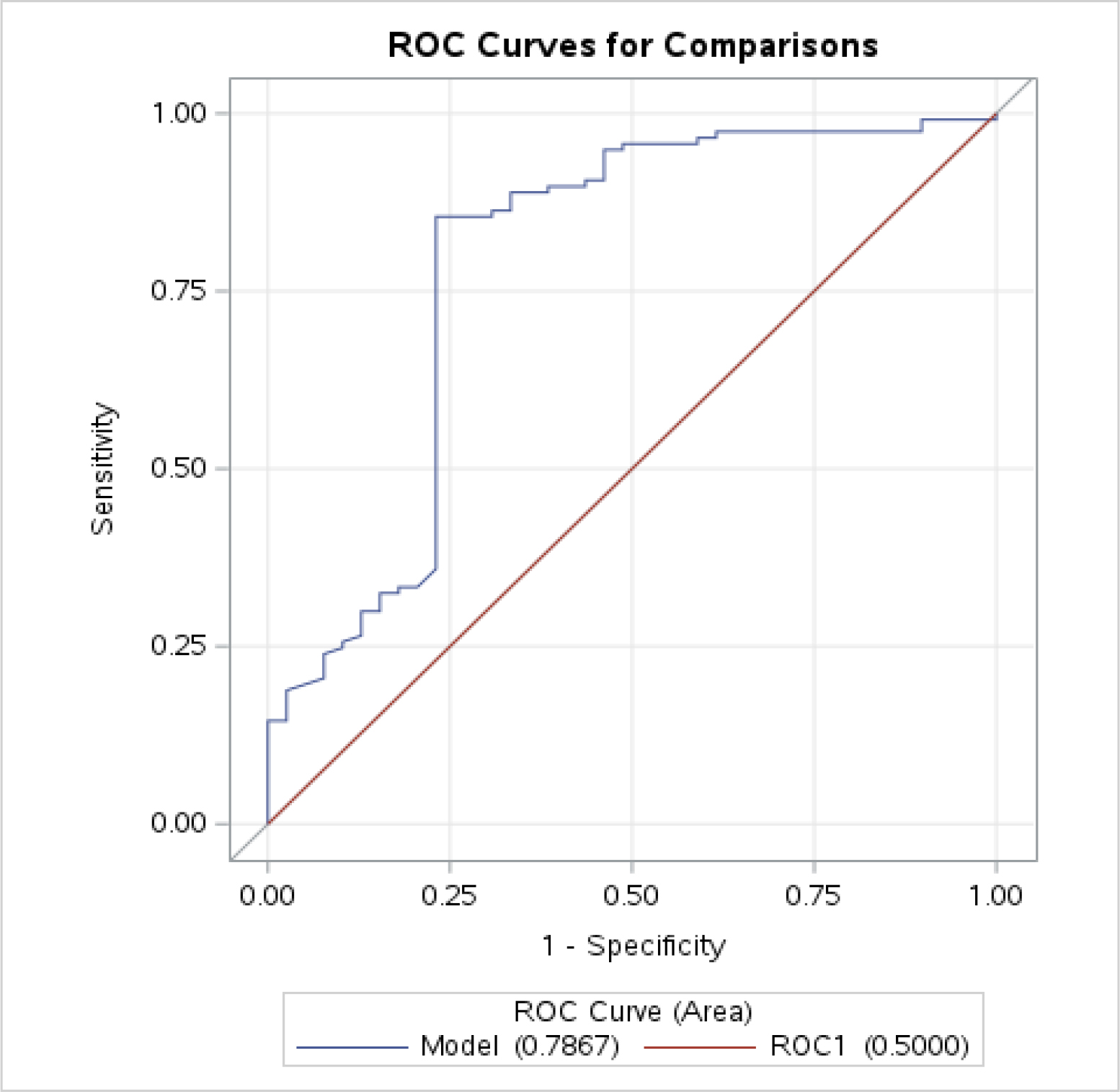
Fig. 4.
ROC curve for predicting the bactericidal efficacy of a disinfectant