
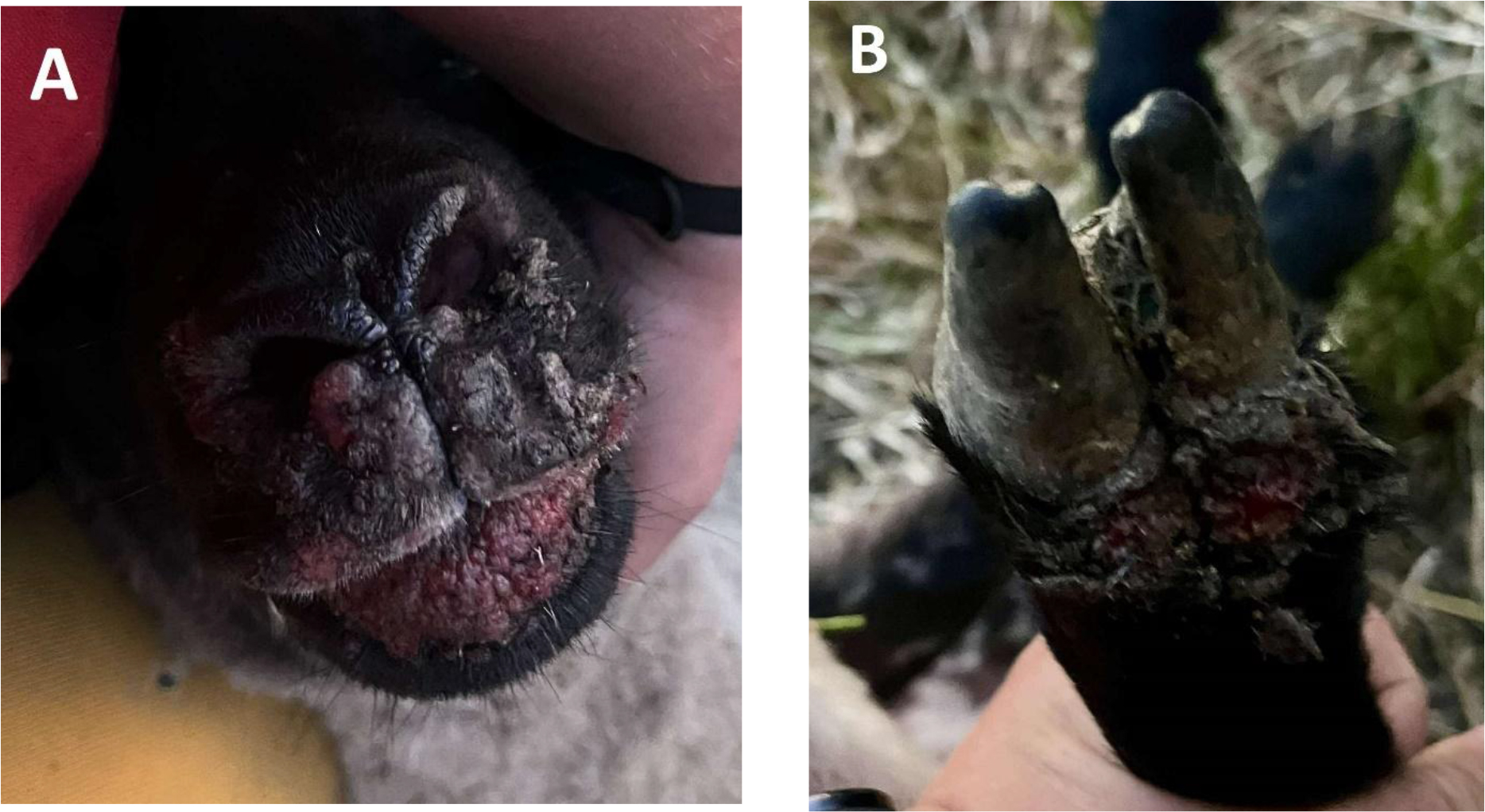
Fig. 1.
Erythema, pustules and crusts on the muzzle (A) and papules at the coronary band of the front feet (B) in Polish Blackhead sheep infected with orf virus
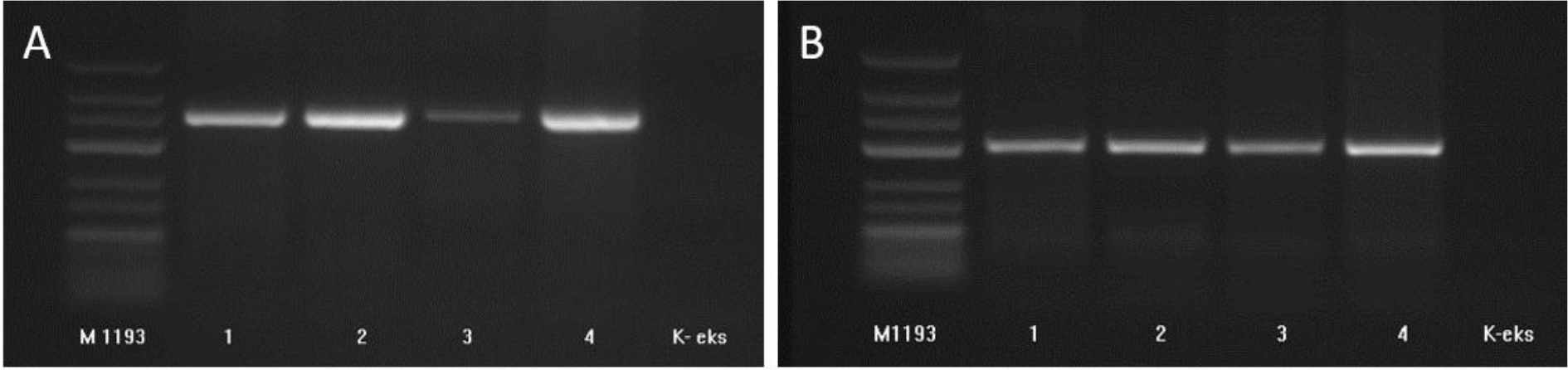
Fig. 2.
Amplification of orf virus genetic material from skin scraping samples from infected Polish Blackhead sheep. Analysis of PCR products with GIF5 and GIF6 primers with visible 408-bp amplicon (A), and with vIL03 and vIL04 primers with visible 300-bp amplicon (B). M1193 – molecular size marker; K-eks – no template control
Table 1.
Similarity matrix sequence heatmap for pairwise amino acid identity of granulocyte-macrophage colony-stimulating factor gene fragments of parapoxviruses detected in sheep in Kluczbork, Poland and other sequences retrieved from GenBank (these preceded by their accession Nos). The colour intensity of the grid indicates degree of similarity (darker for high and lighter for lower)
| PQ374835.1_ORFV-1V | PP565901.1_D1701V | ON805832.1 | MF497783.1 | MF175205.1 | KM057389.1 | KF666566.1 | GU460372.1 | AY605983.1 | AY605975.1 | OR452360.1 | ON805831.1 | LC476575.1 | AY605988.1_NZ2 | orf_virus_1_Poland_2025 | orf_virus_2_Poland_2025 | orf_virus_3_Poland_2025 | orf_virus_4_Poland_2025 | |
|---|---|---|---|---|---|---|---|---|---|---|---|---|---|---|---|---|---|---|
| PQ374835.1_orf_virus_ORFV-1V2024_vaccine | 100 | |||||||||||||||||
| PP565901.1_orf_virus_D1701_vaccine | 100 | 100 | ||||||||||||||||
| ON805832.1_orf_virus_NAV_sheep_Spain_2018 | 100 | 100 | 100 | |||||||||||||||
| MF497783.1_pseudocowpox_virus_Iraq-D.NO1_cattle_Iraq_2017 | 99.9 | 99.9 | 99.9 | 100 | ||||||||||||||
| MF175205.1_parapoxvirus_sp._O.r.r._Svalbard_atlantic_walrus_Norway_2015 | 100 | 100 | 100 | 99.9 | 100 | |||||||||||||
| KM057389.1_orf_virus_2010-147_Muskox_USA(Alaska)_2010 | 100 | 100 | 100 | 99.9 | 100 | 100 | ||||||||||||
| KF666566.1_orf_virus_Xinjiang2_goat_China_2013 | 99.9 | 100 | 99.9 | 99.9 | 99.9 | 99.9 | 100 | |||||||||||
| GU460372.1_orf_virus_Cam09_dromedary_camel_India_2008 | 99.9 | 99.9 | 99.9 | 99.9 | 99.9 | 99.9 | 99.9 | 100 | ||||||||||
| AY605983.1_pseudocowpox_virus_N71.2Bos_cattle_Norway | 100 | 100 | 100 | 99.9 | 100 | 100 | 99.9 | 99.9 | 100 | |||||||||
| AY605975.1_seal_parapoxvirus_Sc95.1Hg_grey_seal_United_Kingdom | 99.9 | 100 | 100 | 99.9 | 100 | 100 | 99.9 | 99.9 | 100 | 100 | ||||||||
| OR452360.1_orf_virus_ORFVGoatBangladeshBLRI-012021_goat_Bangladesh_2021 | 100 | 100 | 100 | 99.9 | 100 | 100 | 100 | 99.9 | 100 | 99.9 | 100 | |||||||
| ON805831.1_orf_virus_HRE_sheep_Argentina_2018 | 100 | 100 | 100 | 99.9 | 100 | 100 | 99.9 | 99.9 | 100 | 100 | 100 | 100 | ||||||
| LC476575.1_orf_virus_S-1_japanese_serow_Japan_1985 | 100 | 100 | 100 | 100 | 100 | 100 | 100 | 99.9 | 100 | 100 | 100 | 100 | 100 | |||||
| AY605988.1_orf_virus_NZ2_New_Zealand | 99.9 | 99.9 | 100 | 99.9 | 100 | 100 | 99.9 | 99.9 | 100 | 100 | 100 | 100 | 100 | 100 | ||||
| orf_virus_isolate_kluczbork_1_sheep_Poland_2025 | 100 | 100 | 100 | 99.9 | 100 | 100 | 99.9 | 99.9 | 100 | 100 | 99.9 | 100 | 100 | 100 | 100 | |||
| orf_virus_isolate_kluczbork_2_sheep_Poland_2025 | 100 | 100 | 100 | 99.9 | 100 | 100 | 99.9 | 99.9 | 100 | 100 | 99.9 | 100 | 100 | 100 | 100 | 100 | ||
| orf_virus_isolate_kluczbork_3_sheep_Poland_2025 | 100 | 100 | 100 | 99.9 | 100 | 100 | 99.9 | 99.9 | 100 | 100 | 99.9 | 100 | 100 | 100 | 100 | 100 | 100 | |
| orf_virus_isolate_kluczbork_4_sheep_Poland_2025 | 100 | 100 | 100 | 99.9 | 100 | 100 | 99.9 | 99.9 | 100 | 100 | 99.9 | 100 | 100 | 100 | 100 | 100 | 100 | 100 |
Table 2.
Similarity matrix sequence heatmap for pairwise amino acid identity of viral interleukin 10 orthologue gene fragments of parapoxviruses detected in sheep in Kluczbork, Poland and other sequences retrieved from GenBank (these preceded by their accession Nos). The colour intensity of the grid indicates degree of similarity (darker for high and lighter for lower)
| PQ374835.1_ORFV-1V | PP565901.1_D1701V | XM_005885225.2 | OR900038.1 | KY382358.2 | AY606011.1 | KF927101.1 | KM098083.1 | KM098071.7 | NC_055142.1 | PP943426.1 | KM875472.1 | JQ728421.1 | AY606006.1_NZ2 | orf_virus_1_Poland_2025 | orf_virus_2_Poland_2025 | orf_virus_3_Poland_2025 | orf_virus_4_Poland_2025 | |
|---|---|---|---|---|---|---|---|---|---|---|---|---|---|---|---|---|---|---|
| PQ374835.1_orf_virus_isolate_ORFV-1V2024_vaccine | 100 | |||||||||||||||||
| PP565901.1_orf_virus_isolate_D1701_vaccine | 100 | 100 | ||||||||||||||||
| XM_005885225.2_brandts_bat_Russia_2011 | 94.2 | 94.5 | 100 | |||||||||||||||
| OR900038.1_sheep_isolate_1_Egypt_2023 | 94.2 | 94.5 | 99.7 | 100 | ||||||||||||||
| KY382358.2_seal_parapoxvirus_isolate_AFK76s1_seal_Poland_2015 | 94.4 | 94.1 | 97.6 | 97.4 | 100 | |||||||||||||
| AY606011.1_pseudocowpox_virus_isolate_No79.1Bos_cattle_Norway | 94.1 | 94.3 | 98.3 | 98.2 | 97.7 | 100 | ||||||||||||
| KF927101.1_orf_virus_isolate_SV269_11_sheep_Brazil_2011 | 94.2 | 94.3 | 98.3 | 98.2 | 97.8 | 100 | 100 | |||||||||||
| KM098083.1_orf_virus_isolate_2011-106_Dalls_sheep_USA_2011 | 94.1 | 94.3 | 98.3 | 98.2 | 97.7 | 100 | 100 | 100 | ||||||||||
| KM098071.7_orf_virus_isolate_2005-167_mountain_goat_USA_2005 | 94.1 | 94.3 | 98.3 | 98.2 | 97.7 | 100 | 100 | 100 | 100 | |||||||||
| NC_055142.1_lymphocryptovirus_macaca/pfe-lcl-E3_long-tailed_macaque_USA_2012 | 93.9 | 94 | 98.1 | 97.7 | 97.2 | 98.3 | 98.3 | 98.3 | 98.3 | 100 | ||||||||
| PP943426.1_orf_virus_isolate_FX17_goat_China_2012 | 94.1 | 94.2 | 98.3 | 98.2 | 97.7 | 100 | 100 | 100 | 100 | 98.1 | 100 | |||||||
| KM875472.1_bovine_papular_stomatitis_virus_strain_BV-TX09c1_cattle_USA_2009 | 94.5 | 94.7 | 98.6 | 98.7 | 98.1 | 98.6 | 98.6 | 98.6 | 98.6 | 97.9 | 98.6 | 100 | ||||||
| JQ728421.1_pseudocowpox_virus_dromedary_camel_India_2011 | 92.9 | 93.1 | 94.2 | 93.7 | 93.2 | 93.5 | 93.5 | 93.5 | 93.5 | 93.6 | 93.6 | 93 | 100 | |||||
| AY606006.1_orf_virus_isolate_NZ2_NewZealand | 100 | 100 | 94.3 | 94.4 | 94.1 | 94.1 | 94.2 | 94.1 | 94.1 | 94 | 94 | 94.7 | 92.9 | 100 | ||||
| orf_virus_isolate_kluczbork_1_sheep_Poland_2025 | 94.3 | 94.5 | 98.3 | 98.3 | 97.8 | 100 | 100 | 100 | 100 | 98.2 | 100 | 98.6 | 93.4 | 94.3 | 100 | |||
| orf_virus_isolate_kluczbork_2_sheep_Poland_2025 | 94.2 | 94.4 | 98.3 | 98.2 | 97.7 | 100 | 100 | 100 | 100 | 98.2 | 100 | 98.6 | 93.5 | 94.2 | 100 | 100 | ||
| orf_virus_isolate_kluczbork_3_sheep_Poland_2025 | 94.2 | 94.4 | 98.3 | 98.2 | 97.7 | 100 | 100 | 100 | 100 | 98.2 | 100 | 98.6 | 93.5 | 94.2 | 100 | 100 | 100 | |
| orf_virus_isolate_kluczbork_4_sheep_Poland_2025 | 94.3 | 94.5 | 98.3 | 98.3 | 97.8 | 100 | 100 | 100 | 100 | 98.2 | 100 | 98.6 | 93.4 | 94.3 | 100 | 100 | 100 | 100 |
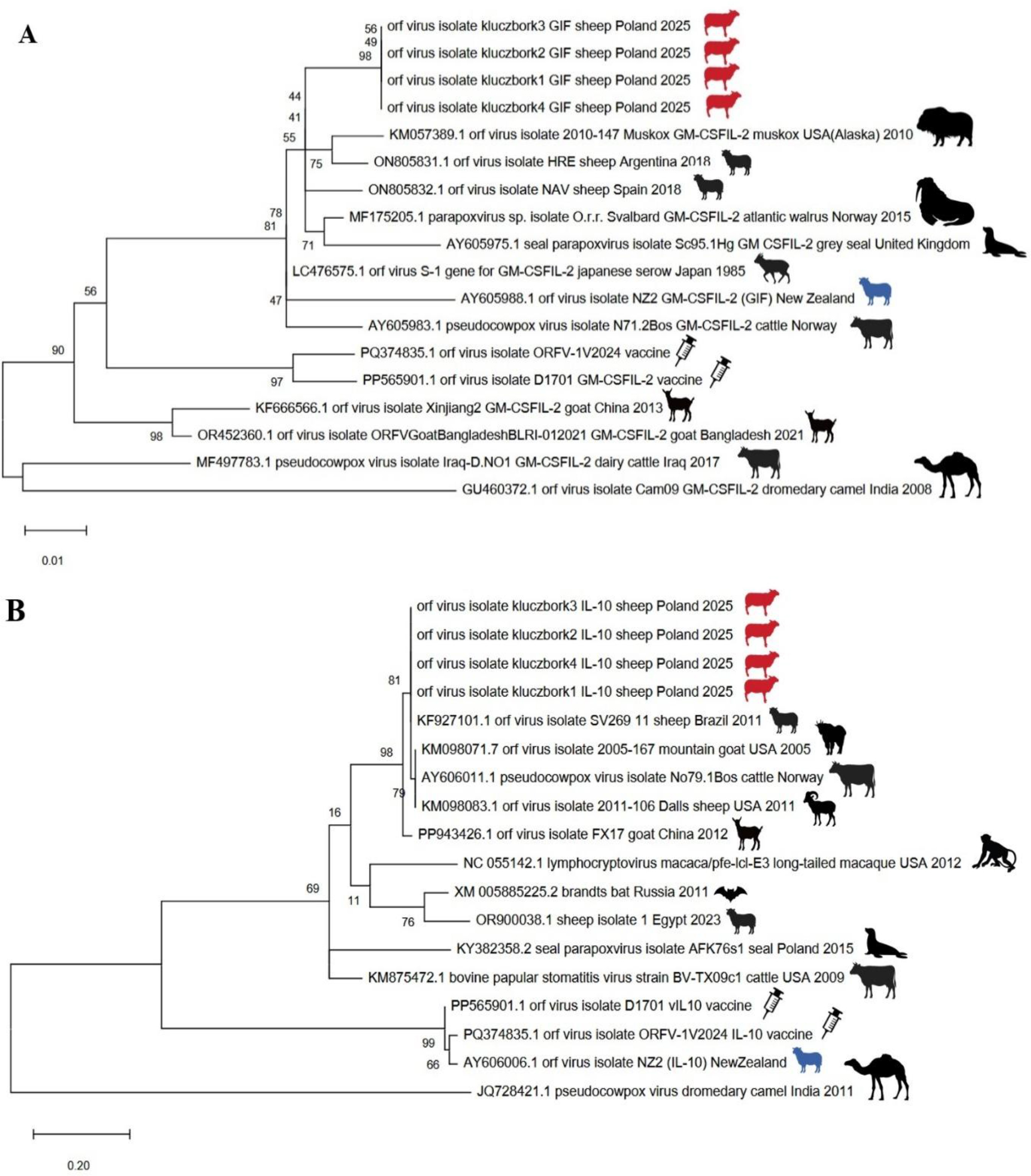
Fig. 3.
Maximum-likelihood trees based on the nucleotide sequences of the granulocyte-macrophage colony-stimulating factor and interleukin-2 inhibition factor (GIF) (A) and viral interleukin 10 orthologue (vIL-10) (B) gene fragments of parapoxviruses detected in sheep in Kluczbork, Poland (sheep in red), Orf virus reference strain NZ2 (sheep in blue), two vaccine strains (marked with syringes) and other sequences retrieved from GenBank (all strains not isolated in the present research preceded by their accession Nos). Bootstrap values were generated for 1,000 repeats
Table 4.
Differential diagnoses of sheep infectious diseases involving changes in the mouth, hooves, teats or external reproductive organs
| Feature | Contagious ecthyma | Sheep pox | Foot-and-mouth disease | Bluetongue | Peste des petits ruminants |
|---|---|---|---|---|---|
| Causative agent | Orf virus (a DNA virus in the Parapoxvirus genus). | Sheeppox virus (a DNA virus in the Capripoxvirus genus). | Foot-and-mouth disease virus (an RNA virus in the Aphthovirus genus). | Bluetongue virus (an RNA virus in the Orbivirus genus). | Peste des petits ruminants virus (an RNA virus in the Morbillivirus genus). |
| Affected species | Sheep, goats and wild ruminants (zoonotic to humans). | Primarily sheep, but also goats (goatpox). | All cloven-hoofed animals (cattle, sheep, goats, pigs). | Sheep, goats, cattle and wild ruminants. | Primarily sheep and goats. |
| Clinical signs | Localised, proliferative skin lesions/scabs, mainly around the mouth and lips of young animals; heals without scarring in 4–5 weeks. | Severe, generalised pox lesions throughout the skin and mucous membranes, persistent fever, pneumonia and high mortality. | Fever, vesicular lesions (blisters) and erosions in the mouth (especially tongue), muzzle, feet and teats; causes lameness. | Oedema of the face/muzzle, soreness of the mouth and feet, oral ulcers, lameness and general weakness. | High fever, severe nasal/ocular discharge (which becomes purulent), diarrhoea, mouth lesions and bronchopneumonia. |
| Affected systems | Integumentary | Integumentary and respiratory | Epithelial surfaces | Multiple systems, including oral mucosa and circulatory system | Respiratory and gastrointestinal |
| Transmission | Direct contact with infected animals or contaminated environment. | Direct contact and possibly insects. | Direct contact, aerosols and contaminated fomites. | Vector-borne by Culicoides biting midges. | Direct contact and contaminated feed/water. |
| Mortality rate | Low (unless secondary infection or starvation in lambs). | Can be very high (up to 100% in lambs). | Low mortality in adult sheep; production losses are the main impact. | Variable, but can be high, especially in lambs. | Can be very high (up to 100% in outbreaks). |
| Zoonotic potential | Yes | No | No | No | No |
| WOAH notifiable disease | No | Yes | Yes | Yes | Yes |
| Present | Endemic worldwide | Africa, the Middle Eastand Asia* | Asia, Africa and South America | Widespread globally | Africa, the Middle East and Asia* |