
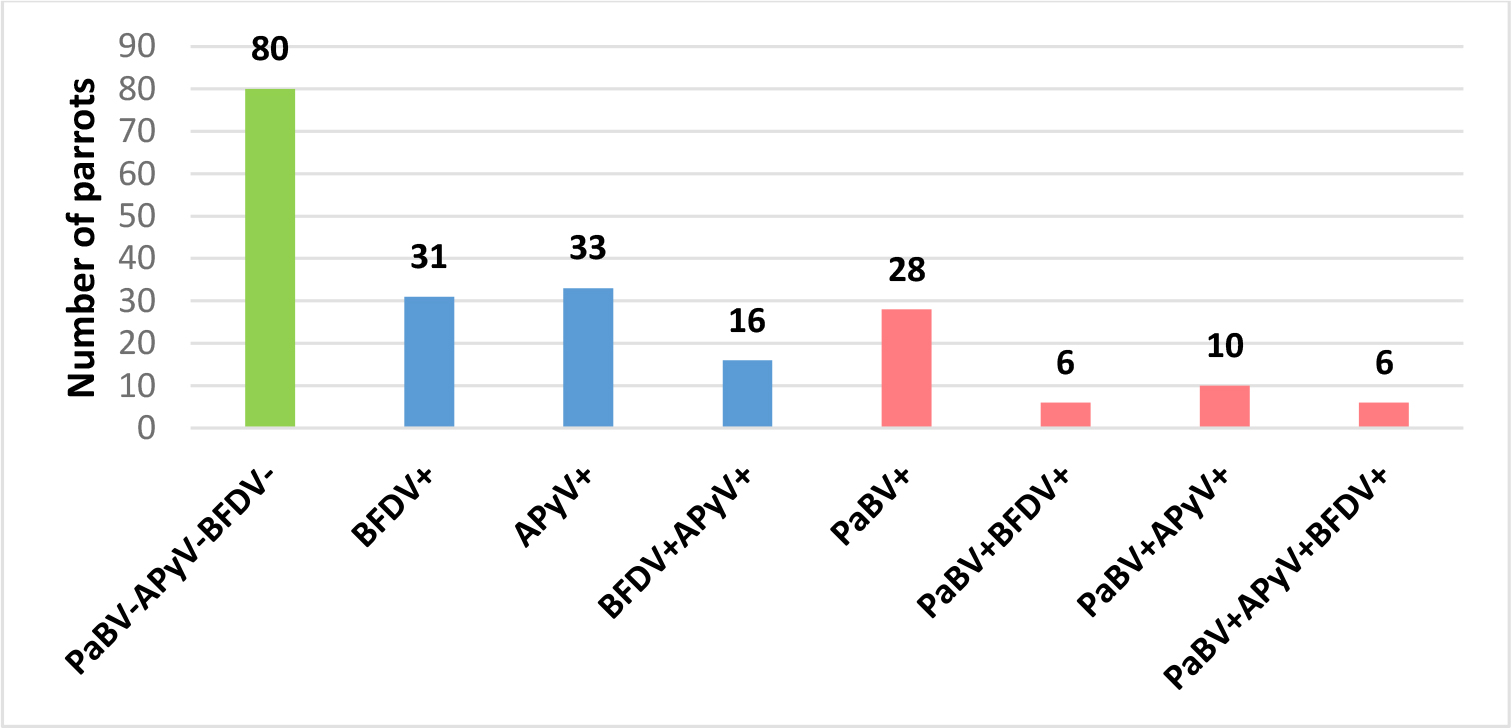
Fig. 1.
Infection patterns among necropsied parrots in Poland 2014–2024, including absence of tested viruses (green), single and mixed infections without parrot bornavirus (PaBV) (blue), and infections involving PaBV (pink). BFDV – beak and feather disease virus; ApyV – avian polyomavirus
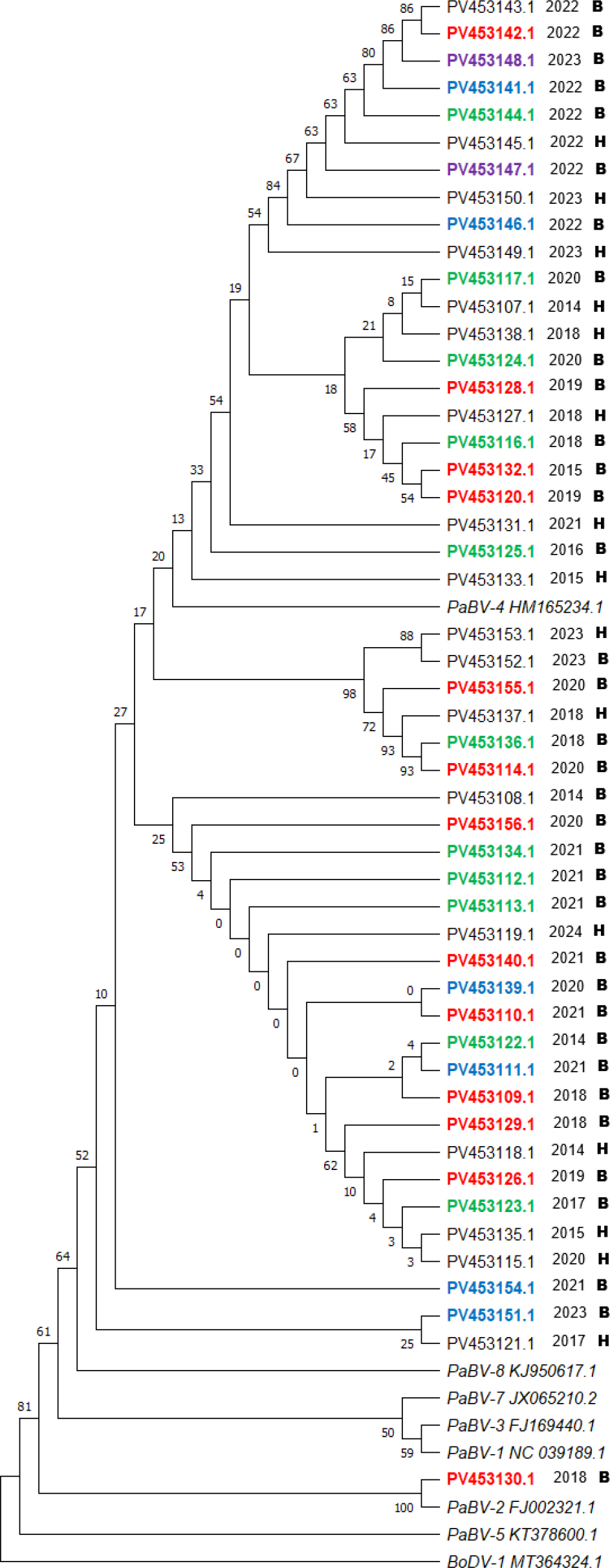
Fig. 2.
Phylogenetic relationships between parrot bornavirus (PaBV) strains detected in tissue samples of naturally deceased parrots in Poland 2014–2024. The tree is based on partial N-gene sequences and was constructed with distances calculated with the Jukes–Cantor model and using the unweighted pair-group method with arithmetic mean. Bootstrap values (1,000 replicates) are shown at the nodes. Reference sequences of PaBV-1 to PaBV-5, PaBV-7 and PaBV-8 and Borna disease virus 1 (BoDV-1; outgroup) were retrieved from GenBank; PaBV-6 could not be included due to absence of N-gene sequences in public databases. Two-letter and seven-digit codes are GenBank accession numbers. Black accession numbers – all samples origin from birds from different owners; coloured accession numbers – sequences written in one colour origin from the same owner; B – breeder aviary; H – home birds (from one to a few individuals); BoDV – Borna disease virus
Table 1.
Yearly distribution of infections
| Year | Total number of birds tested | PaBV-positive birds | BFDV-positive birds | APyV-positive birds |
|---|---|---|---|---|
| 2014 | 10 | 4 (40.00%) | 2 (20.00%) | 5 (50.00%) |
| 2015 | 6 | 3 (50.00%) | 0 (0.00%) | 4 (66.67%) |
| 2016 | 9 | 1 (11.11%) | 2 (22.22%) | 6 (66.67%) |
| 2017 | 16 | 3 (18.75%) | 12 (75.00%) | 6 (37.50%) |
| 2018 | 18 | 9 (50.00%) | 6 (33.33%) | 6 (33.33%) |
| 2019 | 30 | 3 (10.00%) | 12 (40.00%) | 5 (16.67%) |
| 2020 | 34 | 5 (14.71%) | 11 (32.35%) | 11 (32.35%) |
| 2021 | 26 | 8 (30.77%) | 9 (34.62%) | 9 (34.62%) |
| 2022 | 29 | 7 (24.14%) | 2 (6.90%) | 3 (10.34%) |
| 2023 | 15 | 6 (40.00%) | 2 (13.33%) | 3 (20.00%) |
| 2024 | 17 | 1 (5.88%) | 1 (5.88%) | 7 (41.18%) |
Table 2.
Species distribution of infections
| Species | Scientific name | Total number of birds tested | PaBV-positive birds | BFDV-positive birds |
|---|---|---|---|---|
| cockatiel | Nymphicus hollandicus | 21 | 3 | 1 |
| Solomons corella | Cacatua ducorpsii | 1 | 1 | 0 |
| Pink cockatoo | Cacatua leadbeateri | 0 | 0 | 0 |
| grey parrot | Psittacus erithacus erithacus | 3 | 1 | 1 |
| Senegal parrot | Poicephalus senegalus | 3 | 1 | 1 |
| monk parakeet | Myiopsitta monachus | 3 | 1 | 0 |
| blue-headed parrot | Pionus menstruus | 1 | 0 | 1 |
| blue-fronted amazon | Amazona aestiva | 17 | 4 | 6 |
| yellow-headed amazon | Amazona oratrix | 4 | 0 | 0 |
| orange-winged amazon | Amazona amazonica | 1 | 0 | 0 |
| festive amazon | Amazona festiva | 1 | 0 | 1 |
| Cuban amazon | Amazona leucocephala | 1 | 1 | 0 |
| barred parakeet | Bolborhynchus lineola | 3 | 1 | 1 |
| caique | Pionites spp. | 11 | 3 | 1 |
| green-cheeked parakeet | Pyrrhura molinae | 5 | 2 | 1 |
| burrowing parrot | Cyanoliseus patagonus | 1 | 0 | 1 |
| sun conure | Aratinga solstitialis | 2 | 2 | 0 |
| military macaw | Ara militaris | 1 | 0 | 0 |
| golden-collared macaw | Primolius auricollis | 1 | 0 | 0 |
| blue-winged macaw | Primolius maracana | 3 | 0 | 0 |
| hyacinth macaw | Anodorhynchus hyacinthinus | 1 | 0 | 1 |
| chestnut-fronted macaw | Ara severus | 2 | 1 | 0 |
| blue-and-yellow macaw | Ara ararauna | 7 | 5 | 3 |
| Ara harlequin | Ara ararauna × chloroptera | 1 | 1 | 0 |
| red-and-green macaw | Ara chloroptera | 2 | 1 | 0 |
| scarlet macaw | Ara macao | 1 | 0 | 0 |
| red-shouldered macaw | Diopsittaca nobilis | 4 | 4 | 2 |
| regent parrot | Polytelis anthopeplus | 3 | 0 | 0 |
| red-breasted parakeet | Psittacula alexandri | 3 | 0 | 0 |
| plum-headed parakeet | Psittacula cyanocephala | 5 | 2 | 4 |
| rose-ringed parakeet | Psittacula krameri | 8 | 1 | 2 |
| Alexandrine parakeet | Psittacula eupatria | 1 | 1 | 0 |
| Bourke’s parrot | Neopsephotus bourkii | 2 | 2 | 0 |
| scarlet-chested parrot | Neophema splendida | 9 | 3 | 4 |
| red-crowned parakeet | Cyanoramphus novaezelandiae | 7 | 2 | 3 |
| eastern rosella | Platycercus eximius | 4 | 0 | 1 |
| crimson rosella | Platycercus elegans | 3 | 0 | 1 |
| Fischer’s lovebird | Agapornis fischeri | 8 | 2 | 1 |
| rosy-faced lovebird | Agapornis roseicollis | 13 | 2 | 5 |
| budgerigar | Melopsittacus undulatus | 43 | 3 | 17 |
| Total | 210 | 50 | 59 |
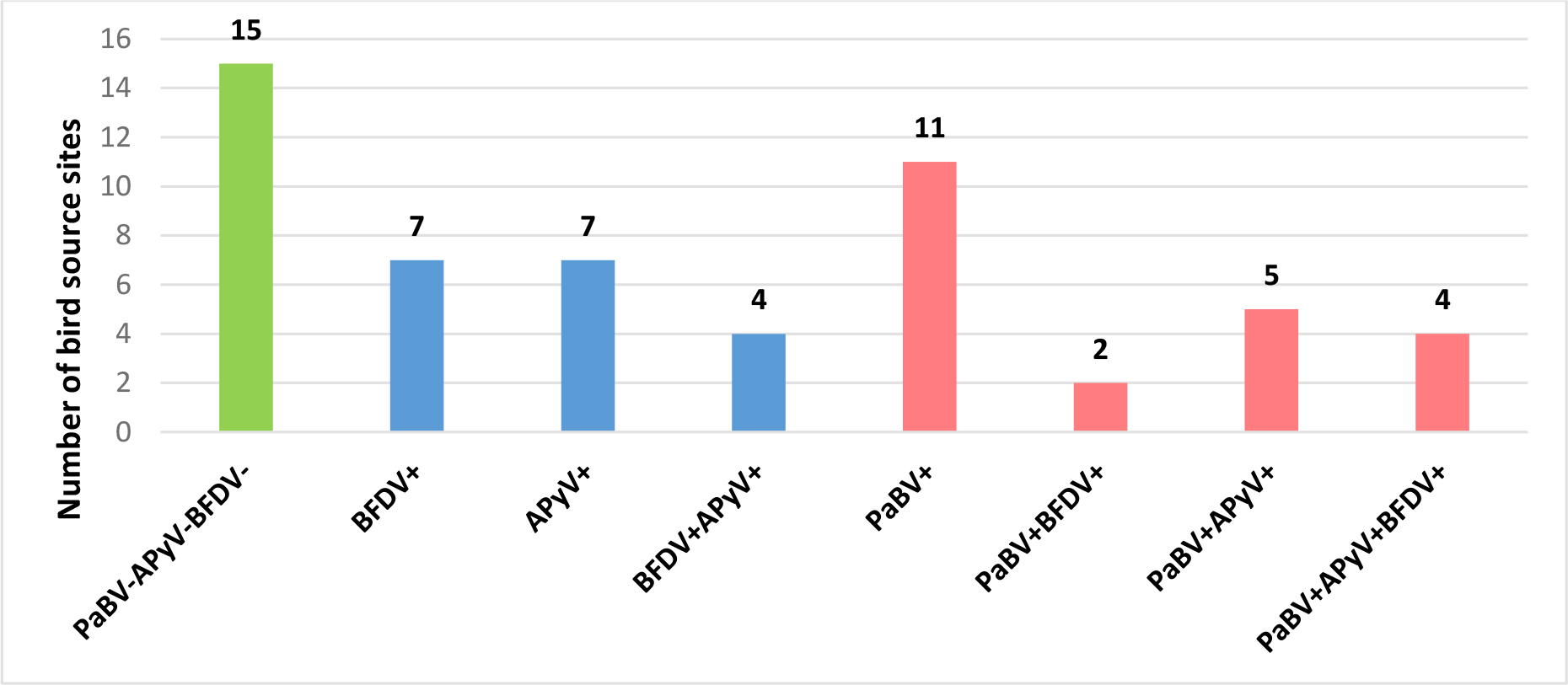
Fig. 3.
Results of viral testing at the bird source–site level, showing sites free of detectable infections (green), those with single or multiple infections without PaBV (blue) and those with infections involving PaBV (pink). PaBV – psittacine bornavirus; BFDV – beak and feather disease virus; APyV – avian polyomavirus