
Table 1.
Summary of demographic and clinical factors characterising the cats of which the conjunctival sacs were swabbed for Chlamydia felis testing
| Number of tested cats | ||
|---|---|---|
| Sex | Male | 86 |
| Female | 70 | |
| 0–1 | 23 | |
| Age (years) | 2–3 | 47 |
| 4–7 | 32 | |
| ≥8 | 54 | |
| European Shorthair | 87 | |
| British Shorthair/Longhair | 16 | |
| Devon Rex | 7 | |
| Mixed breed | 19 | |
| Sphynx | 8 | |
| Breed | Maine Coon | 4 |
| Ragdoll | 5 | |
| Persian | 2 | |
| Scottish Fold | 4 | |
| Exotic Shorthair | 1 | |
| Siberian | 1 | |
| Siamese | 1 | |
| Norwegian Forest | 1 | |
| Cattery | 47 | |
| Stray | 43 | |
| Shelter | 14 | |
| Origin | Raised from birth by one owner | 2 |
| Adoption | 8 | |
| Other | 42 | |
| Evident conjunctivitis | Yes | 81 |
| No | 75 |
Table 2.
Prevalence data for C. felis in cats cross-referenced with demographic and clinical factors
| Number of tested cats | Number of Chlamydiaceae/C. felis-positive cats | ||
|---|---|---|---|
| Sex | Male | 86 | 10 |
| Female | 70 | 2 | |
| Age (years) | 0–1 | 23 | - |
| 2–3 | 47 | 8 | |
| 4–7 | 32 | 3 | |
| ≥8 | 54 | 1 | |
| Breed | European Shorthair | 87 | 6 |
| British Short-/Longhair | 16 | 3 | |
| Devon Rex | 7 | 2 | |
| Mixed-breed | 19 | - | |
| Sphynx | 8 | - | |
| Maine Coon | 4 | - | |
| Ragdoll | 5 | - | |
| Persian | 2 | - | |
| Scottish Fold | 4 | - | |
| Exotic Shorthair | 1 | - | |
| Siberian | 1 | - | |
| Siamese | 1 | - | |
| Norwegian Forest | 1 | 1 | |
| Origin | Cattery | 47 | 5 |
| Stray | 43 | 4 | |
| Shelter | 14 | 2 | |
| Raised from birth by one owner | 2 | 1 | |
| Adoption | 8 | - | |
| Other | 42 | - | |
| Evident | Yes | 81 | 11 |
| conjunctivitis | No | 75 | 1 |
Table 3.
Demographic data and real-time PCR results (threshold cycle (Ct) values) for Chlamydiaceae- and C. felis-positive cats from ocular swabs
| Cat ID | Sex | Age (months) | Breed | Origin | Chlamydiaceae-positive Ct | C. felis-positive Ct | ||
|---|---|---|---|---|---|---|---|---|
| Right eye | Left eye | Right eye | Left eye | |||||
| 23-10A(1/2) | M | 36 | British Longhair | Cattery | 23.97 | 24.69 | 23.90 | 24.40 |
| 23-91A(1/2) | M | 6 | British Shorthair | Cattery | 23.06 | negative | 22.91 | negative |
| 23-162A(1/2) | M | 84 | European Shorthair | Raised from birth by one owner | negative | 35.47 | negative | 34.19 |
| 23-340A | M | 7 | European Shorthair | Shelter | 27.1 | not tested | 26.90 | not tested |
| 23-393A(1/2) | M | 18 | British Shorthair | Cattery | 31.23 | negative | 31.04 | negative |
| 23-445A(1/2) | M | 30 | Norwegian Forest | Shelter | negative | 31.26 | negative | 30.84 |
| 23-716A(1/2) | M | 24 | Devon Rex | Cattery | 26.09 | negative | 26.05 | negative |
| 24-1A (1/2) | M | 12 | European Shorthair | Stray | negative | 25.66 | negative | 25.93 |
| 24-10A(1/2) | F | 6 | European Shorthair | Stray | 31.98 | 32.83 | 32.13 | 32.65 |
| 24-101A(1/2) | M | 48 | European Shorthair | Stray | 31.38 | 28.33 | 30.79 | 27.95 |
| 24-370A(1/2) | M | not available | Devon Rex | Cattery | 35.77 | 33.91 | 35.51 | 33.33 |
| 24-491A(1/2) | F | 6 | European Shorthair | Stray | 29.26 | negative | 25.56 | negative |
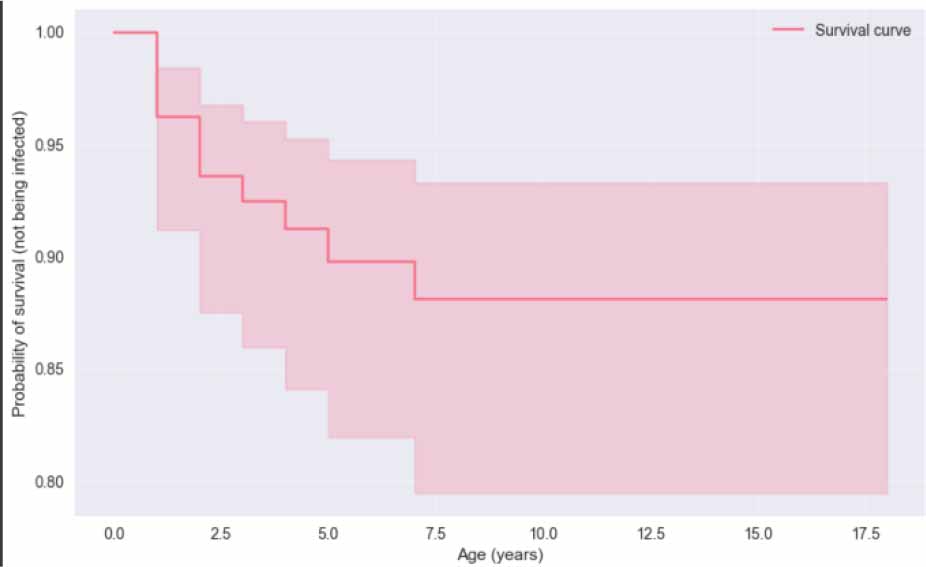
Fig. 1
Kaplan–Meier survival curve showing the probability of remaining infection-free by age in cats
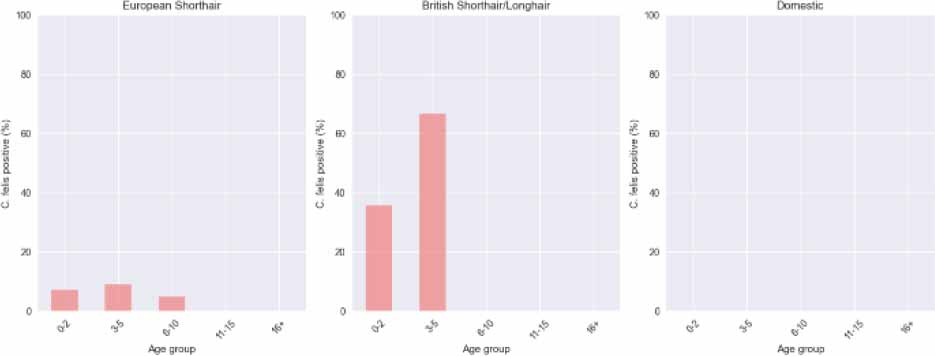
Fig 2.
Prevalence of C. felis infection in cats by age group and breed
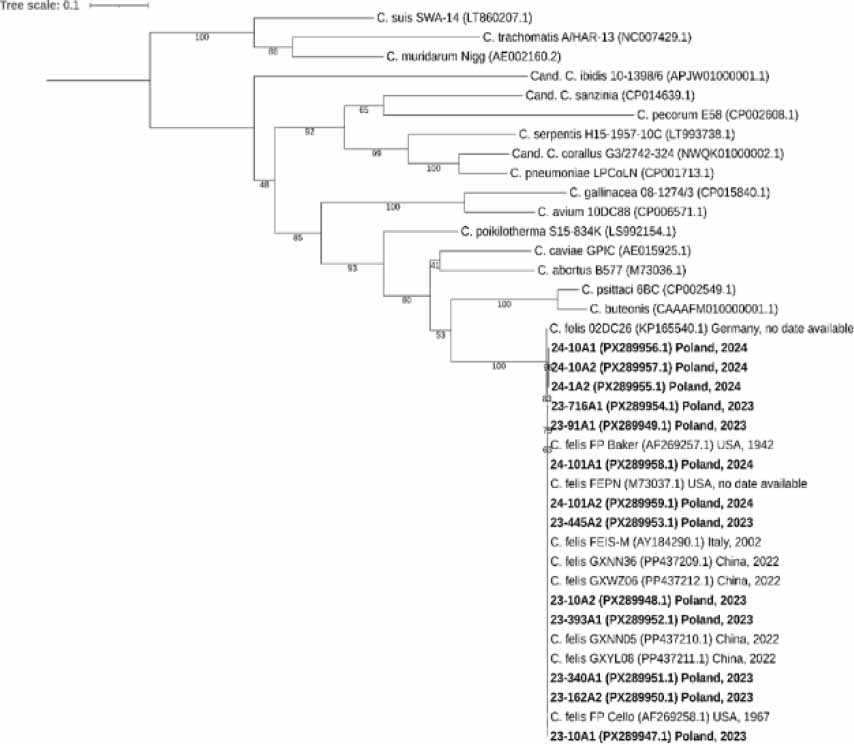
Fig 3.
Analysis of the partial ompA gene of C. felis and representatives of Chlamydia spp. The phylogenetic tree is based on 808-base-pair consensus alignment and was constructed by the maximum-likelihood method with best-fit model according to the Bayesian information criterion general time reversible model with free base frequencies, invariant sites and γ four-rate category distribution, with support values calculated from 1,000 bootstraps. The scale bar represents the number of nucleotide substitutions per site. Sequences obtained in this study are marked in bold. GenBank accession numbers are shown in brackets