
Table 1.
Type and number of samples tested for glycerol triheptanoate marker content in Poland 2010–2024
| Type of material | Meat and bone meal | Fat | Processed animal proteins | Soil improvers | Others | ||||||
|---|---|---|---|---|---|---|---|---|---|---|---|
| GTH marker | Unknown material of animal origin | Antioxidants | Feed materials and mixtures | Dog chews | Feathers | Bird balls | |||||
| Numer of samples | 1,163 | 1,017 | 58 | 30 | 14 | 9 | 3 | 5 | 2 | 1 | 1 |
| Total: 35 | |||||||||||
| Total | 2,303 | ||||||||||
Table 2.
Optimal operating conditions for gas chromatograph and flame ionization detector
| Carrier gas | Helium, flow rate 2.3 mL/min |
| Capillary column | DB-5, 30 m, Internal diameter 0.25 mm, film thickness 0.25 μm |
| Column thermostat | Initial temperature 80°C for 1 min Ramp 70°C/min to 250°C (hold for 1 min) Ramp 73°C/min to 330°C Final temperature 330°C for 7 min |
| Injector temperaturę | 280°C |
| Sample injection | Split 10:1, injection volume 2 μL |
| Detector temperaturę | 360°C |
| Detector gases | Hydrogen:synthetic air 1:10; 40 mL/min: 400 mL/min |
Table 3.
Optimal operating conditions for gas chromatograph and mass spectrometer
| Carrier gas | Helium, flow rate 1.4 mL/min |
| Capillary column | DB-5 MS, 30 m, Internal diameter 0.25 mm, film thickness 0.25 μm |
| Column thermostat | Initial temperature 70°C for 1 min Ramp 45°C/min Final temperature 325°C for 8 min |
| Injector temperature | 250°C |
| Sample injection | Split 20:1, injection volume 2 μL |
| Ionisation type | Electron ionisation (EI) |
| Dwell time | 50 msec |
| Ion source temperaturę | 230°C |
| Operation mode | Selected ion monitoring (SIM) |
| Recorded ions (m/z) | Glicerol triheptanoate - 299.1; 285.0; 228.2 Internal standard – 217.0; 372.4, 218.0 |
| Tuning | Automatic optimisation - autotune |
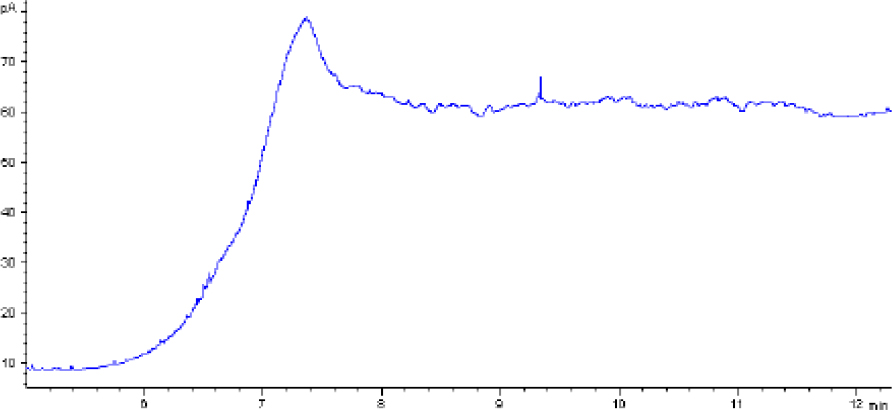
Fig. 1a.
Chromatogram of a blank animal by-product sample obtained using gas chromatography–flame ionisation detection
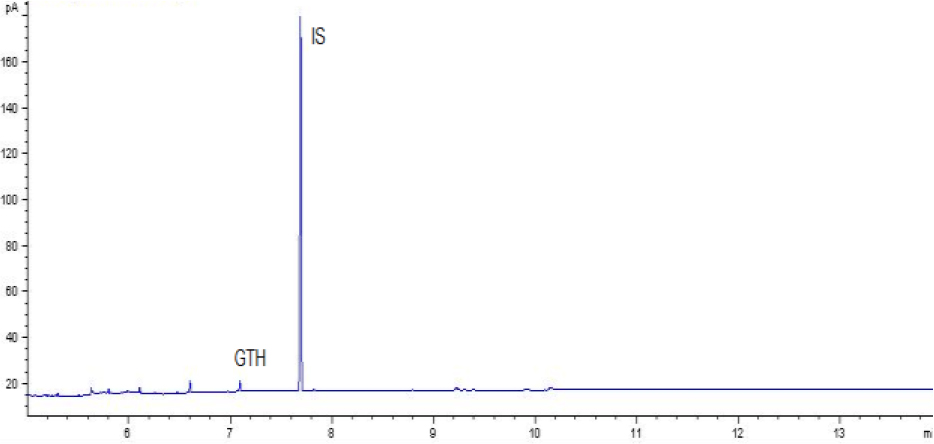
Fig. 1b.
Chromatogram of a control sample with glycerol triheptanoate (GTH) content of 250 mg/kg of fat using gas chromatography–flame ionisation detection. IS – internal standard
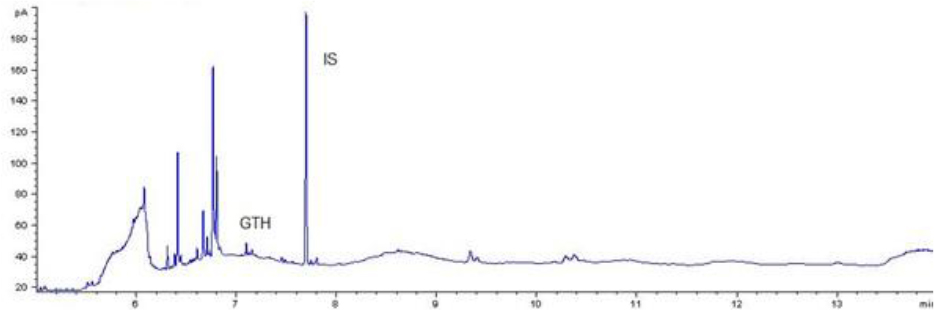
Fig. 1c.
Chromatogram of a routine sample with glycerol triheptanoate (GTH) content of 440 mg/kg of fat using gas chromatography–flame ionisation detection. IS – internal standard
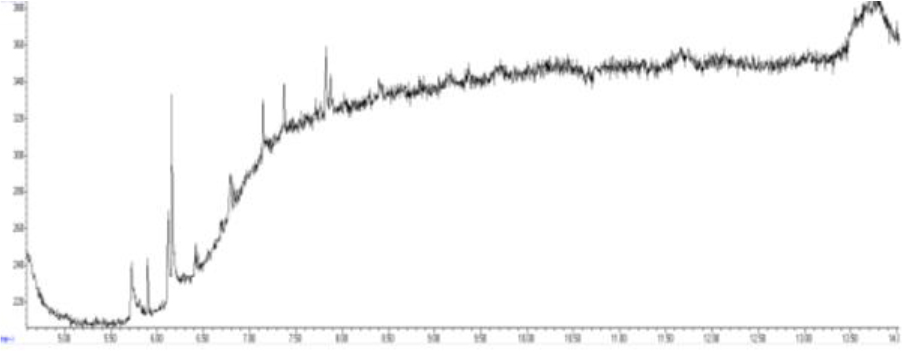
Fig. 2a.
Chromatogram of a blank sample obtained using gas chromatography–mass spectrometry
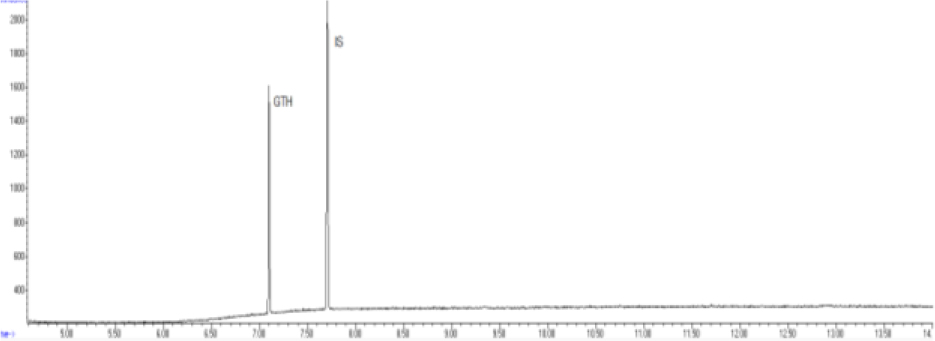
Fig. 2b.
Chromatogram of a control sample with glycerol triheptanoate (GTH) content of 250 mg/kg of fat using gas chromatography–mass spectrometry. IS – internal standard
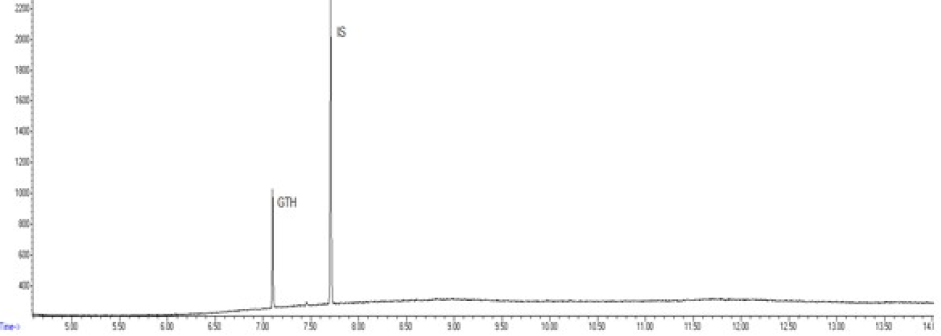
Fig. 2c.
Chromatogram of a routine sample with glycerol triheptanoate (GTH) content of 160 mg/kg of fat using the gas chromatography–mass spectrometry. IS – internal standard
Table 4.
Validation results of gas chromatography–flame ionisation detection method for glycerol triheptanoate measurement in animal by-product samples
| Validation parameter | Validation result | |||||
|---|---|---|---|---|---|---|
| Meat and bone meal | Fat | |||||
| Linearity | 0.999 | |||||
| R2 | 75–600 | |||||
| Working range (mg/kg of fat) | ||||||
| Selectivity | No interference | |||||
| Limit of detection (mg/kg of fat) | 28.93 | 25.07 | ||||
| Limit of quantification | 60.43 | 37.26 | ||||
| Matrix spiking level (mg/kg of fat) | 75 | 250 | 600 | 75 | 250 | 600 |
| Repeatability (CV, %) | 5.20 | 8.79 | 2.64 | 3.35 | 2.17 | 2.95 |
| Within-laboratory reproducibility (CV, %) | 11.79 | 9.76 | 2.87 | 2.75 | 4.02 | 3.14 |
| Recovery (%) | 80.47 | 91.98 | 91.54 | 89.86 | 89.65 | 89.15 |
| Uncertainty (U, %) | 18.40 | 18.54 | 8.39 | 14.03 | 13.20 | 13.69 |
Table 5.
Validation results of the gas chromatography–mass spectrometry method for glycerol triheptanoate measurement in animal by-product samples
| Validation parameter | Validation result | |||||
|---|---|---|---|---|---|---|
| Meat and bone meal | Fat | |||||
| Linearity | ||||||
| R2 | 0.999 | |||||
| Working range (mg/kg of fat) | 75–625 | |||||
| Selectivity | No interference | |||||
| Limit of detection (mg/kg of fat) | 13.98 | 16.76 | ||||
| Limit of quantification | 21.68 | 23.66 | ||||
| Matrix spiking level (mg/kg of fat) | 75 | 250 | 625 | 75 | 250 | 625 |
| Repeatability (CV, %) | 2.03 | 3.89 | 3.68 | 8.97 | 2.22 | 3.53 |
| Within-laboratory reproducibility (CV, %) | 9.63 | 7.42 | 4.30 | 7.35 | 1.94 | 6.15 |
| Recovery (%) | 91.50 | 89.40 | 87.60 | 85.50 | 87.60 | 89.10 |
| Uncertainty (U, %) | 7.31 | 8.25 | 7.91 | 15.33 | 5.16 | 7.75 |
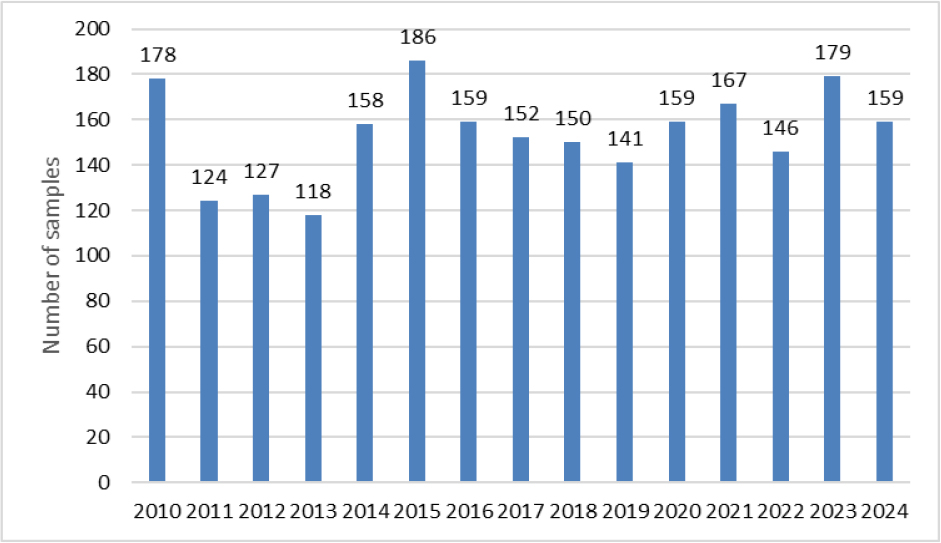
Fig. 3.
Number of animal by–products samples tested in 2010 – 2024
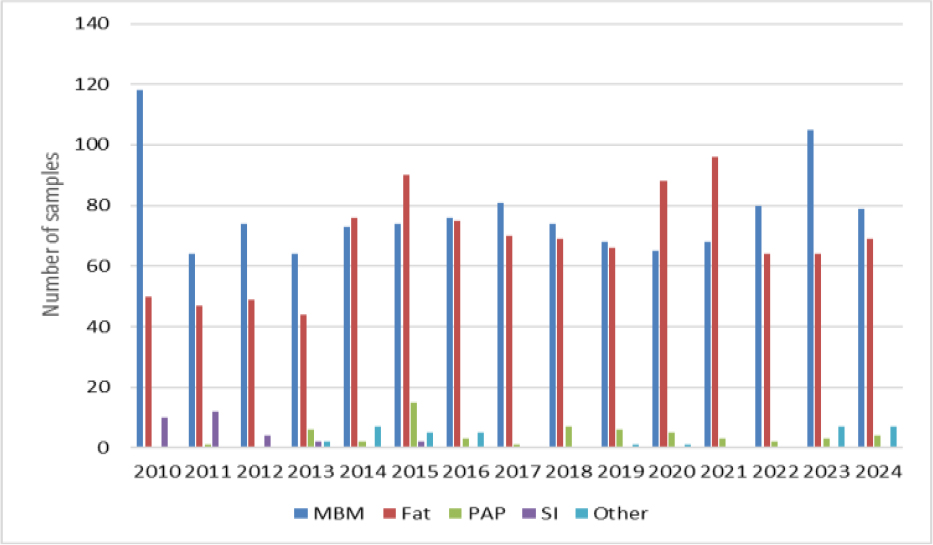
Fig. 4.
Number of animal by-product samples analysed in individual years by broad category of tested material. MBM – meat and bone meal; Fat – rendered fat; PAP – processed animal protein; SI – soil improver; Other – antioxidants, feed materials and mixtures, dog chews, feathers, bird balls, unknown material of animal origin and GTH markers
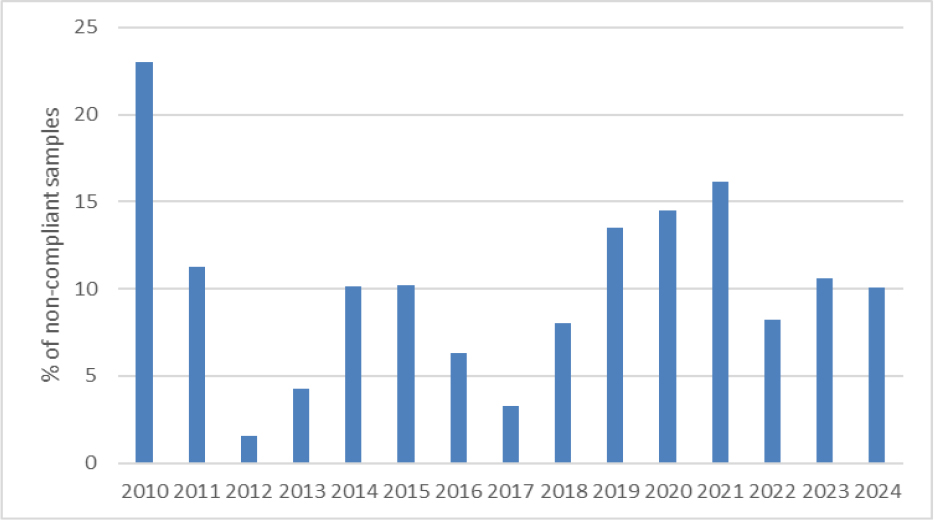
Fig. 5.
Percentage of non-compliant samples in individual years