
Table 1.
Comparison of the number of horses tested for Taylorella equigenitalis and showing positive results in particular years
| Year | Number of horses tested | Number/% of tested | Number/% of positive horses | Sex of positive horses | |
|---|---|---|---|---|---|
| mares | stallions | ||||
| 2018 | 64 | 20/31.25 | 44/68.75 | ||
| 2019 | 68 | 9/13.24 | 59/86.76 | 1/1.47 | ♂ |
| 2020 | 52 | 6/11.54 | 46/88.46 | ||
| 2021 | 99 | 19/19.20 | 80/80.80 | 1/1.01 | ♂ |
| 2022 | 80 | 14/17.50 | 66/82.50 | 1/1.25 | ♂ |
| 2023 | 68 | 12/17.65 | 56/82.35 | 3/4.41 | 3 × ♂ |
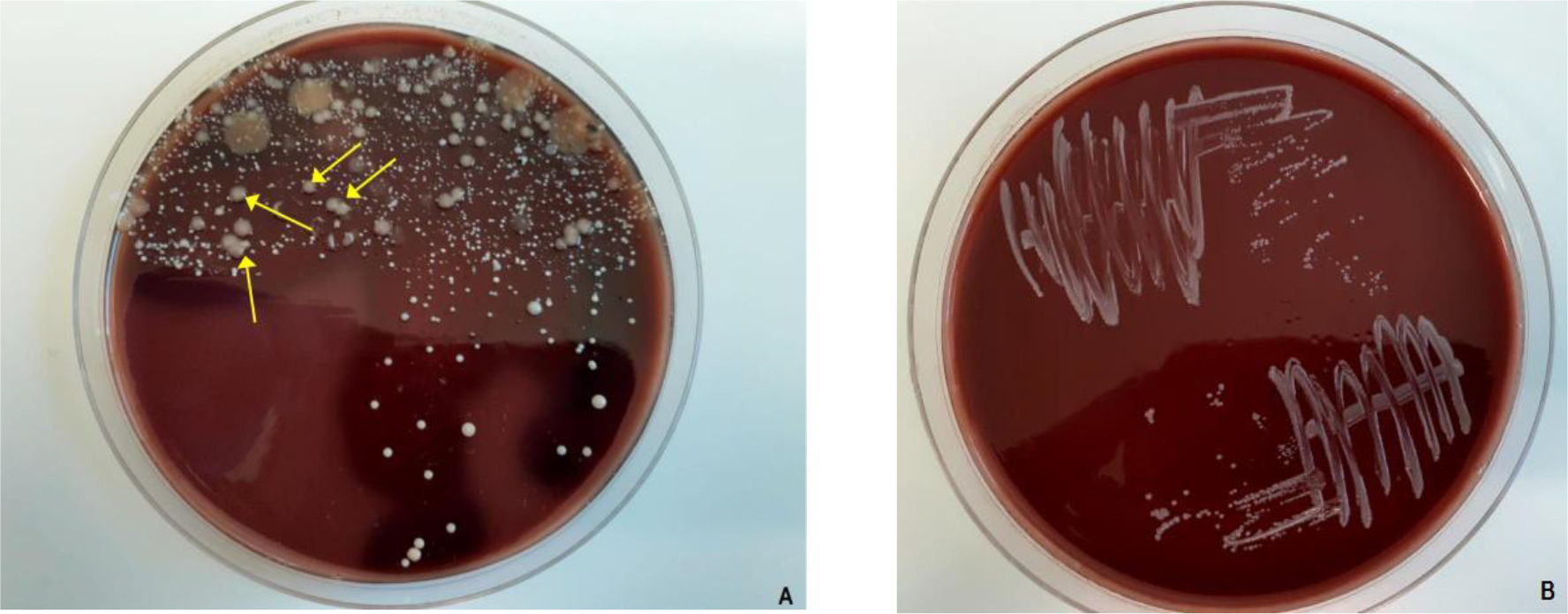
Fig. 1.
Growth of Taylorella equigenitalis on chocolate agar. A) colonies (indicated by arrows) among mixed cultures of bacteria grown in direct inoculations from urogenital swabs of stallions onto agar. B) isolated cultures
Table 2.
Comparison of the age and breed of stallions identified as infected with Taylorella equigenitalis and of the laboratory results of their urogenital swabs
| Year of examination | Age (years) | Breed | Culture (isolation) | Streptomycin susceptibility/resistance | Serological identification (latex agglutination) | Oxidase production | Catalase production | Real-time PCR |
|---|---|---|---|---|---|---|---|---|
| 2019 | 5 | Arabian | + | susceptible | T. equigenitalis | + | + | + |
| 2021 | 19 | Malopolski | + | susceptible | T. equigenitalis | + | + | + |
| 2022 | 20 | Malopolski | + | susceptible | T. equigenitalis | + | + | + |
| 2023 | 4 | Anglo European Sport Horse (AES) | + | resistant | T. equigenitalis | + | + | + |
| 2023 | 4 | Westphalian | + | resistant | T. equigenitalis | + | + | + |
| 2023 | 4 | Sella Italiano | + | resistant | T. equigenitalis | + | + | + |
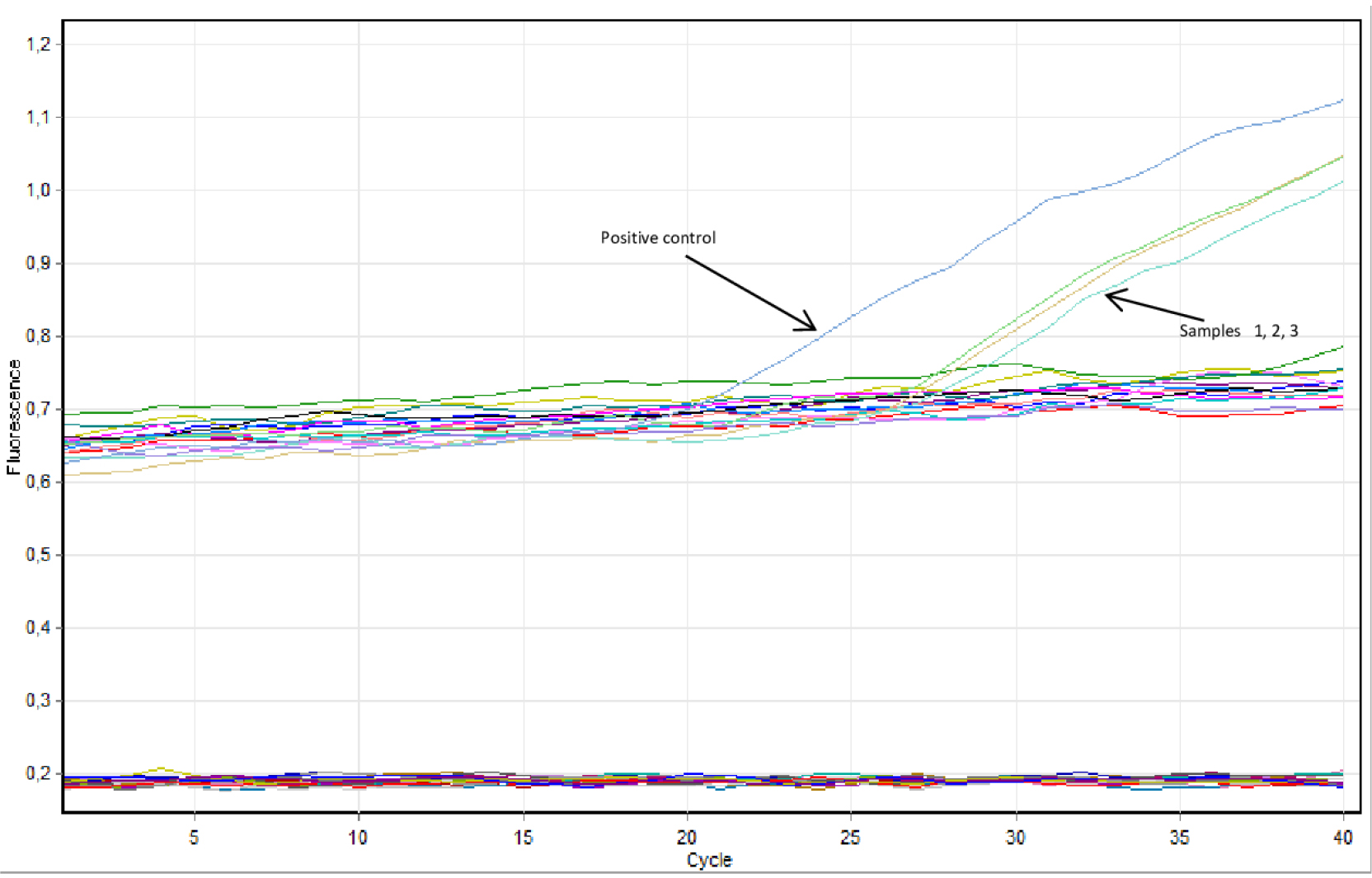
Fig. 2.
Real-time PCR amplification curves showing positive detections of Taylorella equigenitalis DNA in urogenital swabs from stallions