
Table 1.
Results of mycobacterial interspersed repetitive unit–variable number of tandem repeats (MIRU-VNTR) typing and insertion sequence (IS)901, IS900 and IS1245 identification of a Mycobacterium avium strain isolated from black howler monkey (Alouatta caraya) faeces
| Isolate No. | Strain origin | Number of copies MIRU-VNTR region | Subspecies assignment | IS901 | IS900 | IS1245 | |||||||
|---|---|---|---|---|---|---|---|---|---|---|---|---|---|
| TR 292 | TR X3 | TR 25 | TR 47 | TR 3 | TR 7 | TR 10 | TR 32 | ||||||
| N32 | Black howler monkey | 2 | 2 | 2 | 2 | 1 | 2 | 2 | 9 | MAH | – | – | + |
Table 2.
Antibiogram results for the tested Mycobacterium avium strain isolated from black howler monkey (Alouatta caraya) faeces
| Antibiotic | MIC result | Interpretation |
|---|---|---|
| Clarithromycin | 1 | S |
| Moxifloxacin | 8 | S |
| Amikacin | 4 | R |
| Linezolid | 16 | I |
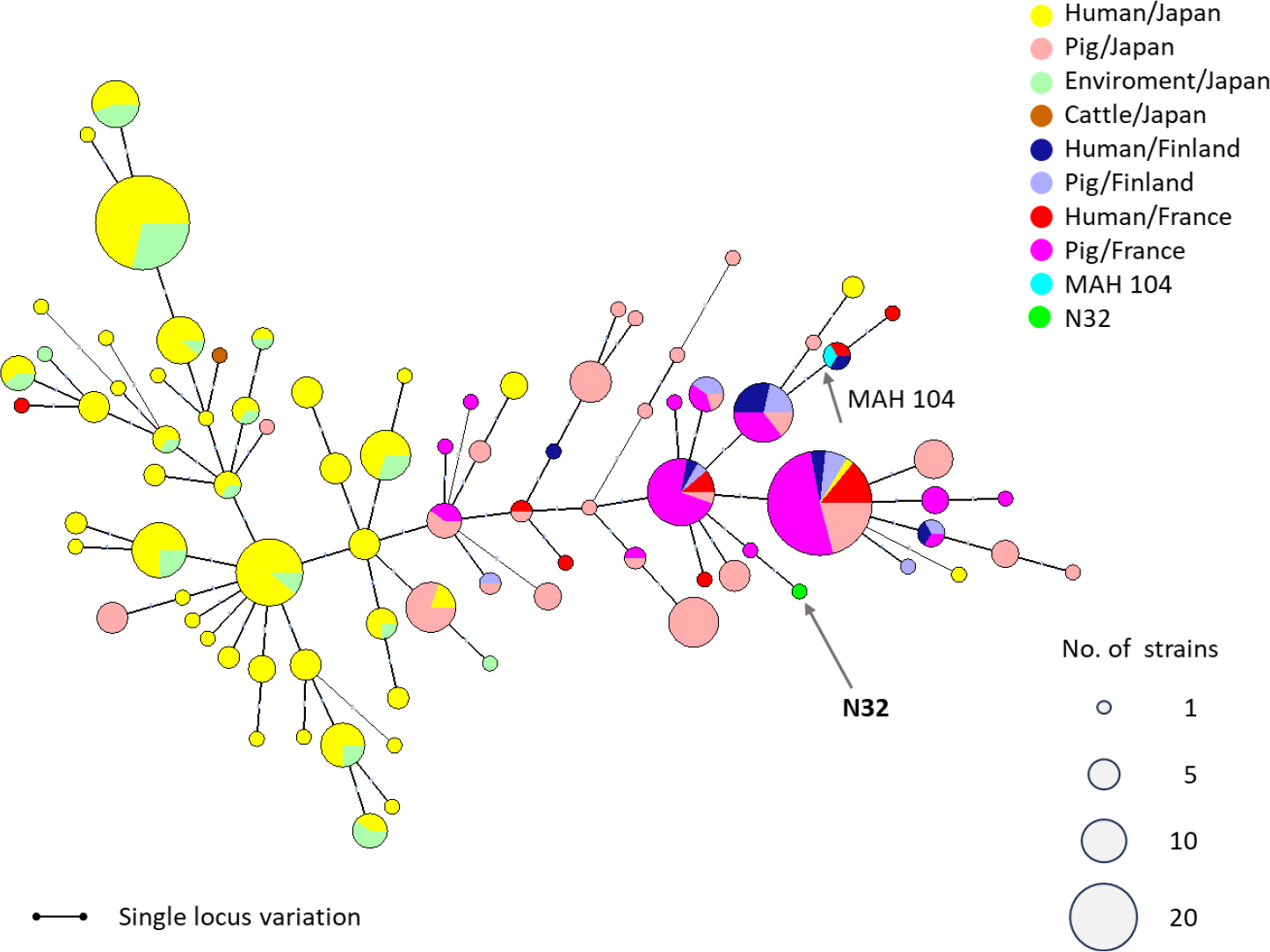
Fig. 1.
Combined minimum spanning tree analysis based on seven-locus (mycobacterial interspersed repetitive unit-variable number of tandem repeats (MIRU-VNTR) genotyping taking the 07, 10, 25, 32, 47, 292 and X3 loci of Mycobacterium avium subsp. hominissuis (MAH) strains. The N32 MAH strain isolated from two black howler monkeys with recurrent diarrhoea (N32) and previously published strain data were used for the analysis. Circle sizes are proportional to the number of isolates sharing an identical VNTR pattern. MAH 104 is a reference strain. Lines connecting two types denote single- or double-locus variations with each length