
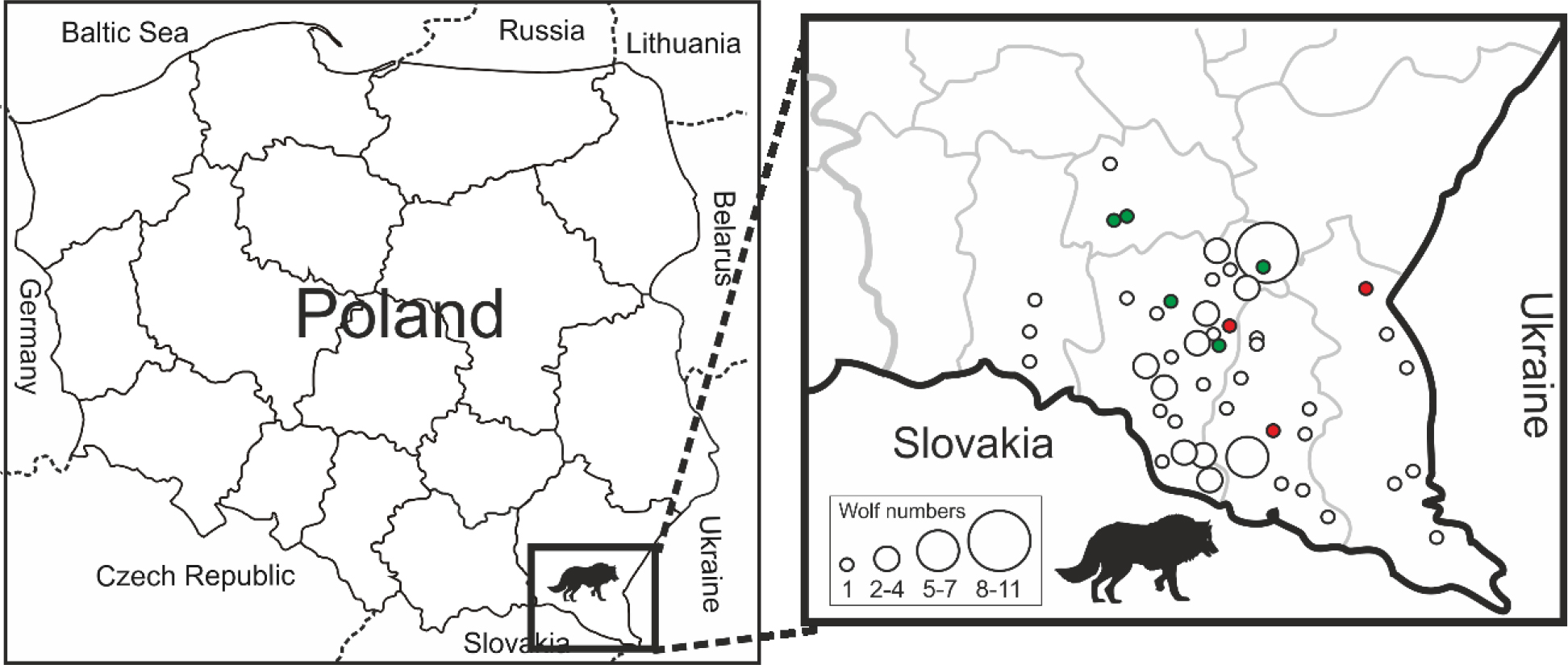
Fig. 1.
Geographical location of wolf faecal samples collected for the study. Numbers of samples obtained in individual locations are represented by circles of different sizes. Green circles – Echinococcus multilocularis-positive samples; red circles – E. ortleppi-positive samples; white circles – Echinococcus spp.-negative samples
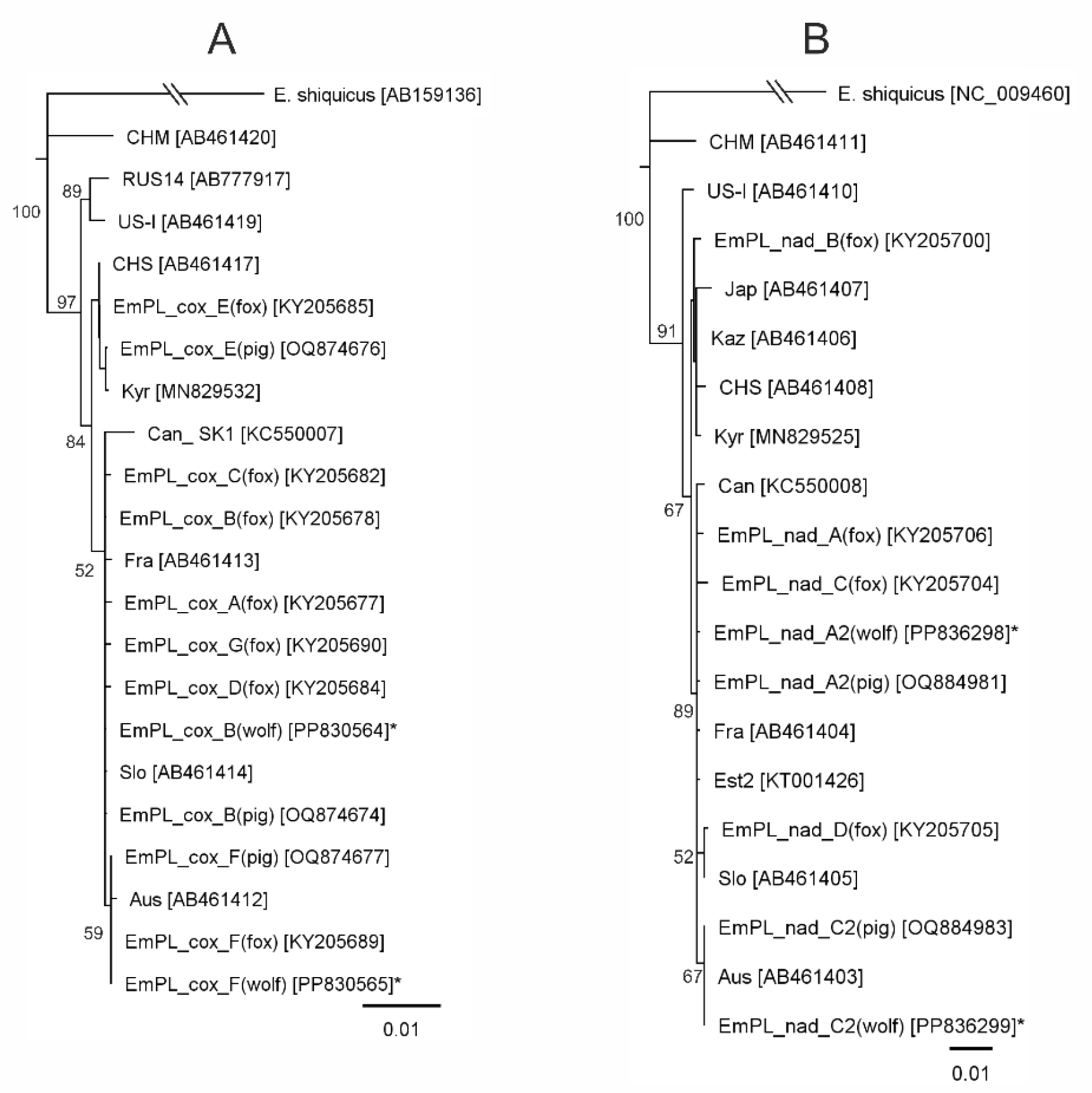
Fig. 2.
Phylogenetic trees of Echinococcus multilocularis based on the cox1 gene (A) and nad2 gene (B). EmPL_cox_A-EmPL_cox_G and EmPL_nad_A-EmPL_nad_D – Polish haplotypes (* – sequences of this study); Aus – Austria; Can/Can_SK1 – Canada; CHM – China (Inner Mongolia); CHS – China (Sichuan); Est2 – Estonia; Fra – France; Jap – Japan, Kaz – Kazakhstan; Kyr – Kyrgyzstan; RUS14 – Russia; Slo – Slovakia; US-I – USA (Indiana). Values on the tree nodes are bootstrap proportions (%)
Table 1.
Combined results of multiplex and quantitative PCR analysis of wolf faeces samples (n = 74) to detect helminth DNA
Table 2.
Occurrence of helminths in wolf intestines (n = 20) estimated using sedimentation and counting technique taking into account the location and distribution of parasites in individual parts of the intestines
| Helminth | Entire intestines (small + large) | Small intestine | Large intestine | |||||||
|---|---|---|---|---|---|---|---|---|---|---|
| Anterior part | Middle part | Posterior part | ||||||||
| % Positive (95% CI) | Mean intensity (range) [CV] | % Positive (95% CI) | Mean intensity (range) [CV] | % Positive (95% CI) | Mean intensity (range) [CV] | % Positive (95% CI) | Mean intensity (range) [CV] | % Positive (95% CI) | Mean intensity (range) [CV] | |
| Echinococcus multilocularis | 10 (3–30) | 27,833 (6–55,660) [141%] | 10 (3–30) | 1,832 (3–3,660) [141%] | 10 (3–30) | 26,002 (3–52,000) [141%] | 0 | - | 5 (1–24) | 8 |
| E. granulosus s.l.a | 10 (3–30) | 250 (64–436) [105%] | 10 (3–30) | 184 (42–326) [109%] | 10 (3–30) | 61 (14–108) [109%] | 10 (3–30) | 3 (1–5) [94%] | 10 (3–30) | 2 (1–3) [71%] |
| Taenia spp. | 100 | 33 (1–208) [135%] | 90 (70–97) | 5 (1–30) [178%] | 90 (70–97) | 24 (1–150) [140%] | 80 (58–92) | 8 (1–30) [121%] | 35 | 1.3 (1–3) [59%] |
| Mesocestoides spp. | 10 (3–30) | 15 (1–28) [131%] | 5 (1–24) | 1 | 5 (1–24) | 28 | 0 | - | 0 | - |
| Euryhelmis spp. | 5 (1–24) | 477 | 0 | - | 0 | - | 5 (1–24) | 477 | 0 | - |
| Alaria alata | 20 (8–40) | 34 (1–135) [190%] | 20 (8–40) | 34 (1–135) [190%] | 0 | - | 0 | - | 0 | - |
| Uncinaria/ Ancylostoma | 30 (15–50) | 45 (1–219) [188%] | 10 (3–30) | 1 | 30 (15–50) | 32 (1–148) [183%] | 15 (5–36) | 26 (1–70) [144%] | 5 (1–24) | 2 |
| Molineus spp. | 5 (1–24) | 47 | 5 (1–24) | 1 | 5 (1–24) | 1 | 5 (1–24) | 45 | 0 | - |
| Trichuris vulpis | 15 (5–36) | 1 | 0 | - | 0 | - | 0 | - | 15 (5–36) | 1 |
| Total (all parasites) | 100 | - | 90 (70–97) | - | 90 (70–97) | - | 85 (64–95) | - | 55 (34–74) | - |
Table 3.
Results of microscopic examination (flotation) of wolf faeces for helminths (n = 63)
| % of positive samples (95% CI) | Mean EPG/OPG (range) (CV) | |
|---|---|---|
| Taeniidae | 27.0 (17.6–39.0) | 399 (15–3,000) (186%) |
| Trematoda | 3.2 (0.9–10.9) | 26 (15–50) (76%) |
| Capillariidae | 58.7 (46.4–70.0) | 316 (7–2,250) (173%) |
| Uncinaria/Ancylostoma | 1.6 (0.2–8.5) | 15 |
| Trichuris vulpis | 1.6 (0.2–8.5) | 15 |
| Toxocara sp. | 1.6 (0.2–8.5) | 15 |
| Coccidia | 1.6 (0.2–8.5) | 300 |