Have a personal or library account? Click to login
Immunodetection of selected pancreatic hormones under intragastric administration of apelin-13, a novel endogenous ligand for an angiotensin-like orphan G-protein coupled receptor, in unweaned rats Cover

Immunodetection of selected pancreatic hormones under intragastric administration of apelin-13, a novel endogenous ligand for an angiotensin-like orphan G-protein coupled receptor, in unweaned rats

Open Access
|Aug 2024

Figures & Tables

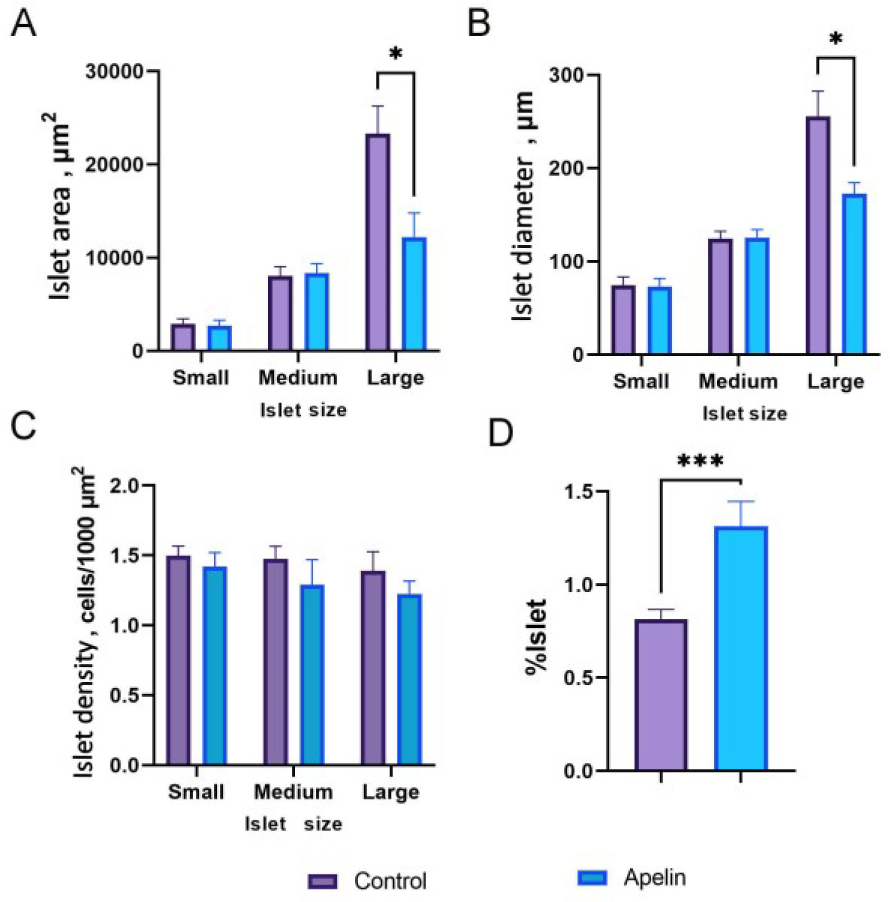
Fig. 1.

(A) Islet area, (B) islet diameter and (C) islet density mean values (with standard deviation-whiskers) of small, medium and large islets in the control (n = 6) and apelin-treated (n = 6) rat groups and (D) percentage of islet area in the pancreas in the control and apelin-treated groups. Asterisks (*) indicate significant differences between control and apelin treated groups within like-sized subgroups of islets (* – P-value < 0.05; *** – P-value < 0.001)
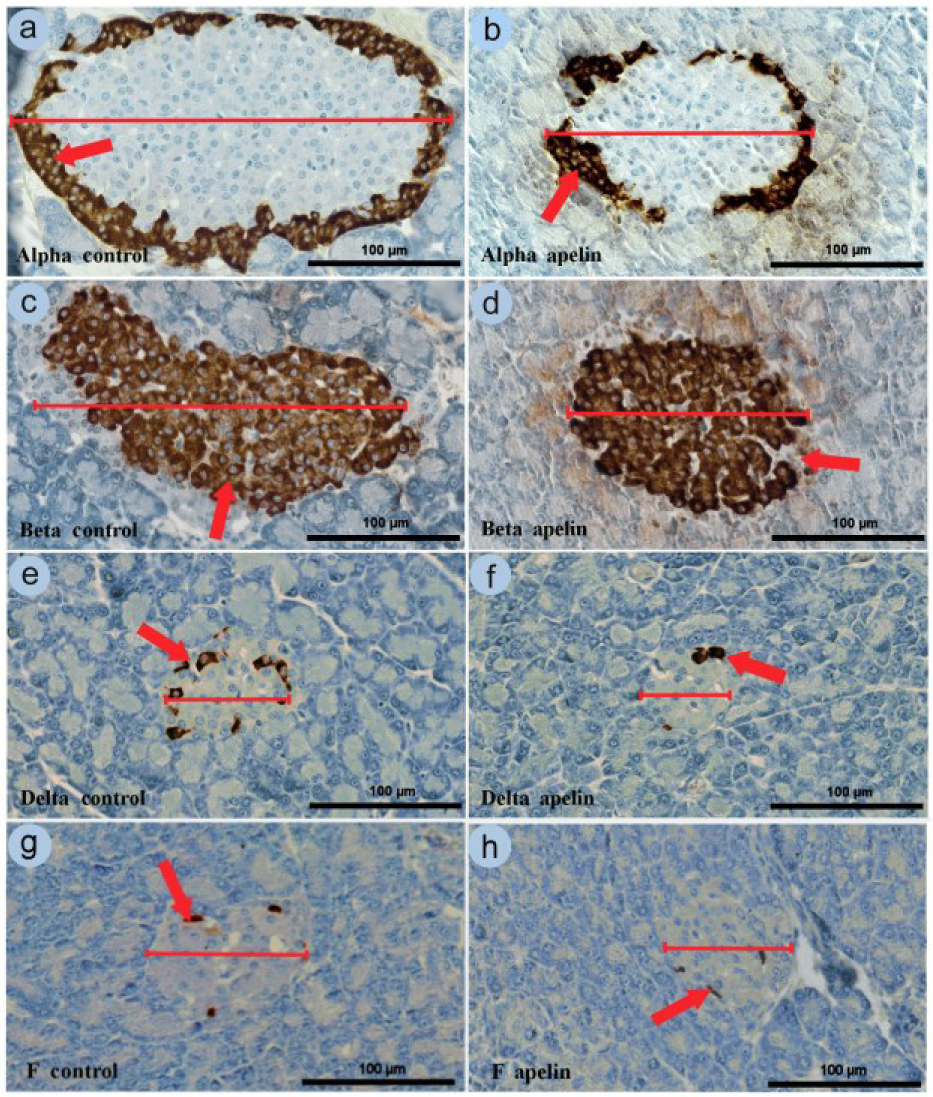

Fig. 2.

(a and b) Immunoreactivity of glucagon, (c and d) insulin, (e and f) somatostatin and (g and h) pancreatic polypeptide in (a–d) large and (e–h) small pancreatic islets: a, c, e and g – control group; b, d, f and h – apelin group. Red lines indicate the diameter of the islet and red arrows indicate changes in immunoreactive cell density (cells/1,000 µm2). Scale bar: 100 µm
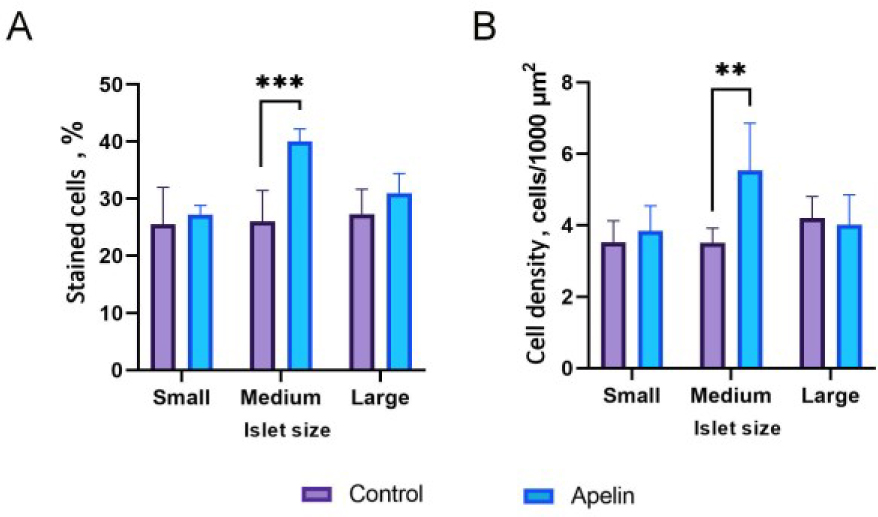

Fig. 3.

(A) Stained alpha cell percentage and (B) alpha cell density mean values (with standard deviation-whiskers) in small, medium and large islets in the control (n = 6) and apelin-treated (n = 6) rat groups. Asterisks (*) indicate significant differences between control and apelin treated groups within like-sized subgroups of islets (** – P-value < 0.01; *** – P-value < 0.001)
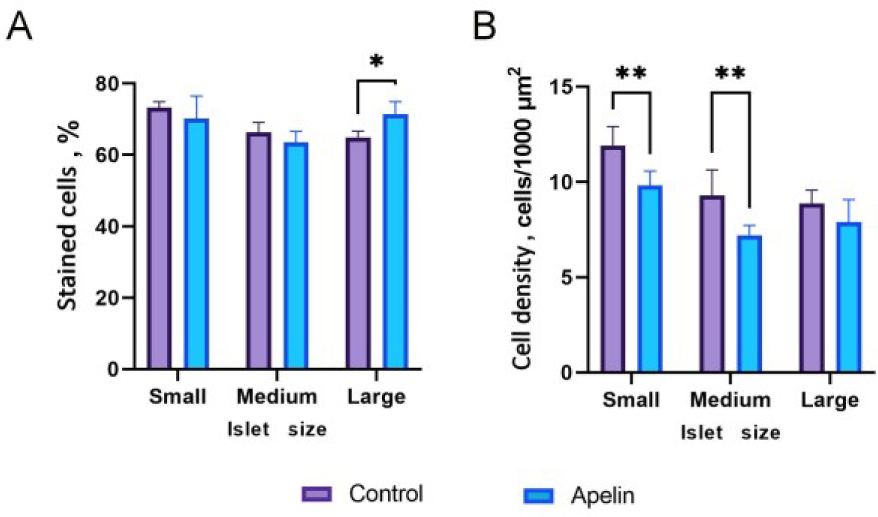

Fig. 4.

(A) Stained beta cell percentage and (B) beta cell density mean values (with standard deviation-whiskers) in small, medium and large islets in the control (n = 6) and apelin-treated (n = 6) rat groups. Asterisks (*) indicate significant differences between the control and apelin-treated groups in like-sized subgroups of islets (* – P-value < 0.05; ** – P-value < 0.01)
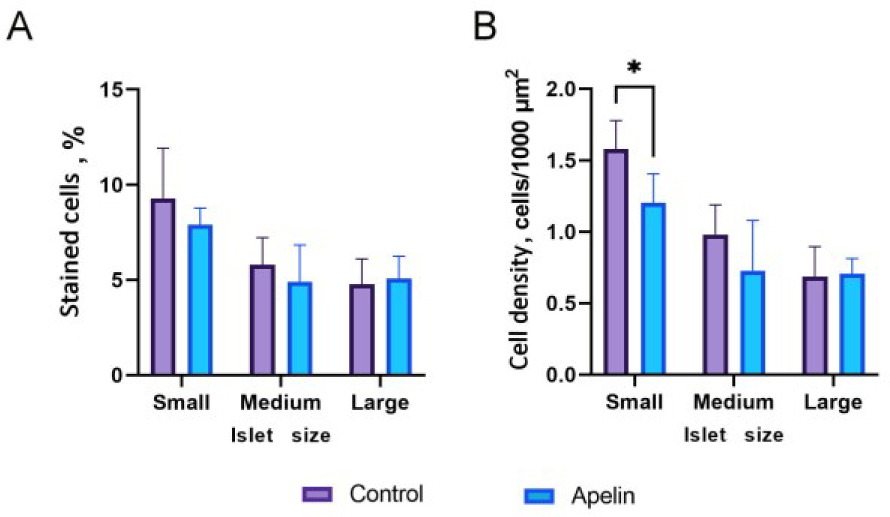

Fig. 5.

(A) Stained delta-cell percentage and (B) delta cell density mean values (with standard deviation-whiskers) in small, medium and large islets in the control (n = 6) and apelin-treated (n = 6) rat groups. Asterisks (*) indicate significant differences between the control and apelin-treated groups in like-sized subgroups of islets (* – P-value < 0.05)
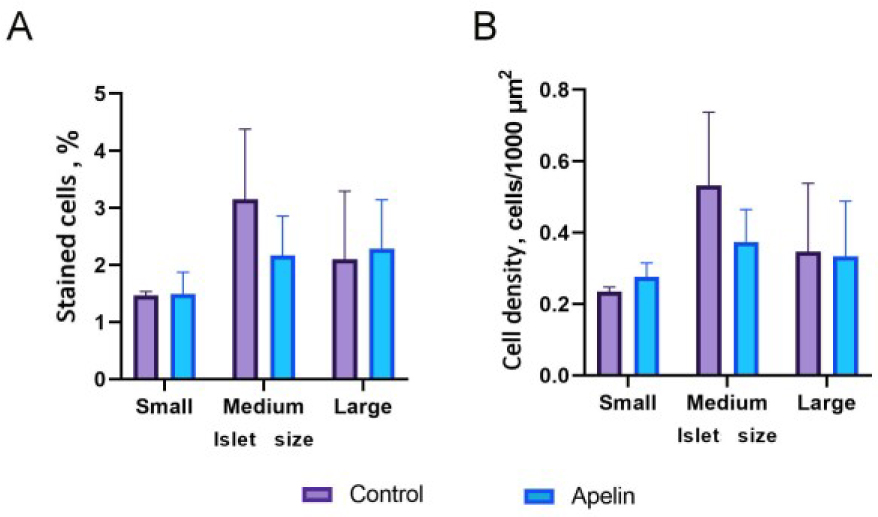

Fig. 6.

(A) Stained F-cell percentage and (B) F-cell density mean values (with standard deviation-whiskers) in like-sized subgroups of islets in the control (n = 6) and apelin-treated (n = 6) rat groups
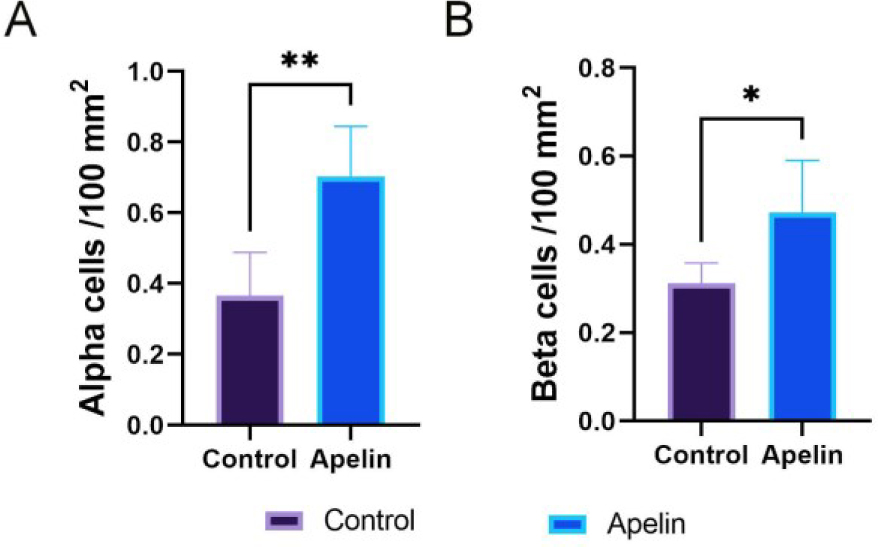

Fig. 7.

(A) Alpha cell number per 100 µm2 of pancreas and (B) beta cell number per 100 µm2 of pancreas outside of the pancreatic islets mean values (with standard deviation-whiskers). Asterisks (*) indicate significant differences between the control (n = 6) and apelin-treated (n = 6) groups (* – P-value < 0.05; ** – P-value < 0.01)
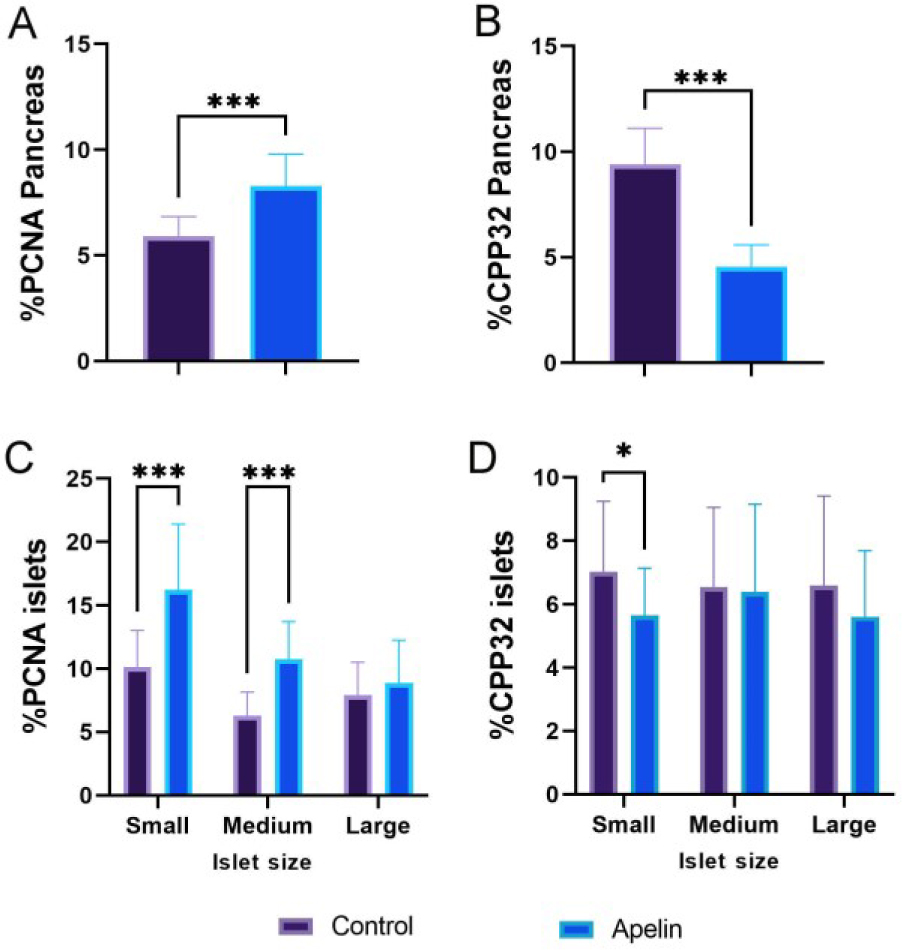

Fig. 8.

(A) Proliferating cell nuclear antigen percentage (%PCNA) of positive exocrine pancreatic cells, (B) proenzyme form of cysteine protease, 32 kDa percentage (%CPP32) of positive exocrine pancreatic cells, (C) %PCNA of positive cells in individual pancreatic islets and (D) %CPP32 of positive cells in individual pancreatic islets mean values (with standard deviation-whiskers) for the control (n = 6) and the apelin-treated (n = 6) rat groups. Asterisks (*) indicate significant differences between control and apelin treated groups (* – P-value < 0.05; *** – P-value < 0.001)

Primary and secondary antibodies used in the study

AntibodyHostCatalogue numberDilutionSource
Primary antibody
    Anti-glucagonMouse14-9743-821 : 200ThermoFisher, Waltham, MA, USA
    Anti-insulinMouseMA5-120371 : 200ThermoFisher
    Anti-somatostatinMouse14-9751-821 : 5000ThermoFisher
    Anti-pancreatic polypeptideRabbitab2727321 : 2000Abcam, Cambridge,UK
    Anti-cleaved caspase 3RabbitAF70221 : 150Affinity Biosciences, Cincinnati, OH, USA
    Anti-proliferating-cell nuclear antigenRabbitAF02391 : 150Affinity Biosciences
Secondary antibody
    Anti-mouse/rabbitGoatDPVB-HRPRTUImmunoLogic, Duiven, the Netherlands
Language: English
Page range: 461 - 468
Submitted on: Dec 16, 2023
Accepted on: Jul 30, 2024
Published on: Aug 8, 2024
Published by: National Veterinary Research Institute in Pulawy
In partnership with: Paradigm Publishing Services
Publication frequency: 4 issues per year

© 2024 Sylwia Szymańczyk, Katarzyna Kras, Cezary Osiak-Wicha, Małgorzata Kapica, Iwona Puzio, Hanna Antushevich, Atsukazu Kuwahara, Ikuo Kato, Marcin B. Arciszewski, published by National Veterinary Research Institute in Pulawy
This work is licensed under the Creative Commons Attribution-NonCommercial-NoDerivatives 3.0 License.