
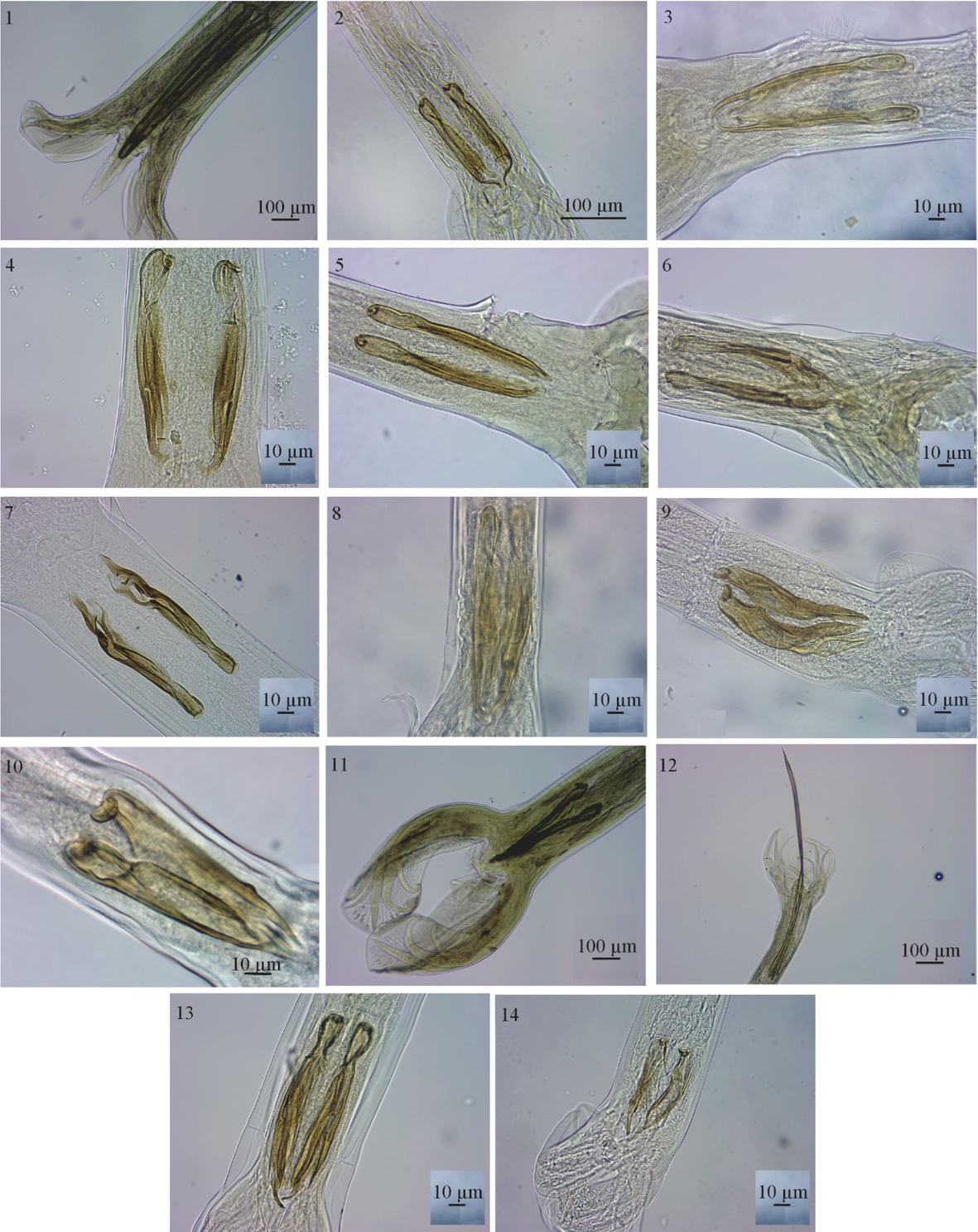
Figs 1–7
Male distal body parts of abomasal nematodes found in both red deer and roe deer. 1 – Ashworthius sidemi (100×); 2 – Mazamastrongylus dagestanica (200×); 3 – Ostertagia antipini (400×); 4 – Ostertagia kolchida (400×); 5 – Ostertagia leptospicularis (400×); 6 – Spiculopteragia asymmetrica (400×); 7 – Spiculopteragia boehmi (400×)
Figs 8–10. Male distal body parts of abomasal nematodes found exclusively in roe deer. 8 – Ostertagia lyrata (400×); 9 – Trichostrongylus capricola (400×); 10 – Trichostrongylus vitrinus (1,000×)
Figs 11–14. Male distal body parts of abomasal nematodes found exclusively in red deer. 11 – Haemonchus contortus (100×); 12 – Nematodirus roscidus (100×); 13 – Spiculopteragia mathevossiani (400×); 14 – Trichostrongylus axei (400×)
Table 1
Intensity and prevalence of abomasal nematodes of roe deer (Capreolus capreolus)
| Nematode | X | Range | Prevalence (%) | 95% Confidence interval |
|---|---|---|---|---|
| Ashworthius sidemi | 10 | 10 | 20 (1 of 5) | 26.1 |
| Mazamastrongylus dagestanica | 3 | 3 | 20 (1 of 5) | 26.1 |
| Ostertagia antipini | 2 | 2 | 20 (1 of 5) | 26.1 |
| O. kolchida | 1.7 | 1–3 | 60 (3 of 5) | 32.0 |
| O. leptospicularis | 18.3 | 2–33 | 60 (3 of 5) | 32.0 |
| O. lyrata | 1 | 1 | 20 (1 of 5) | 26.1 |
| Spiculopteragia asymmetrica | 1 | 1 | 20 (1 of 5) | 26.1 |
| S. boehmi | 212.7 | 17–506 | 60 (3 of 5) | 32.0 |
| Trichostrongylus capricola | 4 | 4 | 20 (1 of 5) | 26.1 |
| T. vitrinus | 1 | 1 | 20 (1 of 5) | 26.1 |
Table 2
Intensity and prevalence of abomasal nematodes of red deer (Cervus elaphus)
| Nematode | X | Range | Prevalence (%) | 95% Confidence interval |
|---|---|---|---|---|
| Ashworthius sidemi | 289.8 | 1–1.136 | 66.7 (6 of 9) | 30.8 |
| Haemonchus contortus | 1.5 | 1–2 | 22.2 (2 of 9) | 27.2 |
| Mazamastrongylus dagestanica | 1 | 1 | 11.1 (1 of 9) | 20.5 |
| Nematodirus roscidus | 1 | 1 | 11.1 (1 of 9) | 20.5 |
| Ostertagia antipini | 3 | 3 | 11.1 (1 of 9) | 20.5 |
| O. kolchida | 3 | 2–4 | 33.3 (3 of 9) | 30.8 |
| O. leptospicularis | 4.2 | 3–5 | 66.7 (6 of 9) | 30.8 |
| Spiculopteragia asymmetrica | 3 | 3 | 11.1 (1 of 9) | 20.5 |
| S. boehmi | 62.4 | 9–184 | 100 (9 of 9) | - |
| S. mathevossiani | 3.8 | 1–10 | 44.4 (4 of 9) | 32.5 |
| Trichostrongylus axei | 1 | 1 | 11.1 (1 of 9) | 20.5 |
Table 3
Comparison of the spicule length of abomasal nematodes of red deer and roe deer
| N | X ± SD | Range | N | X ± SD | Range | nematode | |
|---|---|---|---|---|---|---|---|
| Ashworthius sidemi | 759 | 777.8 ± 25.5 | 675–864 | 14 | 780.5 ± 66.0 | 622–823 | P = 0.004* |
| Haemonchus contortus | 6 | 451.2 ± 22.2 | 417–469 | 0 | - | - | - |
| Mazamastrongylus dagestanica | 2 | 198.5 ± 0.7 | 198–199 | 4 | 193.8 ± 7.0 | 187–202 | - |
| Nematodirus roscidus | 1 | 899 | 899 | 0 | - | - | - |
| Ostertagia antipini | 4 | 184.3 ± 2.2 | 181–186 | 0 | - | - | - |
| O. kolchida | 16 | 200.3 ± 16.6 | 169–238 | 10 | 192.6 ± 14.8 | 166–211 | P = 0.243 |
| O. leptospicularis | 17 | 182.4 ± 12.8 | 149–194 | 52 | 171.9 ± 7.3 | 156–187 | P < 0.001* |
| O. lyrata | 0 | - | - | 2 | 197.5 ± 0.7 | 197–198 | - |
| Spiculopteragia asymmetrica | 4 | 236 ± 8.0 | 230–247 | 2 | 177 ± 2.8 | 175–179 | - |
| S. boehmi | 502 | 164.6 ± 8.4 | 144–213 | 639 | 160.9 ± 7.0 | 140–186 | P < 0.001* |
| S. mathevossiani | 24 | 182.2 ± 16.1 | 151–211 | 0 | - | - | - |
| Trichostrongylus axei | 2 | 84 ± 5.7 | 80–88 | 0 | - | - | - |
| T. capricola | 0 | - | - | 5 | 139.4 ± 5.6 | 134–148 | - |
| T. vitrinus | 0 | - | - | 2 | 92 ± 1.4 | 91–93 | - |
[i] SD – standard deviation; * – statistically significant difference