
Table. 1
Primers and TaqMan probes used in this study for BIV and GAPDH gene amplification
| Primer/Probe | Sequence 5′ → 3′ | Position in target sequence | Product length (bp) | Application |
|---|---|---|---|---|
| BIVg723F | GAAGCAGACATCGAATCAGA | 723–742a | 552 | BIV standard |
| BIVg1274R | TCTTTTGTGGTTTCTGGAGC | 1255–1274 a | DNA | |
| BTG1F | TGATGCTGGTGCTGAGTATGTG | 4–25b | 182 | GAPDH standard |
| BTG2R | CCTTCAAGTGAGCCTGCAGCAA | 164–185 b | DNA | |
| BIVg1074F | ACAAGCCACCCTGATCTCAGTA | 1074–1095 a | 128 | RT-qPCR and |
| BIVg1202R | TCCTTGGGTTCCCTGATGAATGT | 1181–1202 a | qPCR- | |
| BIVg1107P | Cy5 - AACTTTCAGACAGTGGGTGCTGCAGG - BHQ3 | 1107–1132 a | - | BIV gag gene |
| BTG3F | CCACTGGGGTCTTCACTACCAT | 33–54 b | ||
| BTG4R | AAGTTAATTGCACCCGGGCTCT | 137–158 b | 126 | GAPDH qPCR- |
| BTG5P | JOE - CTGGAGAGGAGGGTGTAACAGGA - BHQ1 | 83–105 b | - |
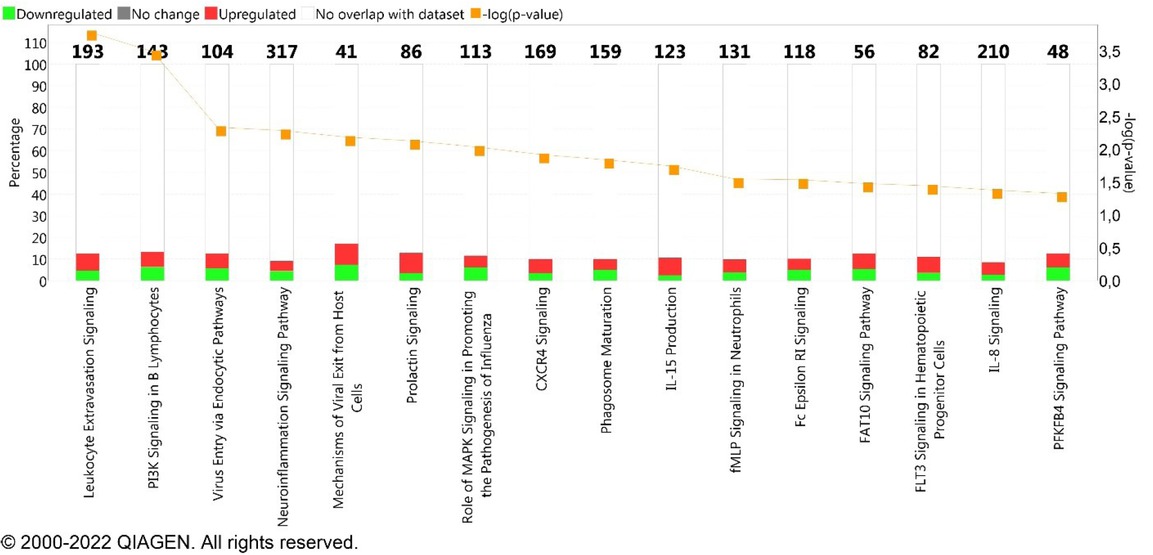
Fig. 1
Top canonical pathways enriched in differentially expressed genes (DEGs). The value of −log(p) >1.3 reflects a significant association between the canonical pathway and the involved genes. The percentage indicates the number of DEGs overlapping with molecules associated to canonical pathways. The colours represent up- (red) and downregulated (green) genes. The numbers on top of the bars represent the total number of molecules associated to each pathway
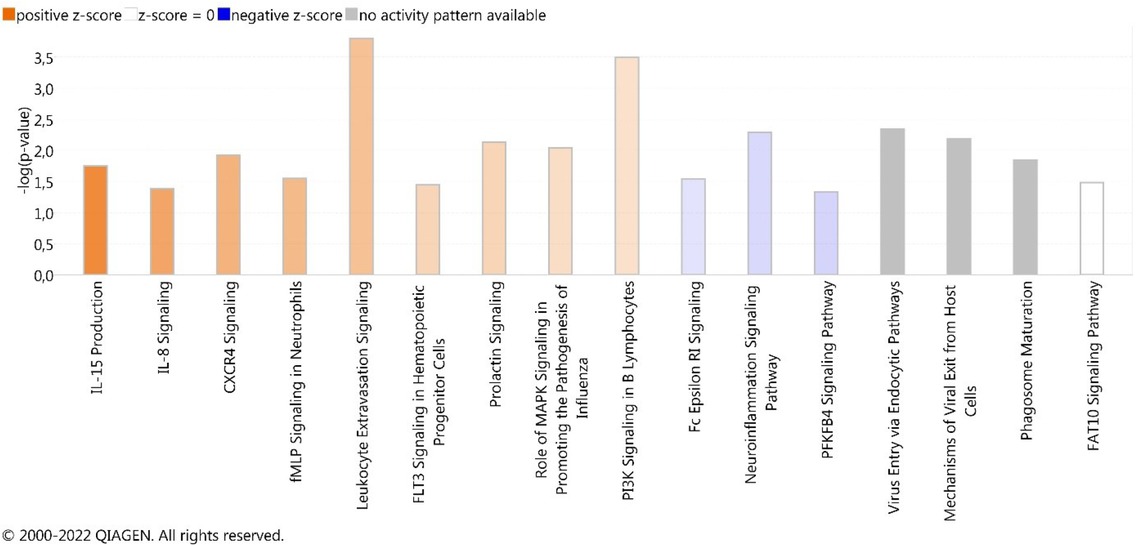
Fig. 2
Most prominent canonical pathways ordered according to z-score value and their predicted activation state with regard to −log (p-value) greater than 1.3. The bars represent the p-values of overlap (−log) of differentially expressed genes in the dataset with known pathway-associated molecules. Pathways in orange are those predicted to be activated and pathways in blue are those predicted to be inhibited. The higher the intensity of the colours, the higher the absolute z-score
Table 2
Disease and biofunctions identified by IPA ordered with respect to activation z-score
| Diseases or functions annotation | P-value | Activation z-score | Number of molecules |
|---|---|---|---|
| Inflammation of joints | 4.61E−09 | −3.228* | 143 |
| Inflammatory response | 1.71E−06 | −2.003* | 103 |
| Activation of leukocytes | 6.71E−07 | −1.664 | 88 |
| Inflammation of respiratory system component | 6.93E−06 | −1.518 | 76 |
| Inflammation of body cavity | 4.07E−06 | −1.467 | 139 |
| Rheumatoid arthritis | 2.18E−07 | −1.387 | 102 |
| Inflammation of lungs | 3.60E−06 | −1.379 | 54 |
| Allergic pulmonary eosinophilia | 2.95E−06 | −1.342 | 12 |
| Inflammation of organs | 1.03E−07 | −1.088 | 187 |
| Inflammation of absolute anatomical region | 6.76E−06 | −1.049 | 153 |
| Immune response of tumour cell lines | 1.06E−05 | −0,788 | 29 |
| Dermatitis | 9.31E−06 | −0.363 | 68 |
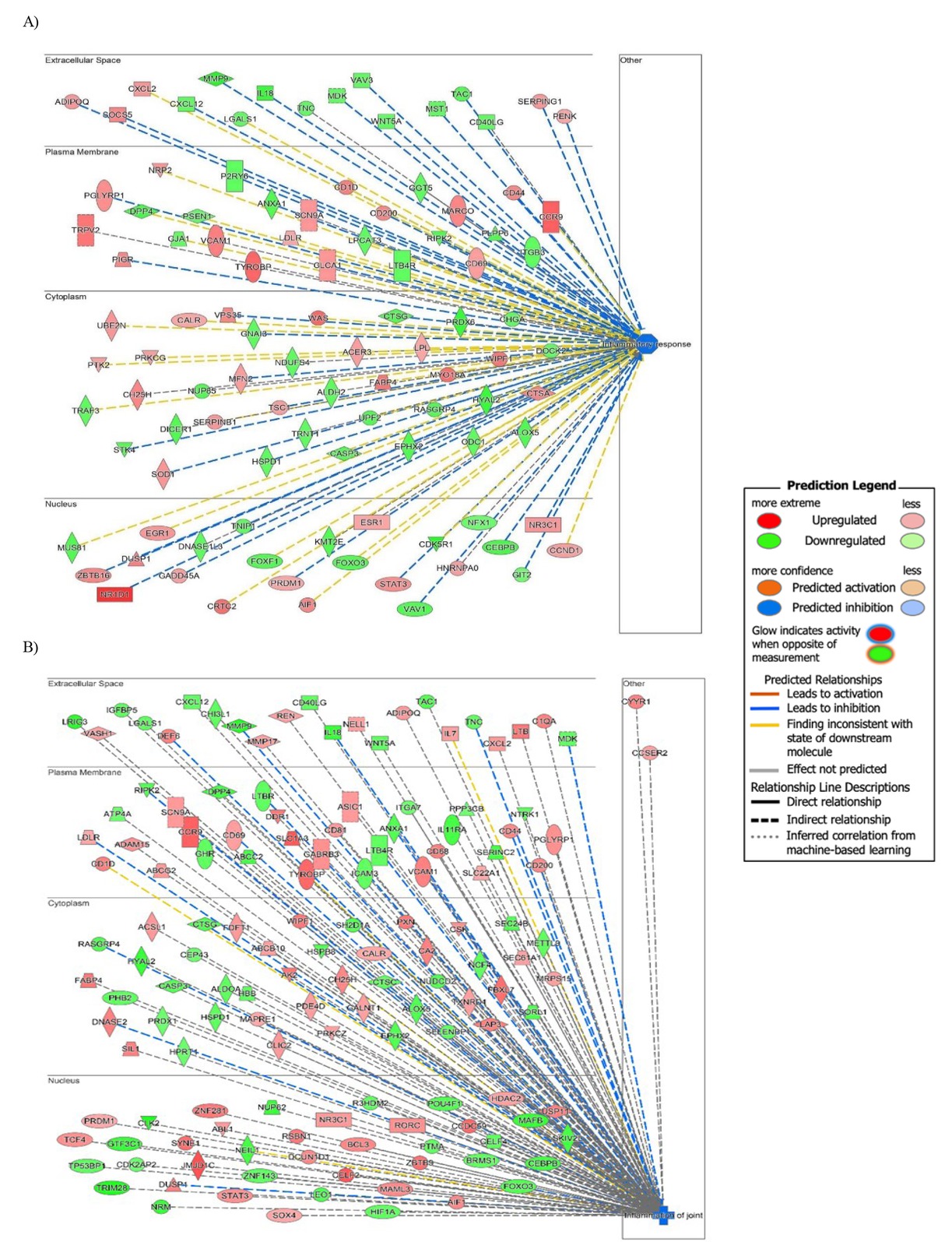
Fig. 3
The inflammation of joints (A) and inflammatory response (B) pathways in BIV infected BoMac cells. The shapes of the nodes reflect the functional class of each gene product: transcriptional regulator (horizontal ellipse), transmembrane receptor (vertical ellipse), enzyme (rhombus), cytokine/growth factor (square), kinase (triangle), and complex/group/other (circle). Other indicators are explained in the prediction legend
Table 3
The top-scoring regulatory networks identified using IPA software
| Consistency score | Node total | Regulator total | Regulators | Target total | Target molecules in dataset | Diseases & functions |
|---|---|---|---|---|---|---|
| −8.660 | 5 | 1 | DDX3X | 3 | CCND1, ODC1, RPS5 | Metabolism of protein |
Table 4
Comparison of gene expression changes observed in microarray analysis and RT-qPCR
| Gene | Reference sequence ID | Primer sequence (5′–3′) | FC | |
|---|---|---|---|---|
| Microarray | RT-qPCR | |||
| UCHL5* | 174481* NM_ | F: ACAAAGACAACTTGCTGAGGAACCC | N/A | N/A |
| R: GGCAACCTCTGACTGAATAGCACTT | ||||
| ATR | XM_002685057.2 | F: AATGCACGTGTCCTTCGATA | 2.45 | 1.05 |
| R: TGAAAAGGCCAAGACTCATGT | ||||
| LTA | NM_001013401.2 | F: CCCTCAGAGCCTCGCTTT | 2.00 | 1.19 |
| R: GCGAGACATCAGAAGAAAGAGC | ||||
| IL-18 | NM_001562 | F: AGACAGGTTGATTTCCCTGGT | −1.50 | −1.15 |
| R: CCTGGAATCAGATCACTTTGG | ||||
| HYAL2 | XM_024982390 | F: GCGACCAGAGGGGGAACTC | −1.50 | −1.03 |
| R: TAGCACTGGCAGCGAAAGTGCA | ||||
| F: TGGTGGAGACTGCCTGCG | ||||
| DCTN6 | XM_024986251 | R: CCGACTAAAGAGGTTCTAGCAC | 3.00 | 1.12 |
[i] * − Primers designed by Brym et al. (3)