
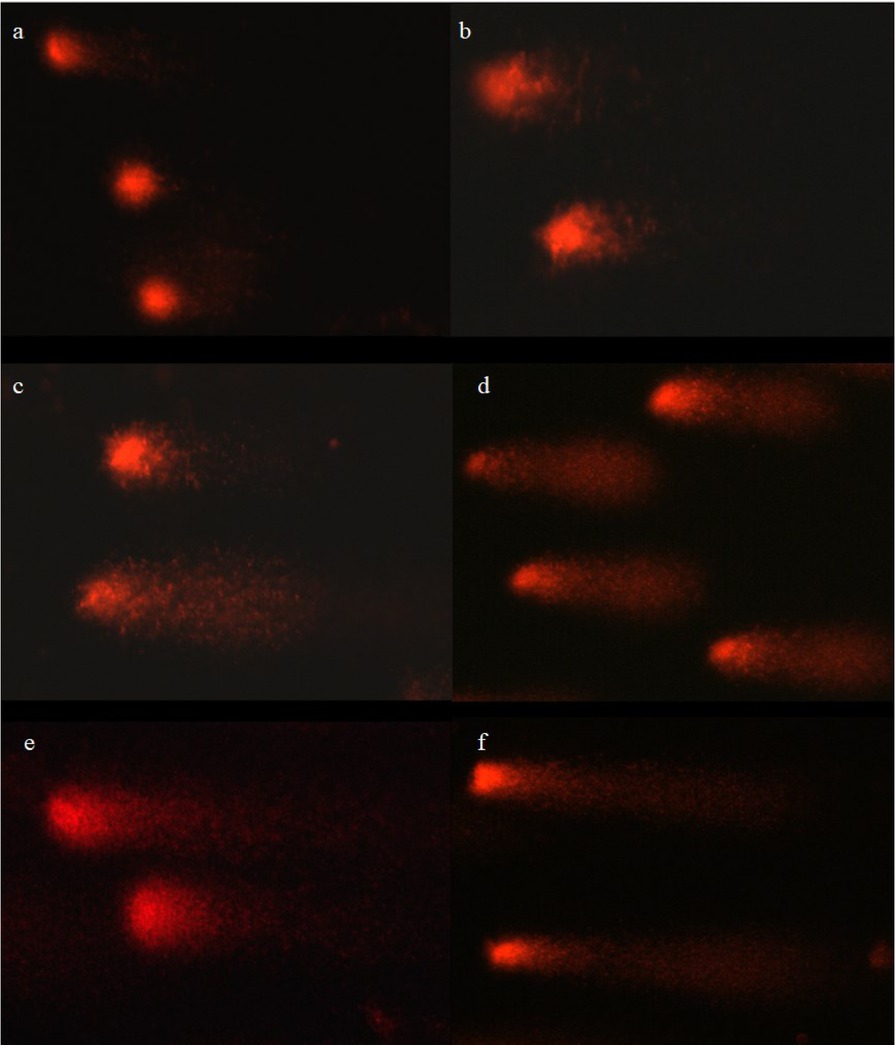
Fig. 1
Erythrocytes of Prussian carp with different levels of DNA damage in the comet assay: cells from control samples after 14 days (a), after 21 days (c), and after 28 days (e); cells after exposure to Cd for 14 days (b), for 21 days (d) and for 28 days (f). 400×
Table 1
Comet assay results for Prussian carp exposed to different treatments of cadmium, zinc and their binary mixture
| Control | Cd | Zn | Cd + Zn | |
|---|---|---|---|---|
| Day | DNA in Tail (%) | |||
| 14 | 26.30 ± 0.56 Aa | 31.78 ± 0.69 Ab | 33.35 ± 0.67 Ab | 37.87 ± 0.76 Ac |
| 21 | 28.08 ± 0.65 Aa | 31.84 ± 0.59 Ab | 24.40 ± 0.53 Bc | 31.89 ± 0.64 Bb |
| 28 | 32.04 ± 0.61 Ba | 32.87 ± 0.67 Aa | 28.58 ± 0.51 Cb | 31.90 ± 0.59 Ba |
| Tail moment | ||||
|---|---|---|---|---|
| 14 | 48.82 ± 1.49 Aa | 64.46 ± 1.82 Abc | 63.77 ± 1.85 Ab | 69.51 ± 1.91 Ac |
| 21 | 53.58 ± 1.80 Ba | 46.11 ± 1.33 Bb | 30.39 ± 1.05 Bc | 38.81 ± 1.39 Bd |
| 28 | 2.80 ± 0.35 Ca | 2.18 ± 0.28 Ca | 3.56 ± 0.33 Ca | 4.14 ± 0.54 Cb |
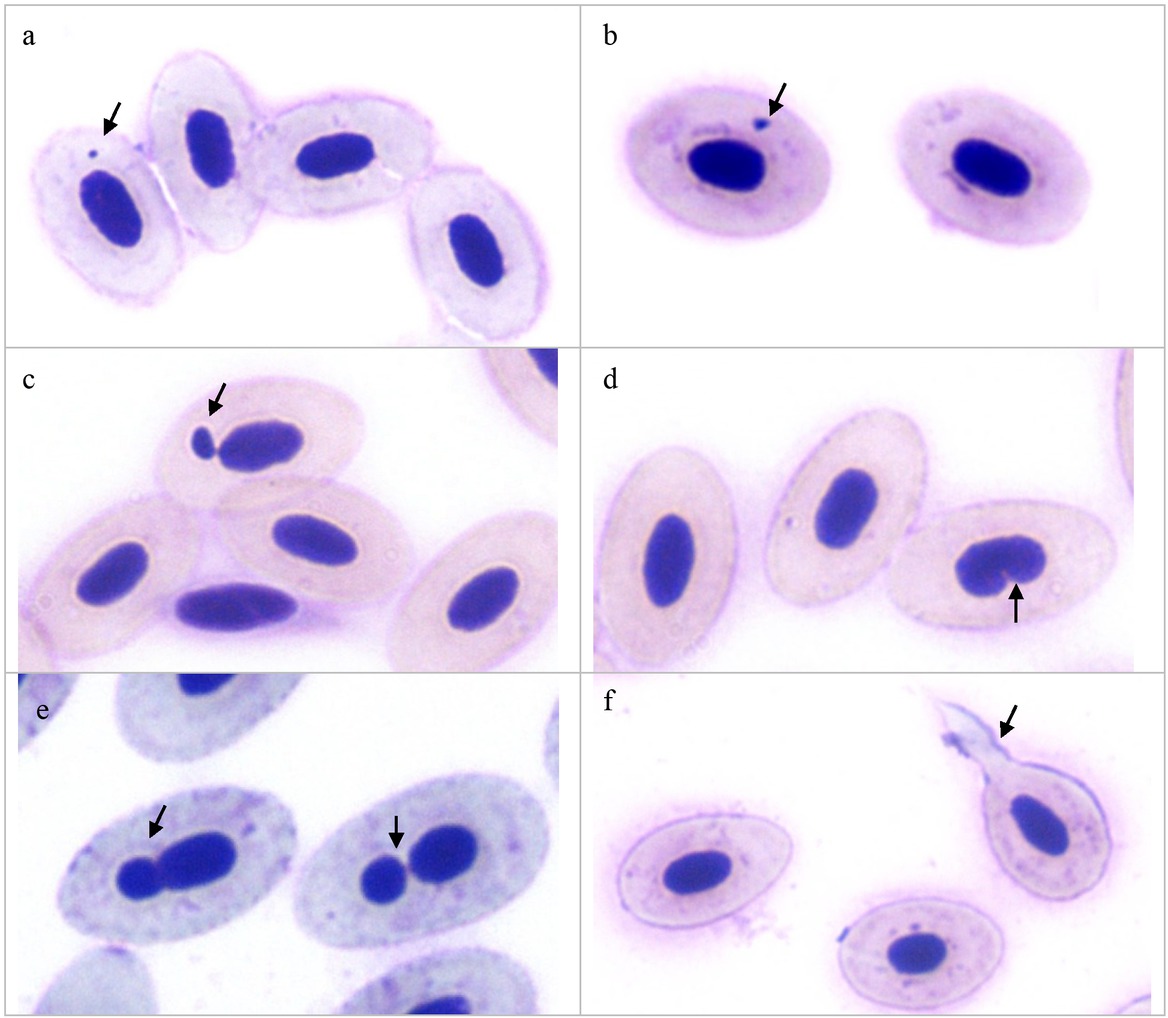
Fig. 2
Giemsa-stained peripheral blood smear of erythrocytes of Prussian carp with micronuclei (a and b), a nuclear bud (c), a notched nucleus (d), binucleated cells with unequal nuclear division (e), and a cell with abnormal cytoplasm (f). Arrows show the abnormalities. Erythrocytes are from the control group after 21 days of the experiment (c and d), exposed to Cd after 14 days (f) and exposed to Cd after 28 days (a, b and e). 1000×
Table 2
The frequency of erythrocyte nuclear and cellular abnormalities in Prussian carp exposed to different concentrations of cadmium, zinc and their binary mixture
| Group | ||||
|---|---|---|---|---|
| Control | Cd | Zn | Cd + Zn | |
| Day | MN (one or more micronuclei) | |||
| 14 | 2.30 ± 0.36 Aa | 12.49 ± 1.08 Ab | 7.35 ± 0.80 Ac | 16.07 ± 1.68 Ab |
| 21 | 1.29 ± 0.21 Ba | 4.00 ± 0.48 Bb | 4.61 ± 1.14 ABb | 3.67 ± 0.43 Bb |
| 28 | 3.11 ± 0.34 Aab | 2.33 ± 0.298 Ca | 3.69 ± 0.34 Bbc | 4.53 ± 0.63 Bc |
| BUD (nuclear buds) | ||||
|---|---|---|---|---|
| 14 | 0.26 ± 0.05 Aa | 0.16 ± 0.08 Aa | 0.15 ± 0.05 Aa | 0.34 ± 0.08 Aa |
| 21 | 0.11 ± 0.05 Ba | 0.19 ± 0.06 Aa | 0.21 ± 0.10 Aa | 0.12 ± 0.05 Ba |
| 28 | 0.07 ± 0.03 Ba | 0.28 ± 0.07 Ab | 0.17 ± 0.06 Aab | 0.18 ± 0.08 ABab |
| BNC (binuclear cells) | ||||
|---|---|---|---|---|
| 14 | 0.25 ± 0.22 Aa | 0.30 ± 0.09 Aa | 0.22 ± 0.06 Aa | 0.12 ± 0.07 Aa |
| 21 | 0.19 ± 0.07 ABa | 0.23 ± 0.06 Aa | 0.32 ± 0.12 ABab | 0.54 ± 0.14 Bb |
| 28 | 0.09 ± 0.03 Ba | 0.43 ± 0.11 Bb | 0.69 ± 0.17 Bb | 0.51 ± 0.08 Bb |
| AN (abnormal shapes of nucleus) | ||||
|---|---|---|---|---|
| 14 | 0.01 ± 0.01 Aa | 0.04 ± 0.02 Aa | Not found | 0.18 ± 0.09 Aa |
| 21 | 0.21 ± 0.07 Ba | 0.03 ± 0.02 Aab | 0.012 ± 0.011 Ab | Not found |
| 28 | 0.15 ± 0.05 Ba | 1.68 ± 0.43 Bb | 0.009 ± 0.009 Ac | 0.036 ± 0.036 Ad |
| NT (different shapes of notched nuclei) | ||||
|---|---|---|---|---|
| 14 | 2.28 ± 0.45 Aa | 0.07 ± 0.03 Ab | 0.91 ± 0.18 ABc | 3.94 ± 0.52 Ad |
| 21 | 0.67 ± 0.10 Ba | 2.91 ± 0.42 Bb | 0.66 ± 0.12 Aa | 1.30 ± 0.26 Ba |
| 28 | 0.69 ± 0.14 Ba | 1.15 ± 0.24 Cab | 1.57 ± 0.36 Bb | 0.28 ± 0.07 Cc |
| Total nuclear abnormalities (MN+BUD+BNC+AN+NT) | ||||
|---|---|---|---|---|
| 14 | 5.50 ± 0.63 Aa | 14.57 ± 1.27 Ab | 8.35 ± 0.80 Ac | 20.61 ± 1.84 Ad |
| 21 | 2.39 ± 0.23 Ba | 7.36 ± 0.69 Bb | 5.80 ± 1.10 Ab | 5.62 ± 0.65 Bb |
| 28 | 4.08 ± 0.41 Aa | 5.66 ± 0.48 Cb | 6.12 ± 0.38 Ab | 5.53 ± 0.64 Bab |
| A (apoptotic cells) | ||||
|---|---|---|---|---|
| 14 | 0.02 ± 0.013 a | 0.44 ± 0.24 Ab | 0.00 ± 0.00 | 0.10 ± 0.06 c |
| 21 | 0.00 ± 0.00 | 0.00 ± 0.00 | 0.01 ± 0.001 Aa | 0.00 ± 0.00 |
| 28 | 0.00 ± 0.00 | 2.04 ± 0.56 Bb | 0.011 ± 0.001 Aa | 0.00 ± 0.00 |
| AC (abnormal shapes of cytoplasm) | ||||
|---|---|---|---|---|
| 14 | 0.86 ± 0.16 Aa | 22.11 ± 1.99 Ab | 1.33 ± 0.12 Ac | 2.16 ± 0.55 Ac |
| 21 | 0.39 ± 0.12 Ba | 1.31 ± 0.16 Bb | 4.60 ± 1.13 Bb | 1.21 ± 0.15 Bb |
| 28 | 0.94 ± 0.16 Aa | 1.31 ± 0.25 Bab | 1.94 ± 0.39 Ab | 1.32 ± 0.18 Bab |