
Table 1
Clinical characteristics of the study subjects
| Variable | Healthy subject n = 12 | With diabetic retinopathy n = 8 | Diabetic without retinopathy n = 12 |
|---|---|---|---|
| Age, Y | |||
| Mean (±SD) | 10.8 ± 1.8 | 10.3 ± 2.8 | 11.4 ± 2.1 |
| Range | 8–13 | 7–16 | 8–12 |
| Sex | |||
| Male | 7 | 3 | 4 |
| Female | 5 | 5 | 8 |
| Weight, kg | |||
| Mean (±SD) | 23.1 ± 7.7 | 13.9 ± 8.6 | 14.4 ± 5.3 |
| Range | 10–37 | 5.4–38 | 6.3–21 |
| Duration of diabetes, y | |||
| Mean (±SD) | 0 | 1.2 ± 0.6 | 2.4 ± 0.2 |
| Duration | 0 | 0.5–2 | 1–4 |
| Blood glucose, mmol/L | |||
| Mean (±SD) | 5.9 ± 0.2 | 17.8 ± 6 | 18.3 ± 2.3 |
| Range | 5.6–6.2 | 8.3–29.7 | 9.3–22.3 |
| Cataract | 0 | 0 | 0 |
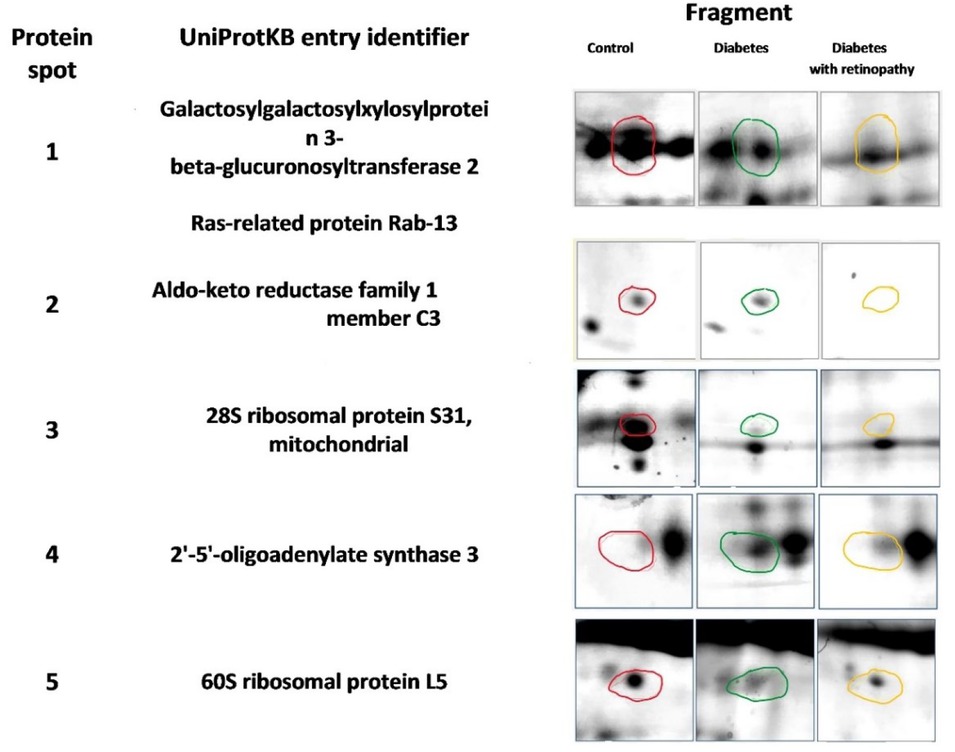
Fig. 1
Statistically significant (P ≤ 0.05) representatives of two-dimensional electrophoresis gel spots in the diabetic groups of dogs compared to the control group of dogs as revealed by Delta2D software. Protein spots from the healthy group are marked in red, protein spots from the diabetic group without retinopathy are marked in green, and protein spots from the diabetic group with retinopathy are marked in yellow
Table 2
Significantly differentially expressed proteins (P ≤ 0.05) in diabetic dogs identified by matrix-assisted laser desorption/ionisation–tandem time-of-flight mass spectrometry
| ID | Protein | Accession number (UniProtKB) | Score | Match | MW (kDa)* | pI* | Modif. | Seq. cov. (%) | Rt** C : D | Rt** C : D ret. | P-value |
|---|---|---|---|---|---|---|---|---|---|---|---|
| 1 | Ras-Rab-related 13 protein | F1PTE3 | 79 | 6 | 22881 | 9.36 | Carb, (M) Ox | 24 | 0.655 | 0.455 | 0.048 |
| 2 | Aldo-family keto 1 member reductase C3 | Q5R7C9 | 70 | 9 | 37224 | 7.13 | Carb | 18 | 0.793 | 0.015 | 0.015 |
| 3 | 28S ribosomal protein S31, mitochondrial | B0BN56 | 111 | 8 | 44220 | 8.46 | Carb, Ox (M) | 14 | 0.189 | 0.502 | 0.032 |
| 4 | 2synthase ′-5′-oligoadenylate 3 | Q8VI93 | 120 | 11 | 127907 | 8.99 | Carb, (M) Ox | 8 | 2.709 | 1.741 | 0.030 |
| 5 | 60protein S ribosomal L5 | P46777 | 81 | 20 | 34568 | 9.78 | Carb, (M) Ox | 42 | 0.074 | 0.128 | 0.001 |
[i] Modif. – Modification; Seq. cov. – Sequence coverage; Carb – carbamidomethylation of cysteine; Ox (M) – oxidation of methionine; Ox (HW) – oxidation of histidine or tryptophan; * – listed molecular weights (MW) and isoelectric point (pI) values correspond to the Mascot search result; ** – Rt (Ratio); C – Control; D – Diabetic; ret – retinopathy
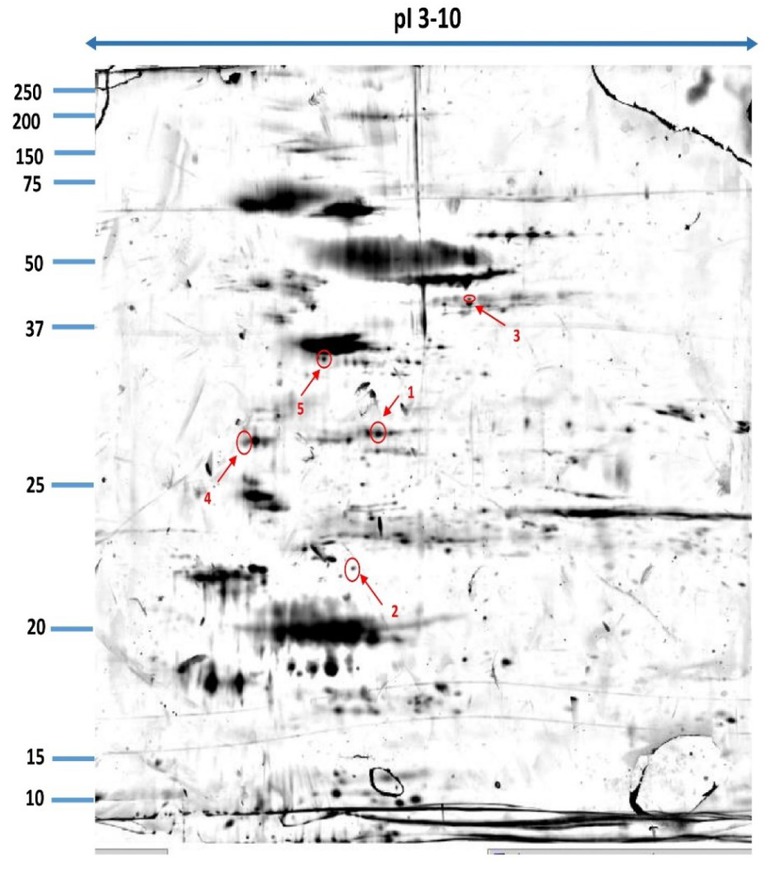
Fig. 2
Proteome map containing every protein spot present on every electrophoretic gel obtained in the experiment. The map is a fused image showing the condensed spot patterns from the experiment. Differentially expressed proteins are marked in red. pI – isoelectric point