
Table 1
The primer sequences used in gene expression analysis
| Primer | Sequence | Accession number | Amplicon size (bp) |
|---|---|---|---|
| Bcl-2 | F: TTCAAGCGAAAACAGGGTGG R: CTCTGAGCACATGGAAAGCC | NM_205339.2 | 167 |
| Bax | F: CACCTTTGTCTCACCTGTGC R: GATGGCAGTGATGAGCATGG | XM_015290060.2 | 241 |
| CASP-3 | F: TTGAAGCAGACAGTGGACCA R: GTTCAAGTTTCCTGGCGTGT | NM_204725.1 | 177 |
| β-actin | F: CCCACACCCCTGTGATGAAAR: TAGAACTTTGGGGGCGTTCG | NM_205518.1 | 177 |
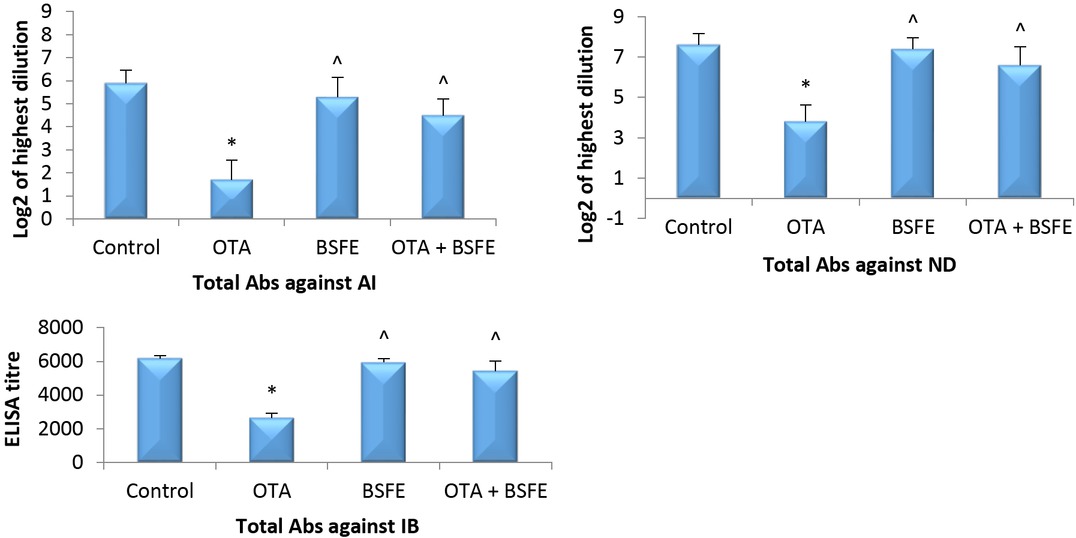
Fig. 1
Impacts of ochratoxin A (OTA) and/or Bacillus subtilis fermentation extract (BSFE) on the specific antibody titres 21 days after vaccination (n = 5 birds/group)
* – P < 0.05 versus control group; ^ – P < 0.05 versus OTA group
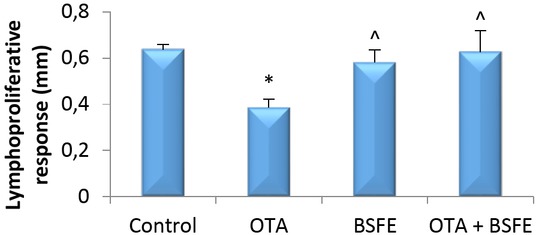
Fig. 2
Impacts of ochratoxin A (OTA) and/or Bacillus subtilis fermentation extract (BSFE) on swelling of the toe web skin 21 days after phytohaemagglutinin-P injection (n = 5 birds/group)
* – P < 0.05 versus control group; ^ – P < 0.05 versus OTA group
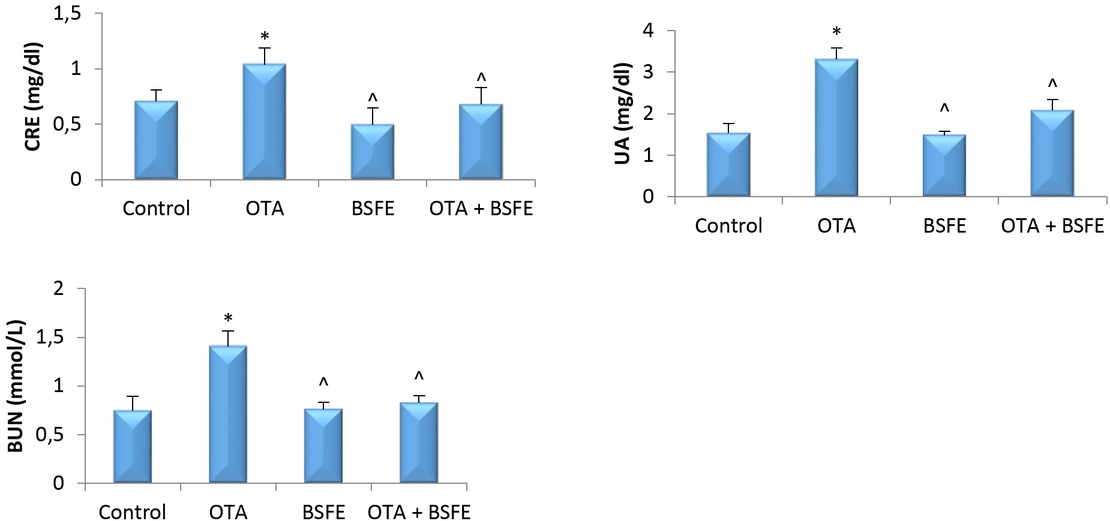
Fig. 3
Analysis of serum metabolic wastes in chickens after exposure to ochratoxin A (OTA) and/or Bacillus subtilis fermentation extract (BSFE) (n = 5 birds/group)
CRE – creatinine; UA – uric acid; BUN – blood urea nitrogen; * – P < 0.05 versus control group; ^ – P <0.05 versus OTA group
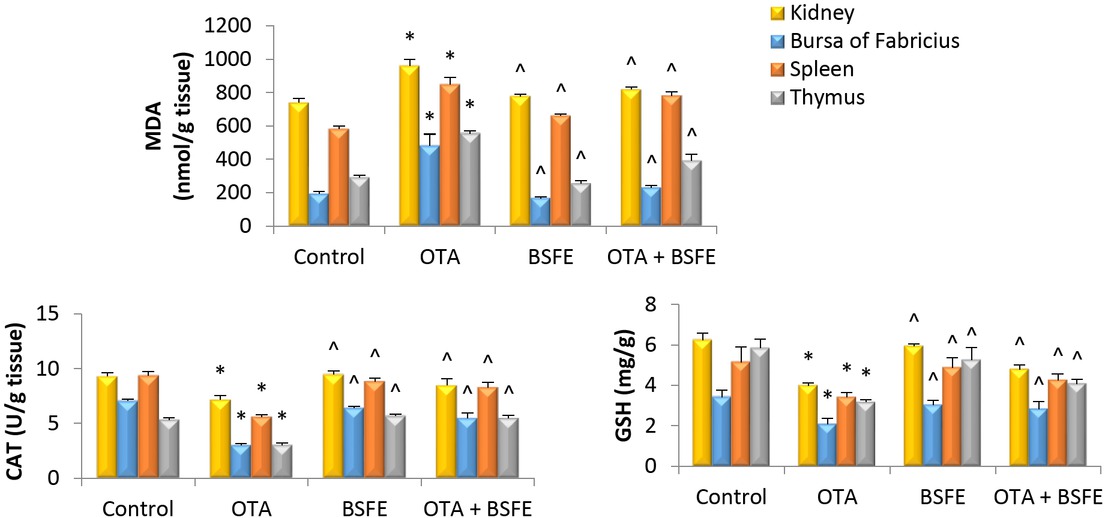
Fig. 4
Impacts of ochratoxin A (OTA) and/or Bacillus subtilis fermentation extract (BSFE) on the levels of oxidative and antioxidative parameters in the kidney and immune tissues (n = 5 birds/group)
MDA – malondialdehyde; CAT – catalase; GSH – glutathione; * – P < 0.05 versus control group; ^ – P < 0.05 versus OTA group
Table 2
Ochratoxin A levels in serum and tissues
| Sample | Control | OTA | BSFE | OTA + BSFE |
|---|---|---|---|---|
| Serum (μg/L) | < LOD1 | 11.3 ± 1.7 | < LOD | 6.6 ± 1.37 ^ |
| Kidney (μg/Kg) | < LOD | 26.67 ± 6.03 | < LOD | 12.3 ± 4.36 ^ |
| Liver (μg/Kg) | < LOD | 14.83 ± 2.84 | < LOD | 5.25 ± 1.52 ^ |
| Muscle (μg/Kg) | < LOD | 8.77 ± 1.97 | < LOD | 2.9 ± 0.85 ^ |
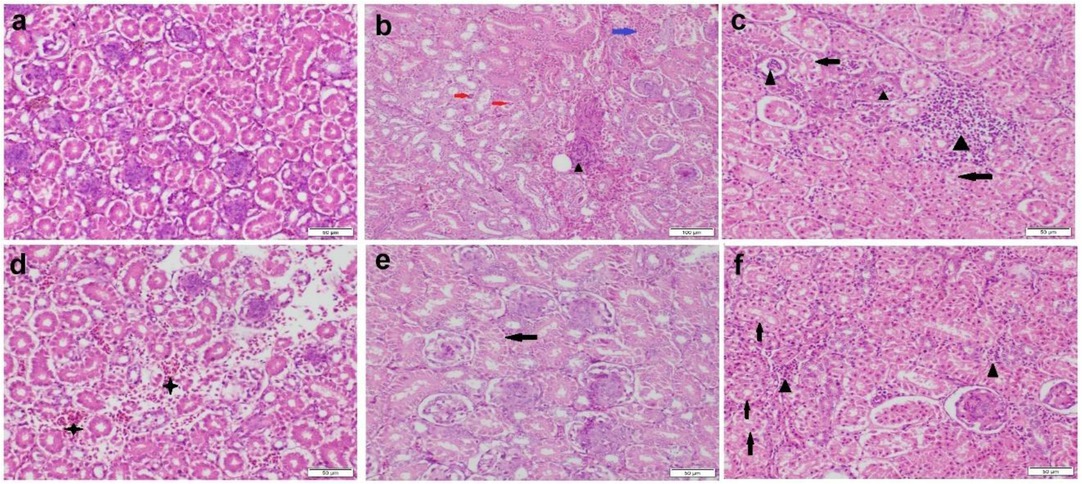
Fig. 5
Photomicrograph of kidney tissue sections stained by haematoxylin and eosin. a – control group with normal histological structure; b–d – ochratoxin A (OTA) group showing vacuolar degeneration (black arrows), necrosis (blue arrow) and desquamation (red arrows) of tubular epithelium, tubular and interstitial inflammatory cell infiltration (black triangles) and interstitial haemorrhage (black stars); e–f – Bacillus subtilis fermentation extract + OTA group showing moderate vacuolar degeneration (black arrows) in some tubular epithelial cells and mild interstitial inflammatory cell infiltration (black triangles)
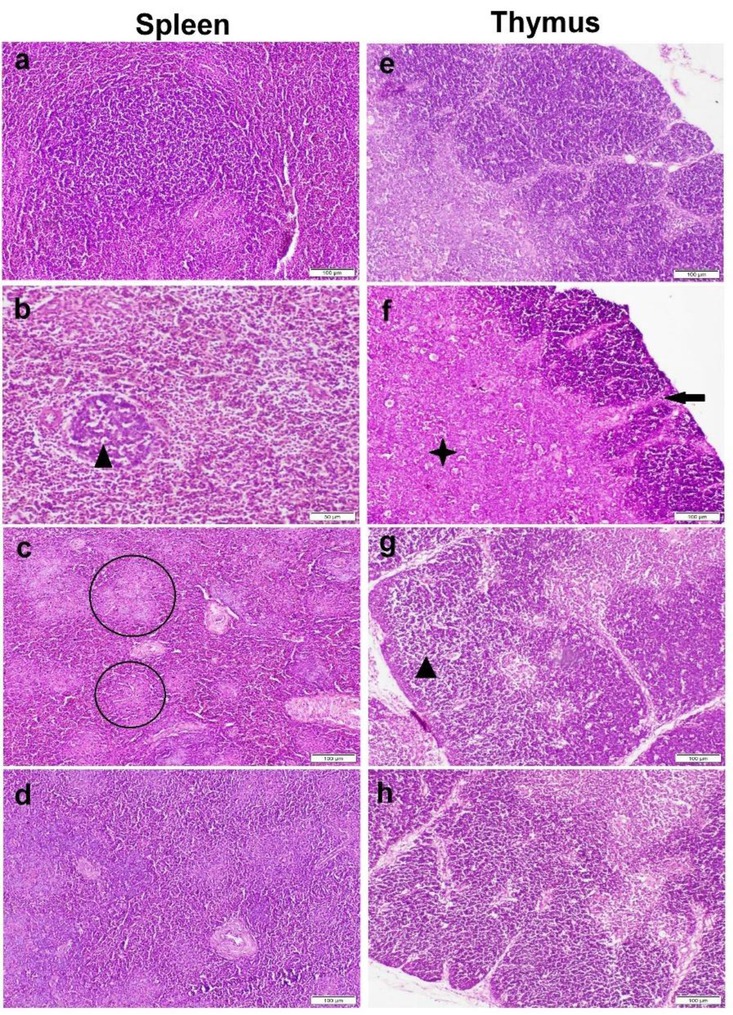
Fig. 6
Photomicrograph of spleen (a–d) and thymus (e–h) tissue sections stained by haematoxylin and eosin. a and e – control group with normal histological structure; b and f, c and g – ochratoxin A (OTA) group showing lymphocytic cell depletion and lymphocytolysis (black triangles), multifocal areas of necrosis (circles), thinning in the cortical layer (black arrow) and expansion with extensive necrosis of medulla (black star); d and h – Bacillus subtilis fermentation extract + OTA group showing normal histological structure
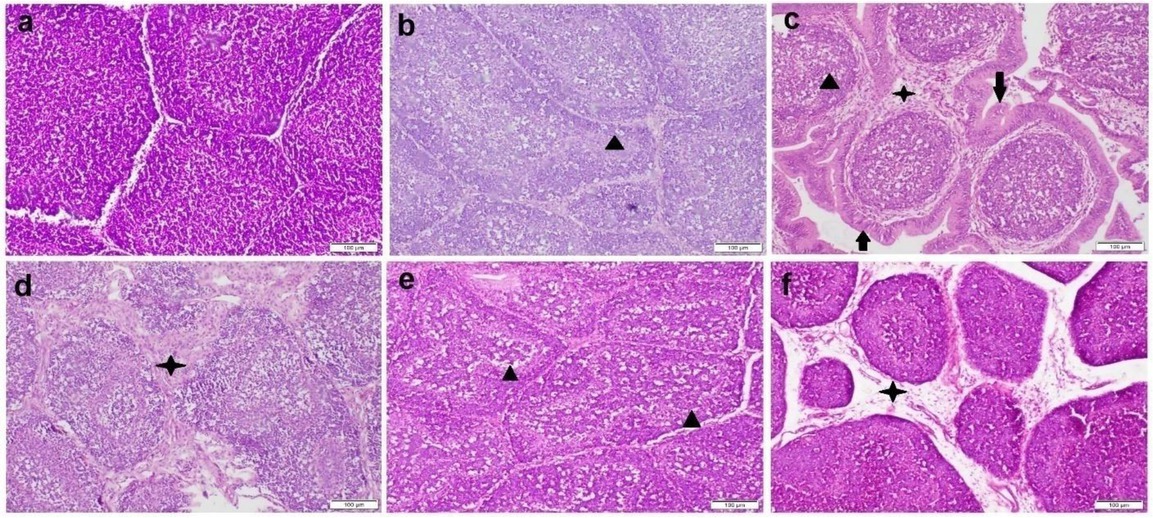
Fig. 7
Photomicrograph of bursal tissue sections stained by haematoxylin and eosin. a – control group with normal histological architecture; b–d – ochratoxin A (OTA) group showing lymphocytic cell necrosis with large number of phagocytic cells (black triangles), interstitial widening by fibrinous exudate and inflammatory cell infiltration (black stars) and atrophy of the lobules with extensive corrugation of the basement membrane (black arrows); e and f – Bacillus subtilis fermentation extract + OTA group showing mild medullary lymphocytolysis (black triangles) and widening of the interfollicular septa by oedema and infiltration by a few inflammatory cells (black star)
Table 3
Microscopic lesion scoring of the examined organs in different groups
| Lesion | Control | OTA | BSFE | OTA + BSFE |
|---|---|---|---|---|
| Microscopic renal lesion scoring | ||||
| RTD | 0 a | 5 b | 0 a | 3 c |
| RTN | 0 a | 5 b | 0 a | 3 c |
| RTP | 0 a | 3 b | 0 a | 2 c |
| Inflammation | 0 a | 5 b | 0 a | 1 c |
| Haemorrhaging | 0 a | 2 b | 0 a | 1 c |
| Congestion | 0 a | 3 c | 1 b | 1 b |
| Glomerular hypercellularity | 0 a | 3 b | 0 a | 0 a |
| Glomerular degeneration | 0 a | 4 b | 0 a | 2 c |
| Microscopic splenic lesion scoring | ||||
| Lymphocytolysis | 0 a | 3 b | 0 a | 0 a |
| Congestion | 0 a | 3 b | 0 a | 1 c |
| Microscopic thymic lesion scoring | ||||
| Lymphocytolysis | 0 a | 4 b | 0 a | 0 a |
| Congestion | 0 a | 2 b | 0 a | 0 a |
| Microscopic bursal lesion scoring | ||||
| Lymphocytolysis | 0 a | 5 b | 0 a | 1 c |
| Congestion | 0 a | 2 b | 0 a | 0 a |
| 0 a | 4 b | 0 a | 0 a | |
[i] OTA – ochratoxin A; BSFE – Bacillus subtilis fermentation extract; RTD – renal tubular degeneration; RTN – renal tubular necrosis; RTP – renal tubular proliferation. Data are presented as median (n = 7 microscopic field/5 sections representing 5 birds/group). Different letters in the same column indicate a significant difference at P < 0.05
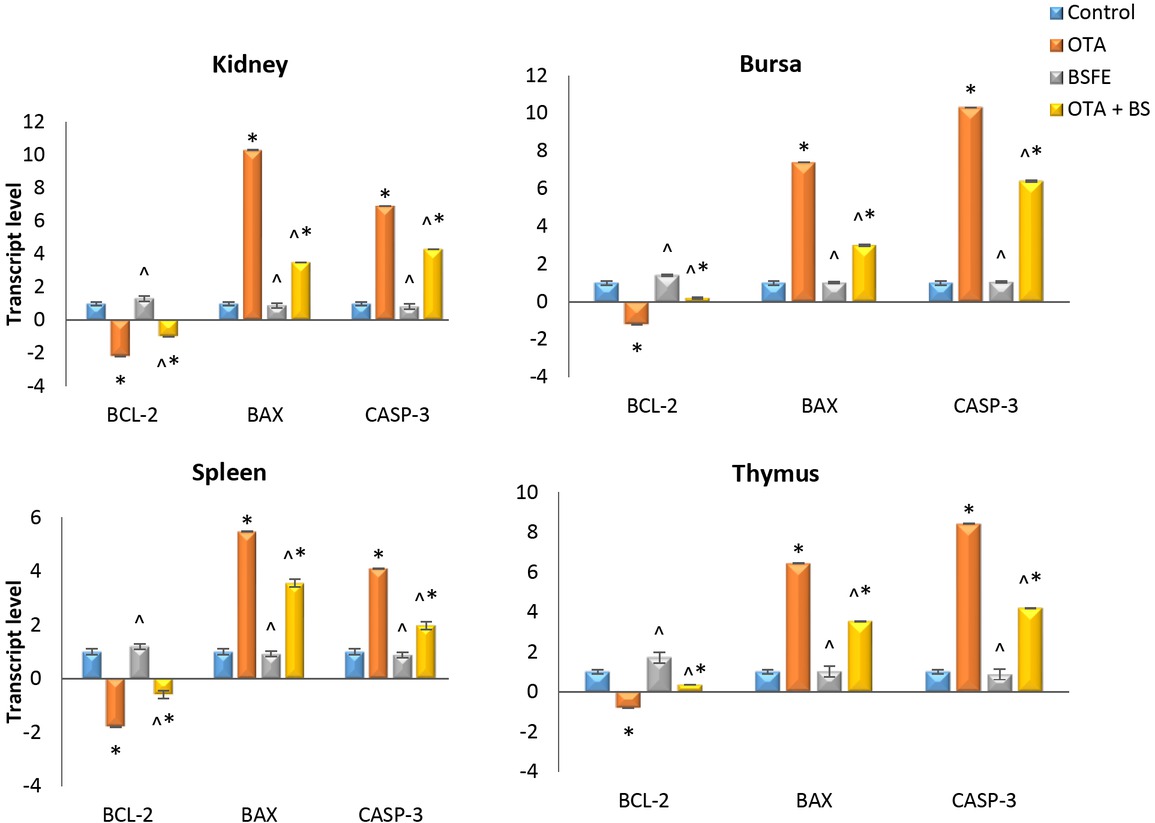
Fig. 8
Impacts of ochratoxin A (OTA) and/ or Bacillus subtilis fermentation extract (BSFE) on gene expression levels of apoptosis-related genes in different tissues of broiler chickens (n = 3 birds/ group)
BCL-2 – B-cell lymphoma 2 protein; BAX – BCL-2-associated X protein; CASP-3 – caspase 3; * – P < 0.05 versus control group; ^ – P < 0.05 versus OTA group