
Table 1
Parameters for the multiple reaction monitoring of carvacrol
| Compound | Precursor ion (m/z) | Product ion (m/z) | DP (V) | EP (V) | CE (V) | CXP (V) |
|---|---|---|---|---|---|---|
| Carvacrol | 149.0 | 134.0 | −55 | −10 | −22 | −9 |
| 133.0 | −55 | −10 | −38 | −17 | ||
| Fipronil-13C4 (IS) | 438.8 | 333.8 | −130 | −10 | −22 | −37 |
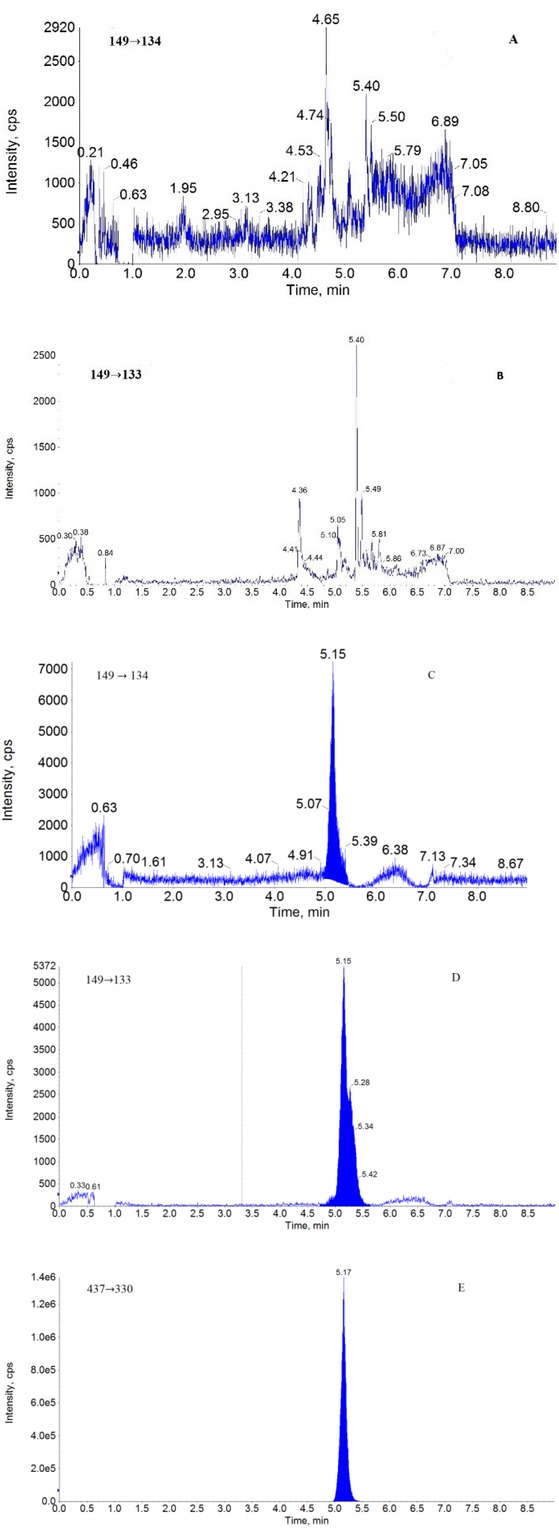
Fig. 1
Chromatograms obtained during validation. cps – counts per second; A and B – blank muscle sample; C and D – blank muscle sample containing carvacrol at the limit of quantification; E – internal standard
Table 2
Parameters obtained for the calibration curves during validation
| Concentration (μg g−1) | Repeatability (RSDr,%) (n = 6) | Within-lab reproducibility (RSDwR,%) (n = 18) | Expanded uncertainty (μg g−1) | Apparent recovery (%) |
|---|---|---|---|---|
| Lung | ||||
| 0.2 | 3.8 ± 4.6 | 5.6 ± 4.4 | - | 103.9 ± 4.3 |
| 1.0 | 3.7 ± 3.6 | 4.8 ± 4.1 | 1.0 ± 0.27 | 107.7 ± 2.4 |
| 5.0 | 2.8 ± 2.9 | 3.2 ± 3.6 | - | 101.1 ± 2.5 |
| 20.0 | 3.2 ± 3.4 | 4.7 ± 3.6 | - | 104.9 ± 4.3 |
| 50.0 | 2.9 ± 3.2 | 4.9 ± 3.1 | - | 103.1 ± 4.3 |
| Plasma | ||||
| 0.2 | 4.1 ± 3.6 | 5.1 ± 4.1 | - | 102.6 ± 5.1 |
| 1.0 | 3.6 ± 3.0 | 4.3 ± 4.2 | 1.0 ± 0.23 | 102.7 ± 3.4 |
| 5.0 | 3.8 ± 2.9 | 3.4 ± 3.3 | - | 103.1 ± 2.7 |
| 20.0 | 3.2 ± 3.7 | 4.0 ± 3.6 | - | 102.6 ± 5.1 |
| 50.0 | 4.1 ± 2.9 | 4.7 ± 3.2 | - | 103.6 ± 2.3 |
| Liver | ||||
| 0.2 | 5.8 ± 4.3 | 6.3 ± 4.6 | - | 106.2 ± 7.8 |
| 1.0 | 4.9 ± 3.7 | 5.2 ± 4.3 | 1.0 ± 0.34 | 104.7 ± 4.1 |
| 5.0 | 3.8 ± 3.9 | 3.8 ± 3.7 | - | 104.1 ± 4.3 |
| 20.0 | 4.2 ± 3.0 | 4.7 ± 4.3 | - | 106.2 ± 3.8 |
| 50.0 | 3.7 ± 3.6 | 4.2 ± 3.1 | - | 103.2 ± 4.3 |
| Muscle | ||||
| 0.2 | 3.8 ± 4.5 | 4.6 ± 4.0 | - | 98.9 ± 3.0 |
| 1.0 | 3.6 ± 3.3 | 4.1 ± 3.7 | 1.0 ± 0.26 | 103.2 ± 3.4 |
| 5.0 | 2.8 ± 3.8 | 3.7 ± 3.2 | - | 105.1 ± 3.1 |
| 20.0 | 3.2 ± 3.4 | 4.0 ± 3.2 | - | 99.9 ± 3.9 |
| 50.0 | 3.7 ± 2.9 | 4.1 ± 3.6 | - | 103.6 ± 3.5 |
Table 3
Validation report for carvacrol
| Matrix | LOD (μg g−1) | LOQ (μg g−1) | Matrix effect (%) | Working range (μg g−1) | Determination coefficient | Calibration curve |
|---|---|---|---|---|---|---|
| Lung | 0.06 | 0.2 | 4.5 ± 1.9% | 0.2–50.0 | 0.985 | y = 0.025x + 0.04 |
| Plasma | 0.06 | 0.2 | 4.3 ± 2.7% | 0.2–50.0 | 0.982 | y = 0.065x + 0.03 |
| Liver | 0.06 | 0.2 | 6.4 ± 3.6% | 0.2–50.0 | 0.980 | y = 0.355x + 0.01 |
| Muscle | 0.06 | 0.2 | 3.3 ± 2.4% | 0.2–50.0 | 0.991 | y = 0.048x + 0.03 |
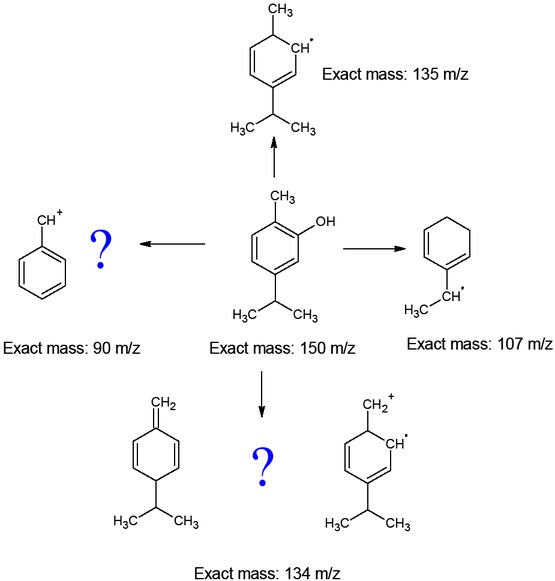
Fig. 2
The proposed carvacrol fragmentation path
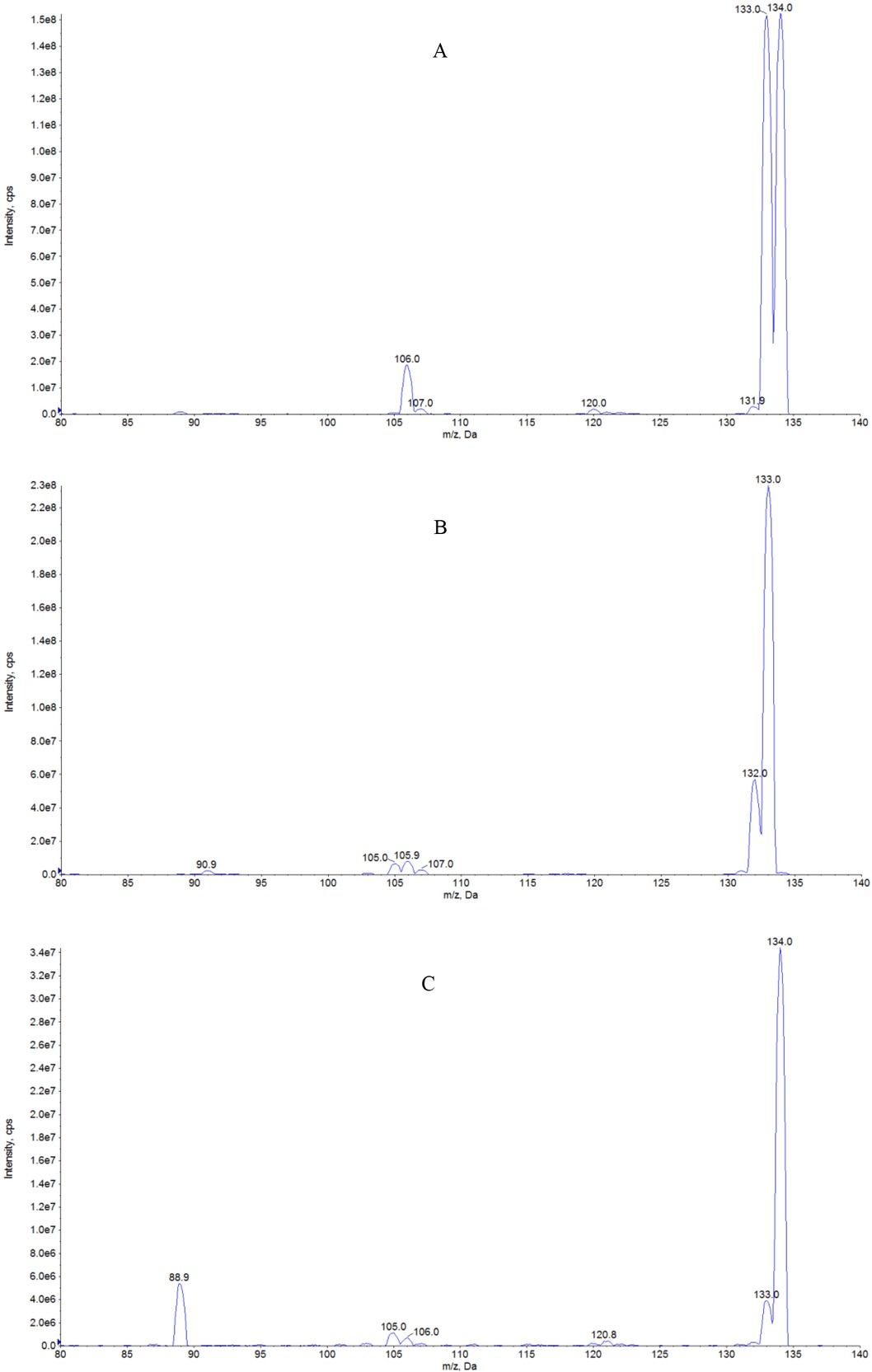
Fig. 3
Mass spectra of carvacrol at different collision energies. A – collision energy − 30 V; B – collision energy − 45 V; C – collision energy − 15 V
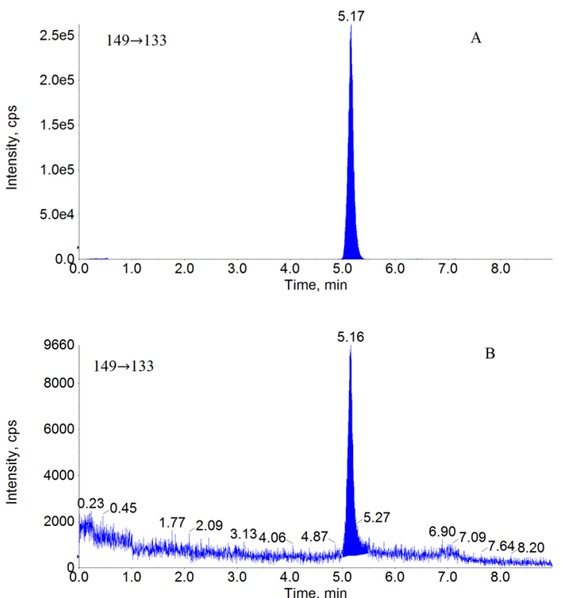
Fig. 4
Chromatograms obtained during optimisation. A – Muscle sample containing carvacrol at a 10 μg g−1 concentration in negative-ion electrospray ionisation mode; B – Muscle sample containing carvacrol at a 10 μg g−1 concentration in negative-ion atmospheric pressure chemical ionisation mode
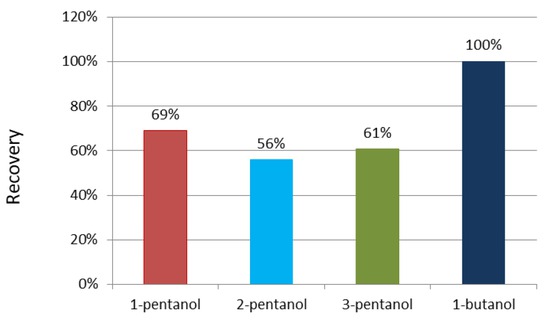
Fig. 5
Comparison of suitability of different extraction solvents for carvacrol