
Table 1
Results for blood haematological parameters in healthy dogs and dogs with chronic kidney disease (CKD) at different stages
| CKD dogs | |||
|---|---|---|---|
| Parameter (reference range) | Healthy dogs (n = 10) | Stage 1 or 2 (n = 5) | Stage 3 or 4 (n = 9) |
| RBC (106/μL) (5.5–8.5) | 6.7 ± 0.35 | 6.7 ± 0.49 | 4.7 ± 0.36** |
| HGB (g/dL) (12–18) | 17.3 ± 0.83 | 16.7 ± 1.17 | 11.6 ± 0.88** |
| HCT (%) (37–55) | 50.1 ± 2.49 | 49.7 ± 3.52 | 34.9 ± 2.63** |
| MCV (fL) (60–77) | 75.2 ± 1.49 | 75.0 ± 2.11 | 75.2 ± 1.57 |
| MCH (pg) (21–26) | 26.0 ± 0.58 | 25.2 ± 0.82 | 25.0 ± 0.61 |
| MCHC (%) (32–36) | 34.6 ± 0.44 | 33.7 ± 0.62 | 33.2 ± 0.47 |
| PLT (103/μL) (200–500) | 307 ± 57.60 | 386 ± 39.7 | 378 ± 64.0 |
| RBC morphology | normal | normal | normal |
| WBC (103/μL) (6–17) | 7.1 ± 0.63 | 8.8 ± 1.35 | 7.5 ± 1.02 |
| WBC morphology | normal | normal | normal |
[i] Data are mean values ± standard errors of the mean
RBC – red blood cell count; HGB – haemoglobin; HCT – haematocrit; MCV – mean cell volume;
MCH – mean cell haemoglobin; MCHC – mean cell haemoglobin concentration; PLT – platelet count;
WBC – white blood cell count; ** P < 0.01, compared to healthy dogs and dogs with stage 1 or 2 CKD
Table 2
Results for blood biochemical parameters in healthy dogs and dogs with chronic kidney disease (CKD) at different stages
| CKD dogs | |||
|---|---|---|---|
| Parameter (reference range) | Healthy dogs (n = 10) | Stage 1 or 2 (n = 5) | Stage 3 or 4 (n = 9) |
| Albumin (g/dL) (2.3–3.8) | 3.2 ± 0.16 | 2.8 ± 0.23 | 2.7 ± 0.20 |
| Urea (mg/dL) (10–60) | 39.4 ± 5.36 | 47.3 ± 13.48 | 259.4 ± 46.70* |
| Creatinine (mg/dL) (0.5–1.4) | 1.1 ± 0.14 | 1.0 ± 0.17 | 7.4 ± 2.34* |
Table 3
Results for routine urinary parameters in healthy dogs and dogs with chronic kidney disease (CKD) at different stages
| CKD dogs | |||
|---|---|---|---|
| Parameter (reference range) | Healthy dogs (n = 10) | Stage 1 or 2 (n = 5) | Stage 3 or 4 (n = 9) |
| USG (1.015–1.045) | 1.037 ± 0.0040 | 1.022 ± 0.0074* | 1.014 ± 0.0009** |
| Protein (mg/dL) | 29.4 ± 2.44 | 210.6 ± 11.67*** | 124.0 ± 35.76* |
| Creatinine (mg/dL) | 206.1 ± 24.00 | 94.4 ± 21.47** | 70.0 ± 21.47** |
| UPC (< 0.5) | 0.15 ± 0.01 | 2.25 ± 0.68* | 1.76 ± 0.50* |
| Chemical analysis | |||
| (semiquantitative testing): | |||
| pH (6.0–7.5) | 6.5 ± 0.37 | 6.4 ± 0.52 | 5.9 ± 0.39 |
| Protein | between 0 and 1+ | between 1 and 3+ | between 1 and 2+ |
| Glucose | negative | negative | negative |
| Ketones | negative | negative | negative |
| Bilirubin | negative | negative | negative |
| Urobilinogen | normal | normal | normal |
| Occult blood | negative | 1+ in the urinary sediment of 1 dog | 1+ in the urinary sediment of 2 dogs |
| Microscopic sediment | |||
| examination: | |||
| Epithelial cells/HPF (<3) | 1.70 ± 0.26 | 1.00 ± 0.22 | 1.44 ± 0.43 |
| Granular cast/HPF (<1) | rare in the urinary sediment of 1 dog | none | rare in the urinary sediment of 1 dog |
| Triple phosphate crystal | 1+ in the urinary sediment of 2 dogs | 2+ in the urinary sediment of 1 dog | none |
| Amorphous phosphate crystal | none | none | 2+ in the urinary sediment of 1 dog |
| RBC/HPF (<5) | 0.30 ± 0.13 | 0.30 ± 0.20 | 0.56 ± 0.49 |
| WBC/HPF (<5) | 0.50 ± 0.18 | 0.60 ± 0.25 | 0.83 ± 0.25 |
| Bacteria | none | none | none |
[i] Data are mean values ± standard errors of the mean
USG – urine specific gravity; UPC – urine protein : creatinine ratio; + – subjective scale ranging from 1+ to 4+; HPF – high-power field (40 × objective); RBC – red blood cell count; WBC – white blood cell count; * P < 0.05; ** P < 0.01; *** P < 0.001, compared to healthy dogs
Table 4
Semi-quantitative analysis of renal ultrasonographic abnormalities in dogs with chronic kidney disease (CKD) at different stages
| CKD dogs | |||
|---|---|---|---|
| Parameter | Stage 1 or 2 | Stage 3 or 4 | P value |
| Irregular contour | 5/5 (100%) | 6/9 (67%) | <0.0001 |
| Loss of corticomedullary differentiation | 4/5 (80%) | 8/9 (89%) | 0.1170 |
| Increased cortical echogenicity | 4/5 (80%) | 8/9 (89%) | 0.1170 |
| Increased medullary echogenicity | 0/5 | 5/9 (56%) | 0.0197 |
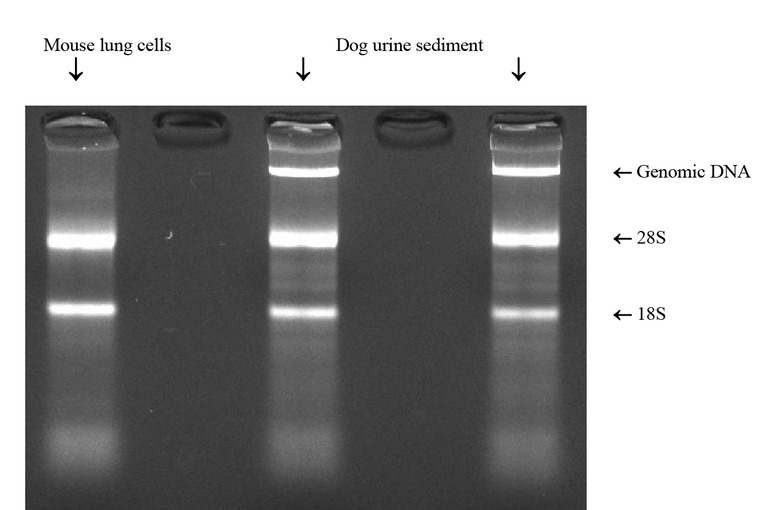
Fig. 1
Electrophoresis of total RNA in agarose gel (2%). Column 1 – total RNA isolated from mouse lung cells; Columns 2 and 3 – total RNA isolated from urine sediment of subject dogs. Ribosomal RNA bands (28S and 18S) were observed in all samples, indicating adequate RNA isolation. The genomic DNA band appeared in samples 1 and 2 because DNAse had not yet been used in the reaction
Table 5
Semi-quantitative analysis of detection of NPHS1 (nephrin mRNA) and NPHS2 (podocin mRNA) in urine sediment samples from healthy dogs and dogs with chronic kidney disease (CKD) at different stages
| CKD dogs | ||||
|---|---|---|---|---|
| Parameter | Healthy dogs | Stage 1 or 2 | Stage 3 or 4 | P value |
| NPHS1 detection | 4/10 (40%) a | 3/5 (60%) b | 1/9 (11%) c | 0.0009 |
| NPHS2 detection | 2/10 (20%) a | 4/5 (80%) b | 1/9 (11%) a | 0.0188 |
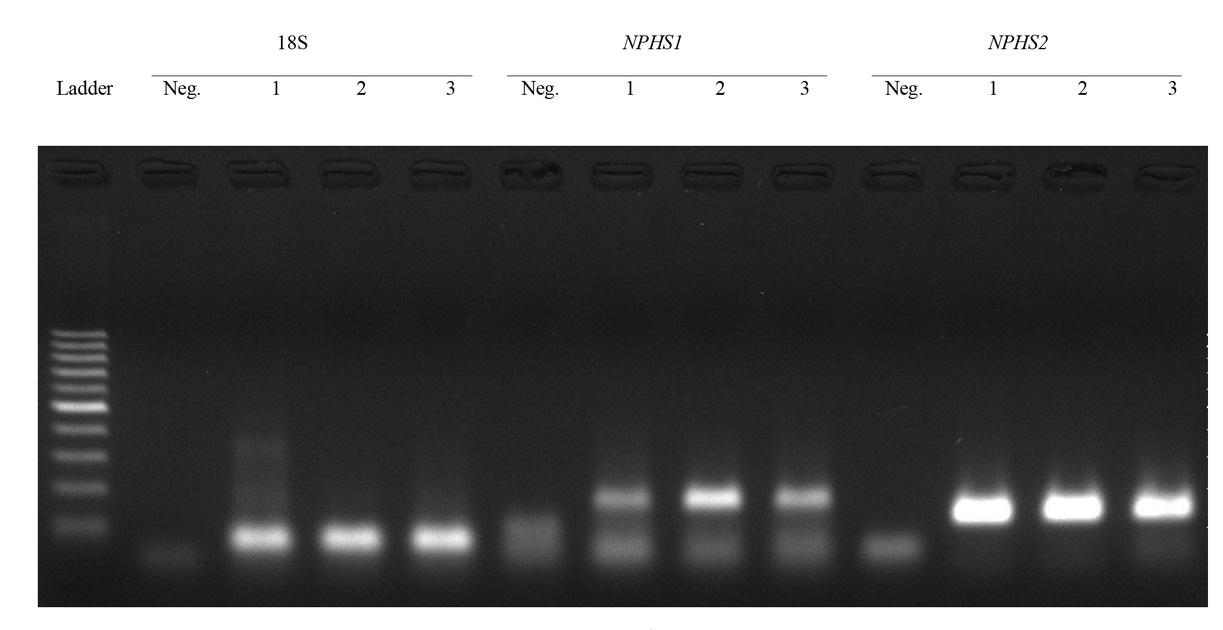
Fig. 2
cDNA product electrophoresis in 1.5% agarose gel. Neg. – negative control; Column 1 – sample from a dog with stage 3 chronic kidney disease; Column 2 – sample from a dog of the control group; Column 3 – sample from a dog with stage 1 chronic kidney disease. The length of 18S was 80 bp, that of NPHS1 was 156 bp, that of NPHS2 was 140 bp, and the DNA ladder was 100 bp long