
Table 1
Number and type of flocks per species and production category tested between 24 November 2020 (date of the first outbreak) to 9 August 2021 (date of the last outbreak)
| Passive surveillance | Contact holdings | Active surveillance | ||
|---|---|---|---|---|
| Laying hens | 219 | 60 | 22 | 301 |
| Broiler chickens | 88 | 27 | 234 | 349 |
| Broiler breeders | 132 | 25 | 5 | 162 |
| Dual-chickens purpose | 32 | 15 | 6 | 53 |
| Fattening turkeys | 174 | 57 | 157 | 388 |
| Turkey breeders | 1 | 0 | 0 | 1 |
| Fattening geese | 37 | 4 | 24 | 65 |
| Geese breeders | 15 | 1 | 2 | 18 |
| Fattening duck | 109 | 11 | 203 | 323 |
| Duck breeders | 9 | 1 | 6 | 16 |
| Pheasants | 1 | 0 | 0 | 1 |
| Guinea fowl | 1 | 2 | 1 | 4 |
| Multi-species | 17 | 3 | 1 | 21 |
| Total | 835 | 206 | 661 | 1702 |
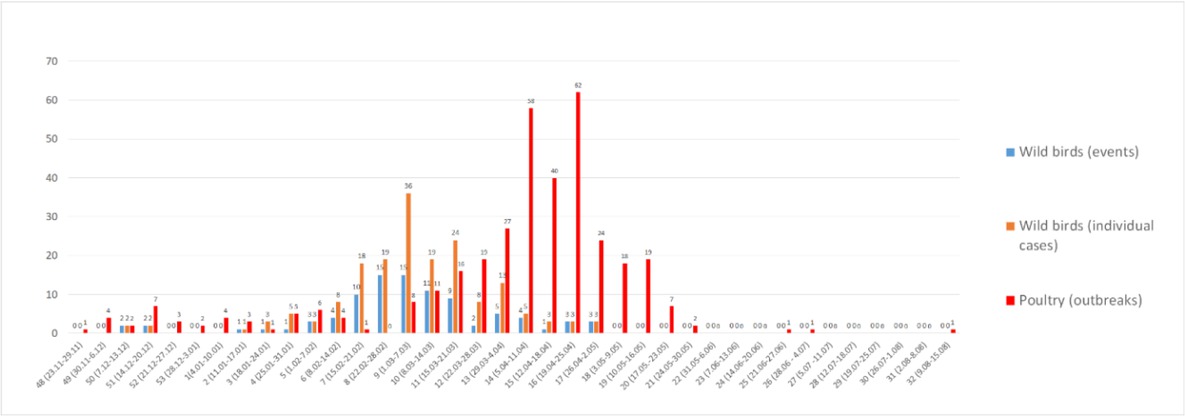
Fig. 1
Number of HPAI outbreaks in poultry and wild birds in Poland in 2020/2021 by week of detection; an epidemiological event in wild birds can involve more than one positive bird found at the same site and time
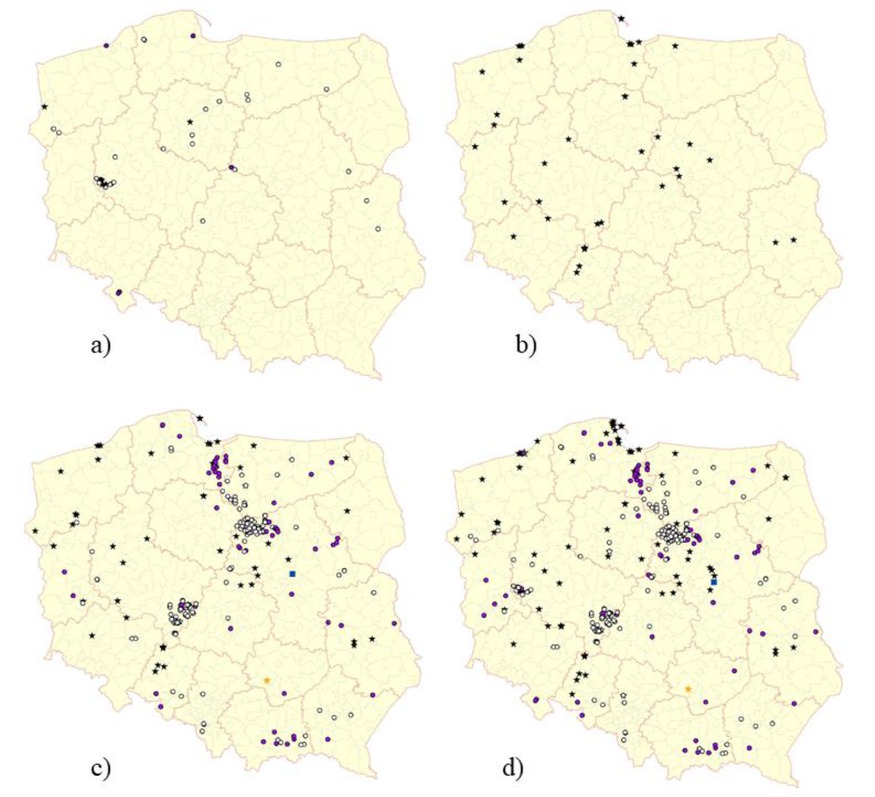
Fig. 2
Distribution of HPAI outbreaks in Poland in the 2020/2021 season. a) HPAI detections in poultry and wild birds during the first phase of the epidemic (end of November 2020–beginning of February 2021); b) HPAI in wild birds during the peak of detections in February–March 2021; c) detections in poultry, wild and captive birds since 1 March 2021; d) detections during the whole 2020/2021 season (24 November 2020–9 August 2021). White dots – outbreaks in commercial poultry; purple dots – outbreaks in non-commercial poultry holdings; black asterisks – H5N8 events in wild birds; yellow asterisks – H5N1 detections in wild birds; blue squares – detections in captive birds
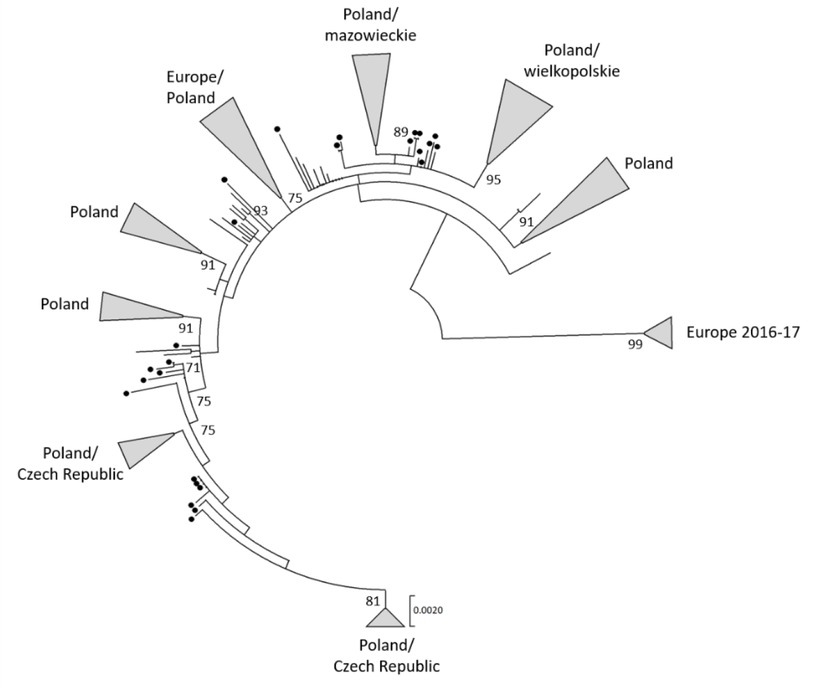
Fig. 3
Phylogenetic tree of the HA gene of Polish H5Nx viruses. Selected sequences from Europe and Asia were also included in the analysis. For clarity, several clusters were compressed and the label indicates the origin of within-cluster sequences. Polish sequences located outside the compressed groups are marked with dots. Bootstrap percentages >70% are shown next to the branches