
Table 1
The primers used for the amplification of the small (S), medium (M) and large (L) segments of the Akabane virus genome
| Gene | Primer | Sequence (5´–3´) | Position | Product size (bp) |
|---|---|---|---|---|
| S | AKVS1 | CTCCACTATTAACTACGCAT | 9–26 | 804 |
| AKVS2 | GGTGTGCACCACATAGACAT | 793–812 | ||
| M | AKVM1 | AGTAGTGAACTACCACAACAAAATG | 1–25 | 4,308 |
| AKVM2 | AGTAGTGTTCTACCACAACAAATAATTAT | 4,280–4,308 | ||
| L | AKVL1 | AGTAGTGTACCCCTAAATACAACATACA | 1–28 | 4,151 |
| AKVL2 | GTCAGCTTGCTTAAATCCC | 4,133–4,151 | ||
| AKVL3 | GTGATTGTGCATTCCTTGG | 3,764–3,782 | 3,106 | |
| AKVL4 | AGTAGTGTGCCCCTAAATGCAATAATAT | 6,842–6,869 |
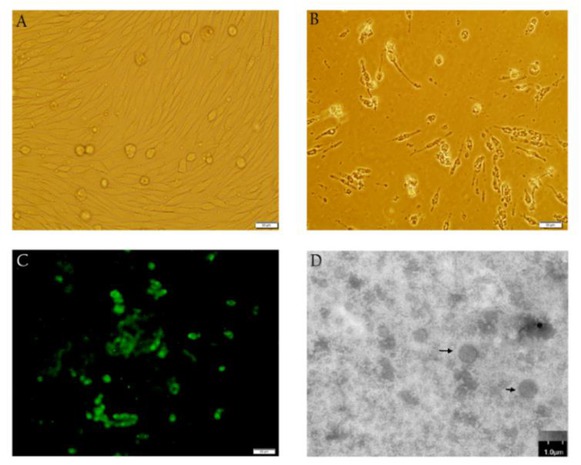
Fig. 1
Histopathological images of baby hamster kidney (BHK)-21 cells infected with Akabane virus strain CX01. A – Control BHK-21 cells; B – Cytopathic effect of CX-01 in BHK-21cells; C – Immunofluorescence results of BHK-21 cells infected with CX-01 after 36 h; D – Negatively stained Akabane virus particles 50–100 nm in diameter. Scale bar - 100 nm
Table 2
Comparison of the three segments S, M and L (ORF) and the coding region of the M segment among AKAVs
| Genotype | Strain | Geographic origin and host | Pairwise % identity (nt/aa) | |||||
|---|---|---|---|---|---|---|---|---|
| S | M | M | L | |||||
| Gn | Gc | NSm | ||||||
| Genogroup Ia | DHL10M110 | China Anopheles vagus | 94.7/99.5 | 91.7/95.6 | 92.7/80.7 | 91.3/78.4 | 90.5/75.7 | 97.5/99.4 |
| NM/BS/1 | China Bovine | 98.1/99.1 | 91.8/96.2 | 92.6/80.7 | 91.5/78.0 | 91.9/79.6 | - | |
| GXLCH01 | China Rhizomys pruinosus | 97.6/99.6 | 96.6/97.9 | 96.8/91.4 | 96.4/91.1 | 96.7/91.7 | 94.5/98.4 | |
| GXLCH70N | China Rhizomys pruinosus | 97.7/99.6 | 96.8/97.9 | 96.4/90.7 | 97.2/93.2 | 95.4/89.0 | 94.6/98.7 | |
| HN10174 | China Culex quinquefasciatus | - | 91.7/96.3 | 92.0/78.9 | 91.5/78.0 | 91.9/79.6 | 95.1/98.8 | |
| KM-1/Br/06 | Japan Bovine | 98.4/100 | 97.3/97.9 | 97.4/93.6 | 97.2/93.5 | 97.1/92.3 | 96.2/98.9 | |
| AKAV-32/SKR/2010 | Korea Bovine | 94.9/98.7 | 97.7/98.4 | 98.1/95.4 | 97.7/94.3 | 97.2/92.8 | - | |
| IRIKI | Japan Bovine | 95.0/98.7 | 94.7/97.0 | 94.9/81.6 | 94.5/86.0 | 93.4/82.9 | - | |
| Genogroup Ib | FO-90-3 | Japan Culicoides spp. | 95.3/98.3 | 91.7/95.6 | 91.0/71.0 | 91.8/79.6 | 92.3/81.2 | - |
| Genogroup II | OBE-1 | Japan Bovine | 95.3/98.7 | 87.5/93.8 | 89.3/66.8 | 86.4/66.7 | 89.4/71.8 | 91.8/97.6 |
| Genogroup III | B8935 | Australia Bovine | 92.7/97.4 | 84.4/91.9 | 85.7/57.6 | 84.1/63.2 | 83.9/58.6 | 96.4/95.8 |
| Genogroup IV | MP496 | Kenya Anopheles funestus | 83.5/90.6 | 70.3/74.4 | 75.2/- | 69.9/38.3 | 65.9/30.4 | - |
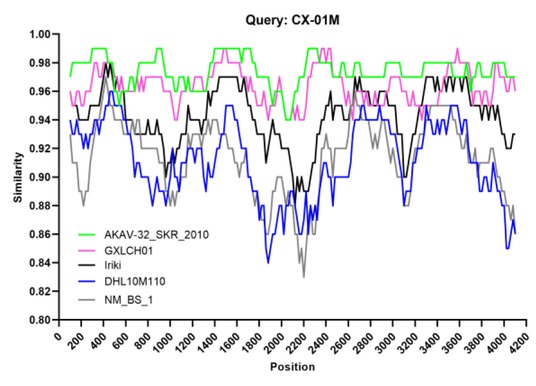
Fig. 3
Recombination analysis of the CX-01 strain using a 200-bpsliding window and a 20-bp step. The y-axis indicates the percentage similarity between the query sequence and the reference sequences. Comparison of genome scale similarity of CX-01 (query) with DHL10M110 (green), GXLCH01(pink), Iriki (black), AKAV-32/SKR/2010 (blue) and NM/BS/1 (grey)
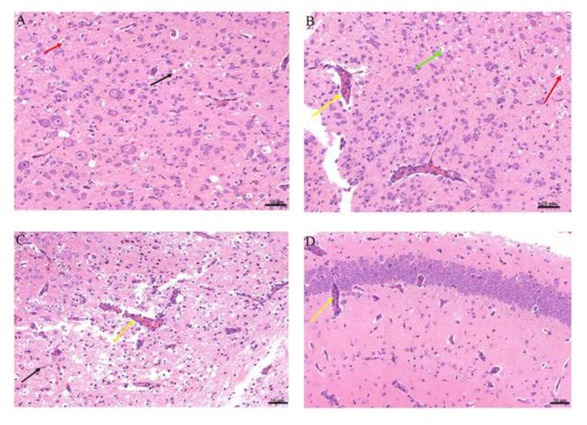
Fig. 4
Histopathological characteristics in the central nervous tissues of mice with AKAV CX-01 strain. A – brain of a 7-day-old mouse inoculated intraperitoneally (IP) with the CX-01 virus. Neuronal degeneration, necrosis (red arrow) and cavities are visible in the brain stem tissue (black arrow); B–brain of a 7-day-old mouse inoculated intracerebrally (IC) with the CX-01 virus. Enlarged vascular endothelial cells and perivascular infiltration of mononuclear cells (yellow arrow), gaps in the neuron cells (green arrow) and neuronal degeneration and necrosis are visible (red arrow); C – brain of a 7-day-old mouse inoculated IP with the CX-01 virus. The cortex, thalamus and hypothalamus on one side of the tissue have extensive necrosis, and fragmented nuclei are visible (black arrows); D – brain of a 7-day-old mouse inoculated IC with the CX-01 virus. Hippocampal pyramidal cells are regularly arranged, with clear demarcation, and round nuclei with white blood cells in the vascular cavity (yellow arrow). Haematoxylin and eosin staining. Scale bar– 50 μm
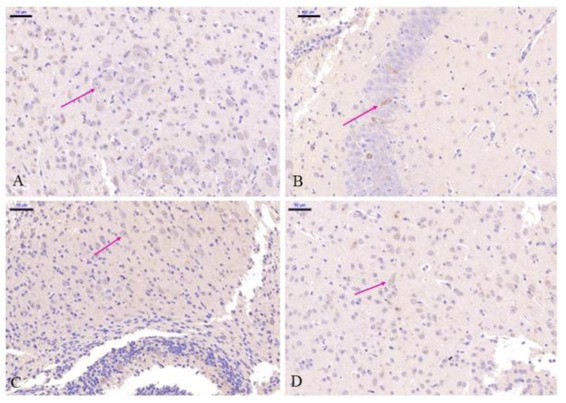
Fig. 5
Immunohistochemical characteristics in the central nervous tissues of mice with AKAV CX01 strain. A– brain stem of a mouse inoculated intraperitoneally (IP). Cells detected as antigen positive were observed as dark brown (red arrow); B– brain of a mouse inoculated intracerebrally (IC). Viral antigen is present mainly in neurons of the hippocampus, of which some cells were detected as antigen positive (red arrow); C – brain of a mouse inoculated IP. The hippocampal pyramidal cells were virus antigen–positive (red arrow); D– brain of a mouse inoculated IC. The hippocampal pyramidal cells were virus antigen positive (red arrow). Haematoxylin and eosin staining. Scale bar– 50 μm