
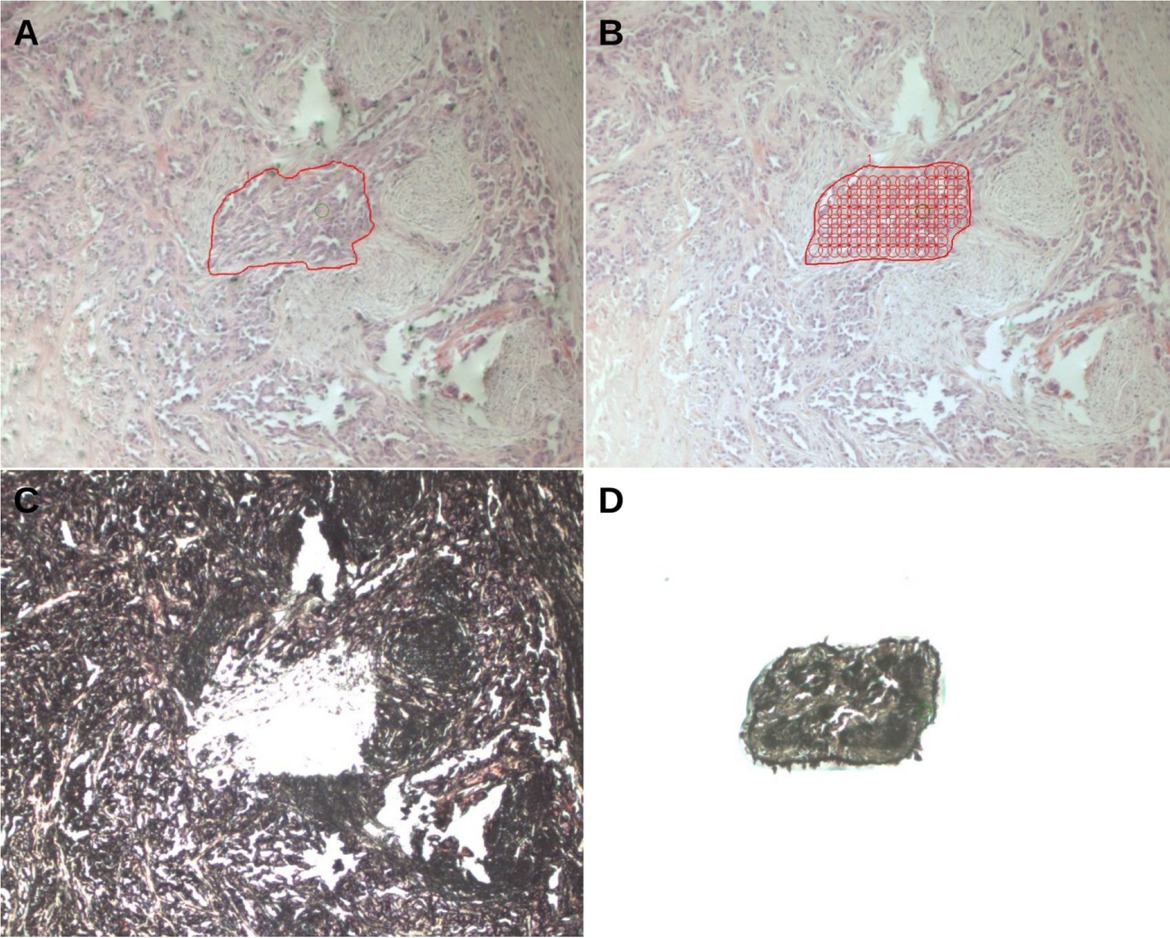
Fig. 1
Example images of the laser capture microdissection of tumour cells acquired using Arcturus XT operating software (10× objective). A – Haematoxylin and eosin stained section, covered with xylene for visualisation, showing cystic/papillary type apocrine sweat gland carcinoma before microdissection, with the area containing tumour cells marked with a red line. B – The same section with marked tumour cells and laser infrared spots (IR spots). C – The same section after xylene evaporation and the microdissection of the marked cells. D – Tumour cells transferred to the macro cap after laser capture microdissection

Fig. 2
Alignment of the amino acid sequence of exon 4 of the p53 protein of the canine control (K1) sample and tested samples of apocrine sweat gland carcinomas with canine (U62133, AB020761) and human (K03199) amino acid reference sequences of the p53 protein
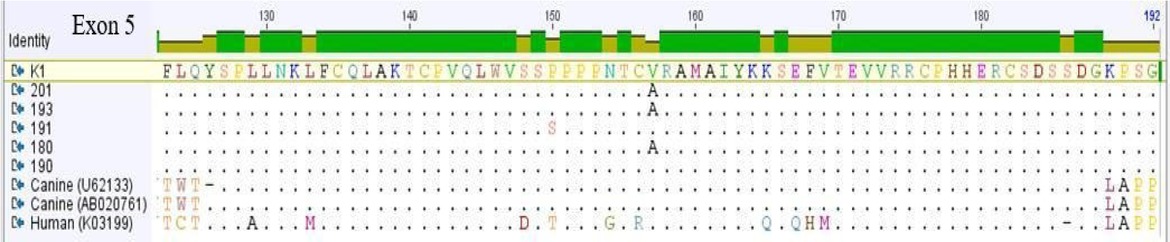
Fig. 3
Alignment of the amino acid sequence of exon 5 of the p53 protein of the canine control (K1) sample and tested samples of apocrine sweat gland carcinomas with canine (U62133, AB020761) and human (K03199) amino acid references sequence of the p53 protein
Table 1
Mutations in the p53 gene in canine ASGC
| Sample no. | Histology* | Breed | Age (years) | Body location | Exon | Codon † | Mutation (amino acid) |
|---|---|---|---|---|---|---|---|
| 180 | Papillary ASGC | — | 5 | Chest (rib area) | 5 | 157 | gTc → gCc (Val → Ala) |
| 188 | Papillary ASGC | German shepherd | 6 | Forelimb (arm area) | 8 | 264 | aAc →a-c reading frame shift |
| 190 | Solid ASGC | Mixed breed | 8 | Neck (side neck area) | 5 | 178 | caC → caT (His = His) |
| 191 | Ductal ASGC | Mixed breed | 10 | Chest (scapular area) | 5 | 149, 150 | tcCCca → tcTTca (Ser = Ser; Pro > Ser) |
| 193 | Solid ASGC | Dachshund | 9 | Forelimb (axillary area) | 5 | 157 | gTc → gCc (Val → Ala) |
| gcT → gcC | |||||||
| 63 | (Ala = Ala) | ||||||
| 194 | Tubular ASGC | Giant schnauzer | — | Finger | 4 6 | 123 | aCt → aGt (Thr → Ser) |
| 214 | aCt → aGt | ||||||
| (Thr → Ser) | |||||||
| 201 | Ductal ASGC | Mixed breed | 12 | Head (auricle area) | 5 | 157 | gTc → gCc (Val → Ala) |
| 212 | Papillary ASGC | Mixed breed | 11 | — | 4 | 90 | tCc → tTc (Ser → Phe) |
| 217 | Ductal ASGC | Mixed breed | 5 | — | 4 | 90 | tCc → tTc |
| (Ser → Phe) | |||||||
| 219 | Cystic, ASGC papillary | Mixed breed | 5 | Pelvis (gluteal area) | 4 | 90 | tCc → tTc (Ser → Phe) |
| 220 | Solid ASGC | — | 11 | Pelvis (anal area) | 4 | 90 | tCc → tTc (Ser → Phe) |
| 221 | Solid ASGC | French bulldog | 11 | — | 4 | 90 | tCc → tTc (Ser → Phe) |
| 222 | Carcinosarcoma ASG | Miniature schnauzer | 8 | Chest (rib area) | 4 | 90 | tCc → tTc (Ser → Phe) |

Fig. 4
Alignment of the amino acid sequence of exon 6 of the p53 protein of the canine control (K1) sample and tested samples of apocrine sweat gland carcinoma with canine (U62133, AB020761) and human (K03199) amino acid reference sequences of the p53 protein

Fig. 5
Alignment of the amino acid sequence of exon 8 of p53 of the canine control (K1) sample and tested samples of apocrine sweat gland carcinomas with canine (U62133, AB020761) and human (K03199) amino acid reference sequences of the p53 protein