
Table 1
Primers used for quantitative real-time PCR
| Gene symbol | Primer sequences (from 5ʹ to 3ʹ) | Length | GenBank accession number |
|---|---|---|---|
| IL-4 | F: GTCTGCTTACTGGCATGTACCA | 118 | NM214123.1 |
| R: GCTCCATGCACGAGTTCTTTCT | |||
| IFNγ | F: CGATCCTAAAGGACTATTTTAATGCAA | 102 | NM213948.1 |
| R: TTTTGTCACTCTCCTCTTTCCAAT | |||
| IL-13 | F: GGATGATTTTTCGCCACGGG | 78 | NM213803.1 |
| R: ATGGTAAAGGGCTGCCTCTG | |||
| GAPDH | F: ACAGACAGCCGTGTGTTCC | 60 | NM001206359.1 |
| R: ACCTTCACCATCGTGTCTCA |
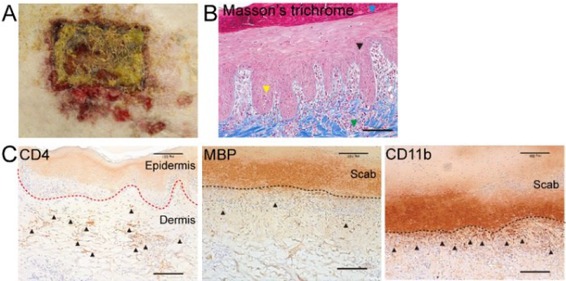
Fig. 1
Macroscopic and microscopic analysis of 1-fluoro-2,4-dinitrobenzene-induced ACD after 24h sensitisation with a 10% solution and 2h challenge with a 1% solution, shown in images which best represent the changes, selected from images of four skin tissue samples from one minipig
A – Macroscopic images of day-17 skin samples; B – Histopathological image with Masson’s trichrome staining. Spongiosis is marked with a yellow arrowhead; acanthosis is marked with a black arrowhead; perivascular immune cell infiltration at the epidermis–dermis junction is marked with a blue arrowhead; C – Immunohistochemistry. CD4+ lymphocytes, major basic protein (MBP)+ eosinophils, and CD11b+ macrophages are marked by black arrow heads. Scale bar = 100 μm
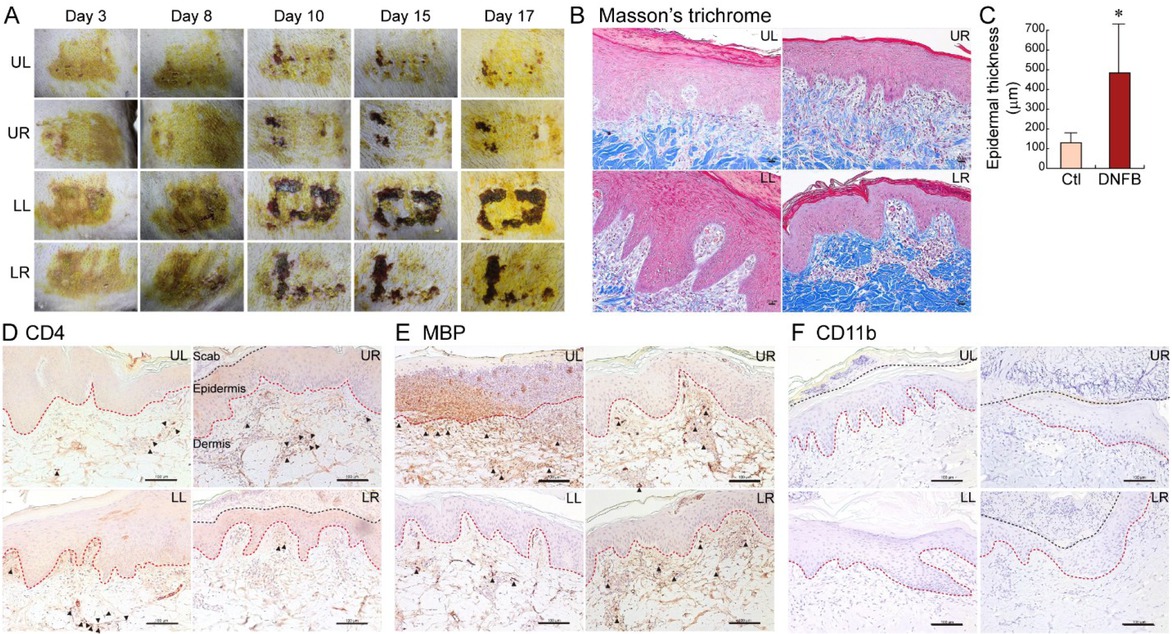
Fig. 2
Macroscopic and microscopic analysis of modified 1-fluoro-2,4-dinitrobenzene-induced ACD after 30 min sensitisation with a 10% solution and 2h challenge with a 1% solution shown in images which best represent the changes, selected from images of eight skin tissue samples from two minipigs
A – Macroscopic images of day-3, day-8, day-10, day-15, and day-17 skin samples; B – Histopathological image with Masson’s trichrome staining. Scale bar = 20 μm; C – Thickness of epidermis. p* < 0.05; D –F – Immunohistochemistry. D – CD4+ lymphocytes; E – major basic protein (MBP) + eosinophils; F – CD11b+ macrophages. All named cells are marked by black arrowheads. Margins of scab, epidermis, and dermis are marked with dotted lines. Scale bar = 100 μm; Ctl – controls; DNFB – 1-fluoro-2,4-dinitrobenzene; UL – upper left; UR – upper right; LL – lower left; LR – lower right
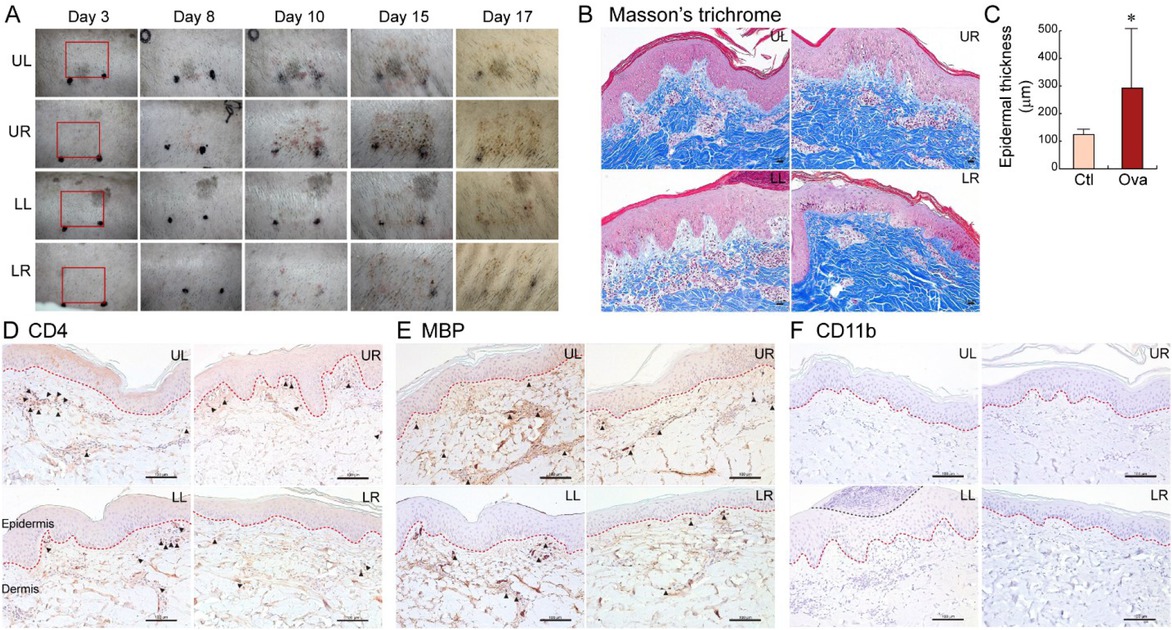
Fig. 3
Macroscopic and microscopic analysis of ovalbumin-induced AD shown in representative images shown in images which best represent the changes, selected from images of eight skin tissue samples from two minipigs
A – Macroscopic images of day-3, day-8, day-10, day-15, and day-17 skin samples; B – Histopathological image with Masson’s trichrome staining. Scale bar = 20 μm; C – Thickness of epidermis. p* < 0.05; D –F – Immunohistochemistry. D – CD4+ lymphocytes; E – major basic protein (MBP) + eosinophils; F – CD11b+ macrophages. All named cells are marked by black arrowheads. Margins of scab, epidermis, and dermis are marked with dotted lines. Scale bar = 100 μm; Ctl – controls; ova – ovalbumin; UL – upper left; UR – upper right; LL – lower left; LR – lower right
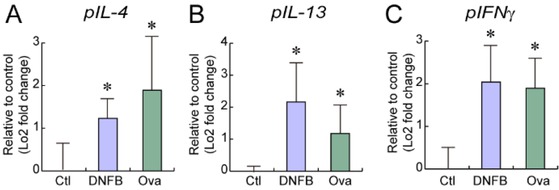
Fig. 4
Analysis of the cytokine mRNA in AD skin as quantified by quantitative reverse transcriptase PCR
A – porcine (p) IL-4; B – porcine IL-13; C –porcine IFNγ. Ctl – controls; DNFB – 1-fluoro-2,4-dinitrobenzene; Ova – ovalbumin. Values are mean ± SD. *p < 0.05

Fig. 5
Analysis of the absolute cytokine protein level in AD skin and serum as quantified by ELISA
A – porcine (p) IL-4; B – porcine IL-13; C –porcine IFNγ. Ctl – controls; DNFB – 1-fluoro-2,4-dinitrobenzene; Ova – ovalbumin. Values are mean ± SD. *p < 0.05