
Table 1
Primers used in this study
| Species | Primer name | Primer sequence | Annealing temperature | Amplicon size (bp) | Reference |
|---|---|---|---|---|---|
| Mycoplasma genus | MGSO RNA5 | TGCACCATCTGTCACTCTGTTAACCTC AGAGTTTGATCCTGGGCTCAGGA | 58°C | 1021 | (21) |
| M. ovipneumoniae | PP1 2 | GACTTCATCCTGCACTCTGT TGAACGGAATATGTTAGCTT | 55°C | 361 | (17) |
Table 2
M. ovipneumoniae PCR detection results in nasal swabs
| Region | Examined | Positive | Prevalence (%) |
|---|---|---|---|
| Hotan | 200 | 76 | 38.00 |
| Kashgar | 242 | 128 | 52.89 |
| Aksu | 232 | 73 | 31.47 |
| Bazhou | 150 | 59 | 39.33 |
| Total | 824 | 336 | 40.78 |
Table 3
M. ovipneumoniae positive rates in nasal swabs by animal age
| Age (months) | Examined | Positive | Prevalence (%) | ||||||
|---|---|---|---|---|---|---|---|---|---|
| Kazak | Duolang | Total | Kazak | Duolang | Total | Kazak | Duolang | Total | |
| < 3 | 106 | 130 | 236 | 59 | 67 | 126 | 55.67 | 51.54 | 53.39 |
| 3-12 | 78 | 85 | 163 | 38 | 37 | 75 | 50.67 | 49.33 | 46.01 |
| >12 | 201 | 224 | 425 | 60 | 75 | 135 | 29.85 | 33.48 | 31.76 |
| Total | 385 | 439 | 824 | 147 | 189 | 336 | 38.10 | 43.05 | 40.78 |
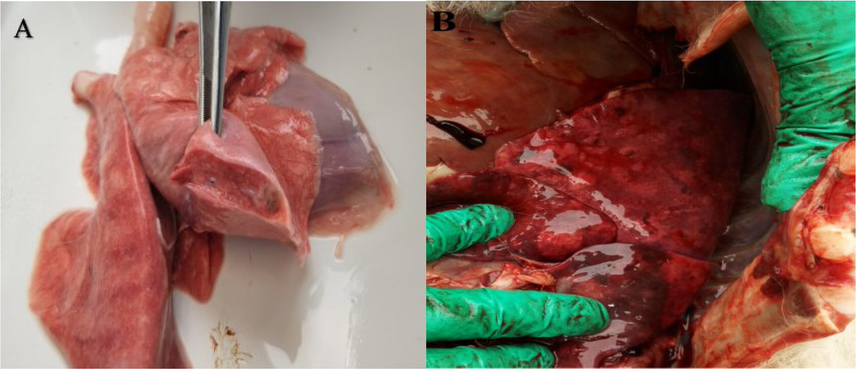
Fig. 1
Pathological changes in the lungs of sheep with suspected M. ovipneumoniae infection. A - caseous transformation; B - lung surface consolidation
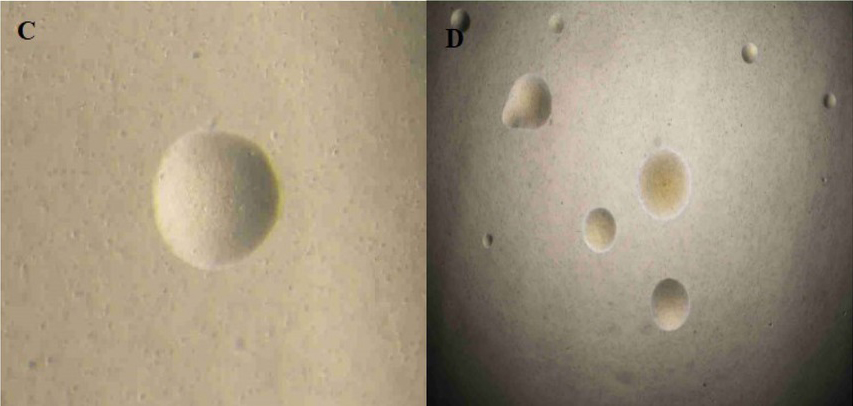
Fig. 2
Morphological identification of M. ovipneumoniae. Single colony of M. ovipneumoniae (C, 100×); multi-colony of M. ovipneumoniae (D, 40×)
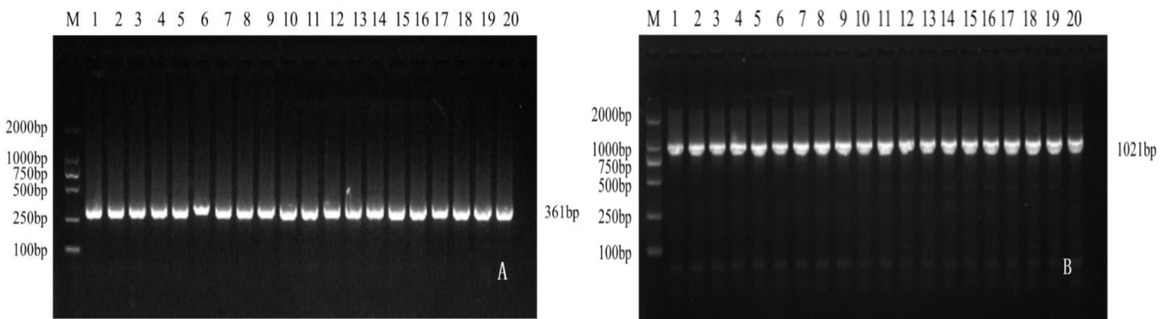
Fig. 3
Detection of M. ovipneumoniae and Mycoplasma genus in samples from sheep by PCR. M - DNA marker DL-2000 (2000, 1000, 750, 500, 250, 100 bp); A - 1–20 M. ovipneumoniae positive samples; B - 1–20 Mycoplasma genus positive samples
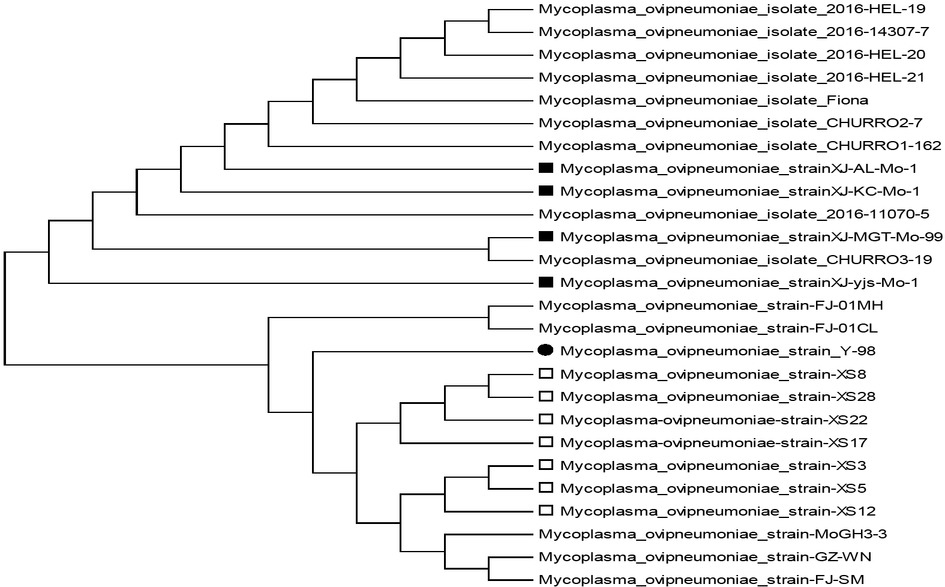
Fig. 4
Phylogenetic tree of M. ovipneumoniae based on partial sequences of the M. ovipneumoniae 16S rRNA gene amplified with specific primers. The Mycoplasma 16S rRNA gene sequences were aligned using MEGA 6.0 software; 1000 bootstrap replicates were used to determine the nucleotide sequence distance. A consensus phylogenetic tree was created using the neighbour-joining method. The black boxes signify the M. ovipneumoniae strains XJ-AL-Mo-1, XJ-KC-Mo-1, XJ-MGT-Mo-99 and XJ-yjs-Mo-1 identified in this study. The white boxes signify M. ovipneumoniae strains isolated in northern Xinjiang (Chen et al., 2015). MoGH3-3, GZ-WN, FJ-SM, FJ-01MH are strains from inland China, and the black circle signifies the M. ovipneumoniae international standard strain Y-98