
Table 1
Results of direct microscopic examinations versus those of cultures
| Test results | Animal | Total (n=308) | ||
|---|---|---|---|---|
| Dog (n=134) | Cat (n=174) | |||
| Negative | 72 (53.8%) | 110 (61.6%) | 182 (59.1%) | |
| Negative | 72 (53.8%) | 106 (60.9%) | 178 (57.8%) | |
Table 2
Profiles of animals with suspected cases of dermatophytosis
| Animal | Total (n=130) | |||
|---|---|---|---|---|
| Dog (n=62) | Cat (n=68) | |||
| Age | <1 year old 1–4 years old >4 years old | 36 (58.1%) 10 (16.1%) 16 (25.8%) | 44 (64.7%) 16 (23.5%) 8 (11.7%) | 80 (61.5%) 26 (20%) 24 (18.5%) |
| Sex | Female Male | 26 (41.9%) 36 (58.1%) | 46 (67.6%) 22 (32.4%) | 72 (55.4%) 58 (44.6%) |
| Habitat | Indoor Outdoor | 50 (80.6%) 12 (19.4%) | 34 (50%) 34 (50%) | 84 (64.6%) 46 (35.4%) |
| Disease in owner | Yes No | 8 (12.9%) 54 (87.1%) | 18 (26.5%) 50 (73.5%) | 26 (25%) 104 (65%) |
| Previous antifungal therapy for cutaneous lesions | Yes No | 4 (6.5%) 58 (93.5%) | 6 (8.8%) 62 (91.2%) | 10 (7.7%) 120 (92.3%) |
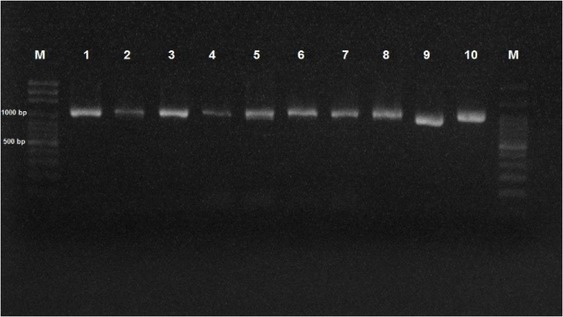
Fig 1
Representative amplified ITS region using V9G-LS266 primer. Lines 1–8 – M. canis; line 9 – M. gypseum; line10 – T. mentagrophytes; M – 100 bp DNA ladder
Table 3
Results of ITS sequence analysis of canine and feline dermatophyte samples
| Molecular results | Animal | Total (n=130) | ||
|---|---|---|---|---|
| Dog (n=62) | Cat (n=68) | |||
| M. canis | 46 (74.3%) | 56 (82.3%) | 102 (78.4%) | |
| ITS sequenced analysis | T. mentagrophytes | 10 (16%) | 4 (5.9%) | 14 (10.8%) |
| M. gypseum | 6 (9.7%) | 8 (11.8%) | 14 (10.8%) | |
Table 4
Fungal strains isolated from animals with skin lesions suspected of being dermatophytes
| Genus | Fungal species | Dog | Cat | Total |
| Microsporum Trichophyton (Dermatophytes) | M. canis T. mentagrophytes M. gypseum | 46 10 6 | 56 4 8 | 102 14 14 |
| M. pachydermatis | 22 | 26 | 48 | |
| Malassezia | M. furfur | 2 | 2 | 4 |
| M. globosa | 1 | 3 | 4 | |
| C. albicans | 3 | 0 | 3 | |
| Candida | Candida spp. | 1 | 0 | 1 |
| Nannizziopsis | N. vriesii | 0 | 2 | 2 |
Table 5
In vitro antifungal susceptibilities of eight antifungal drugs against 130 clinical isolates of dermatophytes from dogs and cats with dermatophytosis
| Dermatophyte species | Drug | MIC range (μg/mL) | GM (μg/mL) | MIC(μg/mL) 50 | MIC(μg/mL) 90 |
|---|---|---|---|---|---|
| Caspofungin | 0.001–0.008 | 0.001 | 0.001 | 0.002 | |
| Ketoconazole | 0.032–8 | 0.064 | 0.032 | 0.125 | |
| Miconazole | 0.032–0.5 | 0.12 | 0.250 | 0.250 | |
| Microsporum canis | Itraconazole | 0.002–2 | 0.06 | 0.125 | 0.25 |
| (n=102) | Griseofulvin | 0.125–8 | 0.6 | 1 | 1 |
| Clotrimazole | 0.016–16 | 0.12 | 1 | 2 | |
| Fluconazole | 0.128–32 | 2.1 | 4 | 8 | |
| Terbinafine | 0.008–2 | 0.064 | 0.125 | 0.25 | |
| Caspofungin | 0.001–0.016 | 0.0025 | 0.002 | 0.004 | |
| Ketoconazole | 0.016–0.128 | 0.026 | 0.016 | 0.032 | |
| Miconazole | 0.064–0.5 | 0.2 | 0.128 | 0.5 | |
| Trichophyton | Itraconazole | 0.002–1 | 0.09 | 0.125 | 0.25 |
| mentagrophytes (n=14) | Griseofulvin | 0.128–2 | 0.25 | 0.250 | 1.0 |
| Clotrimazole | 0.5–8 | 0.9 | 0.5 | 4 | |
| Fluconazole | 0.5–4 | 1.41 | 1 | 4 | |
| Terbinafine | 0.016–0.125 | 0.026 | 0.064 | 0.064 | |
| Caspofungin | 0.001–0.004 | 0.0019 | 0.002 | 0.008 | |
| Ketoconazole | 0.016–0.064 | 0.026 | 0.016 | 0.064 | |
| Miconazole | 0.064–0.5 | 0.15 | 0.125 | 0.5 | |
| Microsporum gypseum | Itraconazole | 0.002–0.5 | 0.07 | 0.125 | 0.25 |
| (n=14) | Griseofulvin | 0.064–2 | 0.23 | 0.125 | 1.0 |
| Clotrimazole | 0.25–4 | 0.82 | 0.5 | 4 | |
| Fluconazole | 0.25–4 | 1.1 | 1 | 2 | |
| Terbinafine | 0.016–0.064 | 0.039 | 0.016 | 0.064 |