
Introduction
Pathologies caused by bovine viral diarrhoea-mucosal disease virus (BVD-MDV) generate massive economic losses in the cattle industry worldwide (18). These pathologies are associated with reproductive, gastrointestinal, respiratory and immunosuppressive syndromes (2). Also, BVD-MDV causes fatal mucosal disease, among the symptoms of which are bloody diarrhoea, gastrointestinal ulceration, and leukopenia (47). As BVD-MDV infections present with a wide range of indicators, it is almost impossible to predict the disease’s harmful effect on cattle populations (25). The complexity of prediction is also compounded by the confusing resemblance of the symptoms to those of other diseases and by the differing natures of BVD-MDV infections from herd to herd. The economic losses can last years after the infection period (22).
BVD-MDV belongs to the Flaviviridae family and the Pestivirus genus. Two genotypes are described for this virus, BVD-MDV1 and BVD-MDV2, and more than 20 globally distribute subgenotypes (49), however
two may become three because a new putative genotype, BVD-MDV3, was detected a few years ago (26, 31). BVD-MDV transplacental transmission to cattle foetuses generates persistently infected (PI) offspring, which constitute the major reservoir of this virus and the main source of viral propagation to susceptible animals (34).
Bovine viral diarrhoea-mucosal disease (BVD-MD) is essentially prevented and controlled by vaccination campaigns, together with biosecurity measures and elimination of PI animals. The induction of an accurate immune response in susceptible animals could prevent the onset of any clinical symptoms and could protect foetuses better by blocking vertical transmission of the virus and allowing fewer calves to be born PI. Inactivated and modified-live viral vaccines have been used for decades to counteract BVD-MDV, demonstrating reduction of viral shedding and viraemia (34). Research into those conventional vaccines has been undertaken, has yielded extensive knowledge, and is ongoing (19, 27). However, there is always a concern around the use of conventional BDV-MDV vaccines due to their intrinsic disadvantages such as a difficult production process and a high probability of vaccine contamination with BVD-MDV other than the vaccine strain. Additionally, there is a risk of inducing immunosuppression and harming PI animals. Likewise, these vaccines could hamper the implementation of the strategy of differentiating the infected from the vaccinated animals (DIVA) (13, 23, 39). To meet the high safety standards that global regulatory agencies demand, new research has focused on generating safer and more cost-effective recombinant vaccines that also allow DIVA strategies for BVD-MDV control. Some studies have developed promising recombinant vaccine candidates exploiting different expression systems for the E2 glycoprotein of this virus as the most antigenic element, and fusing it with other molecules (17, 36, 43).
In the present work, we designed a new molecule containing two consecutive E2 sequences from different BVD-MDV subtypes and the Fc fragment of human immunoglobulin as a dimerisation domain (BVDE2Fc).
Material and Methods
Design of the recombinant gene bvde2fc. The gene bvde2fc was composed of two distinct sequences of the E2 extracellular domain, which were chosen among eight E2 sequences from BVD-MDV deposited in the database of the US National Center for Biotechnology Information. The selected sequences were those with the most distant amino acid identity coefficient when they were compared with the “Multiple Sequence Comparison by Log-Expectation (MUSCLE)” software from the European Bioinformatics Institute (EMBL-EBI, UK), because this selection criterion finds E2 domains that could induce a broader immune response against different BVD-MDV subtypes. The primary sequences correspond to the access numbers AGV40872 and NP-776264, which were separated by a spacer of thrice-repeated Gly-Gly-Gly-Gly-Ser (GSs). At the end of the last E2 sequence, a GSs spacer was added. It was followed by a histidine tag and the Fc fragment of the human immunoglobulin (hFc), both also separated by a GSs spacer.
Transfection of the pcDNA3.1-bvde2fc into HEK-293 cells. Human embryonic kidney 293 cells (HEK-293, ATCC® CRL-1573; American Type Culture Collection) were cultured in six-well plates (Corning, USA) using Dulbecco’s Modified Eagle’s Medium (DMEM) (Sigma-Aldrich, USA) supplemented with 10% of foetal calf serum (FCS) (Biological Industries, Israel). Cells were incubated overnight at 37°C in 5% CO2 and 95% relative humidity. One hour before transfection, fresh medium without FCS was added to the cell culture at 80% confluence. The polycation polyethylenimine 25 000 (PEI) (Sigma-Aldrich) at 0.81 mg/mL, pH 7.0, and the pcDNA3.1-bvde2fc plasmid were used for transfection. DNA was added at 0.72 μg/cm2, and the PEI/DNA ratio was 1 μL/μg. DNA and PEI were diluted in separate tubes using 5% glucose until the volume of each reached 50 μL. After samples were vigorously mixed for 10 s and rested for 5 min, PEI was added to DNA. They were vigorously mixed for 1 min and rested for 20 min. Subsequently, 900 μL of fresh DMEM was added to the PEI/DNA complex, and 1 mL of the mixture was carefully added to the cell culture. Six hours later, FCS was added at a final concentration of 10%, and the culture was extended overnight to reduce cell stress. Next, cells were washed with phosphate-buffered saline (PBS: 0.137 M NaCl, 0.003 M KCl, 0.008 M Na2HPO4, and 0.001 M NaH2PO4 (pH 7.4)), and fresh DMEM without FCS was added. Supernatants of transfected and non-transfected cells were collected 72 h later for evaluation of protein expression by sodium dodecyl sulphate-polyacrylamide gel electrophoresis (SDS-PAGE) and Western blot. For SDS-PAGE, protein samples were diluted in a buffer with beta-mercaptoethanol and run in 10% of polyacrylamide gels and 3% of stacking gel as described by Laemmli (21). The Western blot assay was performed by transferring protein samples, previously run in polyacrylamide gels, to pure nitrocellulose membranes of 0.45 micron (PerkinElmer, USA). Protein transfer was performed in a Trans-Blot® Turbo™ semidry transfer system (Bio-Rad, USA) at 0.3 A and 25 V for 30 min. After blocking with 5% skim milk in PBS, nitrocellulose membranes were incubated with anti-human whole IgG (heavy and light (H+L)) polyclonal antibody conjugated with Alexa Fluor® 790 fluorophore (code number 709-655-149; Jackson ImmunoResearch Laboratories, USA) diluted 1:20000. The reaction was visualised using the Odyssey CLx imaging system and Image Studio version 3.1 software (both LI-COR Biosciences, USA).
Adenoviral vector construction. Replication-defective adenoviral vectors were assembled using the AdEasy system (16). Briefly, the plasmid pAdTrack-CMV was used as a transfer vector, which contained an additional transcriptional unit for expressing the green fluorescent protein. The nucleotide sequence of bvde2fc was inserted into the pAdTrack-CMV vector, obtaining the pAdTrack-bvde2fc. It was linearised with the PmeI endonuclease and co-electroporated with the pAdEasy-1 vector into the BJ5183 electroporation-competent E. coli strain for the construction of the recombinant viral genome, which was digested with the PacI endonuclease and transfected into the HEK-293 cell line for the assembly of infective virions. The adenoviral vector (AdBVDE2Fc) was amplified and stored at −70°C until use.
In vitro expression assay and protein detection. Five mammalian cell lines from different species were used in the in vitro expression study: Madin–Darby bovine kidney cells (MDBK, ATCC® CCL-22), baby hamster kidney cells (BHK21, ATCC® CCL-10), goat mammary glandular epithelial cells (GMGE), human cervix carcinoma cells (SiHa, ATCC® HTB-35), and mouse mammary epithelial cells (HC11, ATCC® CRL-3062). These cell lines were seeded onto 100 mm plates (Corning, USA) using DMEM with 10% FCS. The cell lines of mammary gland origin (HC11 and GMGE) were supplemented with epidermal growth factor (10 ng/mL) (Sigma-Aldrich) and insulin (10 mg/mL) (Sigma-Aldrich). After confluence, cells were transduced with the AdBVDE2Fc recombinant adenoviral vector at a multiplicity of infection (MOI) of 100 for 6 h. Later, cells were washed with PBS and cultured in fresh DMEM without FCS. The supernatant was harvested after 72 h and its protein detected by SDS-PAGE and Western blot as above.
Purification of BVDE2Fc. The BVDE2Fc protein was purified by immobilized metal-affinity chromatography (IMAC). At least six harvests of the supernatant of MDBK cells transduced with AdBVDE2Fc were supplemented with 5 mM imidazole (Merck, Germany), pH 8.0. This solution was passed through 0.45 μm pore size filters before being added to a column filled with 10 mL of the IMAC Sepharose 6 Fast Flow matrix (GE Healthcare, Sweden), which had previously been loaded with a solution of 0.1 M NiSO4 (Merck) and equilibrated with native binding buffer (50 mM NaH2PO4, 500 mM NaCl, pH 8.0) at a flow rate of 1 mL/min. The wash was performed with five volumes of the previous buffer containing 20 mM imidazole, and BVDE2Fc was eluted with the same buffer containing 80 mM imidazole. Fraction detection was performed using ÄKTA prime view software and an ÄKTA prime plus chromatography station (GE Healthcare). The solution containing BVDE2Fc was dialysed in PBS and concentrated with polyethylene glycol 35000 (Santa Cruz Biotechnology, USA). The densitometry was assessed with Image Studio software version 3.1 and the ODYSSEY CLx imaging system (both Li-Cor, USA). Several concentrations of BSA (ThermoFisher Scientific, USA) were used as standard.
Size exclusion chromatography. BVDE2Fc purified by IMAC was loaded into a Superdex 200 pg HiLoad 16/600 column (Sigma-Aldrich), previously equilibrated with four volumes of PBS at a flow rate of 1 mL/min. Fraction detection was performed as above.
Assessment of N-glycan profile
N-glycan release and labelling with 2-aminobenzamide. BVDE2Fc was enzymatically deglycosylated with peptide-N4-(N-acetyl-β-D-glucosaminyl) asparagine amidase F (PNGase-F; New England Biolabs, USA). Free oligosaccharides were fluorescently labelled with 2-aminobenzamide (2-AB) (Sigma-Aldrich) by reductive amination (3). Briefly, oligosaccharides were dissolved in 5 μL of a solution containing dimethyl sulphoxide (DMSO) (Sigma-Aldrich) and acetic acid (Merck) in a ratio of 7 : 3. The solution also had 0.35 M 2-AB and 1 M NaCNBH3 (Sigma-Aldrich). The reaction mixture was incubated for 2 h at 65°C and then filtered through Whatman 3 MM paper for vertical chromatography. It was run for 2 h using acetonitrile (Merck) as the running solvent to eliminate the excess fluorophore. The paper with labelled oligosaccharides (application point) was cut and eluted by adding double-distilled water (2 × 500 μL). The eluate was passed through a 0.45 μm PTFE filter (Millipore, Germany) and concentrated under vacuum.
NP-HPLC analysis. Labelled N-glycans were submitted to normal-phase high-performance liquid chromatography (NP-HPLC) in a TSK-Gel Amide-80 column (4.6 mm ID × 15 cm; 3 μm) (Tosoh Biosep, Japan), inserted in a separation module (Jasco, Japan). Solvent A was composed of 100 mM ammonium formate at pH 4.4 and solvent B was acetonitrile. The oligosaccharide pool was injected in a solution containing 35% A and 65% B. N-glycans labelled with 2-AB were separated for 60 min at a flow rate of 0.8 mL/min using a linear gradient from 35% to 47% of A. Labelled N-glycans were detected with a fluorescence detector (Jasco) using an excitation wavelength of 330 nm and an emission wavelength of 420 nm. The elution peaks were expressed in glucose units (GU) by comparison with a 2AB-labelled dextran ladder separated in the same chromatographic conditions.
Weak anion-exchange HPLC analysis. The 2-AB-labelled oligosaccharides were resolved in a weak anion C3 exchange column (7.5 × 75 mm) (Ludger, UK). A linear gradient was generated by mixing buffers A (20% acetonitrile) and B (500 mM ammonium formate, pH 9.0 in 20% acetonitrile) and transitioned from 0 to 48.5% over 80 min at a flow rate of 0.4 mL/min. Fluorescence was detected as above.
Animals. C57BL/6 male eight-week-old mice were acquired from the Chilean Public Institute of Health and randomly separated into two experimental groups of eight mice each. One group was the negative control and the other group was to be subjected to the immunogen. A total of 29 bovines from 7 to 13 months old of both sexes and belonging to the Angus breed were sampled. They were separated into two experimental groups: a negative control group of 10 animals and another group of 19 PI animals. The locations of the farms from which animals were purchased were the provinces of Aysén, Coyhaique, Capitán Prat, and General Carrera in the region of Aysén, Chile.
Experiment in mice. The negative control group was mock-immunised with PBS mixed with Montanide ISA 50 V2 adjuvant (Seppic, France), and the experimental group was immunised with 20 μg of BVDE2Fc mixed with the same adjuvant. The mixtures were prepared at a ratio of 60 : 40 (v/v), and the first intraperitoneal injection of 150 μL was considered day 0. It was followed by a second injection on day 28. Blood samples were collected weekly for antibody detection until day 63 after the first immunisation.
Bovine serum sample collection and confirmation. Blood samples of 10 mL were taken from the coccygeal vein using 21 G needles. BVDV Total Ab Test™ (IDEXX, USA) and BVDV ag/Serum Plus™ (IDEXX) ELISA kits were used for diagnosis. RNA was extracted with Trizol LS® (Invitrogen, USA) following the manufacturer’s specifications, and complementary DNA was synthesized with a RevertAid First Strand cDNA Synthesis kit (ThermoFisher Scientific). Sequences of 288 base pairs were amplified by PCR from the 5′UTR viral region using the forward primer 5′-ATGCCC TAGTAGGACTAGCA-3′ and the reverse primer 5′-TCAACTCCATGTGCCATGTAC-3′. The PCR reactions were performed with a Platinum SuperFI II PCR Master Mix kit (Invitrogen). The TProfessional Basic Gradient 96 thermocycler (Biometra GmbH, Germany) was programmed with an initial cycle of 1 min at 94°C, followed by 45 cycles of 5 s at 98°C, 10 s at 55°C, and 5 s at 72°C. A final cycle of 3 min at 72°C was included. Bovine amplicons were sent to the Pathology Department of the Faculty of Veterinary Medicine at the Université de Liège, Belgium, to confirm the diagnosis and typing. Samples were sequenced by the Sanger method and typified by a sequence comparison analysis with the Basic Local Alignment Search Tool (BLAST) software from the US National Center for Biotechnology Information.
Immunoenzymatic assays. The ELISA parameters were selected according to a technical guide published by ThermoFisher Scientific (42). Additionally, relevant information about the detection and quantification of important veterinary antigens was considered (12, 38, 44).
Indirect ELISA for the humoral immune response detection. Polystyrene high-binding microtitre plates (ThermoFisher Scientific) were coated with 650 ng/mL of BVDE2Fc in its glycosylated or deglycosylated form and incubated overnight at 4°C. Plates were also coated with 650 ng/mL of the human erythropoietin fused to the human Fc fragment (EPOFc). Phosphate buffered saline plus 0.05% Tween 20 (PBST; Merck) was used to wash the plates, which were blocked with 3% skim milk (Sigma-Aldrich) in PBS for 3.5 h at 37°C. The sera of mice diluted 1: 200 were individually tested in plates coated with BVDE2Fc. Pooled sera from day 42 were tested in plates coated with EPOFc. All sera were incubated for 2 h at 37°C. After washing with PBST, the anti-mouse IgG (H+L) polyclonal antibody conjugated to horseradish peroxidase (catalogue number SAB3701083; Sigma-Aldrich) and diluted in PBS (1: 2000) and 1.5% skim milk were added. After 1 h at 37°C, the plates were washed with PBST. The reaction was visualised with 0.04 M 3,3′,5,5′-tetramethylbenzidine (Sigma-Aldrich) in dimethyl sulphoxide and hydrogen peroxide as the substrate. It was stopped with 3.5% sulphuric acid, and the absorbance was measured in a Synergy HTX multi-mode reader (BioTek Instruments, USA) at 450 nm.
Indirect ELISA for testing the sera of bovines positive to BVD-MDV. Polystyrene high-binding microtitre plates were coated with 10 μg/mL of BVDE2Fc in its glycosylated or deglycosylated form and incubated overnight at 4°C. The plates were washed and blocked as above. Undiluted bovine sera which were negative or positive to BVD-MDV were added to the coated plates for 2 h at 37°C. After washing with PBST, the anti-bovine whole IgG (H+L) polyclonal antibody conjugated to horseradish peroxidase (code number 101-035-003; Jackson ImmunoResearch Laboratories, USA) and diluted 1: 5000 in PBS and 1.5% skim milk were added. Plates were washed with PBST after 1 h at 37°C. The signal display and the absorbance were measured as above. The pool of 10 bovine sera negative for BVD-MDV antibodies was the negative control. This experiment was repeated twice, with three replicates per serum sample. The cut-off value was determined by the formula Cut-off = (Xneg + 3SDneg) × 1.1 (4), where Xneg is the mean of optical density (OD) values from negative samples and SDneg is their standard deviation.
Statistical analysis. The statistical calculation was performed using GraphPad Prism version 8.3.1 software (GraphPad Software, USA). Optical density values from sera of immunised mice obtained by indirect ELISA assays were compared at each time point by the Kruskal–Wallis test and Dunn post-test. The OD values from ELISA assays coated with EPOFc were compared by the Mann–Whitney test. Significance was considered to be P < 0.05.
Results
Production and purification of BVDE2Fc. The functionality of the bvde2fc gene inserted into the pcDNA3.1 plasmid under the control of the early/immediate CMV promoter and the bGH polyA signal (pcDNA3.1-bvde2fc) (Fig. 1A) was confirmed by transfection into HEK-293 cells. Immunoidentification of the transfected cell supernatant by Western blot showed a band of approximately 135 kDa, corroborating that the gene of interest was properly expressed (Fig. 1B). The formation of fluorescent halos confirmed the correct assembly of AdBVDE2Fc, the recombinant adenoviral vector constructed for expressing the bvde2fc gene (Fig. 1C).
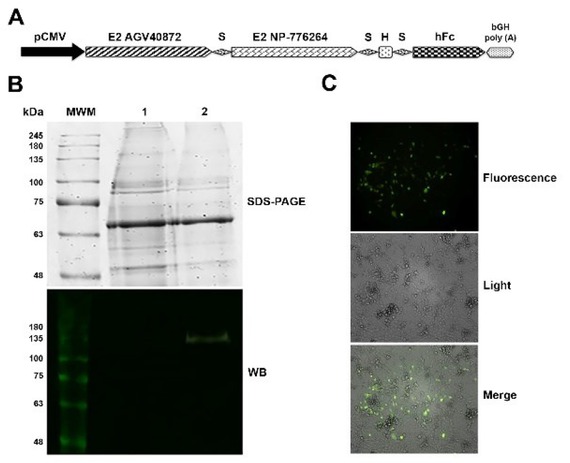
Fig 1
Expression of the bvde2fc gene and assembly of the recombinant adenoviral vector carrying the gene (AdBVDE2Fc)
A – Scheme of the transcriptional unit for bvde2fc gene expression. pCMV – early/immediate cytomegalovirus promoter; S – spacer of glycine and serine; H – histidine tag; hFc – Fc segment of human immunoglobulin; bGH poly (A) – sequence of the transcriptional termination from the bovine growth hormone
B – Expression assay of the bvde2fc gene by transfecting the pcDNA 3.1- bvde2fc plasmid into HEK-293 cells. MWM – molecular weight marker; 1 – supernatant of HEK-293 cells transduced without plasmid; 2 – supernatant of HEK-293 cells transduced with the pcDNA 3.1- bvde2fc plasmid; WB – Western blot
C – Fluorescent halo indicating the correct assembly of AdBVDE2Fc
The expression of the protein of interest (BVDE2Fc) in cell lines of different species (MDBK, BHK21, GMGE, SiHa, and HC11) was assessed by adenoviral transduction with AdBVDE2Fc at an MOI of 100. All transduced cell lines successfully produced the chimaeric protein BVDE2Fc (Fig. 2). As this molecule corresponds to the bovine species, the cell line of the same origin (MDBK) was selected for the final production of BVDE2Fc.
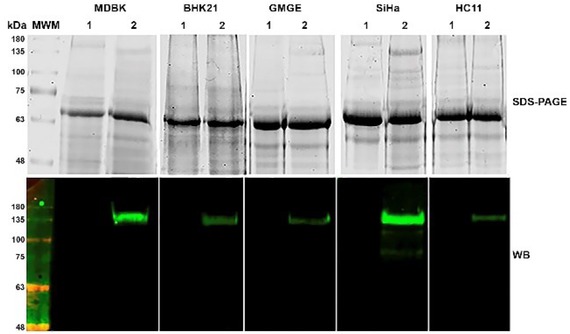
Fig 2
Expression of the bvde2fc gene by transducing mammalian cell lines from different species with AdBVDE2Fc. 1 – supernatant of non-transduced cells; 2 – supernatant of transduced cells with AdBVDE2Fc at MOI 100
The chimaera was purified by IMAC from the supernatant of MDBK cells transduced with AdBVDE2Fc. Most of the contaminant proteins were eliminated in the unbounded material and during the wash with 20 mM imidazole. BVDE2Fc was obtained with more than 90% purity after its elution with 80 mM imidazole (Fig. 3A). Analysis of BVDE2Fc by SDS-PAGE and Western blot under non-reducing conditions showed multimeric conformation (Fig. 3B). The separation of purified BVDE2Fc by size exclusion chromatography revealed that most BVDE2Fc was arranged in tetramers. Fractions of monomers and dimers were also observed (Fig. 3C).
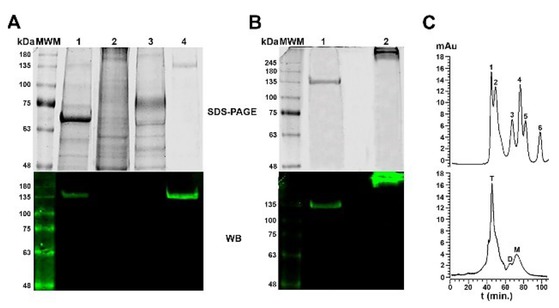
Fig 3
Purification of BVDE2Fc by IMAC
A – Analysis by SDS-PAGE and Western blot of different steps of the purification process. 1 – initial sample; 2 – unbound material; 3 – wash at 20 mM imidazole; 4 – elution at 80 mM imidazole
B – Analysis by SDS-PAGE and Western blot of the purified BVDE2Fc. 1 – in reduced conditions; 2 – in non-reduced conditions
C – HPLC size exclusion chromatography of the purified BVDE2Fc. Upper graph – external standard. 1 – 660 kDa; 2 – 440 kDa; 3 – 158 kDa; 4 – 75 kDa; 5 – 43 kDa; 6 – 13.7 kDa. Lower graph – BVDE2Fc. T – tetramers; D – dimers; M – monomers
Characterisation of the N-glycan profile. The chimaeric glycoprotein BVDE2Fc contains nine potential N-glycosylation sites available for N-glycan addition upon its transit through the secretory pathway. When treated with PNGase-F, the protein showed a faster run pattern than untreated BVDE2Fc, with a molecular weight of approximately 108 kDa in SDS-PAGE. This meant that most, if not all, of the potential N-glycosylation sites were occupied (Fig. 4 inset).
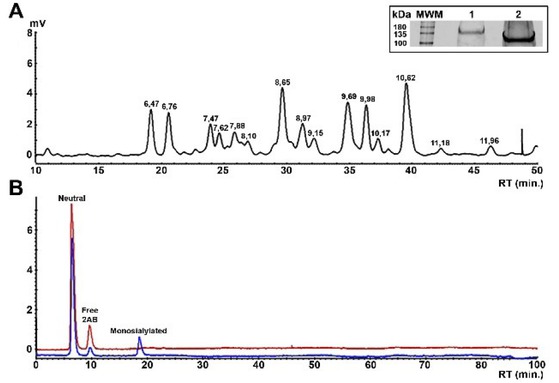
Fig 4
Analysis of the N-glycan profile released after BVDE2Fc deglycosylation
A – N-glycan analysis by a NP-HPLC-Amide 80 column. The N-glycan retention times were expressed as glucose units (GU) by comparison with a standard 2AB-labeled dextran hydrolysate
B – N-glycan analysis by HPLC-weak anion exchange chromatography. Blue – N-glycans of IgG as external standard; Red – N-glycans of BVDE2Fc; RT – retention time
Inset – SDS-PAGE of BVDE2Fc. 1 – glycosylated with PNGase-F; 2 – deglycosylated with PNGase-F
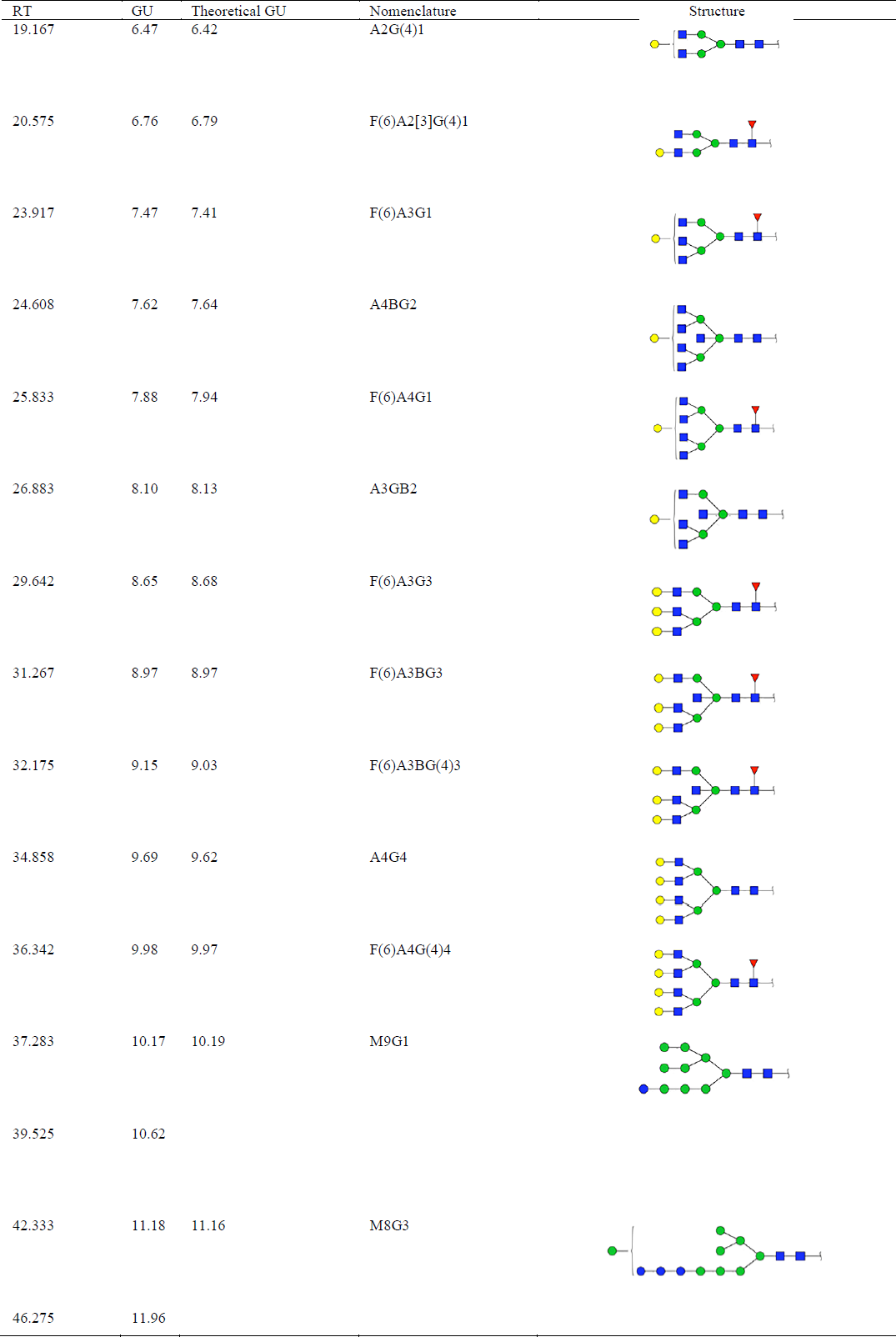
Analysis of BVDE2Fc N-glycans in a normal-phase HPLC-Amide 80 column revealed several peaks at different retention times, indicating the heterogeneity of the oligosaccharide population (Fig. 4A). The same pool of labelled N-glycans was evaluated by weak anion–exchange HPLC to separate neutral and charged fractions. The resulting chromatogram showed only one fraction of neutral oligosaccharides. No charged glycans were observed when compared to the human IgG as an external standard (Fig. 4B).
The experimental glucose units (GU) were calculated during the chromatographic run of the labelled N-glycan pool in a normal-phase HPLC-Amide 80 column. They were compared to GU reported in the Glycostore glycobase (1) for predicting the oligosaccharide structures. Most of the structures corresponded to complex oligosaccharides with fucose in the inner glucosamine (GlcNAc) and lactosamine (Gal-GlcNAc) termini. Likewise, oligomanoside structures were assigned (Table 1).
Immunogenicity of BVDE2Fc. BVDE2Fc immunogenicity was tested in mice by indirect ELISA assays. When mice were inoculated with 20 μg of purified BVDE2Fc, the antibody response was detected for the first time on day 7.
Humoral response increased slightly until day 21 and had begun to decrease by day 28. A rapid and strong antibody response was detected 7 days after the second inoculation. The highest antibody levels were detected 14 days after the second inoculation, diminishing subsequently but maintaining ODs higher than 0.45 until the last day of testing (Fig. 5A). OD values were significantly different from those of the negative control from day 14 to the last sera evaluation, demonstrating the efficient immunogenicity induced by BVDE2Fc.
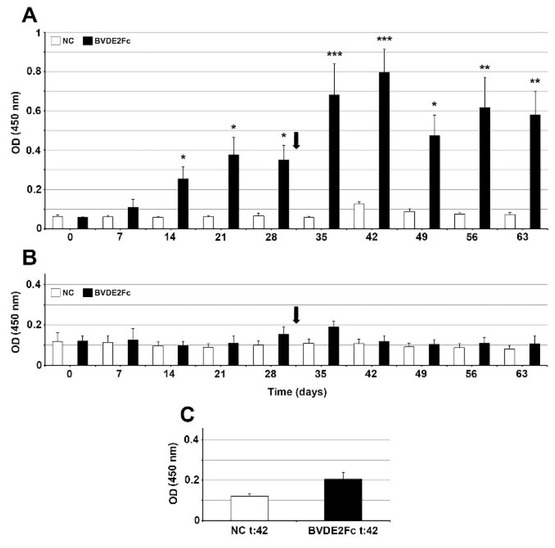
Fig 5
Characterisation of BVDE2Fc as immunogen
A – Humoral immune response after inoculating mice with 20 μg of BVDE2Fc
B – Analysis of mice sera by coating with deglycosylated BVDE2Fc in ELISA assays
C – Analysis of mice sera by coating with EPOFc in ELISA assays. NC – negative control; NC t:42 – negative control of the pool from mice sera at 42 days. The arrow indicates the second inoculation. Bars represent the standard deviation. OD values were compared by the Kruskal–Wallis test and the Dunn post-test (A, B), and by the Mann–Whitney test (C). * P < 0.05; ** P < 0.01; *** P < 0.001
Previously, it was stated that glycosylation and proper folding of proteins could influence their immunogenicity. Therefore, ELISA assays were repeated under the same conditions, but the coating was done with deglycosylated BVDE2Fc. OD values from both experimental groups were low and did not show significant differences (Fig. 5B), indicating that antibodies did not recognise BVDE2Fc without N-glycans. Deglycosylated BVDE2Fc could also not be recognised by antibodies due to protein misfolding. The deglycosylation process includes denaturing buffers that unfold the protein for effective N-glycan elimination.
The humoral immune response induced against BVDE2Fc could also raise undesired antibody production against the Fc fragment of human immunoglobulin (hFc). To know the contribution of hFc to the humoral immune response induced by BVDE2Fc, we performed an antigen–antibody reaction using the sera with the highest humoral immune response of the previous experiment (day 42) and an unrelated protein (human erythropoietin) fused to the same hFc (EPOFc), and obtained under the same condition of BVDE2Fc (Fig. 5C). There were no significant differences between sera of vaccinated mice and those of the negative control, demonstrating that most of the humoral immune response induced by BVDE2Fc corresponded to conformational epitopes of both E2 molecules.
Subsequently, we wanted to know if BVDE2Fc attached to antibodies contained in the sera of bovines infected with different BVD-MDV subtypes. The criterion for positivity was taken as OD values higher than the ELISA cut-off (0.293). The aminoacidic sequences of the E2 glycoproteins contained in BVDE2Fc corresponded to BVD-MDV subtypes 1a (NP-776264) and 1b (AGV40872). Although variable OD values were observed in the nineteen animals tested, antibodies in homologous (1b) and heterologous (1d and 1e) serum samples recognised the BVDE2Fc epitopes (Fig. 6). As samples of the BVD-MDV subtype 1a were not available, homologous recognition of this subtype was not determined. Deglycosylated BVDE2Fc was also submitted to assaying for its recognition by bovine sera. Most of the OD values were near or lower than the cut-off value established in the previous experiment, demonstrating little or no recognition of deglycosylated BVDE2Fc by bovine sera.
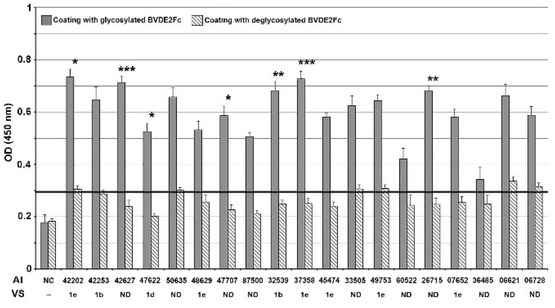
Fig 6
Evaluation of sera from bovines positive to different BVD-MDV subtypes by coating with BVDE2Fc in ELISA assays. Bars represent the standard deviation. OD values were compared by the Kruskal–Wallis test and the Dunn post-test (A, B), and by the Mann–Whitney test (C). * – P < 0.05; ** – P < 0.01; *** – P < 0.001; AI – animal identification; VS – viral subtype; NC – negative control; ND – not determined; black line – cut-off value
Discussion
According to FAO reports, beef production and consumption will rise in the next years, and material aspects of that rise depend on the environmental and food safety regulations (13). The threat that BVD-MDV represents to the cattle industry is well known. Therefore, vaccination has been used to counteract the damages caused by this virus to cattle. Although conventional vaccines have been used for this purpose, new generation vaccines could provide novel prophylactic measures against BVD-MDV. As the E2 glycoprotein is the most immunogenic of the BVD-MDV proteins, it has become one of the main components of new vaccines. Some studies have demonstrated that the E2 glycoprotein obtained in different expression systems and combined with other vaccine candidates against BVD-MDV induces strong humoral and cellular immune responses and improves protection (54, 8, 33, 43). Moreover, the E2 glycoprotein has been obtained as a fusion protein with a molecular adjuvant to increase its immunogenicity (36).
In this study, two different E2 sequences were combined in tandem, together with the Fc fragment of human immunoglobulin (BVDE2Fc). The Fc fragment could provide some advantages to the E2 sequences it is fused to, such as an increase of the half-life time and the stability of the chimaeric molecule by the formation of dimeric or tetrameric structures (51). Also, the appropriate arrangement of polypeptide chains through the Fc fragment, the interaction between E2 molecules, or both, ensures the accurate structure of E2 glycoproteins, which is crucial to preserve conformational epitopes in the molecule (9). These epitopes are responsible for the induction of neutralising antibodies, which could increase the protection against BVD-MDV.
Although this molecule was meant for bovine species, we used the human Fc fragment instead of bovine for three main reasons: (i) the leading objective of this research was to demonstrate the antigenic properties of the specific conformation acquired by E2 molecules from BVD-MDV placed in tandem and assembled by the Fc fragment, not the functions of the Fc fragment in the immune response; (ii) the bovine Fc fragment has never been used in the construction of recombinant genes. In the pursuit of proper expression and conformation of our chimaeric protein, we decided to use the human Fc fragment. It has already been fused to other proteins with positive results (28, 40); (iii) we added a histidine tag between the last E2 molecule and the Fc fragment to purify the chimaeric protein by IMAC. Occasionally, the exposition of the histidine tag is abnormal when it is located in the middle of two protein sequences, which could impair the purification process. If there were such an abnormality, the human Fc fragment not only would function as a dimerisation sequence but also as a tag for purifying the chimaeric protein by affinity chromatography to protein A. The bovine Fc fragment has a low affinity for protein A. Hence, the purification of the chimaeric protein by this method could fail (30).
Production of BVDE2Fc and determination of its N-glycan profile. The approach proposed in this work for obtaining the BVDE2Fc chimaeric protein by adenoviral transduction of MDBK cells constitutes a valuable platform that guarantees sufficient amounts of the desired protein obtained in an easy and fast way and facilitates in vitro studies and field trials. Moreover, the use of almost any mammalian cell line would be effective for producing large amounts of the desired protein in vitro (37, 41) due to the broad cell tropism of adenoviral vectors (7). Consequently, this system can be used for studying the function of E2 protein in the BVD-MDV life cycle of different hosts or for making research into future marker vaccines against this virus less difficult to conduct. Additionally, the MDBK cell line selected for BVDE2Fc production has been extensively used to amplify and maintain BVD-MDV strains (6, 50), which ensures that it can serve as an adequate expression system for E2 proteins. This fact is corroborated by the observation of multimeric structures of BVDE2Fc after HPLC size exclusion chromatography. BVDE2Fc aggregation was expected due to the non-covalent binding of Fc subunits or the interactions between E2 proteins in solution (24). The final conformation of the chimaeric molecule constitutes an important feature for E2 proteins because the structure of these molecules on the viral surface is essential for its immunogenicity (15, 29). Furthermore, epitopes of the E2 protein inducing neutralising antibodies are conformational in a way highly dependent on disulphide bond formation by cysteine residues (9, 39).
The glycoprotein structure and function also depend on posttranslational modifications, where glycosylation plays an important role (46). Glycans attached to the aminoacidic scaffold are involved in folding, solubility, and final conformation of proteins (35). Moreover, the glycan pattern of proteins attached to the viral or bacterial surfaces is essential for the initiation of a specific immune response against the pathogen (45, 48). The neutral oligosaccharides detected during the characterisation of the BVDE2Fc N-glycan profile correlate with the characterisation of the E2 glycoprotein of classical swine fever virus, which belongs to the Pestivirus genus just as BVD-MDV does. Although the N-glycans of the E2 glycoprotein of classical swine fever virus had charged structures, most of the oligosaccharides were in the neutral fraction (32). The N-glycan pattern of BVDE2Fc obtained in the MDBK cells was consistent with that observed in other studies, which described complex and oligomannosidic structures linked to bovine proteins (11, 20). These research articles also noted hybrid glycans; however, they were not observed after the structure assignment.
Immunological characterisation of BVDE2Fc. We evaluated the BVDE2Fc antigenic properties after N-glycan characterisation. High immunogenicity was observed in mice, which is in agreement with several studies describing the induction of efficient immune responses with E2 vaccine candidates in rodents (5, 10, 15).
Antibodies induced during the immune response did not attach to the unfolded and deglycosylated BVDE2Fc. This observation corroborates the conformational nature of the epitopes responsible for the induction of the humoral immune response, where the N-glycosylation and/or the regularity of BVDE2Fc folding played an important role. Also, the immune response induced by hFc was low, demonstrating that this fragment of BVDE2Fc behaved as a dimerisation motive with little contribution to the immune response. This result reinforces the idea that most of the immune response was induced against conformational epitopes of both E2 glycoproteins.
When we evaluated the capacity of BVDE2Fc to attach to antibodies from bovine sera positive for BVD-MDV antibodies, the chimaeric protein not only bound to homologue antibodies (subtype 1b) but also to antibodies from viral subtypes 1d and 1e. However, binding was significantly diminished with deglycosylated BVDE2Fc, which demonstrated that conformation and/or the N-glycan pattern are crucial for antibody recognition.
The antigen–antibody reaction suggests that BVDE2Fc could have conformational epitopes shared by BVD-MDV heterologous strains. Taking into account the high variability of this virus (26, 49), the structural arrangement of the E2 molecules in the BVDE2Fc glycoprotein could be promising for further studies on cross-protection against different BVD-MDV subtypes.
The humoral immune response induced in mice by BVDE2Fc produced antibodies that recognised conformational epitopes in the E2 fragments of BVDE2Fc. Also, bovine sera positive for antibodies to different BVD-MDV subtypes recognised the chimaeric protein BVDE2Fc. In this particular case, the molecule design played a decisive role in inducing an adequate immune response. The E2 stoichiometry imposed by the Fc fragment could notably improve the antigen display. Thus, immunodominant epitopes could be easily recognised by professional antigen-presenting cells. The features of the immune response induced by BVDE2Fc explained above are decisive in counteracting BVD-MDV invasion. Additional studies will be conducted to elucidate the potential of the E2 conformational design as a vaccine candidate.
Acknowledgements
We want to thank Mr. Gerardo Martínez for providing the bovines for sample collection.
Notes
[2] Conflicts of interest Conflict of Interest
Conflicts of Interest Statement: The authors declare that there is no conflict of interests regarding the publication of this article.