
Introduction
Canine parvovirus (CPV) emerged in the late 1970s as a host-range variant of feline panleukopenia virus (FPV) (21). CPV belongs to the Parvoviridae family and is a nonenveloped virus with a single-stranded DNA genome (5,000 nt) comprising two open reading frames (ORFs). The first ORF encodes two nonstructural proteins, NS1 and NS2; the second ORF encodes two structural proteins, VP1 and VP2 (31). Since its discovery, this virus has been detected worldwide, primarily as CPV type-2 (CPV-2), and has become one of the most serious infectious pathogens among dogs. CPV-2 is among the most common aetiological agents of severe gastroenteritis, particularly in 6–20-week-old puppies, unvaccinated puppies, or puppies with poor maternal protection through passive immunity, and replicates mainly in intestinal crypts and the lymphoid organs but may reach any organ in susceptible animals. The most characteristic signs of this illness are diarrhoea, emesis, anorexia, depression, pyrexia, or hypothermia (5, 7, 32).
Currently, only CPV-2 has been thoroughly investigated. The VP2 capsid protein, accounting for 90% of the CPV nucleocapsid and 426 amino acids in size, plays a crucial role in the structure of this virus and serves as the main protective antigen - two characteristics which are the classification criteria for CPV viral typing. Owing to variations in the antigenicity of VP2 across strains, multiple genotypes have emerged, including CPV-2a, CPV-2b, and CPV-2c. CPV-2a, CPV-2b, and CPV-2c differ at the 426th amino acid (Asn in 2a, Asp in 2b, and Glu in 2c) of the parvovirus VP2 protein (11, 17, 18). In general, a novel CPV-2 variant replaces the old variants rapidly (11, 15). In recent decades, CPV-2c has become widespread in European countries (6, 11), the United States (11, 12), South America (2, 11, 19, 20), and Africa (1, 11, 23). In Asia, CPV-2c was first reported from Vietnam in 2004 (11, 16); however, since then, this strain has not been prevalent in Asia (4, 11). Surprisingly, in the past few years, novel CPV-2c isolates from Asia have been identified in mainland China (8, 11, 25, 28), Taiwan (4, 11, 14), Laos (11, 24), and Thailand (3, 11). Therefore, in the present study, VP2 sequence analysis of strains collected from central and eastern China was performed to determine the mutation tendency of CPV-2 in infected dogs sampled from October 2018 to April 2019.
Material and Methods
Sample collection and DNA extraction. During the major CPV-2 infection seasons lasting from October 2018 to April 2019, 118 samples of canine faeces from pets confirmed to be CPV-positive using a colloidal gold strip test (Immunochromatographic Rapid Test Kit, BioNote, Hwaseong-si, Korea), were collected from pet hospitals in Henan, Anhui, and Zhejiang Provinces. Detailed clinical information was recorded for each sampled dog. Each faecal sample was suspended in phosphate-buffered saline, and virus isolation from feline kidney (F81) cells was performed as described previously (27). The virus and F81 cells were incubated until cytopathic effects were apparent. The buffer solution containing the virus was centrifuged, and then 500 μL of the supernatant was inoculated in a cell culture flask of F81 and cultured in cell culture tank at 37°C for 2 h. After that, all the liquid in the culture flask was poured out and replaced by 5mL cell culture medium, and the culture was continued for 3 days to collect the virus until the 5th passage, and the virus infection of F81 cells was detected. In the whole process of cell inoculation, on average 3 passages were completed. DNA was extracted from the infected faeces or F81 cells using the EasyPure Viral DNA/RNA Kit (TransGen Biotechnology, Inc., Beijing, China) according to the manufacturer’s instructions. The extracted DNA samples were stored at −80°C.
Cloning of the VP2-coding sequence of CPV. The complete VP2 sequences of CPV-positive samples were amplified from the extracted viral DNA via PCR using a high-fidelity enzyme (TransGen Biotechnology, Inc.) and the primer pair of CPV-F (5′-AGAGACAAT CTTGCACCAAT-3′) and CPV-R (5′-ATGTTAATA TAATTTTCTAGGTGCT-3′) (from nucleotides 2761– 4536 of the sequence deposited at GenBank under accession number MF805797) was designed using Primer Premier 5.0 software (Premier Biosoft, San Francisco, CA, USA). Each amplicon was then analysed by electrophoresis, and the amplified VP2 sequences were cloned and sequenced. The vaccination status of each dog from which the samples was noted from records, as was the specific vaccine strain administered. That was the Vanguard Plus 5 classical CPV-2 commercial vaccine strain (Pfizer Inc., Lincoln, NE, USA).
Characterisation and genotyping of CPV-2. Sequences were assembled by overlapping and analysed using the SeqMan module of Lasergene 7 (DNASTAR, Inc., Madison, WI, USA). The NCBI nucleotide database was searched for typical VP2 gene sequences to identify mutations in CPV-VP2 sequences in various regions of China in recent years. The sequences obtained were compared using the NCBI nucleotide database to analyse the genotypes.
Mutation and phylogenetic analyses of CPV-2. The VP2 sequences of the investigated strains were compared with those of reference strains using Clustal X (22) to analyse identity and amino acid sequence variation. The CPV-VP2 sequences tested in this study and reference sequences in GenBank were aligned using MEGA 7.0 (13), and phylogenetic trees were constructed to analyse relationships between the strains tested in this study and reference strains. The details of the reference sequences incorporated in the phylogenetic tree are shown in Table 1. Differences in nucleotide and amino acid sequences between the collected and reference strains from China and overseas were analysed using MegAlign (DNASTAR, Inc.). EvolView 2 (10) was adopted for visualising and annotating phylogenetic trees with geographic location and phylogenetic clustering. Sequence identity between the collected and reference strains was determined using Lasergene 7 to examine genotypic variations across different regions of the study area.
Table 1
Reference strains used in the study
| Strain | Accession number | Genotype | Place of isolation | Year of isolation |
|---|---|---|---|---|
| nn171025 | MK332005 | CPV-2a | Guangxi | 2017 |
| nn17101 | MK332003 | CPV-2a | Guangxi | 2017 |
| nn1693 | MK332002 | CPV-2b | Guangxi | 2016 |
| nn1681 | MK331996 | CPV-2b | Guangxi | 2016 |
| nn171105 | MK332007 | CPV-2c | Guangxi | 2017 |
| nn171024 | MK332004 | CPV-2c | Guangxi | 2017 |
| CPV-411b.us.9 | EU659121 | CPV-2b | The USA | 1998 |
| CPV-13.us.81 | EU659118 | CPV-2a | The USA | 1981 |
| CPV-6.us.80 | EU659117 | CPV-2 | The USA | 1980 |
| Raccoon/ WI/ 37/ 10 | JN867618 | CPV-2a | The USA | 2010 |
| 110/ 07-27 | FJ005236 | CPV-2c | The USA | 2007 |
| 08-B | GU362934 | CPV-2a | Italy | 2008 |
| 260-00 | MF177231 | CPV-2a | Italy | 2000 |
| 140/ 05 | FJ005265 | CPV-2b | Italy | 2005 |
| CPV /IZSSI /25835/ 09 | KU508407 | CPV-2c | Italy | 2009 |
| 56/00 | FJ222821 | CPV-2c | Italy | 2000 |
| CPV/dog/HCM/20/2013 | LC216910 | CPV-2c | Indonesia | 2013 |
| Pome | EF599098 | CPV-2c(a) | South Korea | 2007 |
| DH326 | EF599097 | CPV-2b | South Korea | 2007 |
| DH426 | EF599096 | CPV-2a | South Korea | 2007 |
| 16M130 | MH643886 | CPV-2 | South Korea | 2016 |
| 2670/CPV-2c/2010/Ind | KX425920 | CPV-2c | India | 2010 |
| CU267 | MH711901 | CPV-2c | Thailand | 2017 |
| TH011401 | KT364589 | CPV-2c | Thailand | 2014 |
| T37 | CPU72698 | CPV-2a | Taiwan | 1996 |
| T10 | CPU72696 | CPV-2b | Taiwan | 1996 |
| 2017090801 | MH127909 | CPV-2c | Taiwan | 2017 |
| Protein (VP2) | KU244254 | CPV-2c | Taiwan | 2015 |
| PV/PL/HeN02/08 | EU441280 | CPV-2a | Henan | 2008 |
| Henan42 | KJ438805 | CPV-2a | Henan | 2013 |
| CPV-HN1617 | MF467229 | CPV-2c | Henan | 2016 |
| CPV-zj18 | KM386948 | CPV-2b | Zhejiang | 2014 |
| CPV-zj7 | KM386937 | CPV-2a | Zhejiang | 2014 |
| Beijing | HQ883267 | CPV-2a | Beijing | 2010 |
| BJ-1 | MN101726 | CPV-2a | Beijing | 2018 |
| 2011-BJ-B43 | KF803527 | CPV-2b | Beijing | 2011 |
| 2011-BJ-B6 | KF803606 | CPV-2b | Beijing | 2011 |
| CPV-SH1516 | MG013488 | CPV-2c | Shanghai | 2017 |
| Shanghai/04g/2016 | KY937646 | CPV-2a | Shanghai | 2016 |
| ShangHai/3-2/2016 | KY937640 | CPV-2a | Shanghai | 2016 |
| Shanghai/03g/2016 | KY937637 | CPV-2c | Shanghai | 2016 |
| CPVpf/2007(vaccine) | FJ197847 | CPV-2 | South Korea | 2007 |
| 29/97(vaccine) | FJ222823 | CPV-2b | N.I.a | 2008 |
| CPV-GX1581 | MF467242 | CPV-2c | Guangxi | 2015 |
Epitope and selection pressure analyses of CPV-2. Antigenic epitopes of the CPV-2c VP2 protein were predicted using Lasergene 7. Selection pressure on CPV based on entropy was analysed using VP2 sequences of the 61 collected strains using BioEdit (9).
Results
Virus identification and genotypes. All collected samples tested positive for CPV on the basis of virus isolation and PCR assays. The complete sequence (1755 nt) of the VP2 structural protein of 61 strains was obtained from 118 strains tested and deposited in GenBank (where strains had 100% sequence identity and were from the same site, only one was retained for analysis). Accession numbers and clinical information for each strain are summarised in Table 2. Sequence analysis of strains collected from the three provinces showed that the infection rates of CPV-2a, CPV-2b, and CPV-2c were 3/29, 4/29 and 22/29, respectively, in Henan Province and 2/16, 3/16, and 11/16, respectively, in Anhui Province; all CPV genotypes collected from Zhejiang Province were CPV-2c. The vaccination rate was 50% in Anhui Province, 58.62% in Henan Province, and 87.5% in Zhejiang Province. From the above distribution data, CPV-2c is evidently the predominant CPV genotype in central and eastern China. Genotypes and geographical distribution of the 61 strains are shown in Fig. 1.
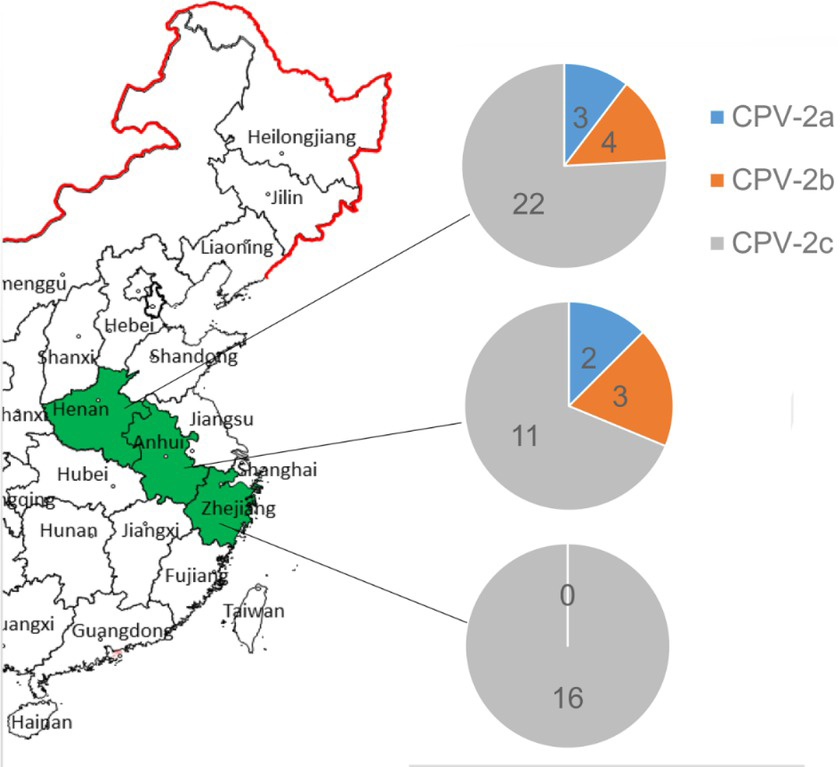
Fig. 1
Genotypes and geographical distribution of the canine parvovirus (CPV) strains tested in this study
Table 2
Clinical information on sources of Chinese canine parvovirus type 2 (CPV-2) obtained in this study
| Strain | Genotype | Site | Date of sampling | Age | Breed | Sex | Vaccinated status | Accession number |
|---|---|---|---|---|---|---|---|---|
| CH-AH-D1 | CPV-2b | Hefei | Oct. 7, 2018 | 5 months | Poodle | Female | Unvaccinated | MN119560 |
| CH-AH-D2 | CPV-2c | Anqing | Oct. 7, 2018 | 2 years | Poodle | Male | 1 dose | MN119561 |
| CH-AH-D3 | CPV-2c | Suzhou | Oct. 8, 2018 | 1 year | Mixed | Female | 2 doses | MN119562 |
| CH-AH-D4 | CPV-2c | Suzhou | Oct. 11, 2018 | 3 months | Poodle | Male | Unvaccinated | MN119563 |
| CH-AH-D5 | CPV-2b | Wuhu | Nov. 9, 2018 | 1 year | Mixed | Female | 2 doses | MN119564 |
| CH-AH-D6 | CPV-2c | Anqing | Nov. 11, 2018 | 4 months | Poodle | Female | 1 dose | MN119565 |
| CH-AH-D7 | CPV-2c | Suzhou | Nov. 13, 2018 | 45 days | Schnauzer | Male | Unvaccinated | MN119566 |
| CH-AH-D8 | CPV-2c | Hefei | Nov. 30, 2018 | 7 months | Mixed | Male | 1 dose | MN119567 |
| CH-AH-D9 | CPV-2c | Wuhu | Dec. 1, 2018 | 6 months | Retriever | Male | Unvaccinated | MN119568 |
| CH-AH-D10 | CPV-2c | Suzhou | Dec. 3, 2018 | 3 months | Schnauzer | Female | Unvaccinated | MN119569 |
| CH-AH-D11 | CPV-2c | Anqing | Jan. 7, 2019 | 8 months | Mixed | Male | 2 doses | MN119570 |
| CH-AH-D12 | CPV-2c | Suzhou | Feb. 7, 2019 | 4 months | Mixed | Female | Unvaccinated | MN119571 |
| CH-AH-D13 | CPV-2c | Wuhu | Mar. 11, 2019 | 2 months | Poodle | Female | 1 dose | MN119572 |
| CH-AH-D14 | CPV-2a | Hefei | Mar. 16, 2019 | 52 days | Mixed | Female | Unvaccinated | MN119573 |
| CH-AH-D15 | CPV-2a | Anqing | Apr. 2, 2019 | 4 months | Retriever | Male | 1 dose | MN119574 |
| CH-AH-D16 | CPV-2b | Suzhou | Apr. 3, 2019 | 3 months | Poodle | Female | Unvaccinated | MN119575 |
| CH-HN-D1 | CPV-2c | Zhengzhou | Oct. 3, 2018 | 40 days | Mixed | Male | Unvaccinated | MN119576 |
| CH-HN-D2 | CPV-2c | Hebi | Oct. 4, 2018 | 4 months | Mixed | Female | 1 dose | MN119577 |
| CH-HN-D3 | CPV-2c | Nanyang | Oct. 8, 2018 | 10 months | Mixed | Male | 1 dose | MN119578 |
| CH-HN-D4 | CPV-2c | Nanyang | Nov. 6, 2018 | 5 months | Retriever | Female | 1 dose | MN119579 |
| CH-HN-D5 | CPV-2b | Luoyang | Nov. 7, 2018 | 4 months | Mixed | Male | Unvaccinated | MN119580 |
| CH-HN-D6 | CPV-2c | Xinxiang | Nov. 12, 2018 | 5 months | Schnauzer | Male | Unvaccinated | MN119581 |
| CH-HN-D7 | CPV-2a | Xinyang | Nov. 14, 2018 | 4 months | Mixed | Female | 1 dose | MN119582 |
| CH-HN-D8 | CPV-2c | Luoyang | Nov. 16, 2018 | 2 months | Mixed | Female | 1 dose | MN119583 |
| CH-HN-D9 | CPV-2c | Zhengzhou | Nov. 28, 2018 | 2 months | Schnauzer | Male | Unvaccinated | MN119584 |
| CH-HN-D10 | CPV-2c | Anyang | Nov. 29, 2018 | 4 months | Mixed | Female | 1 dose | MN119585 |
| CH-HN-D11 | CPV-2c | Xinyang | Dec. 3, 2018 | 50 days | Mixed | Female | 1 dose | MN119586 |
| CH-HN-D12 | CPV-2c | Nanyang | Jan. 1, 2019 | 3 months | Retriever | Male | Unvaccinated | MN119587 |
| CH-HN-D13 | CPV-2c | Shangqiu | Jan. 3, 2019 | 3 months | Mixed | Female | 1 dose | MN119588 |
| CH-HN-D14 | CPV-2a | Anyang | Jan. 4, 2019 | 4 months | Mixed | Female | 1 dose | MN119589 |
| CH-HN-D15 | CPV-2a | Zhengzhou | Jan. 5, 2019 | 1 month | Mixed | Male | Unvaccinated | MN119590 |
| CH-HN-D16 | CPV-2b | Anyang | Jan. 5, 2019 | 2 months | Poodle | Male | Unvaccinated | MN119591 |
| CH-HN-D17 | CPV-2c | Zhengzhou | Feb. 3, 2019 | 1 year | Mixed | Female | 2 doses | MN119592 |
| CH-HN-D18 | CPV-2b | Nanyang | Feb. 4, 2019 | 4 months | Poodle | Male | Unvaccinated | MN119593 |
| CH-HN-D19 | CPV-2c | Xinxiang | Feb. 5, 2019 | 5 months | Mixed | Female | 1 dose | MN119594 |
| CH-HN-D20 | CPV-2b | Hebi | Mar. 8, 2019 | 2 months | Poodle | Female | Unvaccinated | MN119595 |
| CH-HN-D21 | CPV-2c | Xinxiang | Mar. 9, 2019 | 5 months | Mixed | Male | 1 dose | MN119596 |
| CH-HN-D22 | CPV-2c | Nanyang | Mar. 10, 2019 | 8 months | Retriever | Male | 2 doses | MN119597 |
| CH-HN-D23 | CPV-2c | Hebi | Mar. 12, 2019 | 3 months | Mixed | Male | 1 dose | MN119598 |
| CH-HN-D24 | CPV-2c | Luoyang | Mar. 15, 2019 | 2 months | Mixed | Female | 1 dose | MN119599 |
| CH-HN-D25 | CPV-2c | Anyang | Mar. 29, 2019 | 2 months | Schnauzer | Female | Unvaccinated | MN119600 |
| CH-HN-D26 | CPV-2c | Zhengzhou | Mar. 31, 2019 | 4 months | Mixed | Male | Unvaccinated | MN119601 |
| CH-HN-D27 | CPV-2c | Luoyang | Apr. 1, 2019 | 1 year | Mixed | Female | 1 dose | MN119602 |
| CH-HN-D28 | CPV-2c | Nanyang | Apr. 4, 2019 | 9 months | Mixed | Female | 1 dose | MN119603 |
| CH-HN-D29 | CPV-2c | Zhengzhou | Apr. 5, 2019 | 4 months | Poodle | Male | Unvaccinated | MN119604 |
| CH-ZJ-D1 | CPV-2c | Huzhou | Oct. 2, 2018 | 1 month | Mixed | Female | 1 dose | MN119605 |
| CH-ZJ-D2 | CPV-2c | Hangzhou | Oct. 3, 2018 | 3 months | Mixed | Male | Unvaccinated | MN119606 |
| CH-ZJ-D3 | CPV-2c | Jinhua | Oct. 4, 2018 | 2 months | Mixed | Female | 1 dose | MN119607 |
| CH-ZJ-D4 | CPV-2c | Ningbo | Oct. 8, 2018 | 4 months | Retriever | Male | 1 dose | MN119608 |
| CH-ZJ-D5 | CPV-2c | Hangzhou | Nov. 10, 2018 | 3 months | Mixed | Male | 1 dose | MN119609 |
| CH-ZJ-D6 | CPV-2c | Ningbo | Nov. 11, 2018 | 6 months | Mixed | Female | 2 doses | MN119610 |
| CH-ZJ-D7 | CPV-2c | Hangzhou | Nov. 17, 2018 | 2 months | Mixed | Female | Unvaccinated | MN119611 |
| CH-ZJ-D8 | CPV-2c | Jinhua | Dec. 1, 2018 | 5 months | Mixed | Male | 1 dose | MN119612 |
| CH-ZJ-D9 | CPV-2c | Huzhou | Dec. 1, 2018 | 3 months | Mixed | Male | 1 dose | MN119613 |
| CH-ZJ-D10 | CPV-2c | Shaoxing | Dec. 3, 2018 | 4 months | Retriever | Female | 1 dose | MN119614 |
| CH-ZJ-D11 | CPV-2c | Jinhua | Jan. 4, 2019 | 7 months | Mixed | Male | 2 doses | MN119615 |
| CH-ZJ-D12 | CPV-2c | Hangzhou | Feb. 6, 2019 | 2 months | Mixed | Male | 1 dose | MN119616 |
| CH-ZJ-D13 | CPV-2c | Jinhua | Mar. 14, 2019 | 3 months | Mixed | Male | 1 dose | MN119617 |
| CH-ZJ-D14 | CPV-2c | Shaoxing | Mar. 14, 2019 | 1 year | Mixed | Female | 1 dose | MN119618 |
| CH-ZJ-D15 | CPV-2c | Hangzhou | Apr. 4, 2019 | 8 months | Mixed | Male | 2 doses | MN119619 |
| CH-ZJ-D16 | CPV-2c | Jinhua | Apr. 4, 2019 | 9 months | Retriever | Female | 2 doses | MN119620 |
Nucleotide identity of the VP2 gene. Comparison of the nucleotide acid sequences of the VP2 gene between the 61 strains obtained in this study and reference strains in GenBank revealed 98.3%–99.99% identity. The nucleotide identity was 98.5%–99.8% for the 16 strains collected from Anhui Province, 98.3%–99.8% for the 29 strains from Henan Province, and 98.7%–99.8% for the 16 Zhejiang Province strains. Between provinces, the identity was 97.0%–99.9% comparing strains collected in Anhui and Henan Provinces, 97.3%–99.8% for strains collected in Henan and Zhejiang Provinces, and 97.6%–99.8% when Anhui and Zhejiang Province strains were examined.
Main amino acid mutation sites of the VP2 protein. The main amino acid mutation sites of the VP2 protein of the 61 strains were 5, 30, 130, 370, 426, and 440. In CPV-2, Ala5Gly mutation was evident at a rate of 73.77% (8 strains in Anhui Province, 21 in Henan Province, and 16 in Zhejiang Province). Gly30Trp mutation occurred only in one strain (CH-AH-D3), and Val130Al mutation likewise (CH-HN-D7). Gln370Arg mutation was noted in 80.33% of isolates (11 strains in Anhui Province, 22 in Henan Province, and 16 in Zhejiang Province). Two mutations occurred at site 426, with a rate of 11.48% for Asn426Asp (three strains in Anhui and four in Henan Province) and 80.33% for Asn426Glu (11 strains in Anhui Province, 22 in Henan Province, and 16 in Zhejiang Province). Thr440Ala had mutated 80.33% of strains (11 in Anhui Province, 22 in Henan Province, and 16 in Zhejiang Province). The specific mutations by strain are presented in Table 3.
Table 3
Statistics of the main amino acid mutation sites in the VP2 capsid protein of canine parvovirus type 2 in Chinese and reference strains
| Strains/GenBank Accession number | Mutation sites: amino acid residue | |||||
|---|---|---|---|---|---|---|
| 5 | 30 | 130 | 370 | 426 | 440 | |
| EU659117-2/the USA/1980 | A | G | V | Q | N | T |
| FJ197847-2/South Korea/2007/Vaccine | \ | \ | \ | \ | \ | \ |
| MH643886-2/South Korea/2016 | \ | \ | \ | \ | \ | \ |
| EU659118-2a/the USA/1981 | \ | \ | \ | \ | \ | \ |
| MF177231-2a/Italy/2000 | \ | \ | \ | \ | \ | \ |
| GU362934-2a/Italy/2008 | \ | \ | \ | \ | \ | \ |
| EU441280-2a/Henan/2008 | \ | \ | \ | \ | \ | \ |
| HQ883267-2a/Beijing/2010 | \ | \ | \ | \ | \ | A |
| KJ438805-2a/Henan/2013 | \ | \ | \ | \ | \ | A |
| KY937646-2a/Shanghai/2016 | \ | \ | \ | \ | \ | A |
| MK332005-2a/Guangxi/2017 | \ | \ | \ | \ | \ | A |
| MN101726-2a/Beijing/2018 | \ | \ | \ | \ | \ | A |
| CPU72696-2b/Taiwan/1996 | \ | \ | \ | \ | D | \ |
| EU659121-2b/the USA/1998 | \ | \ | \ | \ | D | \ |
| FJ005265-2b/Italy/2005 | \ | \ | \ | \ | D | \ |
| KF803606-2b/Beijing/2011 | \ | \ | \ | \ | D | \ |
| MK332002-2b/Guangxi/2016 | \ | \ | \ | \ | D | A |
| MK331996-2b/Guangxi/2016 | \ | \ | \ | \ | D | A |
| KU508407-2c/Italy/2009 | \ | \ | \ | \ | E | \ |
| KX425920-2c/India/2010 | \ | \ | \ | \ | E | \ |
| KU244254-2c/Taiwan/2015 | \ | \ | \ | \ | E | \ |
| LC216910-2c/Indonesia/2013 | G | \ | \ | R | E | \ |
| MF467242-2c/Vaccine/2015 | G | \ | \ | R | E | \ |
| MF467229-2c/Henan/2016 | G | \ | \ | R | E | \ |
| MGo13488-2c/Shanghai/2017 | G | \ | \ | R | E | \ |
| CH-AH-D1 | G | \ | \ | \ | D | A |
| CH-AH-D2 | \ | \ | \ | R | E | \ |
| CH-AH-D3 | \ | W | \ | R | E | \ |
| CH-AH-D4 | G | \ | \ | R | E | \ |
| CH-AH-D5 | \ | \ | \ | \ | D | A |
| CH-AH-D6 | G | \ | \ | R | E | \ |
| CH-AH-D7 | \ | \ | \ | R | E | \ |
| CH-AH-D8 | \ | \ | \ | R | E | \ |
| CH-AH-D9 | G | \ | \ | R | E | \ |
| CH-AH-D10 | G | \ | \ | R | E | \ |
| CH-AH-D11 | G | \ | \ | R | E | \ |
| CH-AH-D12 | G | \ | \ | R | E | \ |
| CH-AH-D13 | G | \ | \ | R | E | \ |
| CH-AH-D14 | \ | \ | \ | \ | \ | A |
| CH-AH-D15 | \ | \ | \ | \ | \ | A |
| CH-AH-D16 | \ | \ | \ | \ | D | A |
| CH-HN-D1 | G | \ | \ | R | E | \ |
| CH-HN-D2 | G | \ | \ | R | E | \ |
| CH-HN-D3 | G | \ | \ | R | E | \ |
| CH-HN-D4 | G | \ | \ | R | E | \ |
| CH-HN-D5 | \ | \ | \ | \ | D | A |
| CH-HN-D6 | G | \ | \ | R | E | \ |
| CH-HN-D7 | \ | \ | A | \ | \ | A |
| CH-HN-D8 | \ | \ | \ | R | E | \ |
| CH-HN-D9 | G | \ | \ | R | E | \ |
| CH-HN-D10 | G | \ | \ | R | E | \ |
| CH-HN-D11 | G | \ | \ | R | E | \ |
| CH-HN-D12 | G | \ | \ | R | E | \ |
| CH-HN-D13 | G | \ | \ | R | E | \ |
| CH-HN-D14 | \ | \ | \ | \ | \ | A |
| CH-HN-D15 | \ | \ | \ | \ | \ | A |
| CH-HN-D16 | \ | \ | \ | \ | D | A |
| CH-HN-D17 | G | \ | \ | R | E | \ |
| CH-HN-D18 | \ | \ | \ | \ | D | A |
| CH-HN-D19 | G | \ | \ | R | E | \ |
| CH-HN-D20 | \ | \ | \ | \ | D | A |
| CH-HN-D21 | G | \ | \ | R | E | \ |
| CH-HN-D22 | G | \ | \ | R | E | \ |
| CH-HN-D23 | G | \ | \ | R | E | \ |
| CH-HN-D24 | G | \ | \ | R | E | \ |
| CH-HN-D25 | G | \ | \ | R | E | \ |
| CH-HN-D26 | G | \ | \ | R | E | \ |
| CH-HN-D27 | G | \ | \ | R | E | \ |
| CH-HN-D28 | G | \ | \ | R | E | \ |
| CH-HN-D29 | G | \ | \ | R | E | \ |
| CH-ZJ-D1 | G | \ | \ | R | E | \ |
| CH-ZJ-D2 | G | \ | \ | R | E | \ |
| CH-ZJ-D3 | G | \ | \ | R | E | \ |
| CH-ZJ-D4 | G | \ | \ | R | E | \ |
| CH-ZJ-D5 | G | \ | \ | R | E | \ |
| CH-ZJ-D6 | G | \ | \ | R | E | \ |
| CH-ZJ-D7 | G | \ | \ | R | E | \ |
| CH-ZJ-D8 | G | \ | \ | R | E | \ |
| CH-ZJ-D9 | G | \ | \ | R | E | \ |
| CH-ZJ-D10 | G | \ | \ | R | E | \ |
| CH-ZJ-D11 | G | \ | \ | R | E | \ |
| CH-ZJ-D12 | G | \ | \ | R | E | \ |
| CH-ZJ-D13 | G | \ | \ | R | E | \ |
| CH-ZJ-D14 | G | \ | \ | R | E | \ |
| CH-ZJ-D15 | G | \ | \ | R | E | \ |
| CH-ZJ-D16 | G | \ | \ | R | E | \ |
Phylogenetic and evolutionary relationships. A phylogenetic tree was constructed based on VP2 sequences of the 61 strains tested in this study and 45 representative reference strains. Compared with the strains collected from countries such as the United States, Italy, Japan, South Korea, and India, the reference strains collected from China were distantly related. Overall, 49 CPV-2c strains (80.33%) in this study were closely related to CPV-2c reference strains collected from Thailand, Indonesia, Taiwan, Shanghai, Guangxi, and Henan Provinces. Among these 49 strains, 11 were from Anhui Province, 22 from Henan Province, and 16 from Zhejiang Province. Seven strains collected from Anhui (n = 3) and Henan (n = 4) Provinces were similar to CPV-2b. Five strains were closely related to CPV-2a, two of which were from Anhui Province and three from Henan Province. The specific interrelationships between the collected and reference strains are depicted in Fig. 2.
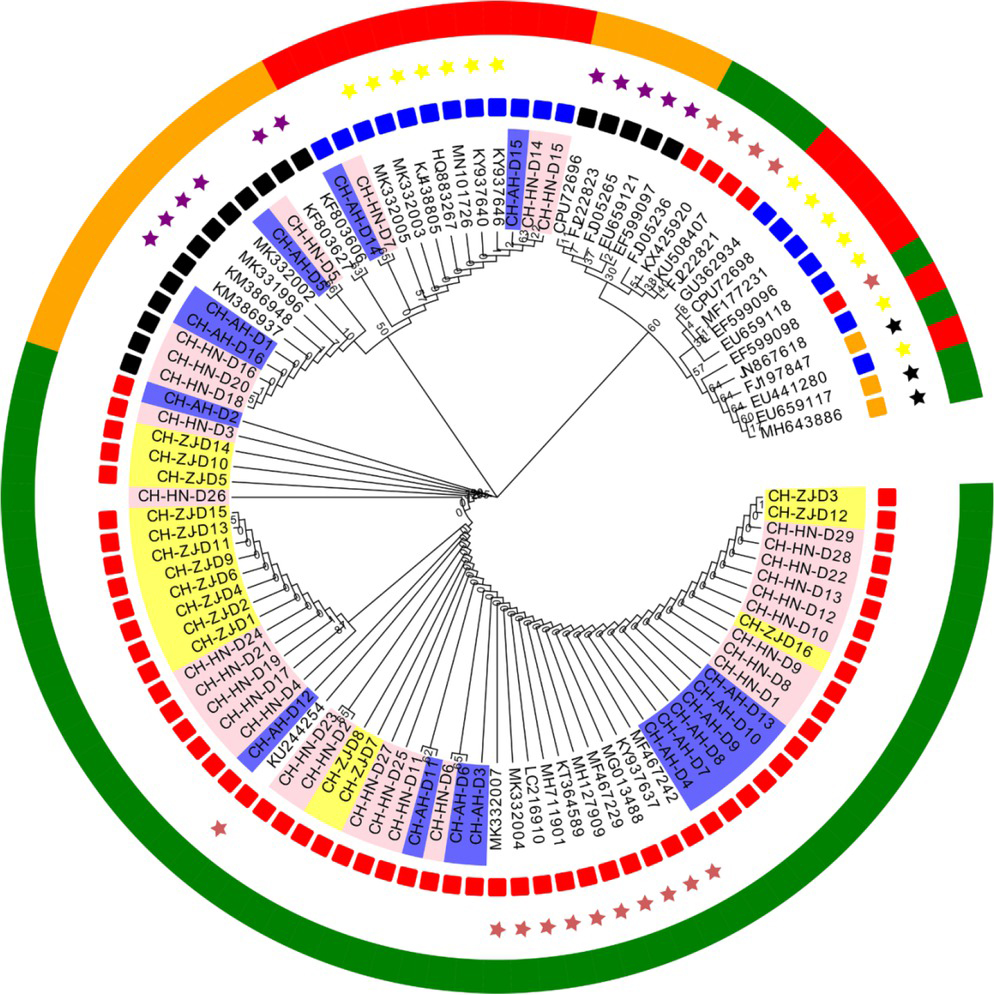
Fig. 2
Evolutionary tree of canine parvovirus type-2 (CPV-2). Blue areas represent the 16 strains collected from Anhui Province, pink areas represent the 29 strains collected from Henan Province, and yellow areas represent the 16 strains collected from Zhejiang Province. Yellow stars denote the CPV-2a reference strain; purple stars denote the CPV-2b reference strain; and red stars denote the CPV-2c reference strain. Red strips indicate the CPV-2a strain; orange strips indicate the CPV-2b strain; and green strips indicate the CPV-2c strain
Epitope and selection pressure analyses of CPV-VP2. Antigenic epitope analysis of the VP2 protein of CPV-2c predicted several epitopes mainly located at amino acid sites 0–25 and 350–450 (Fig. 3A). In selection pressure analysis, the entropy was >0.5 mainly in two regions (0–51 and 251–451) (Fig. 3B). The results of epitope prediction and selection pressure analyses were consistent with one another.
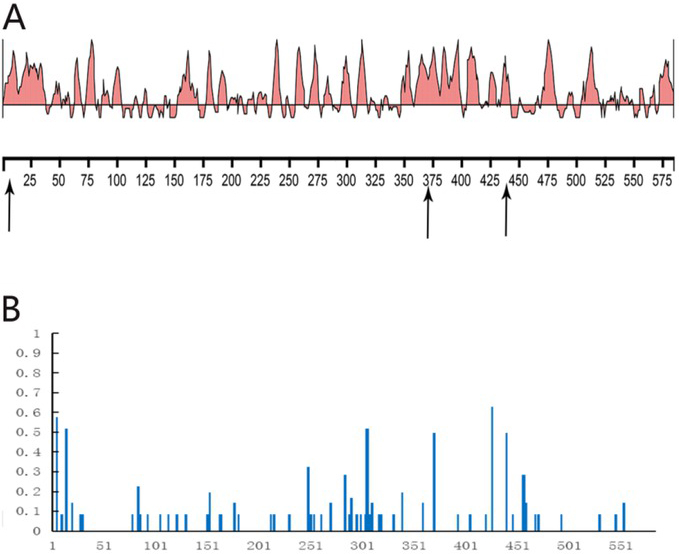
Fig. 3
Antigenic epitope prediction and amino acid entropy rates of the VP2 capsid protein of canine parvovirus type 2. A: Antigen epitope prediction for CPV-VP2; B: Amino acid entropy rates for CPV-VP2
Discussion
A CPV is widely distributed in various regions of China, and the virus undergoes rapid mutations. Since its identification, three important variations in the CPV genotype have occurred, resulting in the emergence of subtypes CPV-2a, CPV-2b, and CPV-2c. During 2009– 2012, CPV-2a was the dominant genotype in the southern region of Nanjing (29). In this period and continuing until 2014, CPV-2c was not widespread in Henan Province (30). By 2015–2016, the novel CPV-2a strain had become the prevalent subtype in Henan, Guangxi, and Jiangsu Provinces and in these years Aln5Gly and Gln370Arg mutations in genotype 2c were reported for the first time (26). In this study, the epidemiological trend of CPV-2 was observed from 2018 to 2019 through sequencing the CPV-2 strains collected from three provinces (Henan, Anhui and Zhejiang). Variations in the CPV-2 genotype were strongly affected by vaccination and tended to be due to 2c mutations. In the present study, trends of CPV infections in Anhui, Henan, and Zhejiang Provinces revealed CPV-2c as the most widespread genotype. Three genotypes coexisted in Anhui and Henan Provinces, which are not perfectly covered by the vaccination program. In Zhejiang Province, in contrast, the vaccination rate was high and CPV-2c was the only strain detected. Based on genotypic and immunisation history, CPV-2c shows high transmissibility and strong adaptability. It is therefore the genotype most likely to cause vaccination failure when the program uses classical CPV-2, and this genotype’s dominance may be explained by its having evolved under pressure from immunisation.
The main amino acid mutations in the VP2 protein of the 61 strains occurred at sites 5, 370, 426, and 440. In Anhui, Henan and Zhejiang Provinces, 45 (73.77%) strains harboured a similar Ala5Gly mutation to the reference strain CPV-2c. This finding indicates that the amino acid mutation at site 5 may determine the CPV subtype (CPV-2c), with such mutations gradually becoming increasingly common in China and overseas. The nearly three quarters proportion of strains collected from Anhui, Henan and Zhejiang Provinces with the Ala5Gly mutation in the CPV-VP2 protein suggests that it has become prevalent. A total of 49 (80.33%) strains in the three provinces displayed a similar Gln370Arg mutation to the reference strain CPV-2c. This site may alter the spatial structure of the VP2 protein to some extent, thereby affecting the pathogenicity of the virus (8). Mutations at the amino acid site 426 markedly affected the classification of CPV-2a, CPV-2b, and CPV-2c (30). The reference strain CPV-2a showed 426Asn, and mutation at this site occurred in 5 of the 61 strains (8.20%) tested in this study. Seven (11.48%) strains collected from Anhui and Henan Provinces were Asn426Asp-mutated in a similar way to the reference strain CPV-2b, although no mutation was detected in the strains collected from Zhejiang Province. A total of 49 (80.33%) strains revealed a similar Asn426Gln mutation to the reference strain CPV-2c. These findings indicate that the Asn426Gln mutation was highly prevalent in the three provinces studied. Furthermore, the strains collected from Henan and Anhui Provinces (19.67%) were like the reference strains CPV-2a and CPV-2b in having the Thr440Ala mutation. This result demonstrates that CPV strains carrying the Thr440Ala mutation are prevalent in Anhui and Henan Provinces. In terms of mutation rates, CPV-2c was the dominant mutant genotype in Anhui, Henan, and Zhejiang Provinces from October 2018 to April 2019.
Sequence identities and phylogenetic relationships of the 61 strains collected from the three provinces revealed in this study will contribute to a better understanding of the frequency and mutation tendencies of CPV strains in these provinces. The VP2 sequences of the CPV strains collected from Anhui, Henan, and Zhejiang Provinces shared high identity without any outstanding variations; however, these strains showed relatively distant relationships with the classical vaccine strains. Moreover, there were no obvious regional differences in CPV genotype distribution according to the evolutionary tree. This result indicates that CPV genotypes are characterised by mutations at individual amino acid sites which do not affect the overall evolutionary characteristics of CPV.
In this study, mutations at four major amino acid sites led to the emergence of different genotypes, which further evolved into the highly immune-resistant subtype CPV-2c under pressure from immunisation as previously described (4, 8). The epitope is the antigenic sequence that stimulates B cells to produce antibodies, leading to antigen–antibody binding. The VP2 protein of CPV-2c presents multiple epitopes; therefore, multiple amino acid mutations might be triggered via adaptive selection for survival under pressure from immunisation. The present study provides a theoretical and technical basis for evolutionary analysis and vaccine strain selection against CPV-2c. Selection pressure analysis revealed that the genomic regions carrying mutations were complex, diverse, and highly prone to mutations, which further explains the differentiation of CPV-2 into additional genotypes in recent years (4). Two regions (0–25 and 350–450) in epitope prediction (Fig. 3A) and two regions (0–51 and 251–451) in selection pressure analysis (Fig. 3B) showed a high degree of coincidence in their entropy values. Moreover, the mutations at the sites 5, 370, 426, and 440 in this study conform to the epidemic trends of the virus, further confirming the authenticity of the mutated sites in this study. Unfortunately, owing to the unavailability of specific sera for genotypic variants in our laboratory, we were unable to provide data for serological analysis in this study. Nonetheless, based on the results of epitope prediction and selection pressure analyses combined with vaccination history, the genotypic variations in strains collected from Anhui, Henan and Zhejiang Provinces in China may be attributed to pressure from immunisation. Animal inoculation experiments are needed to determine whether immunisation failure is a possible consequence of antibody pressure on evolution of CPV-2a, CPV-2b, and CPV-2c.
In conclusion, amino acid sequence analysis of the VP2 protein of 61 CPV strains collected from central and eastern China indicated that CPV-2c is the predominant genotype of CPV in the study regions, particularly in Zhejiang Province. In addition, strains with CPV-2a and CPV-2b genotypes harbouring novel mutations were also detected. These results highlight the need for further research targeting different CPV genotypes to develop vaccines and establish more effective vaccination programs that increase the scope of immunisation.
Notes
[3] Conflicts of interest Conflict of Interest
Conflict of Interests Statement: The authors declare that there is no conflict of interests regarding the publication of this article.
[4] Financial disclosure Financial Disclosure Statement: This study was supported by the National Natural Science Foundation of China (Grant nos. 31802185 and 31870917), the Scientific and Technological Project of Henan Province (Grant no. 182107000040), the program for Innovative Research Teams of Science and Technology in the University of Henan Province (Grant no. 20IRTSTHN024), the Key Scientific and Technological Project of the Education Department of Henan province (Grant no. 18A230012), and Technological Project of Nanyang Normal University (Grant nos. 18046 and 2019QN009).