
Table 1
Target DNA sequences of A238L, EP402R, and 9GL genes of African swine fever strains. Nucleotide positions refer to the ASFV Georgia 2007/1 genome sequence (GenBank accession number FR682468.1). PAM sequences are marked in bold
| Name | Sequence | Position | Length |
|---|---|---|---|
| A238L-1 | CCGAAATAGCCCAACACCCCTTC | 50.832–50.851 | 20 |
| A238L-2 | TCGCATCTATTGACAATCCACGG | 51.027–51.046 | 20 |
| EP402R-1 | CCTCATAATGATGTATTTGATAC | 73.627–73.646 | 20 |
| EP402R-2 | CCTGCTACTCCCCCAAATATCAC | 73.705–73.724 | 20 |
| 9GL-1 | CCAGTACTGAAAGTCCTCCGAG | 95.099–95.117 | 19 |
| 9GL-2 | CCAGTATTTAGGTCCCCAATGCA | 95.285–95.304 | 20 |
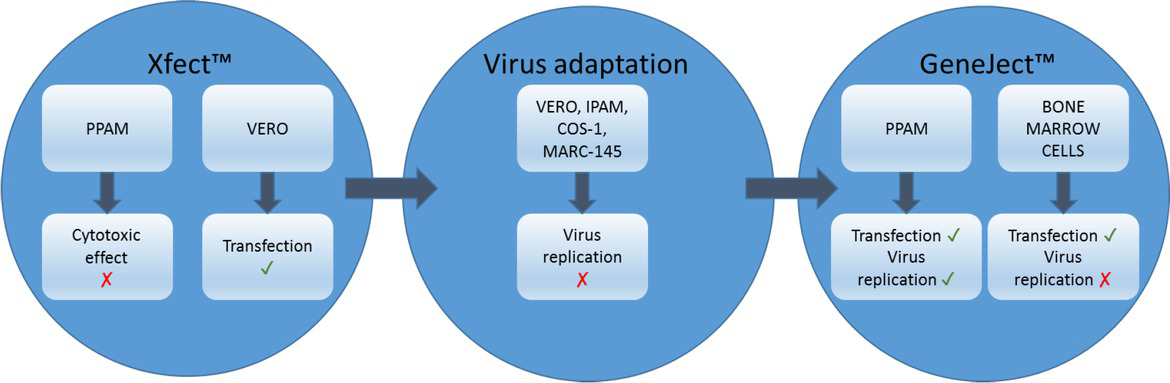
Fig. 1
Schematic representation of the selection of the suitable transfection kit and target cells
Table 2
Transfection protocol. The main conditions for two applied kits are presented
| Parameter | Xfect | GeneJect |
|---|---|---|
| Plasmid DNA | 5 μg | 0.4 μg |
| Total growth medium volume | 1,000 μL | 1,000 μL |
| Transfection reagent | 1.5 μL | 2 μL |
| Incubation time for nanocomplexes creation | 10 min/RT | 30 min/RT |
| Incubation time with target cells | 4 h/37°C | 24–72 h/37°C |
| Additional steps | Disposal Replacement of medium with fresh growth medium | - |
| Control of transfection effect | 48 h | Within 24–72 h incubation time |
Table 3
Primers used for amplification of the region of interest covering target genes. Nucleotide positions refer to the ASFV Georgia 2007/1 genome sequence (GenBank accession number: FR682468.1)
| Name | Sequence | Position | Tm (Primer melting temperature) |
|---|---|---|---|
| A238L-F | TTGGACACAGGAAACGATCT | 50.370–50.389 | 49.7°C |
| A238L-R | ATATGGGAAAAGGGCCTGGC | 51.302–51.283 | 53.8°C |
| EP402R-F | ACTATATTATAAAACATATG | 73.341–73.360 | 37.4°C° |
| EP402R-R | TGCATGTGATGGAAATCGGT | 74.594–74.575 | 49.7°C |
| 9GL-F | GCCTCACTATCGATCGGCAA | 94.046–94.065 | 53.8°C |
| 9GL-R | ACTGGCTGGAATTACGCCAA | 95.450–95.431 | 51.8°C |
| A224L-F | AAAAGCTATTTGTTTATCCCCA | 46.266–46.287 | 47.4°C |
| A224L-R | CCTTCAATTGAGGATGATCATT | 47.057–47.036 | 49.2°C |
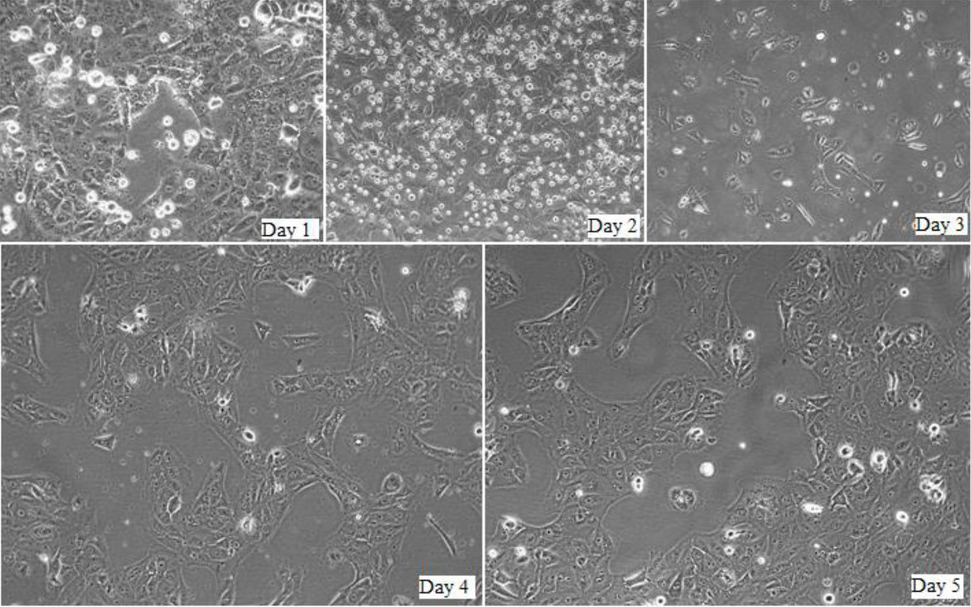
Fig. 2
Vero cells transfected with constructed CRISPR/Cas9 plasmid. In order to confirm successful transfection, a puromycin selection was applied, which led to an increased rate of cell death during the first three days post transfection, and later the cell culture started to grow in antibiotic supplemented medium (magnification 200 ×)
Table 4
Results obtained in real-time PCR
| Target site | PPAM Puromycin 24 h | PPAM Puromycin 48 h | PBM Puromycin 24 h | PBM Puromycin 48 h | ||||
|---|---|---|---|---|---|---|---|---|
| I | II | I | II | I | II | I | II | |
| 9GL-1 | 33.89h | 33.85h | 34.14h | 35.97 | 31.95 h | - | 31.48h | 38.62 |
| 9GL-2 | 34.49h | 31.05h | 34.38h | 31.99h | 31.65 h | 33.55h | 32.37h | 34.08 |
| A238L-1 | 32.26h | 31.3h | 32.75h | 31.26h | 32.34 h | 28.5h | 32.88h | - |
| A238L-2 | 32.92h | 31.93h | 32.92h | 29.88h | 31.93 h | 30.52h | 33.61 h | 35.54 |
| EP402R-1 | 31.92h | 38.71 | 33h | 29.76h | 32.74 h | 34.21 | 32.9h | 33.79 h |
| EP402R-2 | 31.79h | 28.82h | 32.8h | 36.25 | 32.89 h | 38.69 | 32.59h | 34.81 |
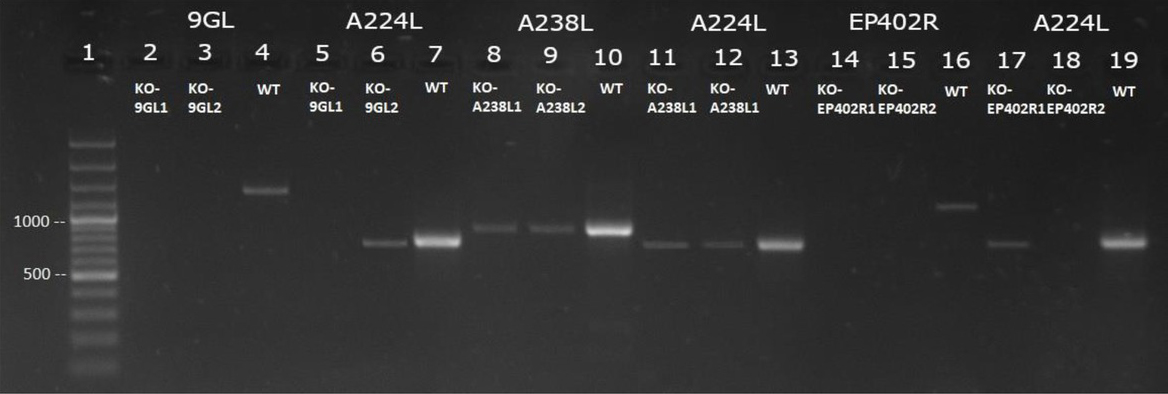
Fig. 3
Agarose gel (2%) showing the results of the conventional PCR to amplify whole sequences of targeted genes. Gene names at the top represent the amplified region. Numbers below gene names correspond to Table 5 numbers in brackets, 1000/500 – band size markers
Table 5
Results of conventional PCR
| Material | PCR target | |||
|---|---|---|---|---|
| 9GL | A238L | EP402R | A224L | |
| KO-9GL1 | (2)− | n/a | n/a | (5)− |
| KO-9GL2 | (3)− | n/a | n/a | (6)+ |
| KO-A238L1 | n/a | (8)+ | n/a | (11)+ |
| KO-A238L2 | n/a | (9)+ | n/a | (12)+ |
| KO-EP402R1 | n/a | n/a | (14)− | (17)+ |
| KO-EP402R2 | n/a | n/a | (15)− | (18)− |
| WT | (4)+ | (10)+ | (16)+ | (7, 13, 19)+ |
[i] Numbers in brackets represent sample numbers in Fig. 3. KO – knock-out targets;
WT – wild type; n/a – not applicable
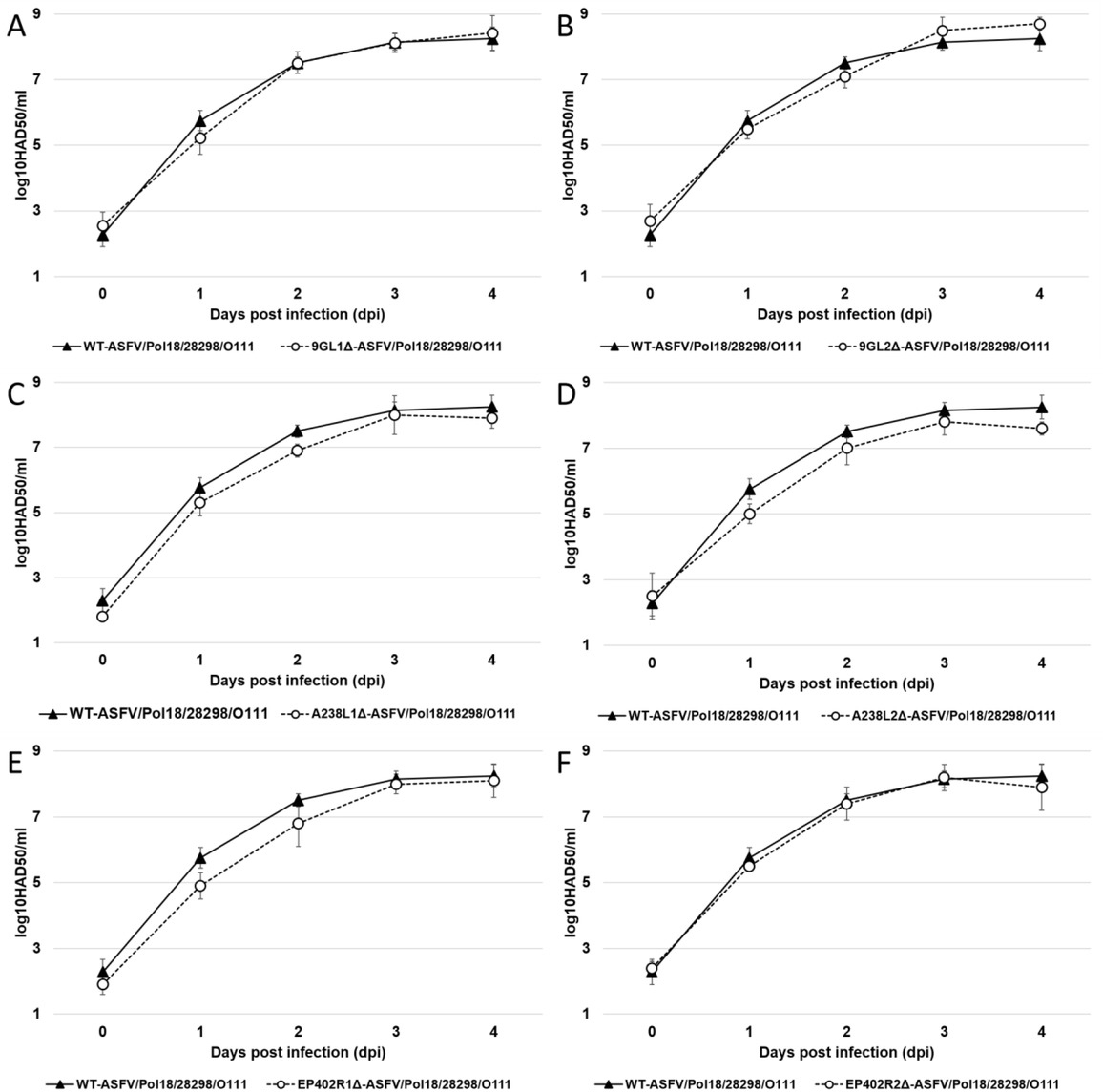
Fig. 4
In vitro replication kinetics of the six generated deletion mutant (A – 9GL1Δ; B – 9GL2Δ; C – A238L1Δ; D – A238L2Δ; E – EP402R1Δ; F – EP402R2Δ) and parent ASFV/Pol18/28298/O111 isolates. PPAM cell cultures were infected (MOI 0.1) with both strains, and subsequently virus titres were estimated daily over 96 h post infection. Data represent means and standard deviations from three independent experiments. The sensitivity of virus detection was 1.8 HAD50/mL