
Table 1
The numbers of faecal samples collected by location and season
| Borecka Forest | Knyszyńska Forest | Białowieża Forest | BiF neighbouring region | Total | |
|---|---|---|---|---|---|
| Autumn 2014 | 12 | 18 | 78 | 50 | 158 |
| Autumn 2015 | 0 | 65 | 0 | 0 | 65 |
| Spring 2015 | 14 | 24 | 20 | 36 | 94 |
| Winter 2016 | 0 | 0 | 41 | 10 | 51 |
| Total | 26 | 107 | 139 | 96 | 368 |
Table 2
The numbers of different gastro-intestinal nematodes, Fasciola hepatica eggs, Dictyocaulus viviparus larvae, and Eimeria spp. oocysts and the parasite prevalence in European bison from the Białowieża Forest (n = 139) and its neighbouring area (n = 96) and the Knyszyńska (n = 107) and Borecka (n = 26) Forests collected in the autumns of 2014 and 2015 (n = 223), winter 2016 (n = 51), and spring 2015 (n = 94)
| Białowieża Forest (BiF) | BiF neighbouring area | Knyszyńska Forest | Borecka Forest | Autumn | Winter | Spring | ||
|---|---|---|---|---|---|---|---|---|
| Trichostrongylidae | na | 37.9 | 98.2 | 25.1 | 14.1 | 14.2 | 43 | 131.9 |
| (range) | (1–1150) | (1–1196) | (1–305) | (1–45) | (1–98) | (1–448) | (1–1196) | |
| %c | 95.7 | 93.7 | 94.4 | 92.3 | 92 | 100 | 98 | |
| (SDb) | (20.4) | (24.3) | (23.1) | (27.2) | (27.3) | (0) | (14.5) | |
| Aonchotheca spp. | na | 5.3 | 4.2 | 1.3 | 6.2 | 3.8 | 2 | 3.1 |
| (range) | (1–82) | (1–58) | (1–8) | (1–28) | (1–82) | (1–20) | (1–79) | |
| %c | 54.7 | 59.4 | 7.4 | 34.6 | 43.5 | 43.1 | 32.9 | |
| (SDb) | (50) | (49.4) | (26.4) | (48.5) | –49.7 | (50) | (47.2) | |
| Nematodirus spp. | na | 0.06 | 1.1 | 0.02 | 0.1 | 1 | 0.4 | |
| (range) | (1–4) | (1–24) | (1–1) | 0 | (1–13) | (1–24) | (1–10) | |
| %c | 3.6 | 19.8 | 1.9 | 4.5 | 9.8 | 11.7 | ||
| (SDb) | (18.7) | (40) | (13.6) | 0 | (20.7) | (30) | (32.3) | |
| Strongyloides spp. | na | 0.1 | 0.05 | |||||
| (range) | 0 | 0 | (1–5) | 0 | (1–5) | 0 | 0 | |
| %c | 2.8 | 1.3 | ||||||
| (SDb) | 0 | 0 | (16.6) | 0 | (11.5) | 0 | 0 | |
| Trichuris spp. | na | 2.1 | 19.8 | 0.6 | 1.7 | 10.3 | 14.3 | |
| (range) | (1–152) | (1–305) | (1–61) | 0 | (1–136) | (1–249) | (1–305) | |
| %c | 5.8 | 17.7 | 1.9 | 3.6 | 11.8 | 13.8 | ||
| (SDb) | (23.3) | (38.4) | (13.6) | 0 | (18.6) | (32.5) | (34.7) | |
| Moniezia spp. | na | 1.7 | 14.3 | 4.5 | 2.1 | 6.5 | 14 | |
| (range) | (1–142) | (1–304) | (1–267) | 0 | (1–267) | (1–142) | (0–304) | |
| %c | 8.6 | 15.6 | 3.7 | 4 | 17.6 | 13.8 | ||
| (SDb) | (28.2) | (36.5) | (19.1) | 0 | (19.7) | (38.5) | (34.7) | |
| Eimeria spp. (oocysts) | nd | 45.4 | 99.2 | 10.8 | 160.6 | 65.9 | 27.5 | 53.8 |
| (range) | (1–748) | (1–5072) | (1–557) | (1–1914) | (1–5072) | (1–391) | (1–1917) | |
| %d | 74.8 | 77.1 | 25.2 | 96.1 | 56 | 82.3 | 65.9 | |
| (SDb) | (43.5) | (42.2) | (43.6) | (19.6) | (49.7) | (38.5) | (47.6) | |
| Fasciola hepatica (eggs) | na | 8.7 | 8.7 | 2.4 | 5.3 | 3.5 | 18.3 | 7.5 |
| (range) | (1–403) | (1–63) | (1–22) | (1–62) | (1–63) | (1–403) | (1–38) | |
| %c | 69.1 | 78.1 | 53.3 | 30.8 | 62.3 | 58.8 | 71.3 | |
| (SDb) | (46.4) | (41.6) | (50.1) | (47.1) | (48.5) | (49.7) | (45.5) | |
| Dictyocaulus viviparus (larvae) | na | 5 | 49.8 | 28.4 | 6 | 20.7 | 40.6 | |
| (range) | (1–173) | (1–856) | 0 | (1–276) | (1–276) | (1–176) | (1–856) | |
| %c | 26.6 | 55.2 | 46.1 | 14.4 | 33.3 | 56.4 | ||
| (SDb) | (44.3) | (50) | 0 | (50.8) | (35.1) | (47.6) | (49.8) |
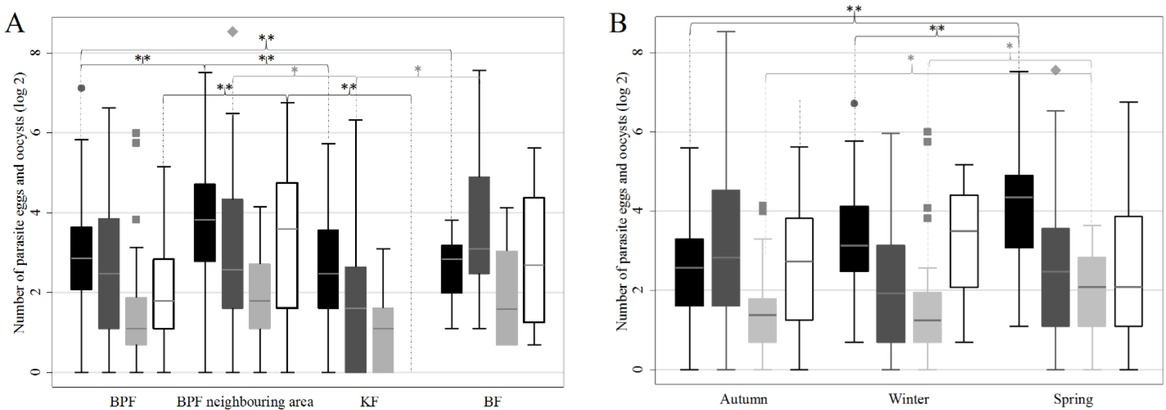
Fig. 1
Box plot of numbers of gastro-intestinal nematode eggs (black), Eimeria spp. oocysts (dark grey), Fasciola hepatica (light grey), and Dictyocaulus viviparus eggs (white) broken down by origin (A) and season (B). Boxes show the median and upper and lower quartiles, while the whiskers illustrate the data range. The additional dot, square, or diamond points stand for outliers. The statistically significant differences were verified using the Kruskal–Wallis test and are indicated with * for P between 0.05 and 0.001 and ** for P < 0.001
Table 3
Cross-correlations between the explanatory variables and outcomes – prevalence and intensity of invasion
| Origin | Season | Trichostrongylidae | Aonchotheca sp. | Nematodirus spp. | Strongyloides spp. | Trichuris sp. | Moniezia spp. | Eimeria spp. | Fasciola hepatica | Dictyocaulus viviparus | ||
|---|---|---|---|---|---|---|---|---|---|---|---|---|
| Origin | 1 | - | 27.1** | 68.5** | 33.2** | 7.3 | 22.9** | 12.0* | 92.3** | 37.2** | 86.4** | |
| Season | 72.1** | 1 | 102.1** | 4.5 | 6.0 | 1.9 | 12.0* | 15.0** | 3.2 | 13.4* | 56.4** | |
| Trichostron- gylidae | 0.73 | 7.9* | 1 | 0.15* | 0.22** | −0.09 | 0.29** | 0.27** | 0.13* | 0.25** | 0.38** | Intensity of invasion (number of eggs/oocysts/larvae) |
| Aonchotheca sp. | 74.4** | 3.2 | 5.8* | 1 | 0.11 | −0.07 | 0.10 | 0.07 | 0.38** | 0.16* | 0.15* | |
| Nematodirus spp. | 32.6** | 5.9* | 1.6 | 7.0* | 1 | −0.02 | 0.46** | 0.35** | 0.16* | 0.22** | 0.26** | |
| Strongyloides spp. | 7.3 | 2.0 | 0.2 | 2.1 | 0.2 | 1 | −0.03 | −0.03 | −0.06 | −0.08 | −0.06 | |
| Trichuris sp. | 22.5** | 11.9* | 1.6 | 4.1* | 74.9** | 0.2 | 1 | 0.47** | 0.15* | 0.22** | 0.29** | |
| Moniezia spp. | 11.9* | 14.7* | 1.9 | 0.8 | 41.6** | 0.3 | 71.2** | 1 | 0.09 | 0.15* | 0.20** | |
| Eimeria spp. | 7.4 | 12.5* | 0.06 | 35.6** | 5.8* | 1.1 | 4.5* | 4.7* | 1 | 0.01 | 0.04 | |
| Fasciola hepatica | 27.7** | 3.0 | 2.3 | 3.7* | 5.1* | 1.2 | 5.6* | 2.6 | 1.0 | 1 | 0.33** | |
| Dictyocaulus viviparus | 81.7** | 59.2** | 0.6 | 11.7* | 16.0** | 1.2 | 22.1** | 9.6* | 2.3 | 18.2** | 1 | |
| Prevalence (presence/absence of parasite) | ||||||||||||
in lower left corner in white – χ2 for the prevalence study; in upper right corner – Kruskal–Wallis χ2 values in darker grey and Spearman ρ values in lighter grey below for the intensity of invasion (number of eggs/oocysts/larvae)
Table 4
Mixed-effect generalised linear model (GLM) coefficients for the effects of season and origin on the intensity of individual parasite invasion in European bison
| BiF | BiF neighbouring area | KnF | BoF | Autumn | Winter | Spring | Intercept | ||
|---|---|---|---|---|---|---|---|---|---|
| Trichostrongylidae | |||||||||
| Coefficient β Standard error z statistic P >|z| |  | 0.50 0.02 27.2 <0.001 | −0.48 0.02 −19.0 <0.001 | −1.7 0.05 −30.8 <0.001 |  | 0.95 0.03 33.11 <0.001 | 2.16 0.02 106.4 <0.001 | 2.69 0.02 127.3 <0.001 | |
| Aonchotheca sp. | |||||||||
| Coefficient β Standard error z statistic P >|z| |  | −0.34 0.06 −5.38 <0.001 | −3.10 0.18 −17.14 <0.001 | −0.75 0.12 −6.11 <0.001 |  | −1.18 0.10 −11.20 <0.001 | −0.23 0.07 −3.30 <0.001 | 1.94 0.04 47.9 <0.001 | |
| Nematodirus spp. | |||||||||
| Coefficient β Standard error z statistic P >|z| |  | 3.33 0.35 9.44 <0.001 | −0.25 0.80 −0.32 0.75 | −12.55 614.7 −0.02 0.98 |  | 2.05 0.22 9.00 <0.001 | 0.53 0.24 2.20 0.03 | −3.87 0.38 −10.21 <0.001 | |
| Trichuris sp. | |||||||||
| Coefficient β Standard error z statistic P >|z| |  | 2.18 0.06 33.27 <0.001 | −0.82 0.14 −5.93 <0.001 | −16.49 481.7 −0.03 0.97 |  | 1.76 0.07 25.72 <0.001 | 1.71 0.06 29.45 <0.001 | −0.36 0.08 −4.69 <0.001 | |
| Moniezia spp. | |||||||||
| Coefficient β Standard error z statistic P >|z| |  | 1.95 0.07 26.61 <0.001 | 1.21 0.08 14.23 <0.001 | −16.1 414.4 −0.04 0.97 |  | 1.51 0.08 19.60 <0.001 | 1.74 0.06 31.57 <0.001 | −0.43 0.08 −5.34 <0.001 | |
| Eimeria spp. | |||||||||
| Coefficient β Standard error z statistic P >|z| |  | 0.76 0.02 45.62 <0.001 | −1.62 0.03 −50.10 <0.001 | 1.25 0.02 60.05 <0.001 |  | −0.99 0.03 −34.66 <0.001 | −0.59 0.02 −35.12 <0.001 | 4.10 0.01 305.10 <0.001 | |
| Fasciola hepatica | |||||||||
| Coefficient β Standard error z statistic P>|z| |  | 0.20 0.05 4.21 <0.001 | −0.77 0.07 −10.30 <0.001 | −0.16 0.09 −1.71 0.09 |  | 1.42 0.05 27.33 <0.001 | 0.65 0.05 12.27 <0.001 | 1.44 0.04 32.17 <0.001 | |
| Dictyocaulus viviparus | |||||||||
| Coefficient β Standard error z statistic P >|z| |  | 2.21 0.04 51.89 <0.001 | −19.31 770.34 −0.03 0.98 | 1.54 0.06 27.65 <0.001 |  | 1.26 0.04 29.94 <0.001 | 1.40 0.03 43.70 <0.001 | 0.82 0.04 18.00 <0.001 | |
Table 5
Mixed-effects generalised linear model (GLM) coefficients for the effects of season and origin on the probability of European bison of being infected with individual parasites
| BiF | BiF neighbouring area | KnF | BoF | Autumn | Winter | Spring | Intercept | ||
|---|---|---|---|---|---|---|---|---|---|
| Aonchotheca sp. | |||||||||
| Coefficient β Standard error z statistic P >|z| |  | 0.22 0.29 0.77 0.44 | −2.96 0.42 −7.01 <0.001 | −0.79 0.47 −1.68 0.09 |  | −0.90 0.34 −2.65 0.008 | −0.84 0.30 −2.78 0.005 | 0.58 0.21 2.73 0.006 | |
| Trichuris sp. | |||||||||
| Coefficient β Standard error z statistic P >|z| |  | 1.20 0.49 2.44 0.02 | −0.95 0.84 −1.13 0.26 | 0 – – – | 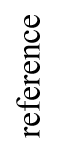 | 1.13 0.60 1.88 0.06 | 1.30 0.49 2.68 0.007 | −3.47 0.49 −6.96 <0.001 | |
| Dictyocaulus viviparus | |||||||||
| Coefficient β Standard error z statistic P >|z| | 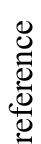 | 1.05 0.32 3.26 0.001 | 0 – – – | 0.21 0.53 0.40 0.69 | 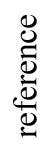 | 0.75 0.38 1.98 0.05 | 2.29 0.36 6.35 <0.001 | −1.67 0.27 −6.23 <0.001 | |