Have a personal or library account? Click to login
Cloning and identification of PK15 cells for enhanced replication of classical swine fever virus Cover

Cloning and identification of PK15 cells for enhanced replication of classical swine fever virus

Open Access
|Mar 2020

Figures & Tables

Fig. 1

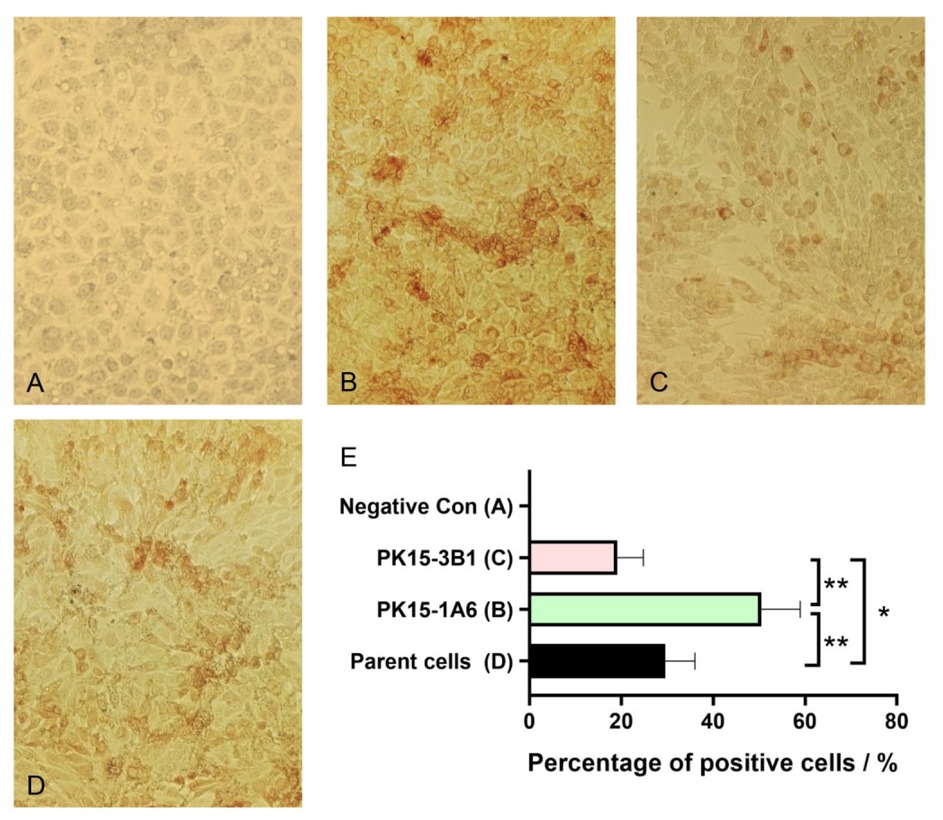
The percentages of CSFV-infected cells in the parent cell line and cloned PK15 cells. A – mock-infected PK15 cells (negative control); B – high-permissive (clone 1A6); C – low-permissive (clone 3B1); D – infected parent PK15 cells; E – percentages of positively stained cells. The cells were infected with CSFV and stained with CSFV-specific monoclonal antibodies (400×). Five visual fields were randomly selected to be photographed in each group. The percentages of positively stained cells in the photos were counted and shown as mean ± SD. * P < 0.05, ** P < 0.01
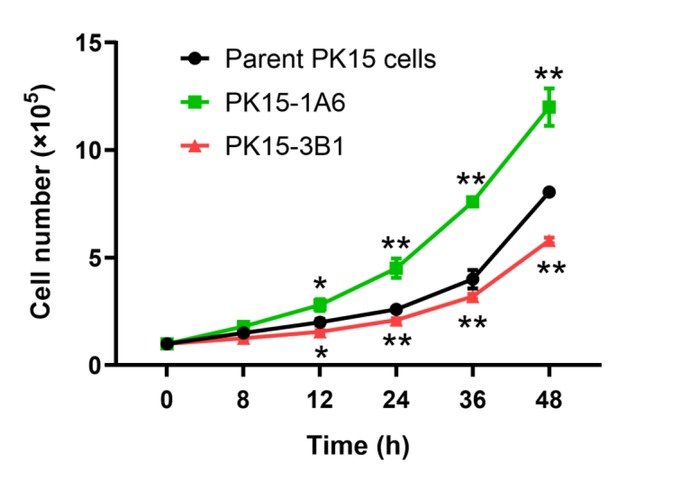

Fig. 2

Growth curves of parent PK15, clone PK15-1A6, and PK15-3B1 cells. The cells were trypsinised and counted at 8, 12, 24, 36, and 48 h post seeding. The data represent the mean ± SD of three independent experiments performed. The differences between the number of parent cells and that of PK15-1A6 cells are shown above the squares. The differences between the number of parent cells and that of PK15-3B1 cells are shown below the triangles. * P < 0.05, ** P < 0.01
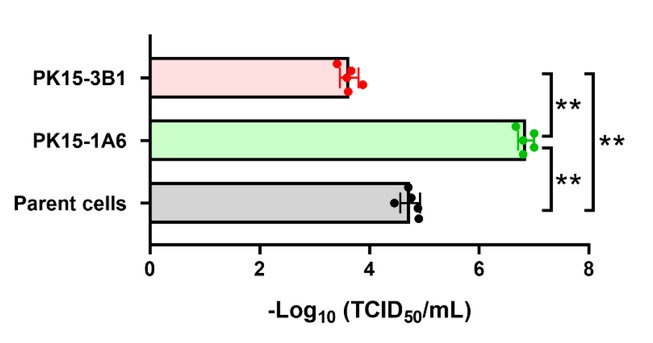

Fig. 3

Mean CSFV titres produced by the parent PK15, PK15-1A6, and PK15-3B1 cells. The replication abilities of CSFV in each type of PK15 cells (TCID50) were detected by the IPMA method. ** P < 0.01
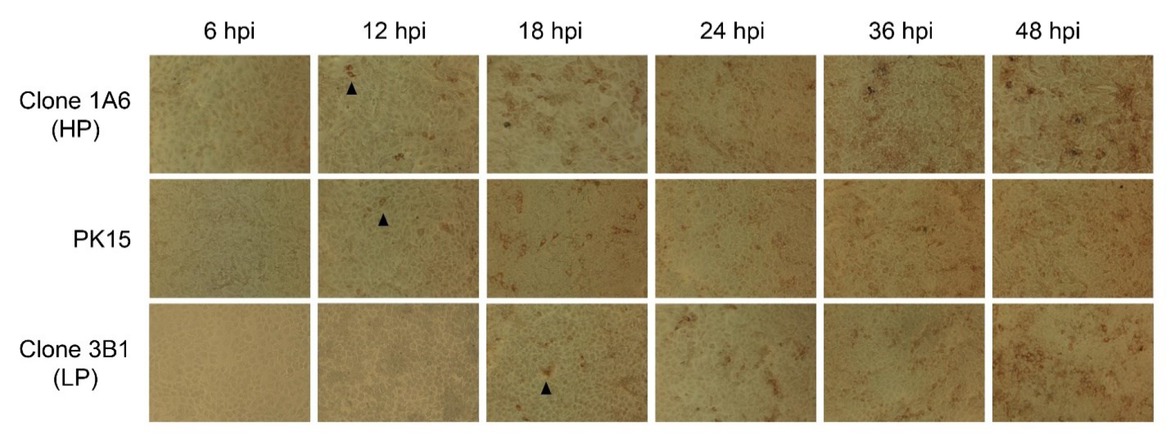

Fig. 4

IPMA results demonstrating the replication abilities of CSFV in high- and low-permissive PK15 cells at different time points. Different cell lines were fixed at 6, 12, 18, 24, 36, and 48 h post CSFV infection and stained with CSFV-specific antibodies followed by HRP-conjugated secondary antibodies (400×)
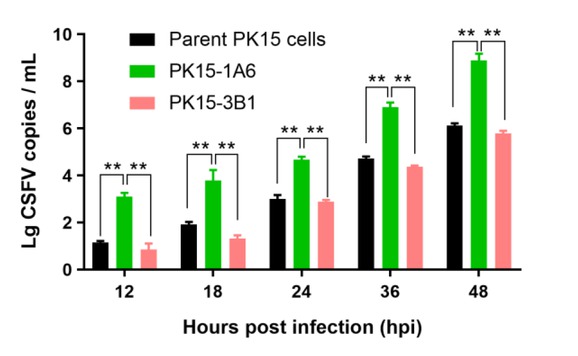

Fig. 5

The synthesis of CSFV genome in parent PK15 cells and PK15-1A6 (HP) and PK15-3B1 (LP) cell lines. The genomic RNA extractions from infected cells were quantitated by RT-PCR (amplification of partial E2 gene). The copy numbers of CSFV were determined by referring to a standard curve. ** P < 0.01
Language: English
Page range: 9 - 14
Submitted on: Jul 17, 2019
|
Accepted on: Feb 27, 2020
|
Published on: Mar 24, 2020
In partnership with: Paradigm Publishing Services
Publication frequency: 4 issues per year

© 2020 Mei Yin, Dongfang Hu, Peng Li, Lingyun Kong, Hongmei Ning, Feng Yue, Jinqing Jiang, Xuannian Wang, published by National Veterinary Research Institute in Pulawy
This work is licensed under the Creative Commons Attribution-NonCommercial-NoDerivatives 3.0 License.