Have a personal or library account? Click to login
First description of histopathological lesions associated with a fatal infection of moose (Alces alces) with the liver fluke Parafasciolopsis fasciolaemorpha Ejsmont, 1932 Cover

First description of histopathological lesions associated with a fatal infection of moose (Alces alces) with the liver fluke Parafasciolopsis fasciolaemorpha Ejsmont, 1932

Open Access
|Nov 2019

Figures & Tables

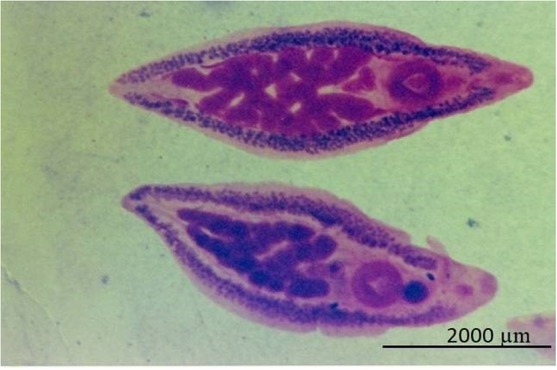
Fig. 1

Parafasciolopsis fasciolaemorpha flukes isolated from a moose liver
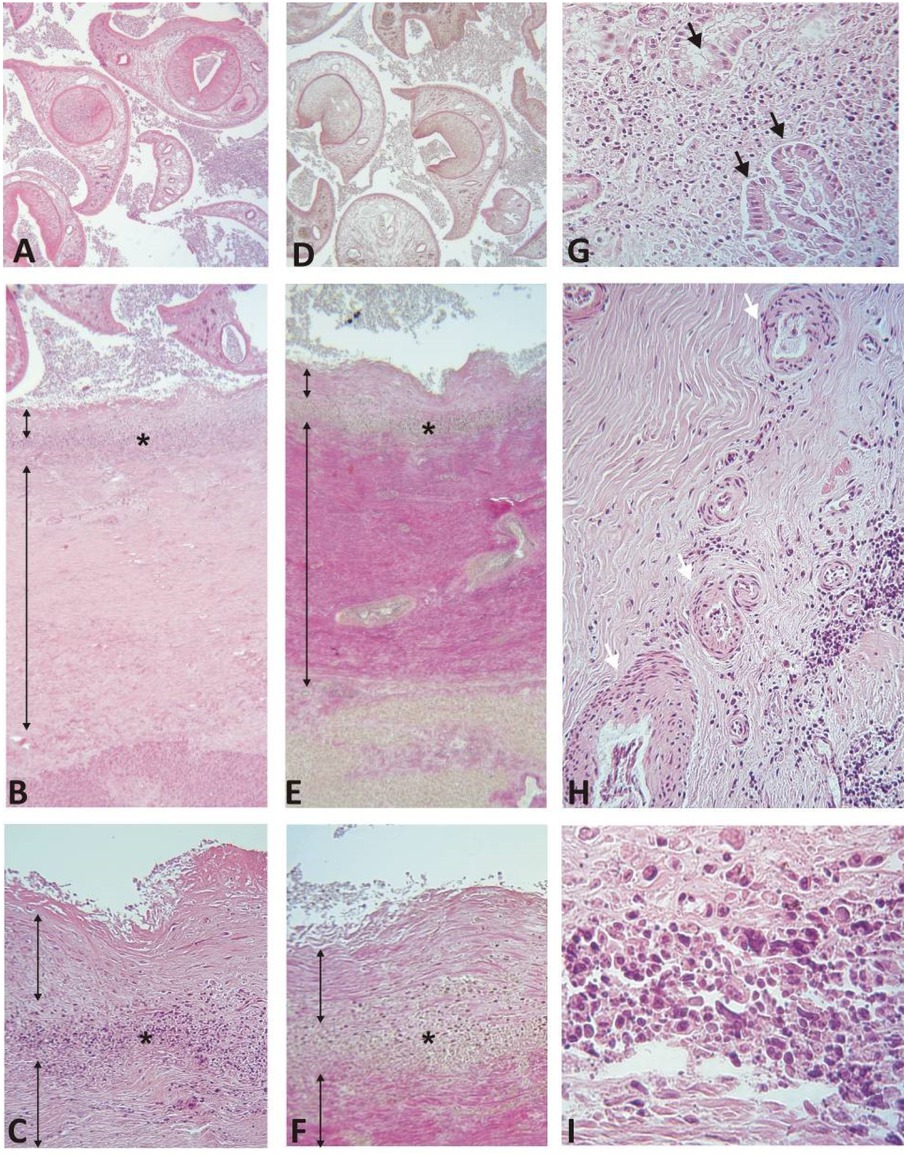

Fig. 2

Histopathological picture of cavities filled with flukes. A, D – liver flukes of Parafasciolopsis fasciolaemorpha, 10× (eyepiece) and 4× (objective); B, E – cyst capsule, 10× (eyepiece) and 4× (objective); C, F – the inner part of the cyst capsule, 10× (eyepiece) and 10× (objective); G – bile ductules in the layer of infiltration and secondary fibrosis, 10× (eyepiece) and 40× (objective); H – arteries in the layer of secondary fibrosis, 10× (eyepiece) and 40× (objective); I – cells of inflammatory infiltration, 10× (eyepiece) and 100× (objective). A, B, C, G, H, I – HE staining; D, E, F – Van Gieson staining. Black arrow – bile ductule, white arrow – artery, double arrow – connective tissue hyperplasia, * inflammatory infiltration
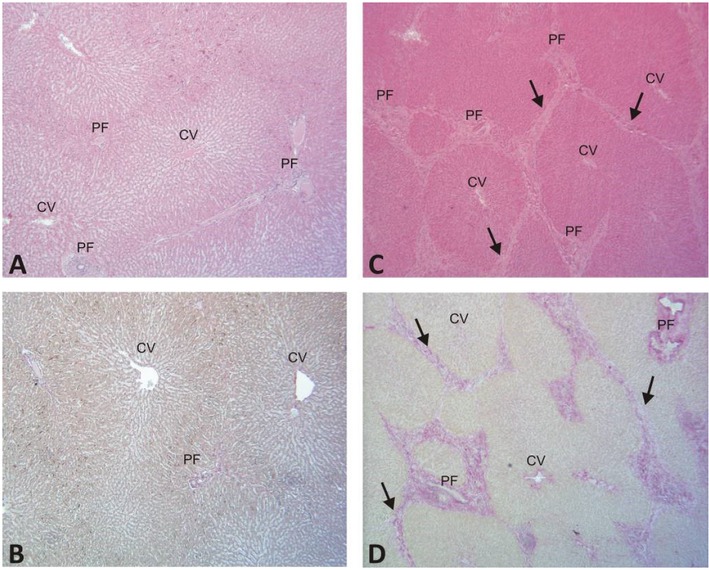

Fig. 3

Histopathological changes in the liver parenchyma in the infection with Parafasciolopsis fasciolaemorpha in comparison to the healthy moose liver. A, B – healthy moose liver; C, D – the parenchyma of a moose liver infected with Parafasciolopsis fasciolaemorpha; All images at 10× (eyepiece) and 10× (objective). A, B – HE staining; C, D – Van Gieson staining. Black arrow – connective tissue bands, CV – central veins, PF – portal fields
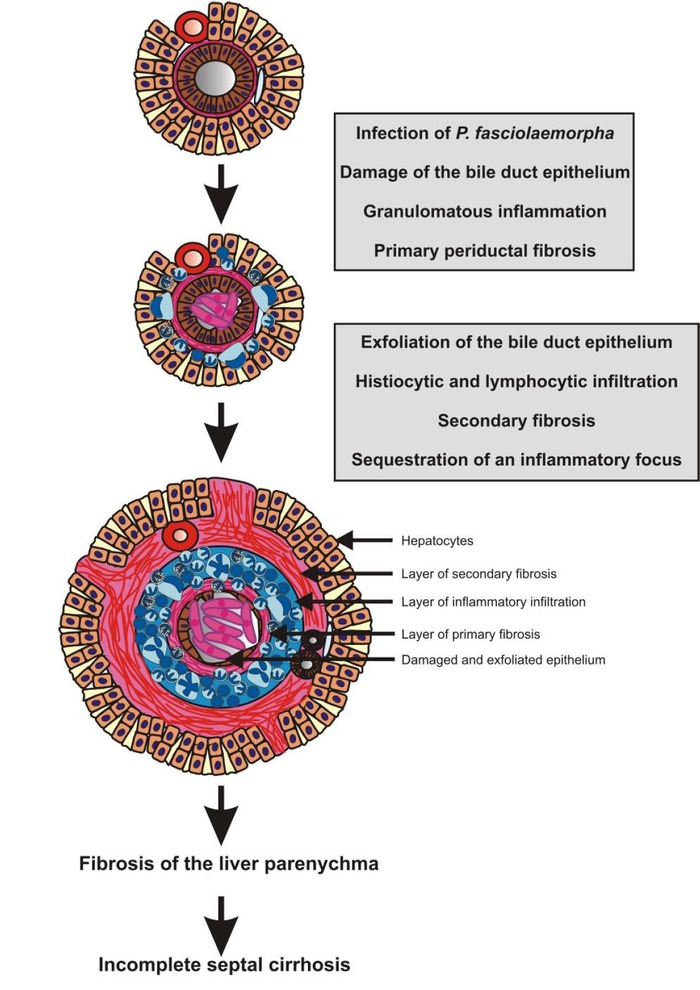

Fig. 4

Diagram of pathogenesis of P. fasciolaemorpha infection
Language: English
Page range: 549 - 554
Submitted on: Mar 28, 2019
Accepted on: Oct 30, 2019
Published on: Nov 16, 2019
Published by: National Veterinary Research Institute in Pulawy
In partnership with: Paradigm Publishing Services
Publication frequency: 4 issues per year

© 2019 Katarzyna Filip-Hutsch, Tomasz Hutsch, Szymon Kolasa, Aleksander W. Demiaszkiewicz, published by National Veterinary Research Institute in Pulawy
This work is licensed under the Creative Commons Attribution-NonCommercial-NoDerivatives 3.0 License.