
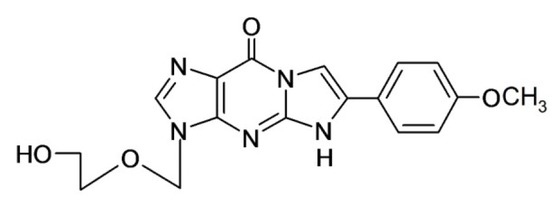
Fig. 1
The tricyclic derivative of acyclovir 3,9-dihydro-3-((2-hydroxyethoxy)methyl)-6-(4-methoxyphenyl)-9-oxo-5H-imidazo (1,2-a)purine T-ACV
Table 1
Primers and probes used for TaqMan qPCR quantification of CyHV-3 DNA copy number
| Target | Sequence FP | Sequence RP | Probe | Primer sequence source |
|---|---|---|---|---|
| CyHV-3 | KHV-86f | KHV-163r | KHV-109p FAM- | |
| GACGCCGGAGACCT | CGGGTTCTTATTTTT | CTTCCTCTGCTCGGCGAGC | Gilad et al. (8) | |
| TGTG | GTCCTTGTT | ACG-BHQ | ||
| Carp glucokinase | CgGluc-162f | CgGluc-230r | cgGluc-185p VIC- | |
| ACTGCGAGTGGAGA | TCAGGTGTGGAGCG | AAGCCAGTGTCAAAATGC | Gilad et al. (8) | |
| CACATGAT | GACAT | TGCCCACT-MGF-NFQ |
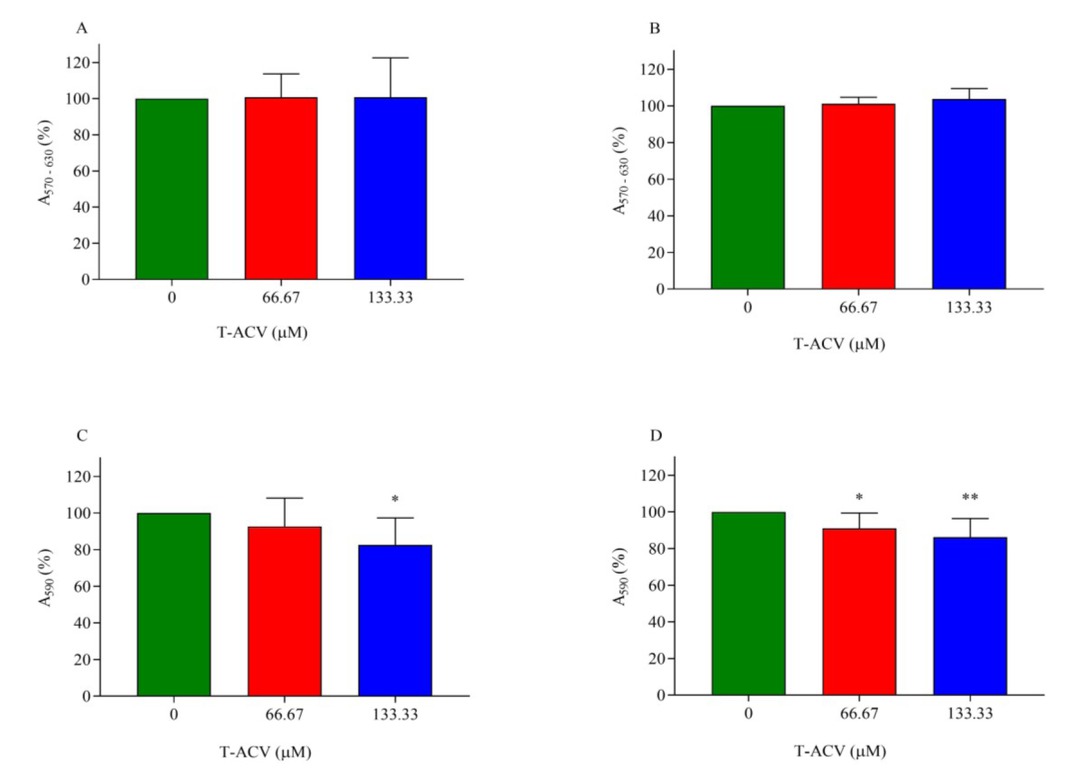
Fig. 2
The cytotoxicity of T-ACV at concentrations of 66.67 and 133.33 μM in CCB and KF1 cell lines at the phase of exponential growth. The graphs depict results yielded by an MTT assay in CCB, n = 9 (A) and KF1, n = 8 (B) and by CV assay in CCB, n =8 (C) and KF1, n = 8 (D). The data are expressed as a percentage of absorbance of the control group (0 μM T-ACV) and presented as mean ± SD. The differences in a paired t-test between the control group and T-ACV group were significant at p ≤ 0.05* or p ≤ 0.01**
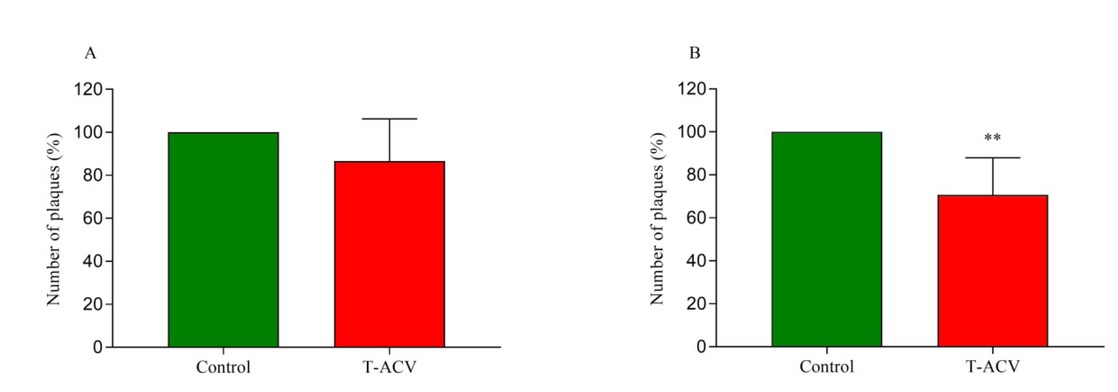
Fig. 3
The anti-CyHV-3 activity of T-ACV in CCB, n = 10 (A) and KF1, n = 8 (B) cell lines determined by plaque assay. The data are expressed as a percentage of plaques of the control group (CyHV-3 infected, 0 μM T-ACV) and presented as mean ± SD. The differences in a paired t-test between the control group and T-ACV group were significant at p ≤ 0.01**
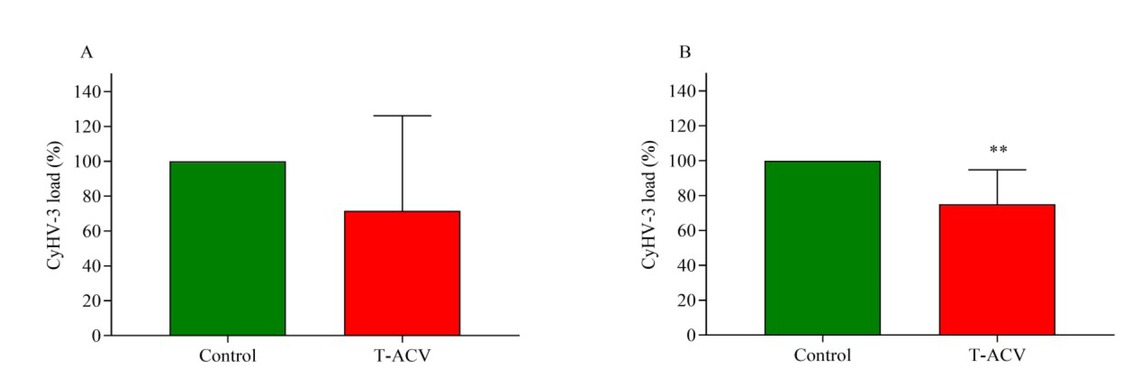
Fig. 4
The anti-CyHV-3 activity of T-ACV in CCB, n = 14 (A) and KF1, n = 9 (B) cell lines determined by TaqMan qPCR assay. The data are expressed as a percentage of viral load of the control group (CyHV-3 infected, 0 μM T-ACV) and presented as mean ± SD. The differences in a paired t-test between the control group and T-ACV group were significant at p ≤ 0.01**