
Table 1
Clinical data in two groups of cow samples at 50 to 60 d postpartum for LC–MS detection and for ELISA validation
| Parameters | Cow samples for LC–MS detection | Cow samples for ELISA validation | ||
|---|---|---|---|---|
| E | IO | E | IO | |
| No. | 16 | 16 | 16 | 16 |
| Age | 3.58 ± 1.40 | 3.07 ± 1.26 | 3.29 ± 0.34 | 3.23 ± 0.55 |
| Parity | 2.27 ± 1.16 | 1.88 ± 1.09 | 1.91 ± 0.28 | 1.86 ± 0.55 |
| BCS | 2.88 ± 0.29 | 2.69 ± 0.23* | 2.84 ± 0.23 | 2.66 ± 0.21* |
| MY (Kg/d) | 33.56 ± 4.48 | 34.68 ± 5.00 | 33.37 ± 4.48 | 34.90 ± 4.64 |
| Glu (mmol/L) | 3.40 ± 0.34 | 3.36 ± 0.38 | 3.53 ± 0.51 | 3.39 ± 0.39 |
| NEFA (mmol/L) | 0.21 ± 0.05 | 0.32 ± 0.12** | 0.21 ± 0.08 | 0.30 ± 0.13* |
| BHBA (mmol/L) | 0.53 ± 0.21 | 0.63 ± 0.18 | 0.54 ± 0.17 | 0.60 ± 0.28 |
[i] * P < 0.05; ** P < 0.01; E – oestrous cows; IO – inactive ovary cows; BCS – body condition score; MY – milk yield per day; Glu – glucose; NEFA – non-esterified fatty acid; BHBA – β-hydroxybutyric acid; samples for LC–MS detection were from 16 oestrous and 16 inactive ovary cows; cow samples for ELISA validation were from 16 oestrous and 16 inactive ovary cows re-selected blindly and these samples were taken and prepared in the same way as those used for LC–MS detection
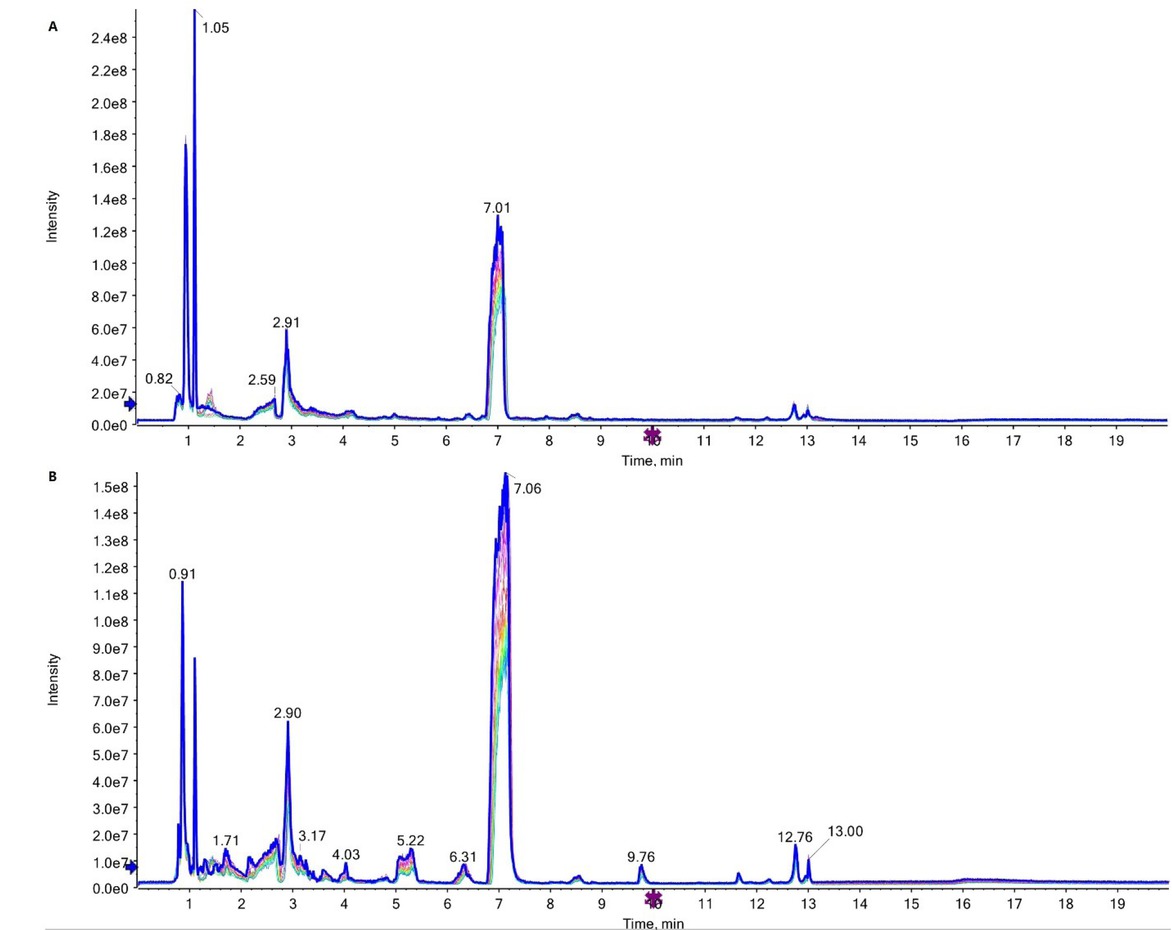
Fig. 1
The TIC (total ion count) of the QC (quality control) samples from the IO (inactive ovary cow) and E (oestrous cow) groups by LC–MS; A – ESI+ (positive ion of electrospray ionisation) mode; B – ESI− (negative ion of electrospray ionisation) mode
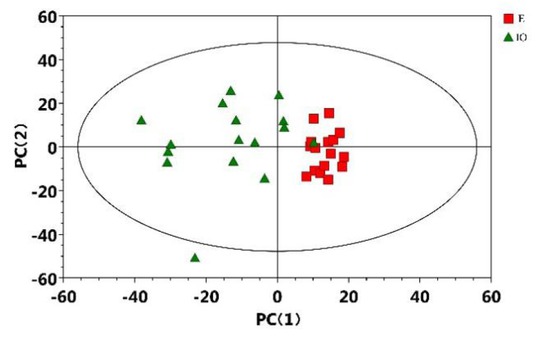
Fig. 2
PCA score plot based on LC–MS spectra of plasma of dairy cows obtained from the E (oestrous cow) and IO (inactive ovary cow) groups
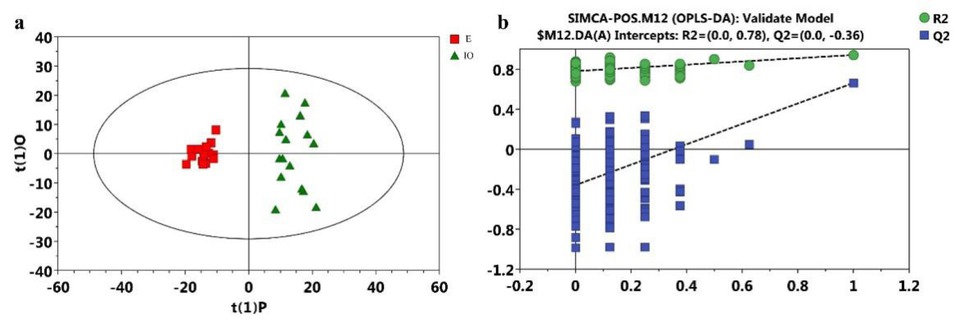
Fig. 3
The OPLS-DA score plot (a) and permutations test plot (b) based on LC–MS spectra of plasma of dairy cows obtained from the E (oestrous cow) and IO (inactive ovary cow) groups
Table 2
Differential plasma metabolites of IO cows and normal E cows screened by LC–MS
| No. | Metabolites | mzmed | rtmed | VIP value | P value | FC | Mode |
|---|---|---|---|---|---|---|---|
| 1 | Tyramine | 120.0801 | 203.3150 | 1.0774 | 0.0078 | 1.3528 | ESI+ |
| 2 | Betaine | 118.0855 | 288.9015 | 1.3930 | 0.0013 | 1.4872 | ESI+ |
| 3 | L-phenylalanine | 166.0855 | 203.3220 | 1.0598 | 0.0099 | 1.3254 | ESI+ |
| 4 | L-glutamate | 148.0594 | 508.3525 | 1.7459 | 0.0059 | 1.5415 | ESI+ |
| 5 | N6,N6,N6-trimethyl-L-lysine | 189.1587 | 802.7070 | 1.5786 | 0.0003 | 1.4007 | ESI+ |
| 6 | D-proline | 116.0703 | 315.4230 | 1.4542 | 0.0007 | 1.2543 | ESI+ |
| 7 | L-pyroglutamic acid | 130.0490 | 508.3120 | 1.4025 | 0.0050 | 1.2130 | ESI+ |
| 8 | Cholic acid | 391.2832 | 46.9290 | 1.8280 | 0.0003 | 0.6327 | ESI+ |
| 9 | p-chlorophenylalanine | 200.0463 | 243.4400 | 1.2859 | 0.0024 | 0.7587 | ESI+ |
| 10 | L-phenylalanine | 164.0719 | 203.9900 | 1.2468 | 0.0144 | 1.4683 | ESI− |
| 11 | L-citrulline | 349.1815 | 485.9170 | 1.1153 | 0.0177 | 1.6022 | ESI− |
| 12 | L-glutamate | 146.0457 | 510.6010 | 1.8904 | 0.0085 | 1.4992 | ESI− |
| 13 | γ-L-glutamyl-L-valine | 245.1133 | 468.3435 | 1.6628 | 0.0038 | 1.5038 | ESI− |
| 14 | Arachidic acid | 311.2936 | 50.1280 | 1.5495 | 0.0431 | 0.6241 | ESI− |
| 15 | L-leucine | 130.0878 | 219.6660 | 1.4373 | 0.0073 | 1.4759 | ESI− |
| 16 | L-valine | 116.0717 | 290.1260 | 1.5806 | 0.0032 | 1.5261 | ESI− |
| 17 | L-pyroglutamic acid | 128.0356 | 281.0020 | 1.9003 | 0.0025 | 1.6062 | ESI− |
| 18 | L-isoleucine | 130.0877 | 240.2465 | 1.7346 | 0.0010 | 1.6988 | ESI− |
| 19 | L-alanine | 88.0408 | 388.2320 | 1.9019 | 0.0000 | 1.3377 | ESI− |
| 20 | D-proline | 114.0560 | 315.8370 | 1.9989 | 0.0003 | 1.3718 | ESI− |
| 21 | Cytidine | 302.0975 | 208.5070 | 1.1421 | 0.0218 | 1.3280 | ESI− |
| 22 | Creatine | 261.1303 | 388.7810 | 1.5459 | 0.0008 | 1.6097 | ESI− |
| 23 | Phenylacetylglycine | 192.0663 | 103.3500 | 1.7514 | 0.0001 | 1.7482 | ESI− |
| 24 | α-N-phenylacetyl-L-glutamine | 385.1378 | 103.4960 | 1.6689 | 0.0003 | 1.8358 | ESI− |
[i] FC – fold change: The ratio of the average of the IO group (inactive ovary cows, n = 16) to the E group (oestrous cows, n = 16), showing the up (>1) and down (<1) relationship of metabolites between inactive ovary cows and oestrous cows; VIP – variable importance in the projection
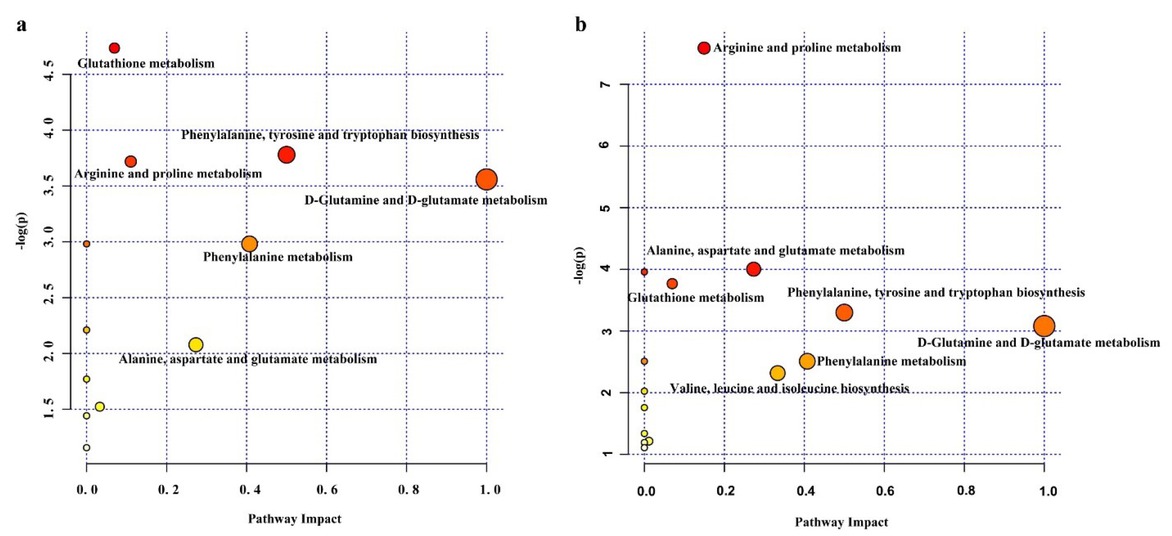
Fig. 4
Pathway analysis of differential plasma metabolites in a – ESI+ (positive ion of electrospray ionisation); and b – ESI− (negative ion of electrospray ionisation) modes between the E (oestrous cow) and IO (inactive ovary cow) groups in LC–MS analysis. The sizes of the bubbles are proportional to the impact of each pathway, with colour denoting the significance from the highest in red to the lowest in white
Table 3
The ELISA validation of 5 differential metabolites between normal oestrous cows and inactive ovary cows
| Parameters | E | IO |
|---|---|---|
| No. | 16 | 16 |
| Cholic acid, pmol/L | 59.85 ± 11.56 | 52.75 ± 11.88 |
| D-proline, ng/mL | 37.84 ± 5.06 | 41.53 ± 5.14* |
| L-alanine, ng/mL | 91.44 ± 7.24 | 97.52 ± 7.12* |
| L-glutamate, ng/mL | 22.50 ± 3.60 | 24.07 ± 2.72 |
| L-pyroglutamic acid, ng/mL | 3.23 ± 0.52 | 3.60 ± 0.48* |
[i] * P < 0.05; E – oestrous cows; IO – inactive ovary cows
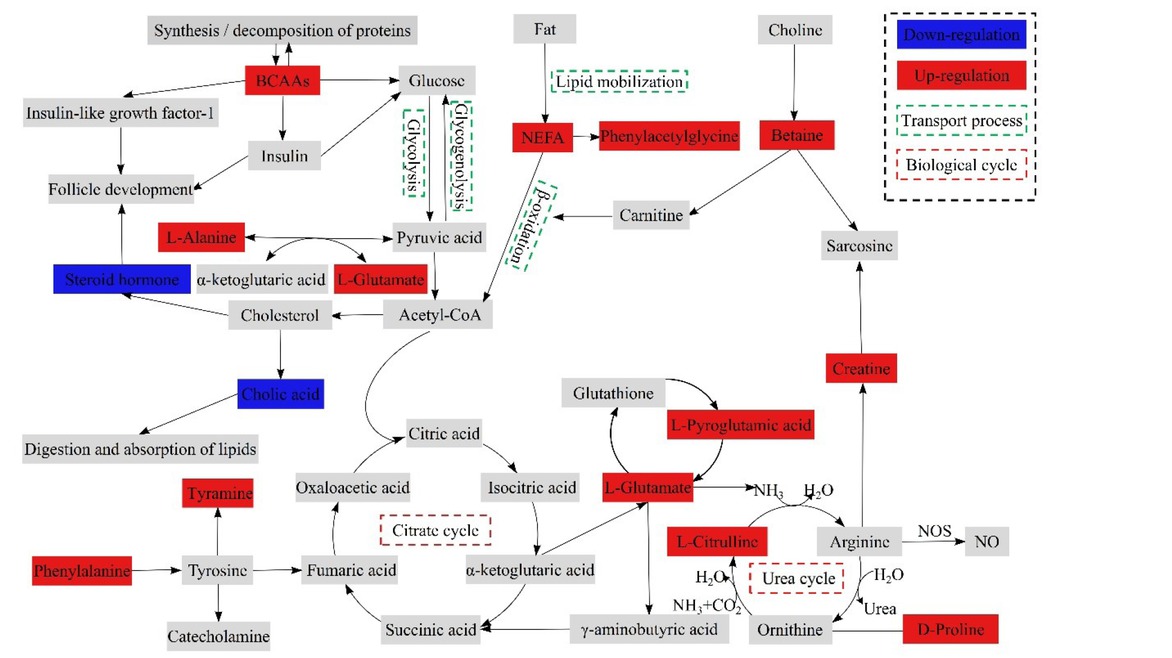
Fig. 5
Summarised pathways of differential metabolites from the IO (inactive ovary cow) and E (oestrous cow) groups. Down-regulation and up-regulation refer to the IO group compared to the E group. The pathways of differential metabolites were from the Kyoto Encyclopedia of Genes and Genomes database (http://www.kegg.jp) and the MetaboAnalyst 3.0 web server (http://www.metaboanalyst.ca)