
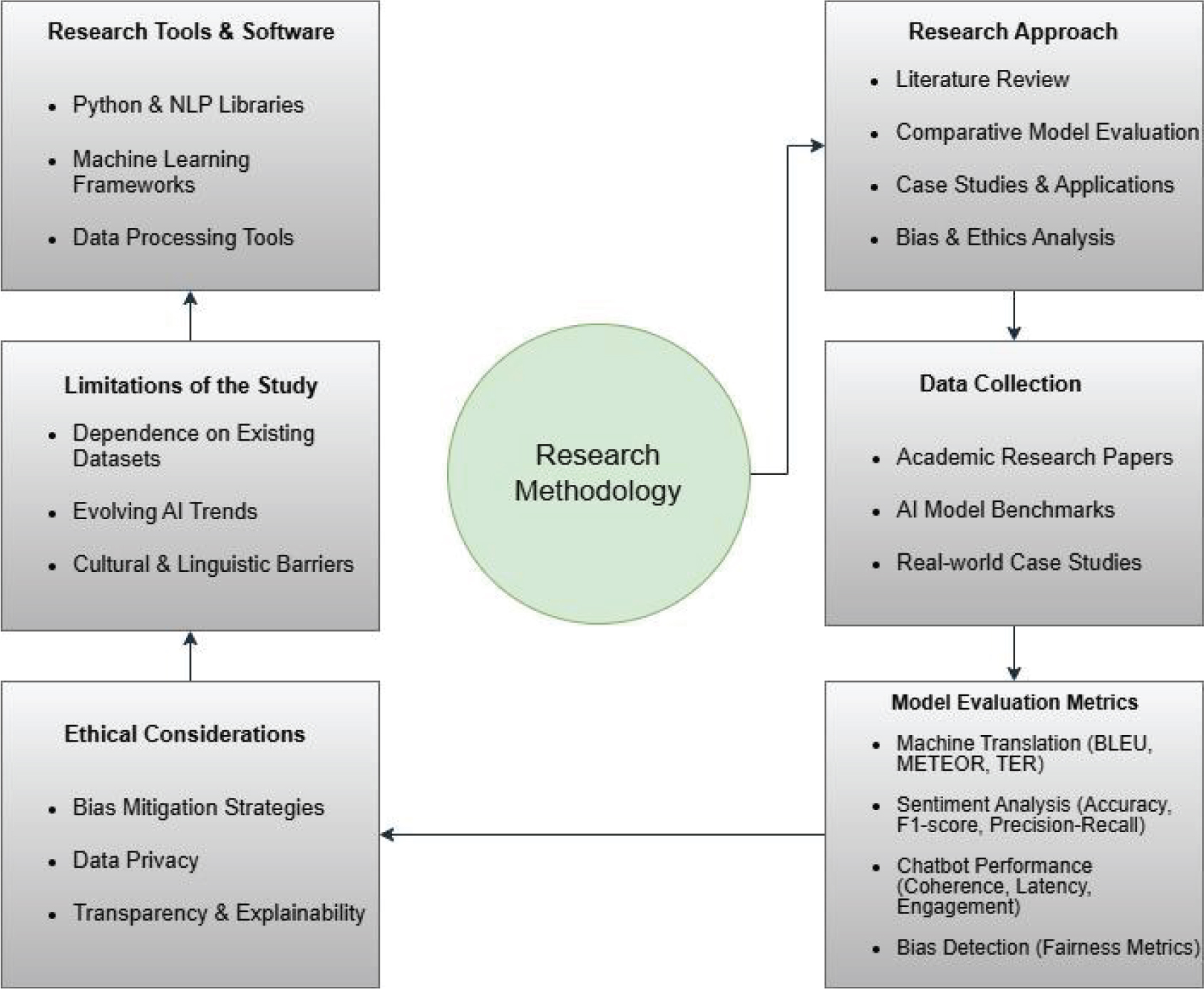
Figure 1.
Flowchart of the Methodology.
Table 1.
Comparison among the reviewed works
| # | Author name/years | Objective | Methodology | Key Findings | Context | Result |
|---|---|---|---|---|---|---|
| 1 | Khan & Mirza (2024) | Role of machine translation in overcoming linguistic barriers | Literature review and AI-based model analysis | AI-driven translation improves communication but faces accuracy and bias issues | Globalized communication, business, diplomacy | AI integration in translation enhances cross-cultural interactions |
| 2 | Al-Said (2024) | Advancements in NLP with a focus on digital language resources | Quantitative and qualitative analysis of linguistic datasets | High-quality datasets are crucial for NLP applications; bias and ethics must be addressed | Education, industry, global communication | Enhanced NLP models through better linguistic data infrastructure |
| 3 | Rifai et al. (2024) | Cross-cultural NLP focusing on Sundanese-Indonesian translation | Transformer-based Seq2Seq model with BLEU & ROUGE evaluation | High translation quality achieved; data scarcity remains a challenge | Underrepresented languages in NLP | Improved translation quality but needs more high-quality datasets |
| 4 | Al-Mansouri (2024) | Bias detection in NLP translation models | Review of bias mitigation techniques | Gender bias, cultural misinterpretation, and ethical dilemmas persist | AI fairness in translation | Adversarial learning & data augmentation reduce bias |
| 5 | Lawson-Body (2024) | Big data analytics & AI in developing countries | Examination of ethical concerns and infrastructure gaps | Developing nations struggle with AI implementation due to weak infrastructure | AI in socio-economic growth | Measurement tools for AI ethics proposed |
| 6 | Hautzenberger (2024) | Hostility in LLMs under adversarial prompts | Comparison of ChatGPT and Claude using a hostility index | ChatGPT shows higher hostility levels | AI safety in hostile environments | Continuous monitoring needed to prevent adversarial misuse |
| 7 | Bassi (2024) | Machine learning & NLP in persuasion detection | Linguistic vs argumentative models for persuasion | Hybrid AI-human approach needed for ethical detection | Online persuasion in digital communication | Social science integration improves ethical AI |
| 8 | Dharrao (2023) | NLP applications in spam classification | Bag of Words (BoW), TF-IDF, NaÖve Bayes model | High precision but recall issues for sophisticated spam | Cybersecurity and digital communication | Ongoing refinements needed for better spam detection |
| 9 | Chen (2024) | Impact of NLP on information retrieval | Comparative analysis of retrieval systems before and after NLP | NLP enhances query processing and user experience | Search engine and AI-driven retrieval | Significant improvements in precision & recall |
| 10 | Herat Joshi (2024) | AI-powered chatbots in project stakeholder engagement | Evaluation of efficiency & challenges in chatbot communication | Chatbots enhance engagement but face NLP limitations | AI in business communication | Potential risks if misaligned with expectations |
| 11 | Ibrahim Babatunde Mahmood (2014) | Biochar production from human manure | Pyrolysis process analysis | Optimized production at 500-600°C with moisture control | Sustainable waste management | Net energy output achieved |
| 12 | Ghazala Bilquise (2023) | AI-driven chatbots in academic advising | Adoption factors among students | Chatbots improve accessibility but require personalization | Higher education and AI | Challenges in intuitive user experience |
| 13 | Jack Krolik (2024) | LLMs for automating medical Q&A evaluation | Analysis of LLMs replicating human evaluators | LLMs reduce medical professionals’ workload | AI in healthcare | Accuracy maintained but complex queries remain challenging |
| 14 | Kaavya Rekanar (2024) | Optimizing Visual Question Answering (VQA) for autonomous driving | Comparison of human vs AI attention patterns | Filtering techniques improved object detection | AI in autonomous vehicles | Enhanced driving-related decision-making |
| 15 | Kevin R. McKee (2024) | Ethical concerns in AI research with human participants | Proposal of a transparency & consent framework | AI lacks standardized ethical guidelines | Human-AI research ethics | Ethical framework proposed |
| 16 | Khader I. Alkhouri (2024) | AI and the psychology of religion | Analysis of AI-driven religious applications | Concerns about authenticity and inclusivity | AI in religious experience | Need for ethical balance in digital rituals |
| 17 | Roumeliotis et al. (2024) | Effectiveness of LLMs in product review analysis | Evaluation of GPT-3.5 & LLaMA-2 | Improved review sentiment prediction | E-commerce AI applications | LLMs enhance customer feedback analysis |
| 18 | Shah et al. (2024) | NLP-based chatbots in education | Development of Lucy chatbot using BERT, RoBERTa | 85%+ accuracy in assisting students | AI in higher education | Reduced face-to-face inquiries |
| 19 | [William Harvey (2024) | NLP advancements in human communication | Sentiment analysis, translation, speech recognition | NLP makes digital interactions more natural | AI in communication industries | NLP enhances user accessibility |
| 20 | Yong Cao et al. (2024) | Cultural values in AI dialogue systems | Integration of Hofstede’s dimensions | Cultural sensitivity improved in AI dialogues | Cross-cultural AI interactions | Benchmark dataset cuDialog introduced |
| 21 | William Harvey (2024) | NLP advancements in human communication | Deep learning-based NLP analysis | NLP improves sentiment analysis, translation, and speech recognition | AI in various industries | Enhances machine comprehension and accessibility |
| 22 | Xinyu Fu (2024) | NLP in urban planning | Social media sentiment analysis, topic modeling | NLP aids policy tracking and decision-making | Urban planning research | Improved automated urban development analysis |
| 23 | Yong Cao et al. (2024) | Cultural values in AI dialogue systems | Integration of Hofstede’s cultural dimensions | Improved cultural sensitivity in AI dialogues | Cross-cultural AI interactions | Introduced cuDialog dataset |
| 24 | Yufei Tao (2024) | Human-AI interaction through role-play scenarios | ChatGPT Role-play Dataset (CRD) analysis | AI mimics human interaction but struggles with pragmatic nuances | Conversational AI | Need for better context adaptation |
| 25 | Ibrahim Mahmood Ibrahim (2020) | Big data mining in cloud systems | Integration of cloud computing with data mining | Optimized large-scale data processing | Cloud-based data mining | Scalable and efficient solutions proposed |
| 26 | Zhaoxing Li (2024) | Collaborative Reinforcement Learning (CRL) systems | Taxonomy and framework design | Structured approach to optimizing CRL models | Human-AI cooperation | Human-AI CRL Design Trajectory Map introduced |
| 27 | Ahmed M. Asfahani (2023) | Data integration in talent management | Analysis of AI-driven HR strategies | AI improves decision-making in HR | Talent management | Semantic web technologies proposed for HR data |
| 28 | Altaf Fakih (2024) | Accuracy of Instagram’s NMT for literary texts | Multidimensional Quality Metrics (MQM)-based analysis | 90% of translations fail to convey meaning | AI in literary translation | Calls for better linguistic architecture |
| 29 | C. V. Suresh Babu (2024) | Generative AI in NLP | Comparison of ChatGPT and other models | AI improves customer service, education, content creation | Conversational AI | Refinements needed for domain-specific applications |
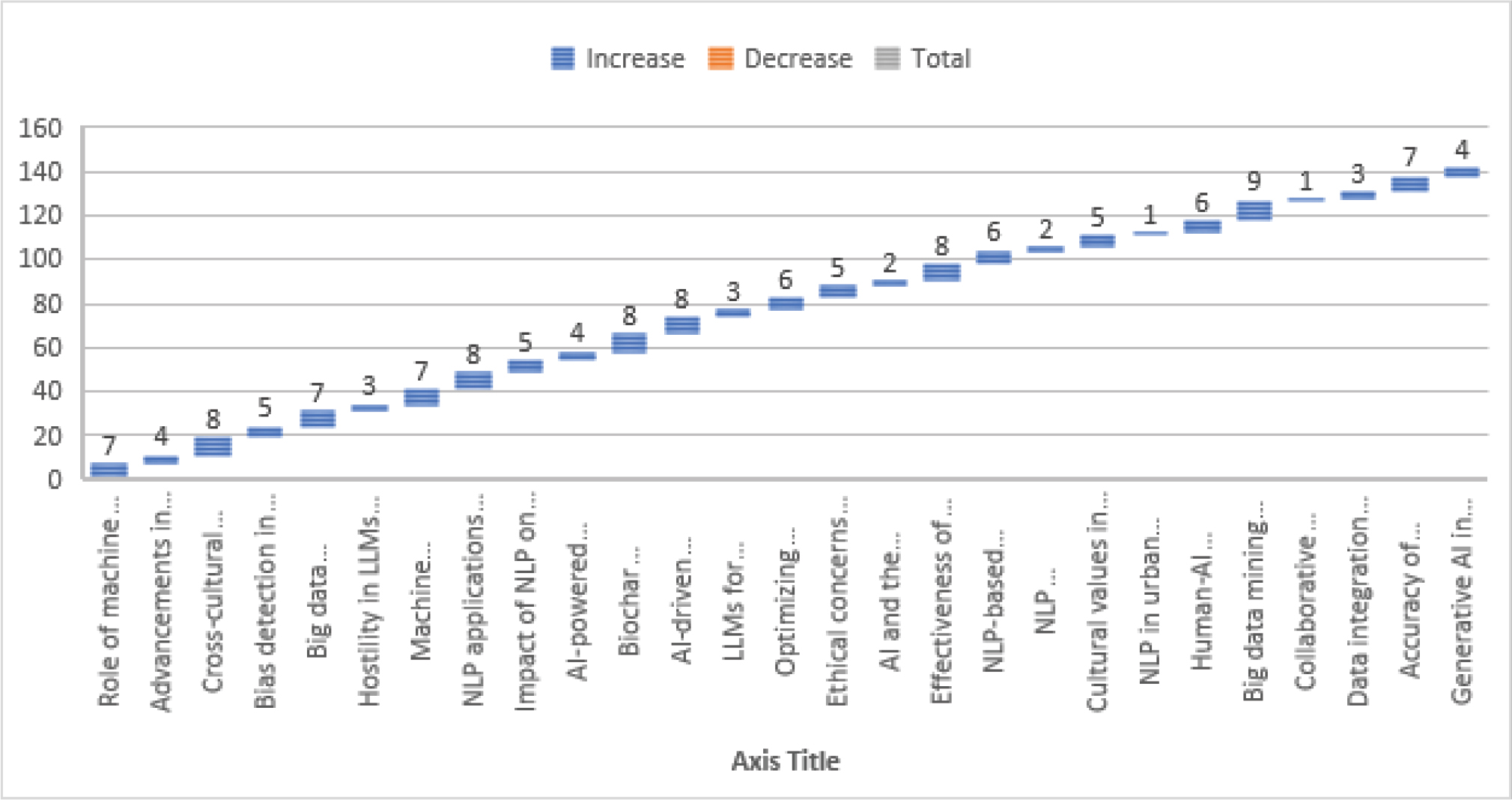
Figure 2.
Frequency for Objective.
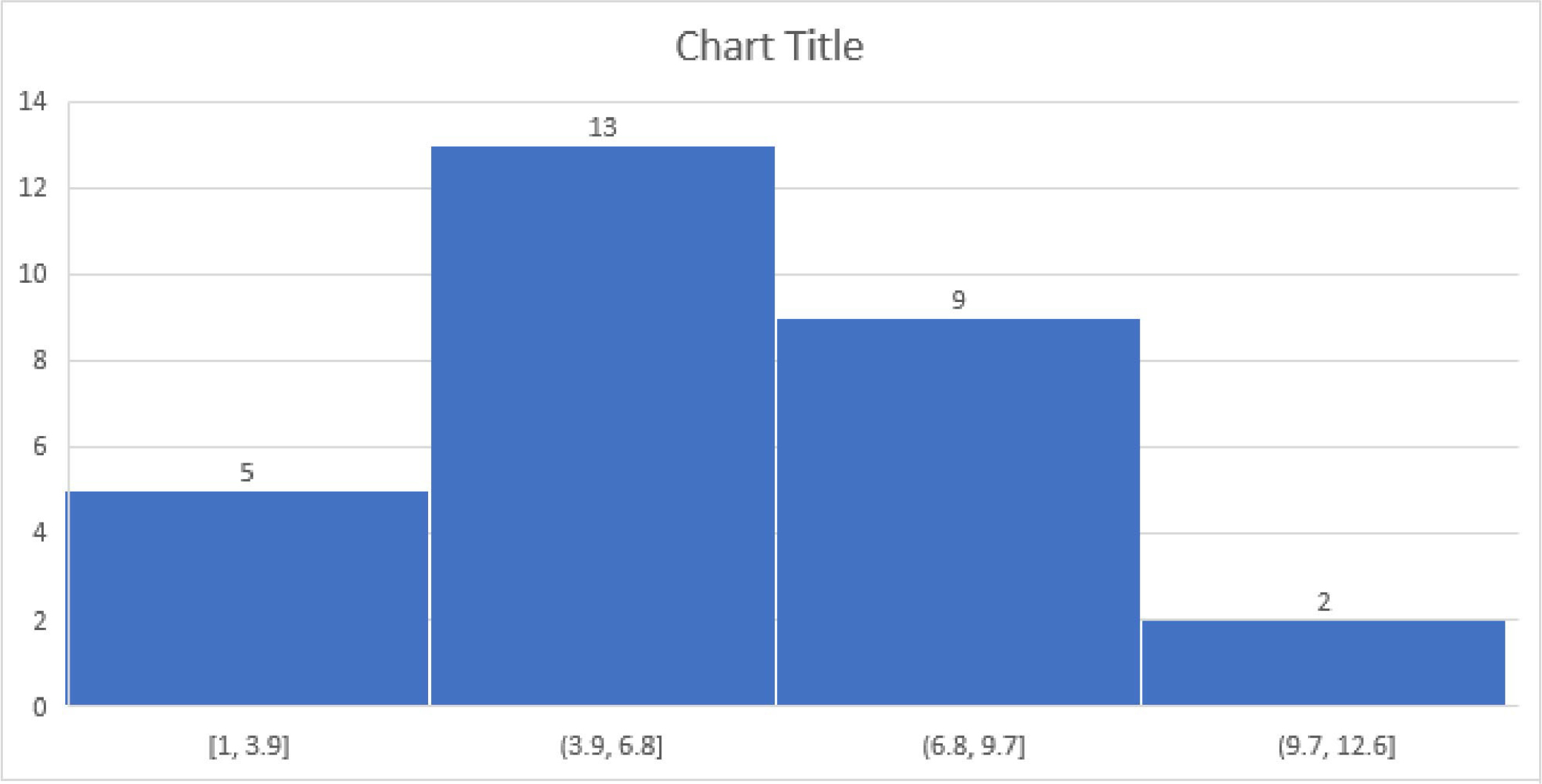
Figure 3.
Frequency for Methodology.
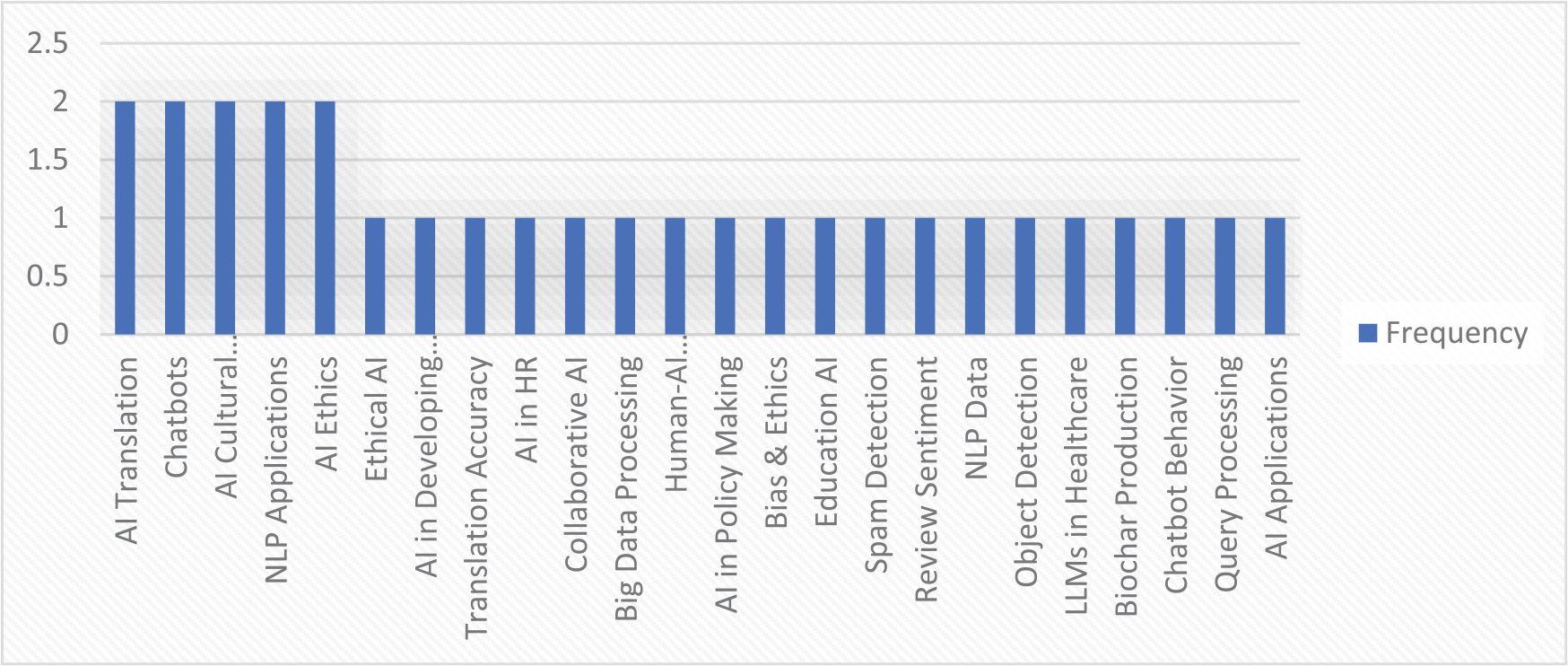
Figure 4.
Frequency for Key Findings.
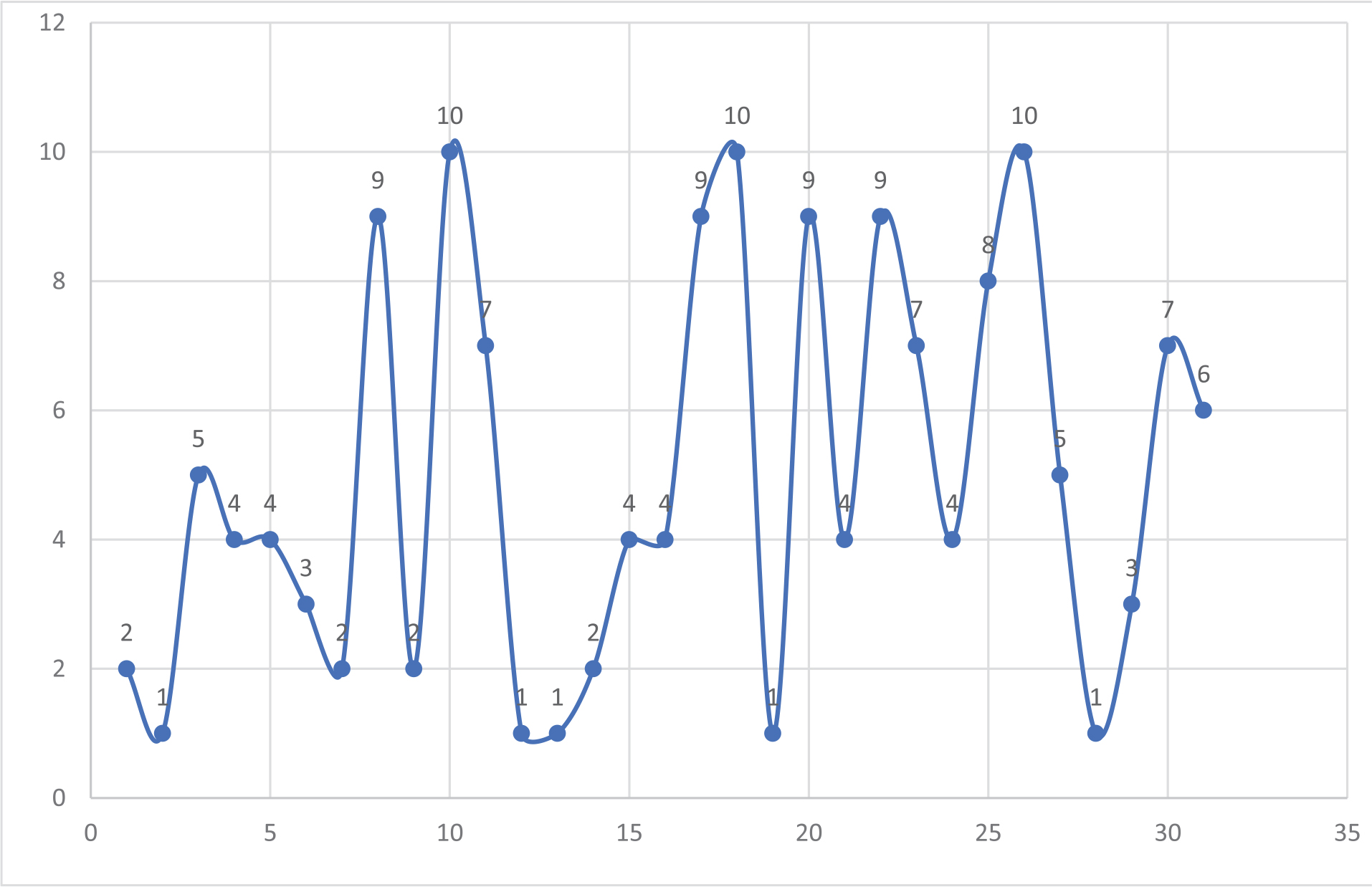
Figure 5.
Frequency for Context.