
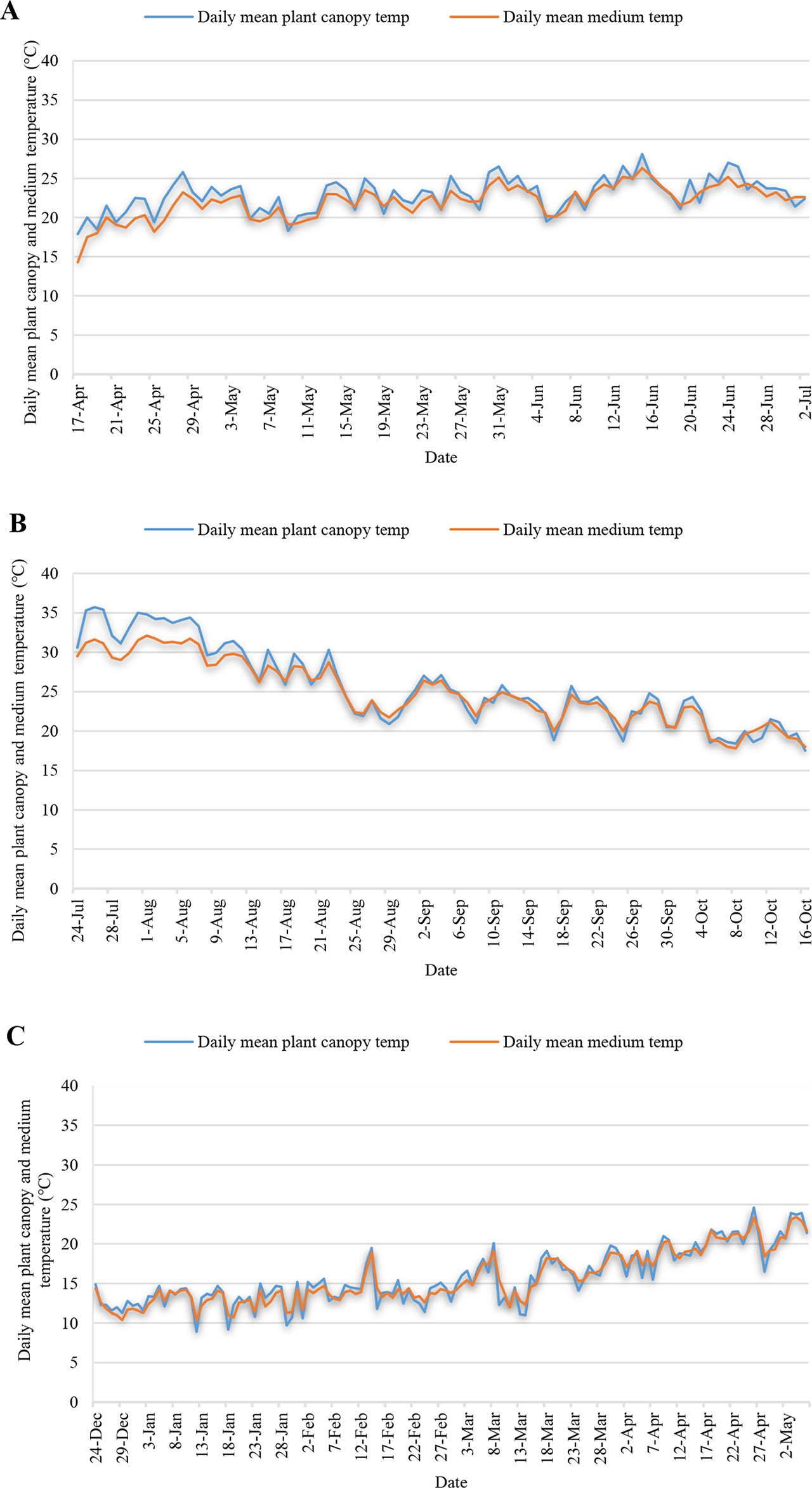
Figure 1.
Daily mean temperatures of plant canopy and medium during the spring (A), summer (B), and winter (C) production tomato cycles
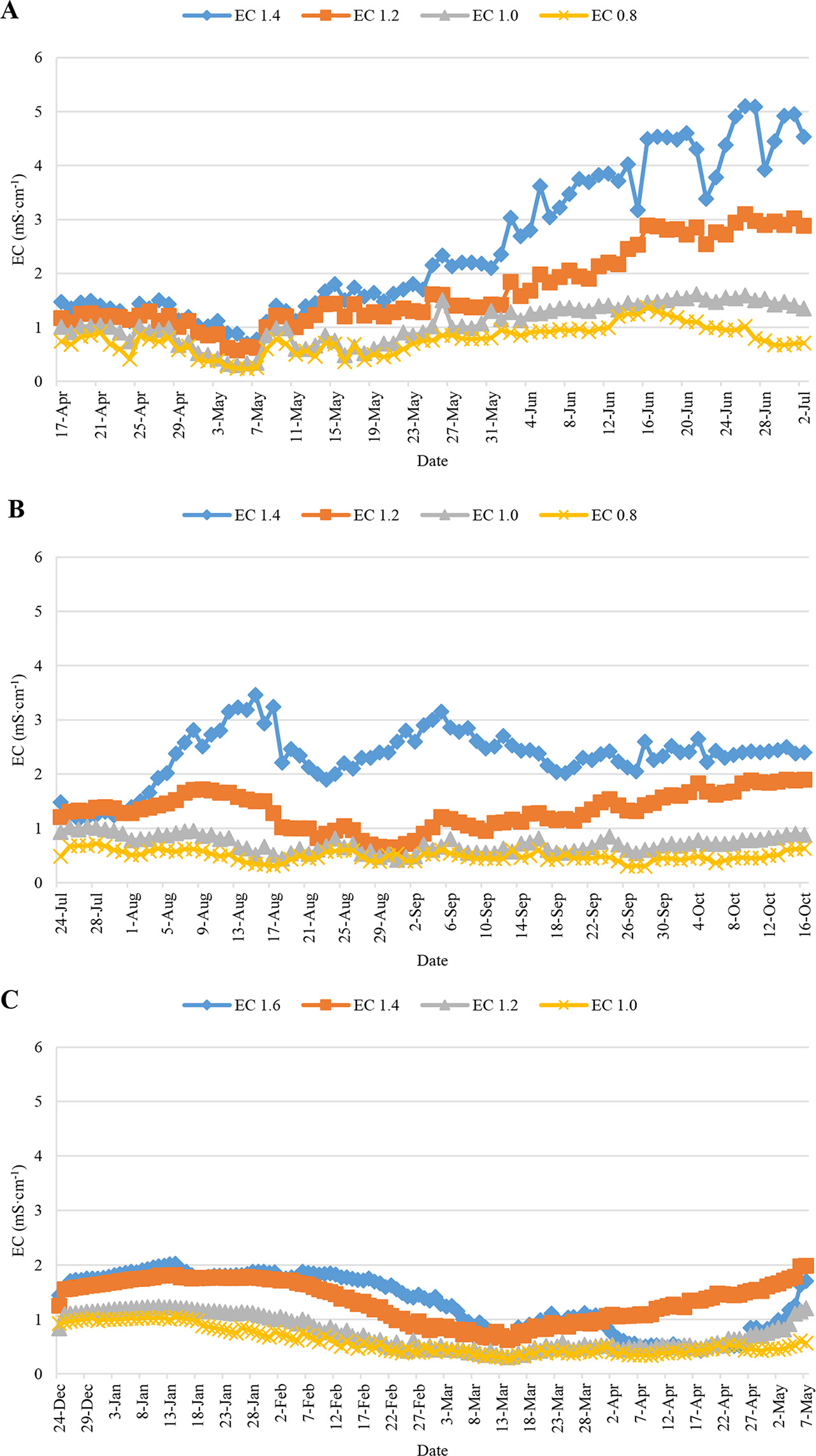
Figure 2.
The time course of nutrient solution concentrations expressed as EC in the spring (A), summer (B), and winter (C) production cycles
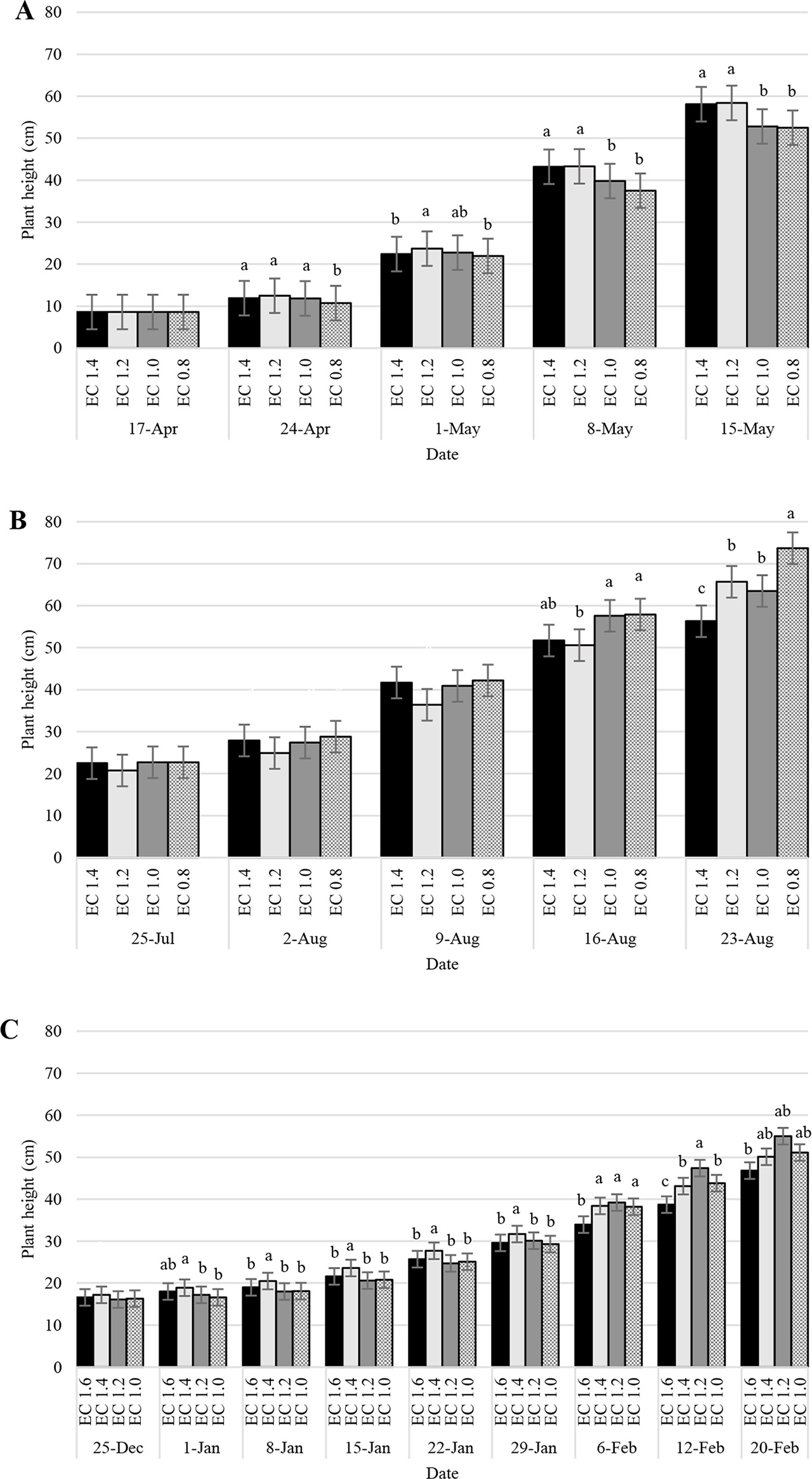
Figure 3.
Effect of nutrient solution concentration expressed as EC on plant height during the spring (A), summer (B), and winter (C) production cycles
The same letters indicate nonsignificant differences as determined by multiple comparisons using the Tukey's HSD test. n = 10, p = 0.05. Vertical bars on each data point represent the standard error
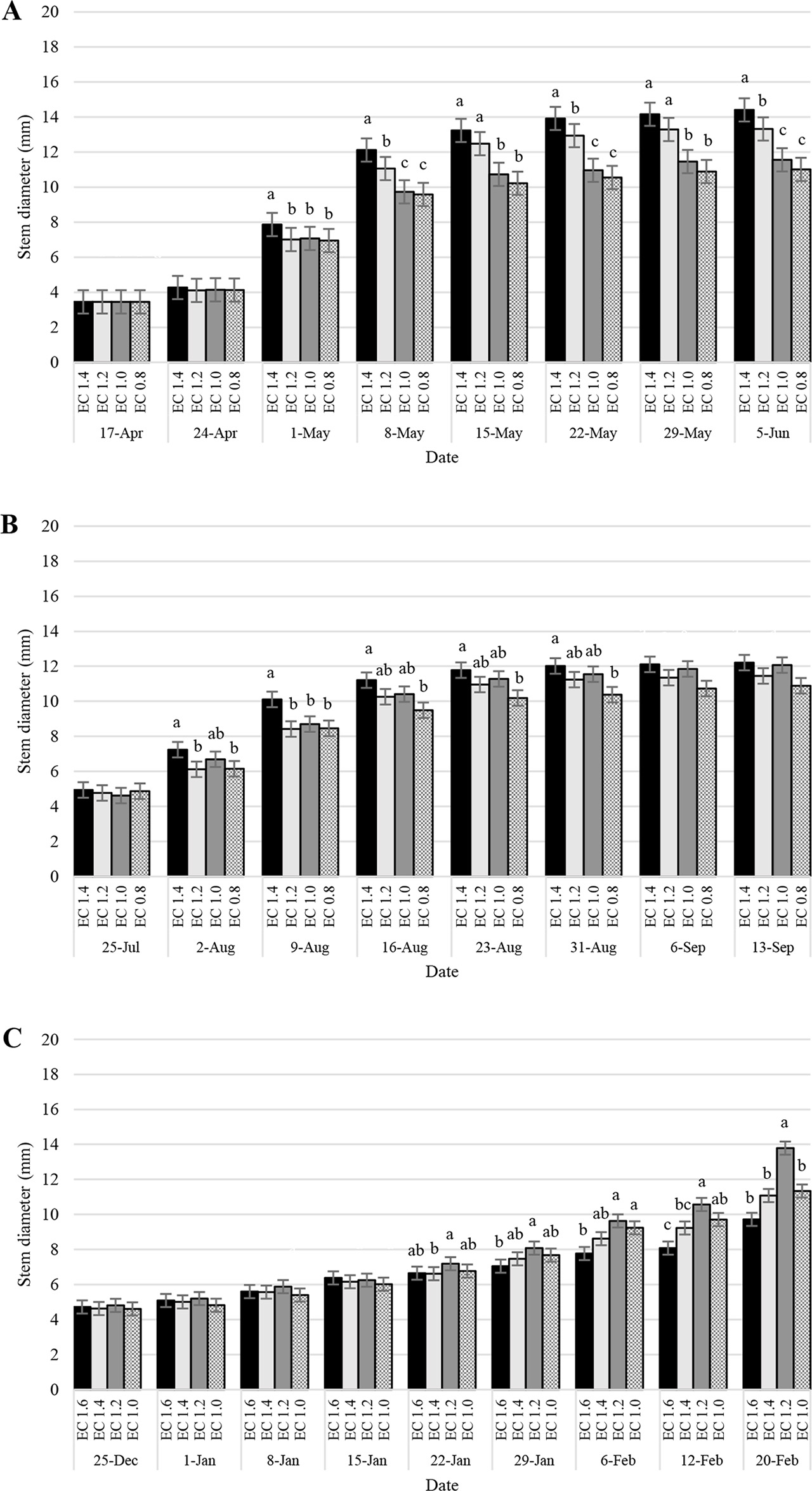
Figure 4.
Effect of nutrient solution concentration expressed as EC on stem diameter during the spring (A), summer (B), and winter (C) production cycles
The same letters indicate nonsignificant differences as determined by multiple comparisons using the Tukey's HSD test. n = 10, p = 0.05. Vertical bars on each data point represent the standard error
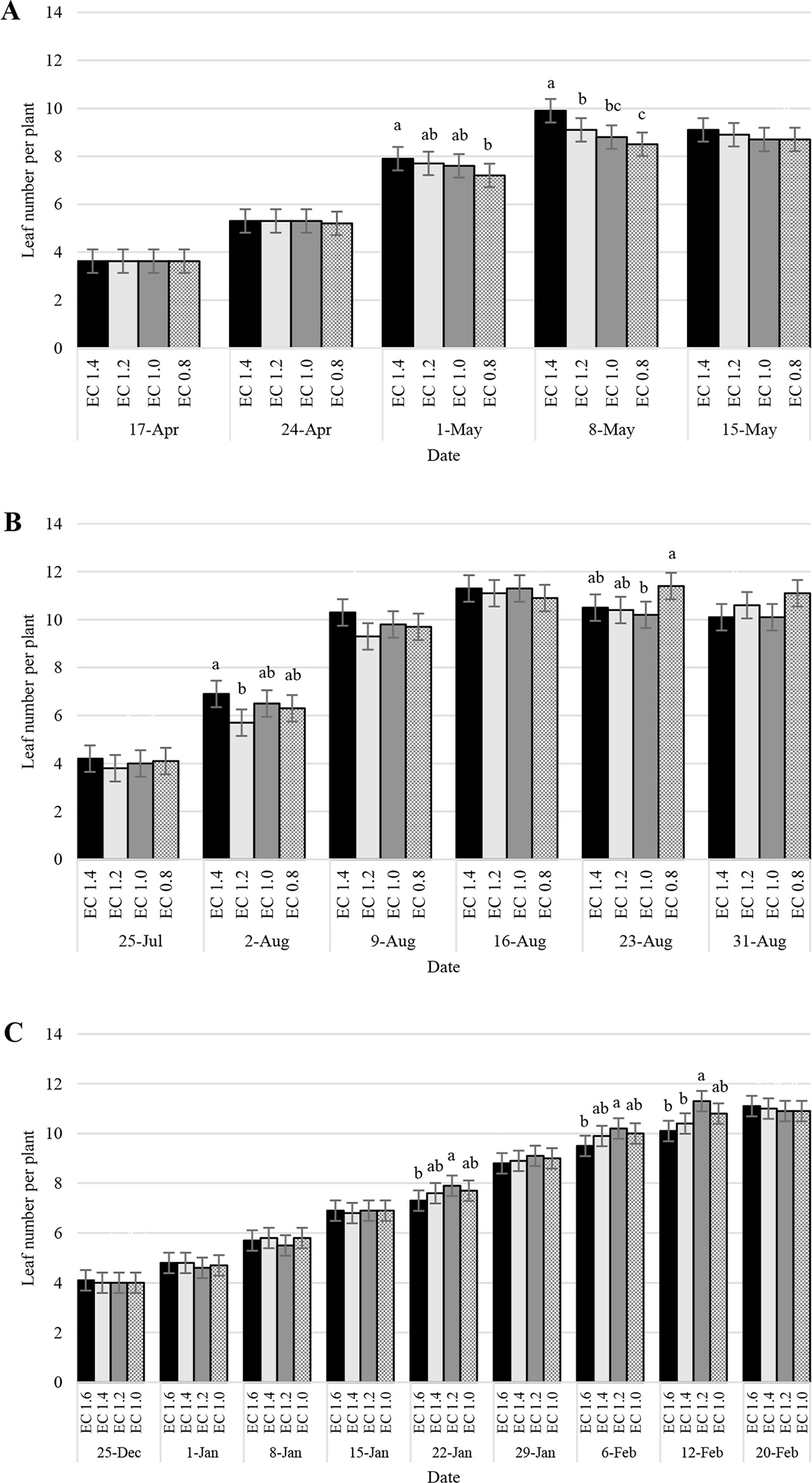
Figure 5.
Effect of nutrient solution concentration expressed as EC on the leaf number per plant during the spring (A), summer (B), and winter (C) production cycles
The same letters indicate nonsignificant differences as determined by multiple comparisons using the Tukey's HSD test. n = 10, p = 0.05. Vertical bars on each represent the standard error
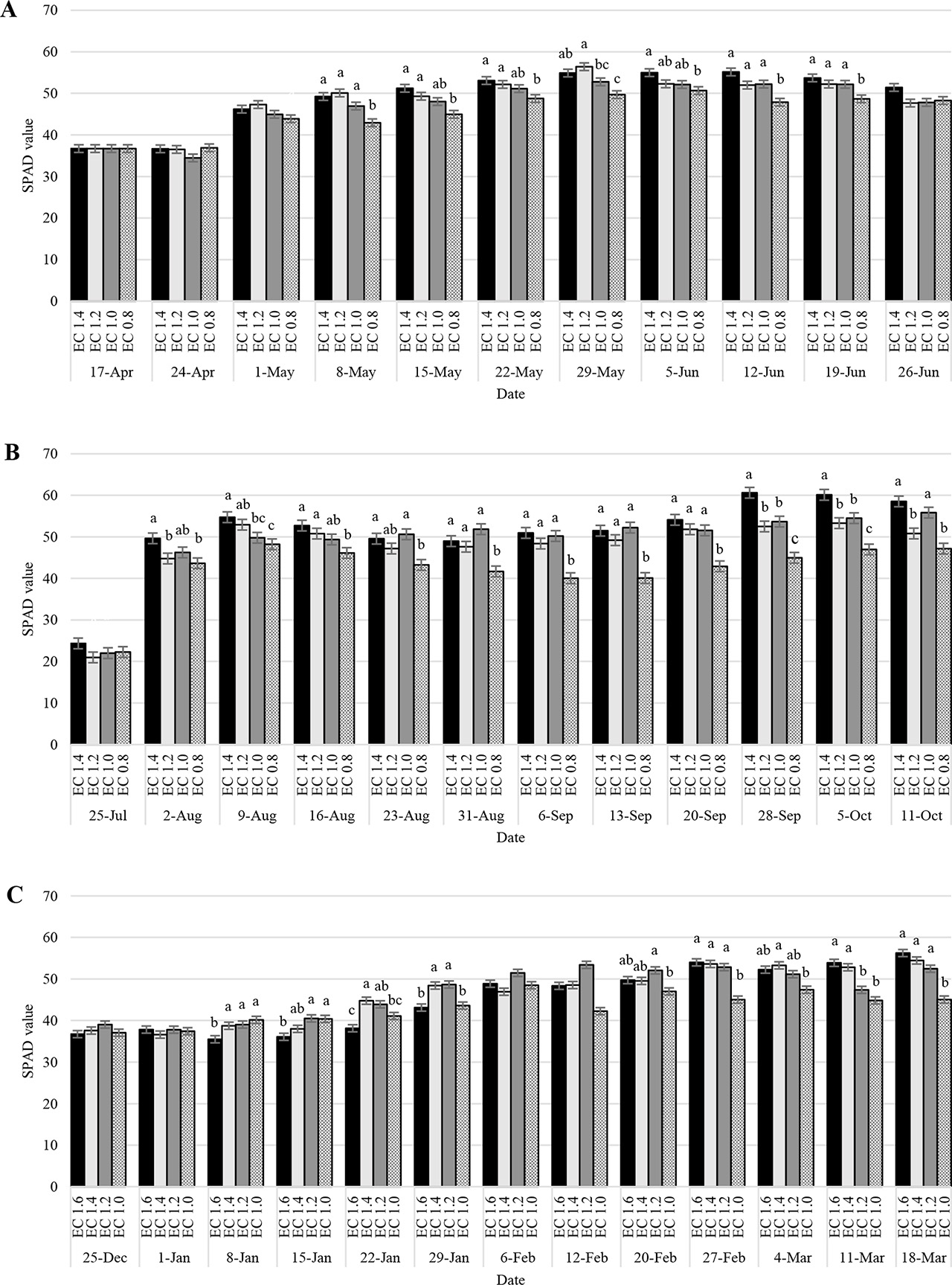
Figure 6.
Effect of nutrient solution concentration expressed as EC on intensity of leaf color during the spring (A), summer (B), and winter (C) production cycles
The same letters indicate nonsignificant differences as determined by multiple comparisons using the Tukey's HSD test. n = 10, p = 0.05. Vertical bars on each data point represent the standard error
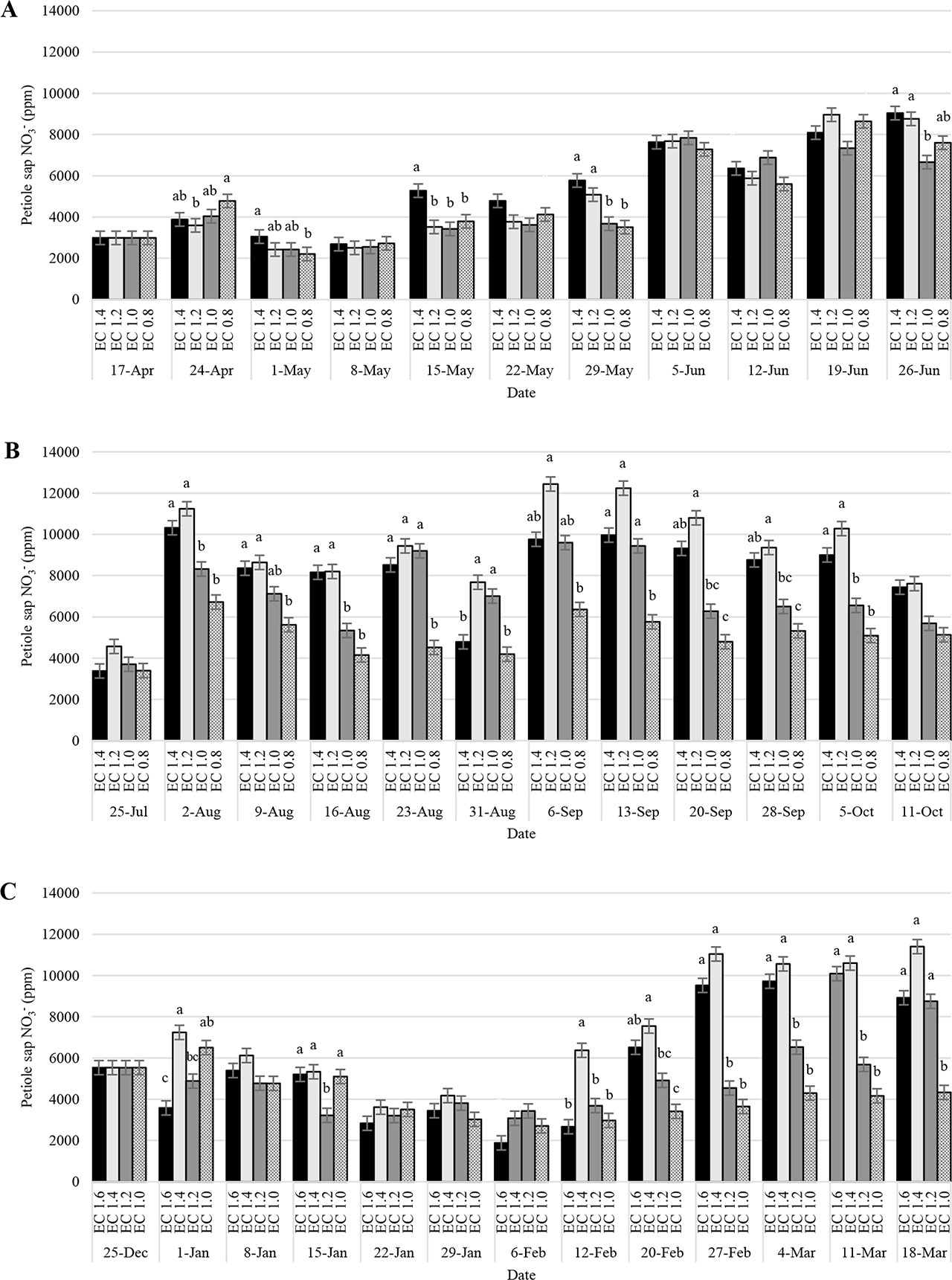
Figure 7.
Effect of nutrient solution concentration expressed as EC on nitrate concentration in petiole sap during the spring (A), summer (B), and winter (C) production cycles
The same letters indicate nonsignificant differences as determined by multiple comparisons using the Tukey's HSD test. n = 10, p = 0.05. Vertical bars on each data point represent the standard error
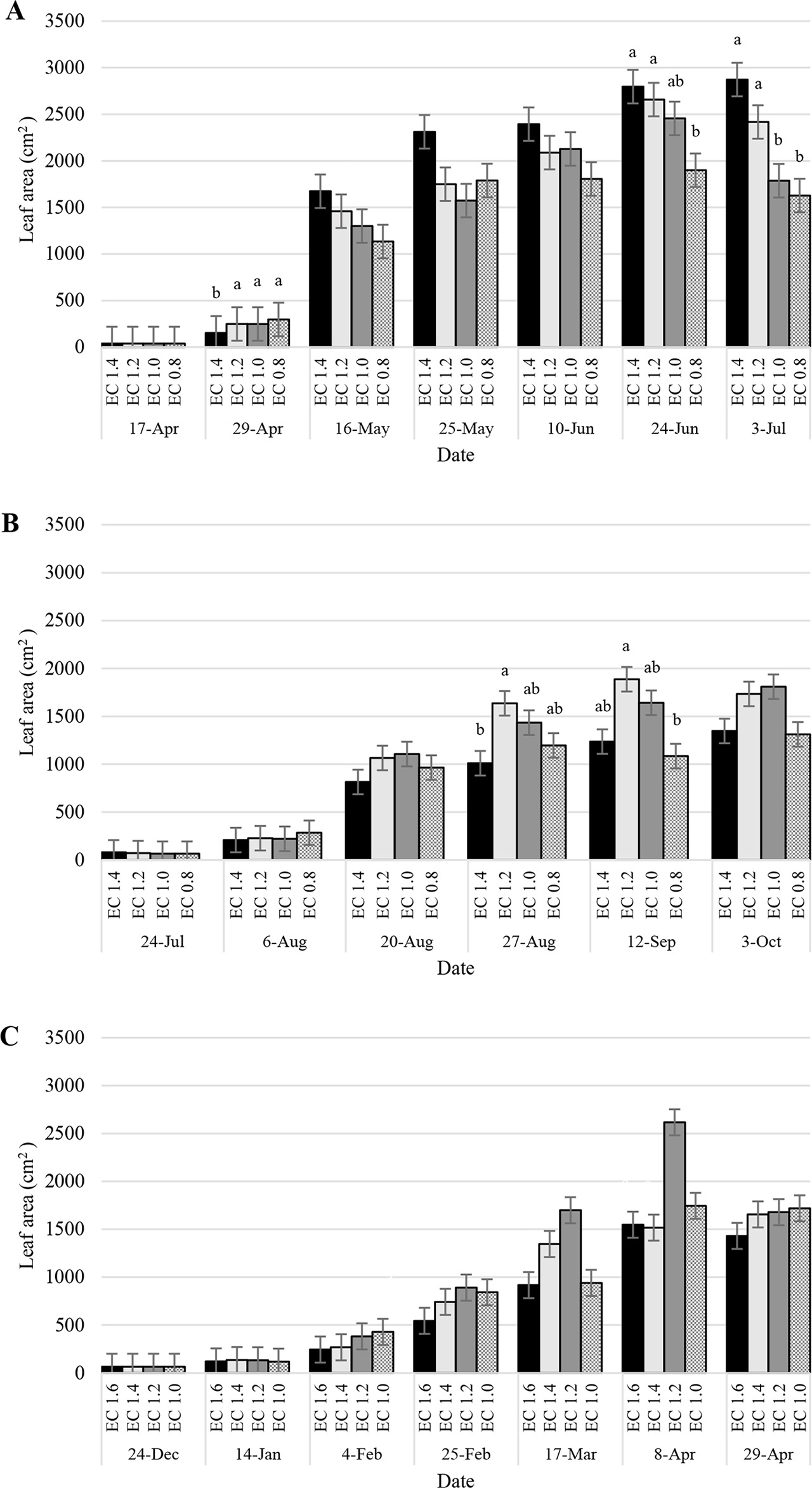
Figure 8.
Effect of nutrient solution concentration expressed as EC on leaf area during the spring (A), summer (B), and winter (C) production cycles
The same letters indicate nonsignificant differences as determined by multiple comparisons using the Tukey's HSD test. n = 4, p = 0.05. Vertical bars on each data point represent the standard error
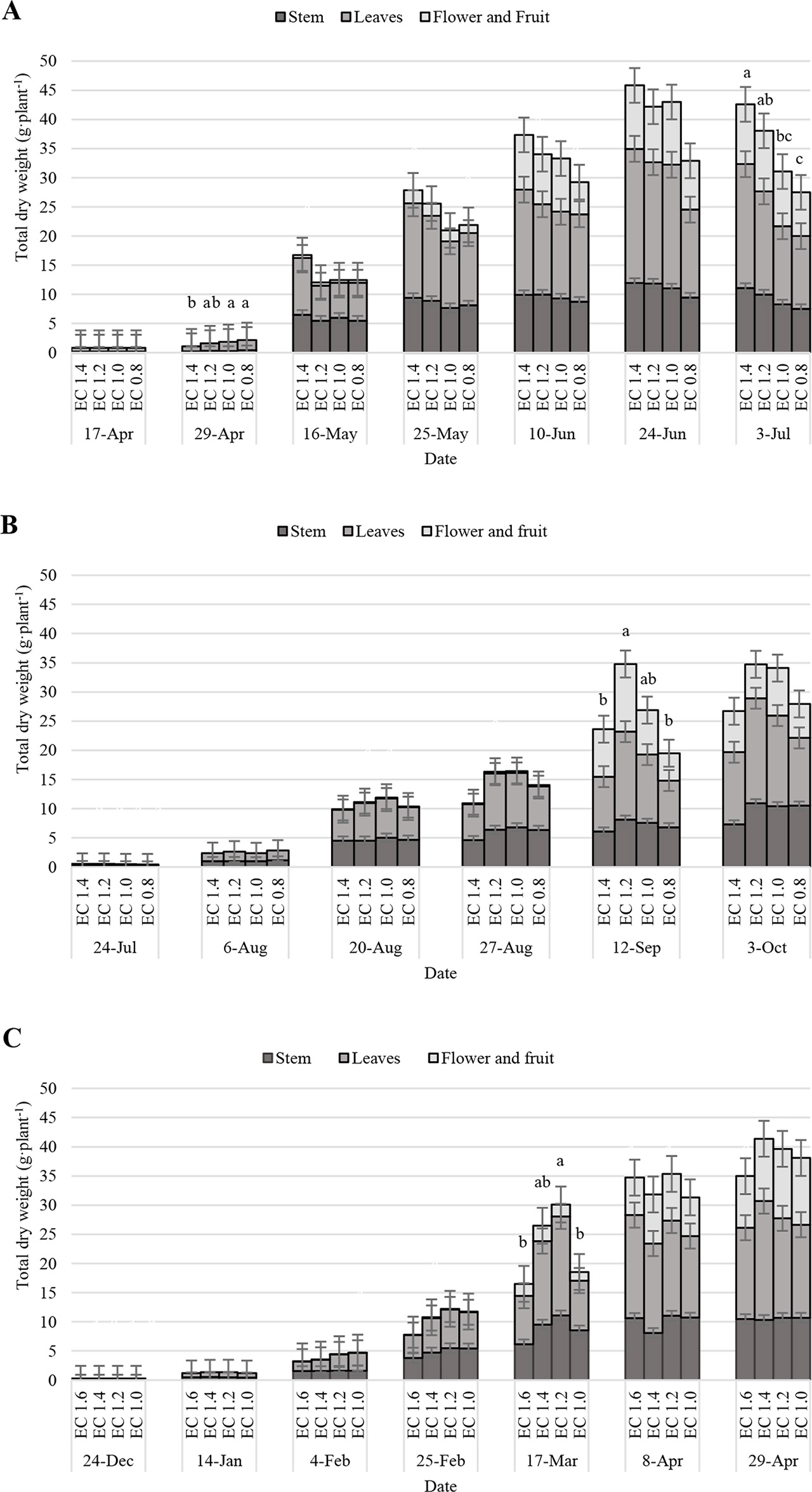
Figure 9.
Effect of nutrient solution concentration expressed as EC on the dry weight of whole plant (stem + leaves + flowers and fruit) during the spring (A), summer (B), and winter (C) production cycles
The same letters indicate nonsignificant differences as determined by multiple comparisons using the Tukey's HSD test. n = 4, p = 0.05. Vertical bars on each data point represent the standard error
Table 1.
Effect of nutrient solution concentration expressed as EC on yield of marketable tomato fruit and their appearance in the spring, summer, and winter production cycles
| Production cycle | Treatment | Fine fruit (number per plant) | Fine fruit (g per plant) | Mean fruit weight (g) | Cracked fruit (number per plant) |
|---|---|---|---|---|---|
| Spring | EC 1.4 | 3.8 ± 0.06 | 723.8 ± 4.0 a | 186 ± 3.7 a | 0.07 ± 0.01 |
| EC 1.2 | 3.7 ± 0.07 | 706.7 ± 11.2 a | 191 ± 4.7 a | 0.04 ± 0.01 | |
| EC 1.0 | 3.7 ± 0.07 | 625.8 ± 20.8 b | 172 ± 6.51ab | 0.08 ± 0.02 | |
| EC 0.8 | 3.8 ± 0.08 | 573.1 ± 20.5 b | 150 ± 7.3 b | 0.06 ± 0.01 | |
| Summer | EC 1.4 | 0.5 ± 0.11 b | 62.8 ± 18 b | 118.4 ± 9.9 | 0.06 ± 0.01 b |
| EC 1.2 | 1.2 ± 0.11 a | 173.7 ± 22 a | 141.1 ± 7.5 | 0.13 ± 0.03 ab | |
| EC 1.0 | 1.1 ± 0.15 a | 155.0 ± 15.8 a | 132.9 ± 8.2 | 0.19 ± 0.04 a | |
| EC 0.8 | 0.6 ± 0.09 b | 68.3 ± 8.2 b | 115.8 ± 8.9 | 0.1 ± 0.01 ab | |
| Winter | EC 1.6 | 2.1 ± 0.04 | 220.6 ± 0.21d | 104.4 ± 2.1b | 0.7 ± 0.09 |
| EC 1.4 | 2.2 ± 0.08 | 270.1 ± 0.41a | 119.7 ± 4.9a | 0.6 ± 0.09 | |
| EC 1.2 | 2.2 ± 0.04 | 267.0 ± 0.40b | 121.3 ± 2.3a | 0.9 ± 0.09 | |
| EC 1.0 | 2.3 ± 0.04 | 259.0 ± 0.40c | 113.1 ± 1.9ab | 0.7 ± 0.09 |
[i] Same letters in a column within each production cycle indicate nonsignificant differences based on the multiple comparisons of the Tukey's HSD test (p < 0.05)
Table 2.
Effect of nutrient solution concentrations expressed as EC on soluble solid concentration and acidity of tomato fruit in the spring, summer, and winter production cycles
| Production cycle | Treatment | SSC (%) | Acidity (%) | SSC to acidity ratio |
|---|---|---|---|---|
| Spring | EC 1.4 | 5.4 ± 0.12 a | 0.75 ± 0.02 | 7.4 ± 0.4 |
| EC 1.2 | 4.8 ± 0.15b | 0.75 ± 0.02 | 6.5 ± 0.3 | |
| EC 1.0 | 4.7 ± 0.13b | 0.69 ± 0.01 | 6.8 ± 0.3 | |
| EC 0.8 | 4.7 ± 0.18b | 0.66 ± 0.03 | 7.4 ± 0.4 | |
| Summer | EC 1.4 | 5.4 ± 0.08 a | 0.95 ± 0.04 a | 5.8 ± 0.3 b |
| EC 1.2 | 4.9 ± 0.15 b | 0.69 ± 0.02 b | 7.2 ± 0.2 a | |
| EC 1.0 | 4.8 ± 0.13 b | 0.73 ± 0.03 b | 6.7 ± 0.2 ab | |
| EC 0.8 | 4.7 ± 0.11 b | 0.71 ± 0.03 b | 6.8 ± 0.3 ab | |
| Winter | EC 1.6 | 6.1 ± 0.13 | 0.78 ± 0.04 | 9.3 ± 1.9 |
| EC 1.4 | 5.7 ± 0.15 | 0.71 ± 0.03 | 8.1 ± 0.2 | |
| EC 1.2 | 5.9 ± 0.17 | 0.74 ± 0.04 | 8.1 ± 0.3 | |
| EC 1.0 | 6.1 ± 0.06 | 0.71 ± 0.03 | 8.9 ± 0.5 |
[i] Same letters in a column within each production cycle indicate nonsignificant differences based on the multiple comparisons of the Tukey's HSD test (p < 0.05)
Table 3.
Daily uptake of macronutrients by tomato plants during the spring, summer, and winter production cycles
| Treatment | N (mg per plant) | P2O5 (mg per plant) | K2O (mg per plant) | MgO (mg per plant) | CaO (mg per plant) |
|---|---|---|---|---|---|
| EC 1.4 | 26.22 ± 3.30a | 12.90 ± 1.69a | 56.05 ± 7.34a | 10.12 ± 1.32a | 27.64 ± 3.62a |
| EC 1.2 | 18.10 ± 2.43ab | 8.74 ± 1.20ab | 37.96 ± 5.21ab | 6.85 ± 0.94ab | 18.72 ± 2.57ab |
| EC 1.0 | 13.84 ± 1.68b | 6.73 ± 0.78b | 29.24 ± 3.39b | 5.27 ± 0.61b | 14.41 ± 1.67b |
| EC 0.8 | 9.39 ± 1.14b | 4.50 ± 0.54b | 19.58 ± 2.34b | 3.53 ± 0.42b | 9.65 ± 1.15b |
| EC 1.4 | 14.51 ± 2.17a | 6.77 ± 0.89a | 29.44 ± 3.87a | 5.31 ± 0.70a | 14.52 ± 1.91a |
| EC 1.2 | 19.06 ± 1.62a | 9.08 ± 0.74a | 39.47 ± 3.24a | 7.12 ± 0.58a | 19.46 ± 1.59a |
| EC 1.0 | 13.92 ± 0.94ab | 6.74 ± 0.54a | 29.28 ± 2.38a | 5.28 ± 0.43a | 14.44 ± 1.17a |
| EC 0.8 | 8.46 ± 0.57b | 4.09 ± 0.29b | 17.79 ± 1.27b | 3.21 ± 0.23b | 8.77 ± 0.62b |
| EC 1.6 | 10.10 ± 3.17 | 3.52 ± 0.87 | 14.05 ± 3.49 | 2.98 ± 0.74 | 8.14 ± 2.02 |
| EC 1.4 | 15.00 ± 3.26 | 5.63 ± 1.16 | 22.47 ± 4.63 | 4.76 ± 0.98 | 13.02 ± 2.68 |
| EC 1.2 | 13.80 ± 3.42 | 5.31 ± 1.22 | 21.18 ± 4.86 | 4.49 ± 1.03 | 12.27 ± 2.81 |
| EC 1.0 | 10.01 ± 2.48 | 3.96 ± 0.97 | 15.80 ± 3.89 | 3.35 ± 0.82 | 9.15 ± 2.25 |
[i] Same letters in a column within each production cycle indicate nonsignificant differences based on the multiple comparisons of the Tukey's HSD test (p < 0.05)