
Table 1
The effect of growing substrate composition on yield components of green lettuce
| Treatments | Total fresh weight of plant (g per plant) | Total dry weight of plant (g per plant) | Fresh weight of marketable yield (g per plant) | Fresh weight of roots (g per plant) | Dry weight of roots (g per plant) |
|---|---|---|---|---|---|
| M1V1 | 40.71 d | 3.81 b | 36.64 e | 4.06 b | 0.37 ab |
| M1V2 | 41.46 d | 3.86 b | 37.21 e | 4.25 b | 0.38 ab |
| M1V3 | 49.99 c | 4.76 ab | 44.75 d | 5.23 ab | 0.47 ab |
| M1V4 | 51.69 c | 4.68 b | 47.90 cd | 3.79 b | 0.30 b |
| M1V5 | 54.77 bc | 4.76 ab | 50.99 cd | 3.78 b | 0.35 b |
| M2V1 | 60.15 ab | 5.03 ab | 53.92 bc | 6.24 a | 0.58 a |
| M2V2 | 61.04 ab | 5.62 ab | 54.73 abc | 4.97 ab | 0.44 ab |
| M2V3 | 62.33 ab | 6.11 ab | 56.28 ab | 4.70 ab | 0.45 ab |
| M2V4 | 66.06 a | 6.38 ab | 61.62 a | 4.44 b | 0.53 a |
| M2V5 | 59.85 ab | 7.18 a | 54.62 abc | 3.84 b | 0.45 ab |
| HSD 5% | 8.084 | 2.47 | 7.46 | 1.54 | 0.22 |
| M1 | 47.72 b | 4.37 b | 43.46 b | 4.22 b | 0.37 b |
| M2 | 61.89 a | 6.06 a | 56.23 a | 4.84 a | 0.49 a |
| HSD 5% | 4.65 | 1.43 | 5.32 | 0.54 | 0.06 |
[i] Note: M1 – growing media: 55% cocopeat, 15% rice husk biochar, and 30% sand, and M2 – growing media: 55% cocopeat, 30% rice husk biochar, and 15% sand, V1–V5 – vermicompost rates of 50, 100, 150, 200, and 250 g per pot. Means followed by different letters in the same column are statistically significantly different at Tukey test, p = 0.05
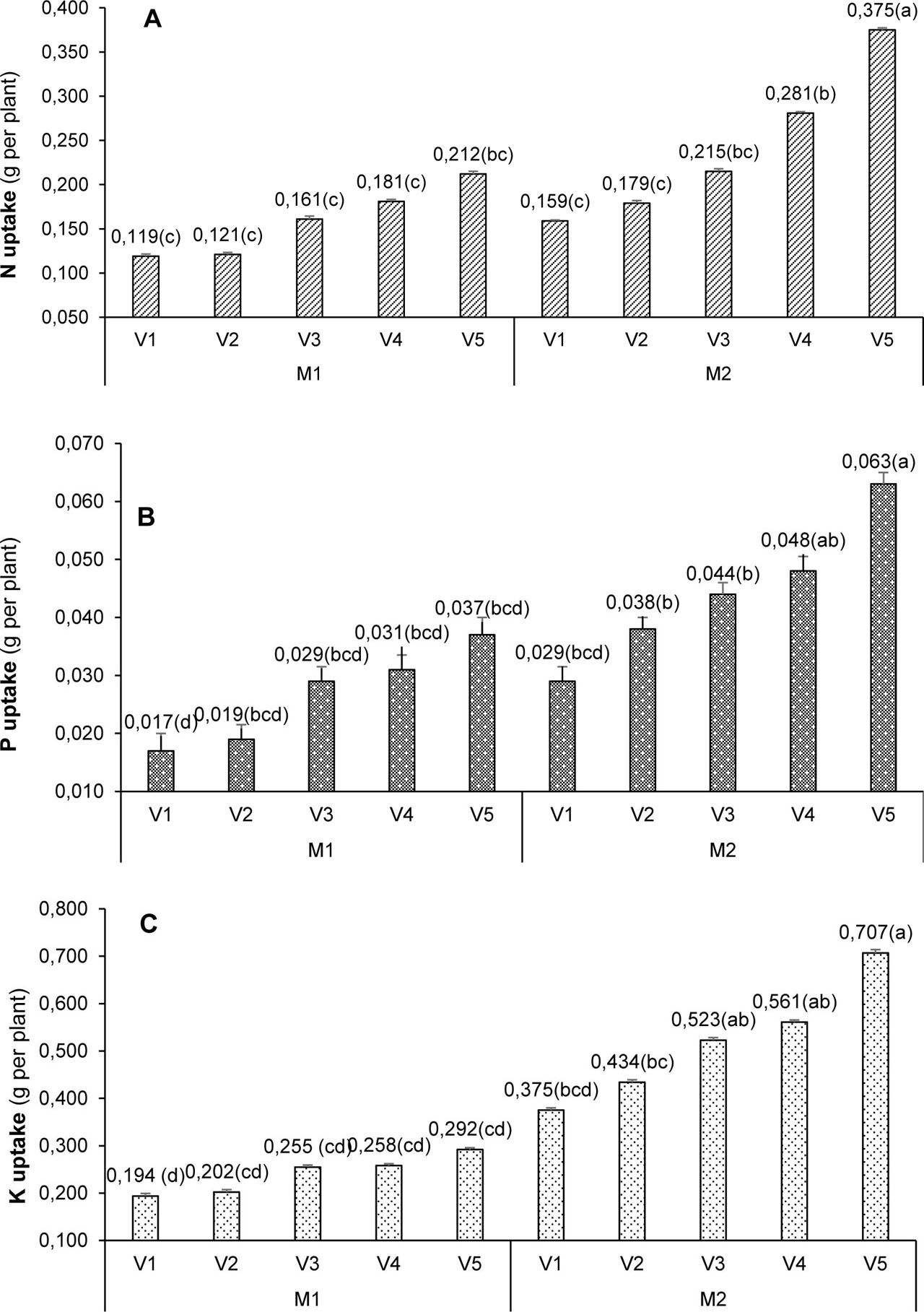
Figure 1
Nutrient uptake (a) N, (b) P, and (c) K in green lettuce leaves at different compositions of the planting substrate M1 – growing substrate: 55% cocopeat, 15% rice husk biochar, and 30% sand, M2 – growing substrate: 55% cocopeat, 30% rice husk biochar, and 15% sand, V1–V5 – vermicompost amounts: 50, 100, 150, 200, and 250 g per pot. The means accompanied by the same letter show no significant difference in the Tukey test 5%
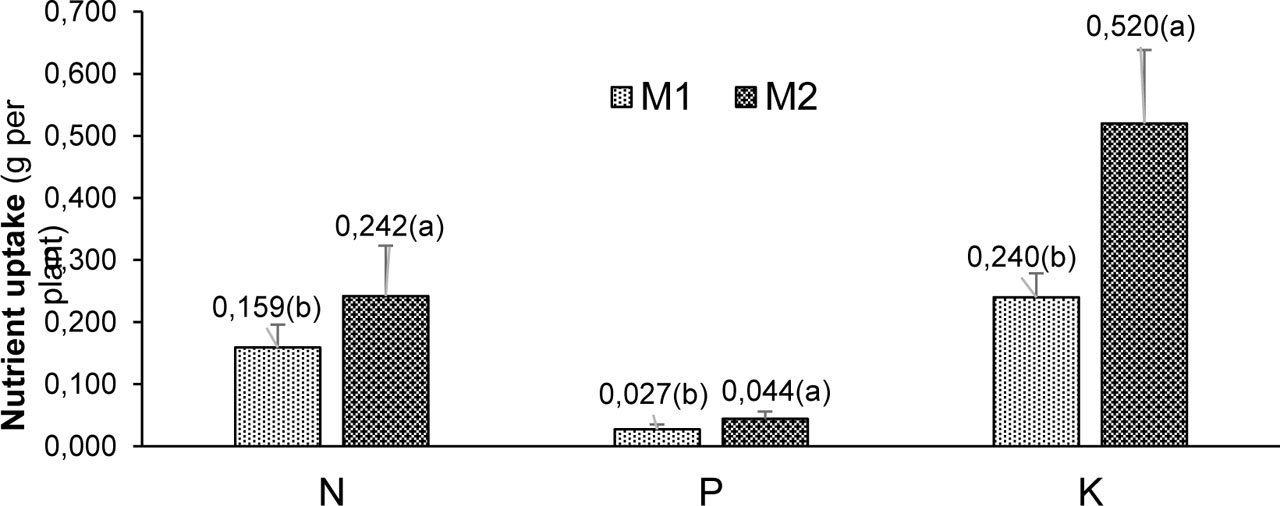
Figure 2
Comparison of the N, P, and K uptake in green lettuce plants grown in substrates containing different proportions of rice husk biochar 15% (M1) and 30% (M2)
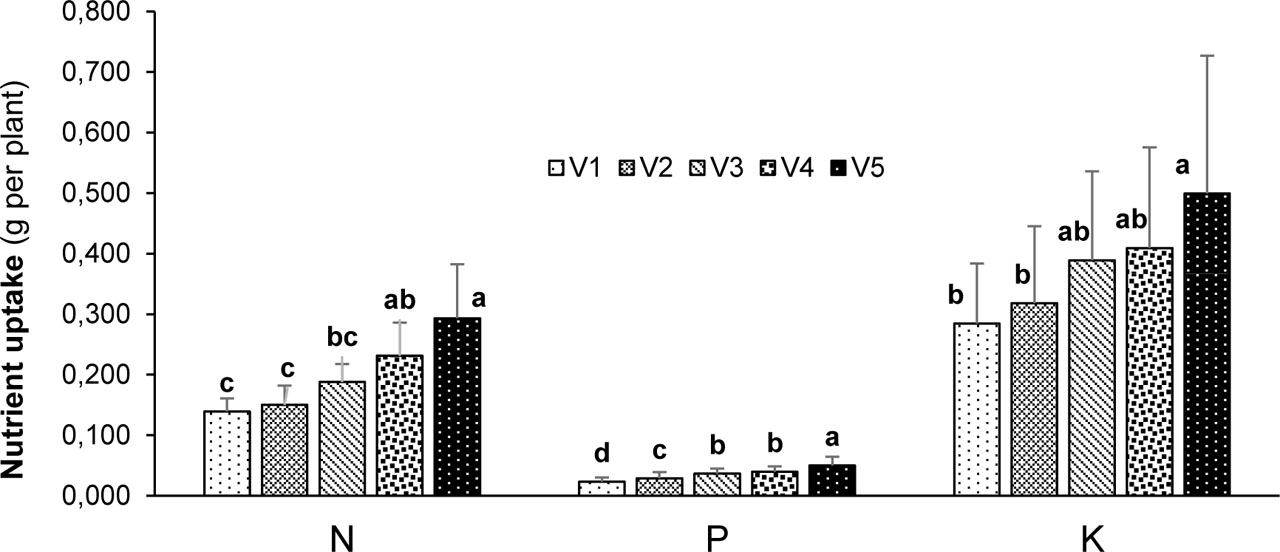
Figure 3
Comparison of the N, P, and K uptake in green lettuce plants grown in substrates containing different amounts of vermicompost (V1–V5: 50, 100, 150, 200, and 250 g per pot)