
Table 1
Capsicum cultivars used for screening of autonomous fruit set ability under high temperatures in the greenhouse
| Cultivar | Species | Number of individuals | Cultivar type |
|---|---|---|---|
| ‘Takanotsume’ | C. annuum | 8 | pungent |
| ‘Nikko’ | C. annuum | 9 | pungent |
| ‘Furu-pi-yellow’ | C. annuum | 11 | nonpungent |
| ‘Furu-pi-red’ | C. annuum | 11 | nonpungent |
| ‘Onikis Red’ | C. annuum | 5 | ornamental |
| ‘Colorful Mix’ | C. annuum | 4 | ornamental |
| ‘Uchu Cream Red’ | C. annuum | 5 | ornamental |
| ‘Goshiki Kyokko’ | C. annuum | 5 | ornamental |
| ‘Shima Togarashi’ | C. frutescens | 4 | pungent |
| ‘Bishop's Crown’ | C. baccatum | 5 | ornamental |
| ‘Sy-2’ | C. chinense | 3 | pungent |
| ‘No. 3686’ | C. chinense | 3 | pungent |
| F1 hybrid of ‘Sy-2’ × ‘No. 3686’ | C. chinense | 3 | pungent |
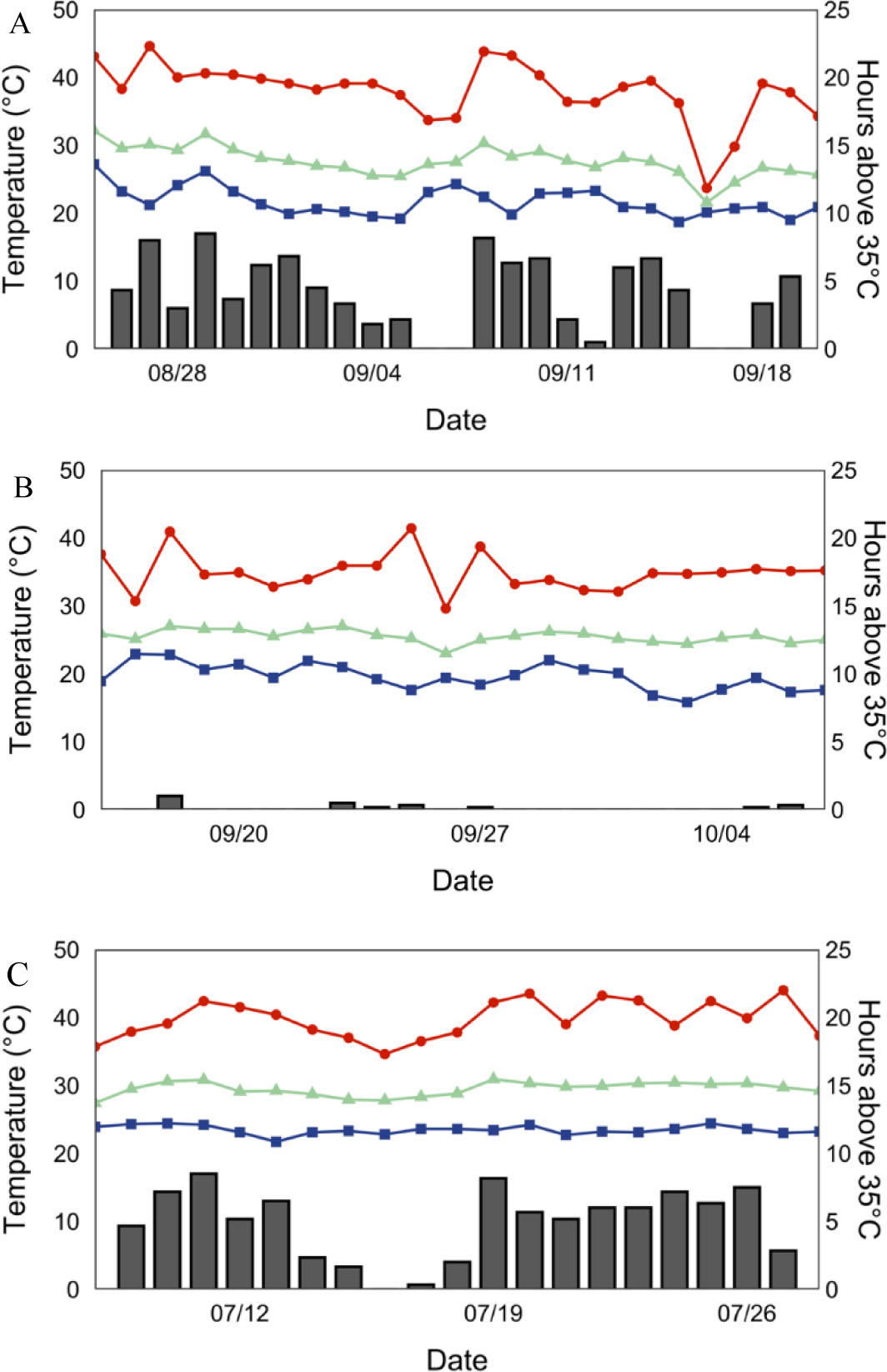
Figure 1
Air temperatures in the greenhouse during the high-temperature period for screening (A) and the moderate-temperature period (B). Air temperature during confirmation survey in the incubator (C). The line graph and the left Y-axis represent air temperature in the greenhouse. Red, green, and blue lines and circle, triangle, and square points mean highest, average, and lowest temperature on the day, respectively. Bars represent number of hours with temperature above 35 °C
Table 2
Reproductive and vegetative trait parameters under high and moderate temperatures under cultivation in the greenhouse
| Cultivar | Pollen number (×103) | Pollen viability (%) | Pollen germination (%) | Fruit set (%) | ||||||
|---|---|---|---|---|---|---|---|---|---|---|
| Temperature | High | Moderate | H/M | High | High | Moderate | H/M | High | Moderate | H/M |
| ‘Takanotsume’ | 28.9±11.3 b | 19.5±3.1 ac | 1.48 | 7.7±7.9 a | 6.5±4.2 ab | 7.1±3.3 a | 0.91 | 57.7±20.6 a | 32.2±15.7 a | 1.79 |
| ‘Nikko’ | 29.9±8.0 b | 13.8±.6.6 bcd | 2.17 | 2.8±2.8 a | 1.6±1.1 bc | 1.4±0.7 a | 1.14 | 18.2±10.3 bc | 19.7±14.4 a | 0.92 |
| ‘Furu-pi-yellow’ | 55.5±15.7 a | 41.4±24.4 a | 1.34 | 0.5±0.7 a | 1.7±2.0 bc | 2.9±2.0 a | 0.61 | 25.5±17.7 b | 36.3±15.8 a | 0.70 |
| ‘Furu-pi-red’ | 51.5±13.8 a | 38.2±11.5 acd | 1.35 | 7.4±14.2 a | 0.6±0.9 c | 1.0±0.8 a | 0.60 | 7.7±8.5 c | 28.3±9.0 a | 0.27 |
| ‘Onikis Red’ | 26.2±5.3 b | - | - | 9.6±7.1 a | 1.4±1.3 bc | 0.5±0.6 a | 2.74 | 9.2±9.5 bc | 18.7±14.0 a | 0.49 |
| ‘Colorful Mix’ | 35.8±13.5 ab | - | - | 8.6±7.7 a | 0.4±0.4 bc | 0.8±1.1 a | 0.57 | 7.3±4.7 bc | 15.4±10.4 a | 0.47 |
| ‘Uchu Cream Red’ | 23.0±16.7 b | - | - | 14.9±10.6 a | 0.4±0.3 bc | 1.6±0.8 a | 0.25 | 4.4±6.7 bc | 3.5±3.8 a | 1.25 |
| ‘Goshiki Kyokko’ | 23.0±9.5 b | - | - | 6.3±8.6 a | 6.3±4.7 ac | 3.2±1.7 a | 1.97 | 52.2±14.2 a | 33.3±12.8 a | 1.57 |
| ‘Shima Togarashi’ | 21.5±12.6 b | - | - | 11.7±7.0 a | 12.5±8.0 a | 6.9±5.0 a | 1.83 | 1.5±2.9 bc | 16.5±13.0 a | 0.09 |
| ‘Bishop's Crown’ | 38.4±8.6 ab | 45.6±15.0 ab | 0.84 | 2.2±2.6 a | 3.8±3.1 bc | 16.1±7.0 a | 0.24 | 0.0±0.0 c | 20.9±6.8 a | 0.00 |
| ‘Sy-2’ | 20.7±9.5 b | 9.0±2.7 def | 2.30 | 5.2±1.5 a | 3.3±1.6 bc | 6.2±3.1 a | 0.53 | 0.0±0.0 bc | - | - |
| ‘No.3686’ | 10.0±5.3 b | 5.0±2.0 f | 2.00 | 6.4±7.2 a | 3.5±4.8 bc | 6.4±2.8 a | 0.55 | 0.0±0.0 bc | - | - |
| F1 hybrid | 10.7±4.0 b | 4.7±2.7 ef | 2.28 | 15.0±3.4 a | 6.1±3.0 ac | 5.9±2.9 a | 1.02 | 7.9±8.0 bc | 31.2±6.4 a | 0.25 |
| Cultivar | Anther length (mm) | Style length (mm) | Anthesis stage | Fv/Fm | ||||||||
|---|---|---|---|---|---|---|---|---|---|---|---|---|
| Temperature | High | Moderate | H/M | High | Moderate | H/M | High | Moderate | H/M | High | Moderate | H/M |
| ‘Takanotsume’ | 2.4±0.2 bc | 2.8±0.2 ac | 0.87 | 6.6±0.4 a | 6.5±0.6 ab | 1.01 | 4.0±0.0 a | 3.9±0.4 a | 1.03 | 0.64±0.14 d | 0.78±0.02 a | 0.82 |
| ‘Nikko’ | 2.5±0.1 b | 2.5±0.2 bed | 1.00 | 7.2±0.4 a | 7.3±0.1 a | 0.99 | 4.0±0.0 a | 4.6±0.0 a | 1.00 | 0.76±0.04 ab | 0.72±0.03 a | 0.96 |
| ‘Furu-pi-yellow’ | 2.9±0.3 a | 2.6±0.3 a | 1.12 | 6.6±0.6 a | 5.7±0.4 cde | 1.17 | 3.8±0.7 a | 4.0±0.0 a | 0.95 | 0.78±0.01 a | 0.77±0.03 a | 1.01 |
| ‘Furu-pi-red’ | 2.9±0.3 a | 3.1±0.2 acd | 0.95 | 5.7±0.4 h | 4.7±0.9 be | 1.21 | 4.0±0.0 a | 3.7±0.7 a | 1.08 | 0.77±0.01 a | 0.78±0.01 a | 0.99 |
| ‘Onikis Red’ | 1.5±0.1 de | 1.9±0.5 ef | 0.80 | 4.2±0.6 d | 4.3±0.4 ef | 0.97 | 4.0±9.0 a | 4.0±0.0 a | 1.00 | 0.65±0.02 bd | 0.72±0.09 a | 0.90 |
| ‘Colorful Mix’ | 2.0±0.2 cd | 2.2±0.4 def | 0.92 | 4.1±0.7 de | 4.6±0.3 df | 0.90 | 4.0±0.0 a | 4.0±0.0 a | 1.00 | 0.61±002 d | 0.78±0.03 a | 0.78 |
| ‘Uchu Cream Red’ | 2.4±0.4 bc | 2.3±0.2 ce | 1.03 | 4.1±0.6 de | 5.4±0.4 cd | 0.77 | 4.0±0.0 a | 4.0±0.0 a | 1.00 | 0.63±0.11 cd | 0.55±0.17 b | 1.15 |
| ‘Goshiki Kyokko’ | 2.1±0.2 c | 2.1±0.1 def | 1.01 | 5.6±02 bc | 5.2±0.6 cde | 1.06 | 4.0±0.0 a | 4.0±0.0 a | 1.00 | 0.72±0.03 ad | 0.77±0.03 a | 0.94 |
| ‘Shima Togarashi’ | 2.4±0.3 bc | 2.3±0.2 ce | 1.03 | 5.3±0.2 bc | 5.4±0.4 cde | 0.99 | 2.3±1.0 b | 4.0±0.0 a | 0.56 | 0.72±0.05 ad | 0.78±0.02 a | 0.92 |
| ‘Bishop's Crown’ | 3.0±0.1 a | 3.0±0.1 ab | 0.99 | 4.7±0.4 cd | 4.5±0.3 df | 1.05 | 2.3±1.2 b | 3.9±0.2 a | 0.58 | 0.77±0.02 ab | 0.79±0.01 a | 0.97 |
| ‘Sy-2’ | 2.1±0.3 bc | 2.0±0.3 def | 1.07 | 3.0±0.2 ef | 3.5±0.3 f | 0.84 | 2.2±0.7 b | 3.7±0.3 a | 0.60 | 0.77±0.03 abc | 0.80±0.01 a | 0.97 |
| ‘No.3686’ | 1.5±0.1 c | 1.5±0.2 f | 0.96 | 1.3±0.3 g | 1.4±0.2 g | 0.91 | 2.1±0.1 b | 3.4±0.7 a | 0.61 | 0.79±0.00 ab | 0.80±0.01 a | 0.99 |
| F1 hybrid | 2.0±0.1 ce | 1.8±0.5 ef | 1.08 | 2.6±0.1 f | 2.0±0.5 g | 1.27 | 4.0±0.0 a | 4.0±0.0 a | 1.00 | 0.80±0.01 ab | 0.81±0.01 a | 0.98 |
[i] ‘Values are the mean ± SE of each cultivar. Different letters indicate significant differences at the 5% level by ANOVA and Tukey-Kramer test. The sample size of each cultivar was shown in Table 1. Lack of data for ‘Sy-2’ and ‘No. 3686’ concerning the fruit set resulted from the lack of fruiting caused by too low temperature for C. chinense at the end of the moderate season. H/M mean represents the ratio of the values under the high temperature to the moderate temperature
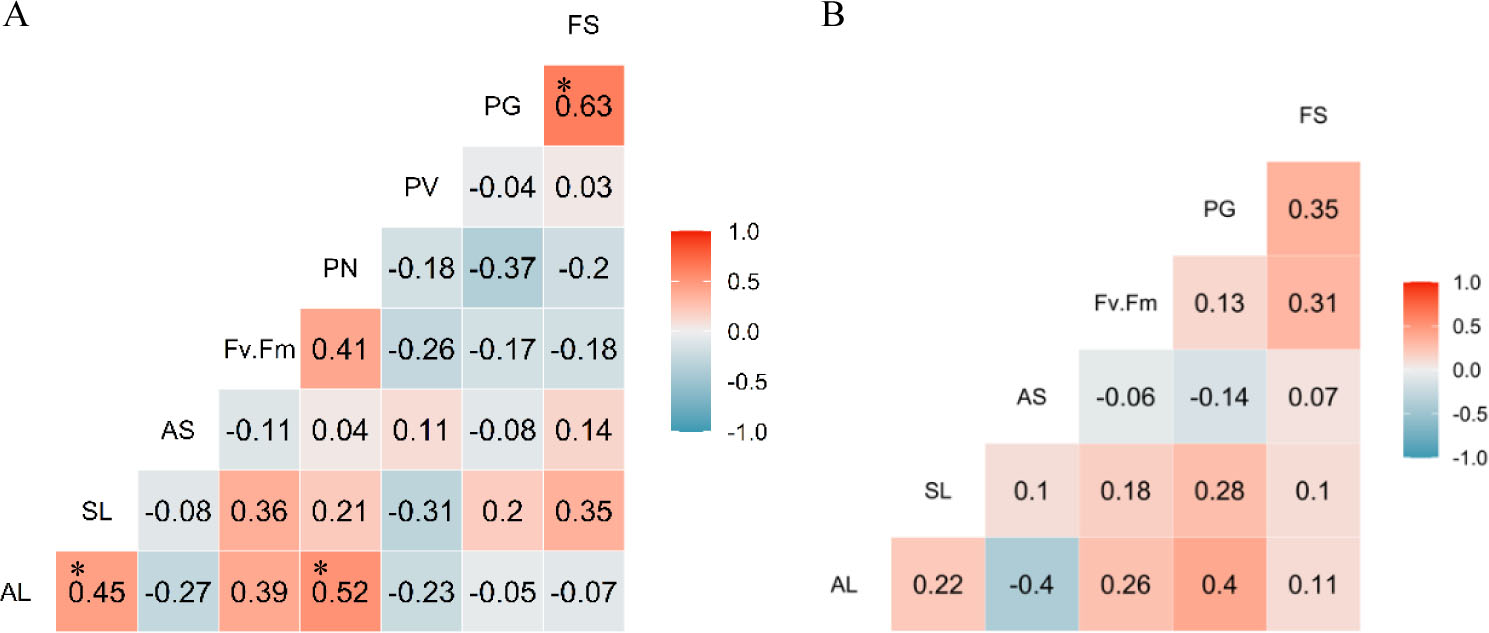
Figure 2
Correlation analysis between traits of C. annuum cultivars grown in the greenhouse under high-temperature conditions (A) and moderate-temperature conditions (B). The numbers in the figure show the correlation coefficient (r value) between two traits. Red and blue colors indicate positive and negative correlations, respectively. The deeper the color, the larger the absolute value of the correlation coefficient. The asterisks indicate significant correlations (p < 0.05). Trait observed: FS – fruit set; PG – pollen germination; PV – pollen viability; PN – pollen number; AL – anther length; SL – style length; AS – anthesis stage
Table 3
Percentage of fruit set and pollen germination rate in the confirmation survey on plants grown in a stable high temperature in the incubator
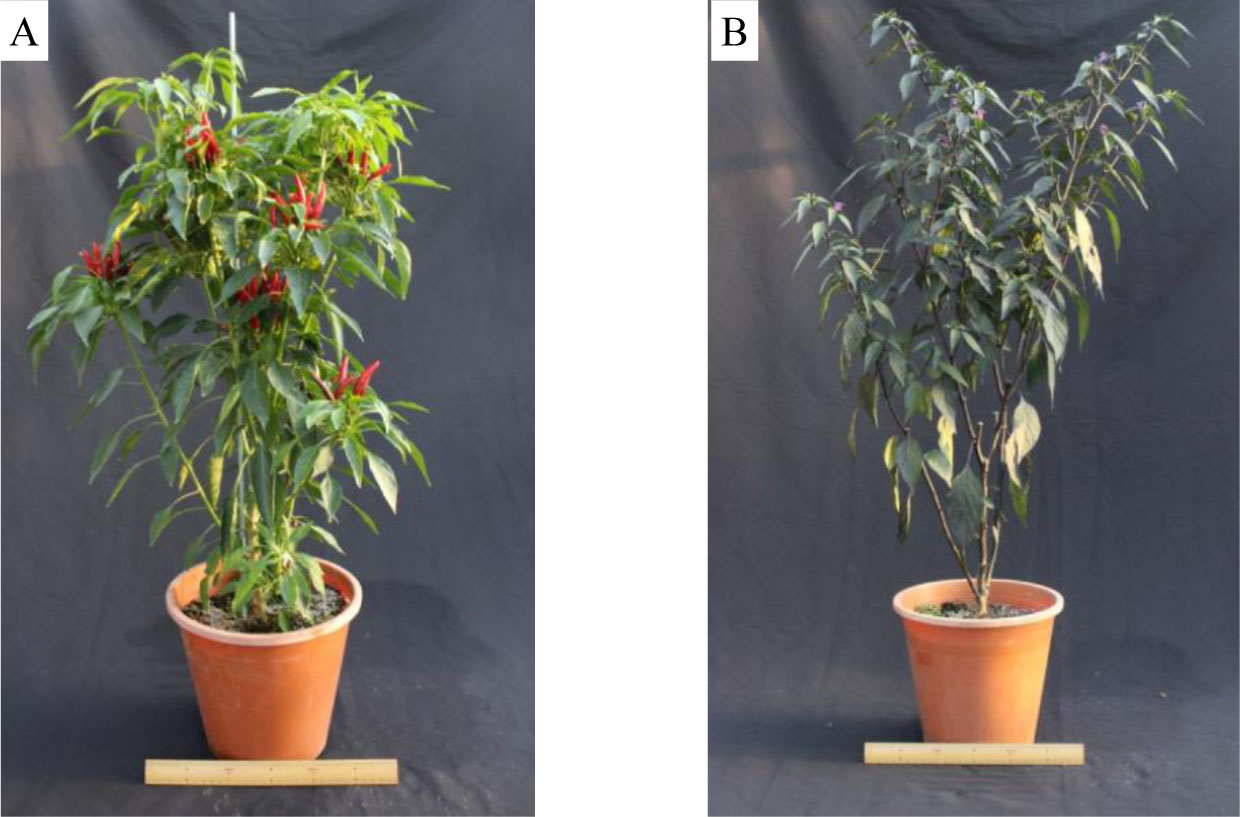
Figure 3
Difference in fruit set under high-temperature conditions of plants grown at the high-temperature period: (A) ‘Takanotsume’ and (B) ‘Peruvian Purple’. The photos were taken on August 30, 2020. The brown ruler shows 30 cm
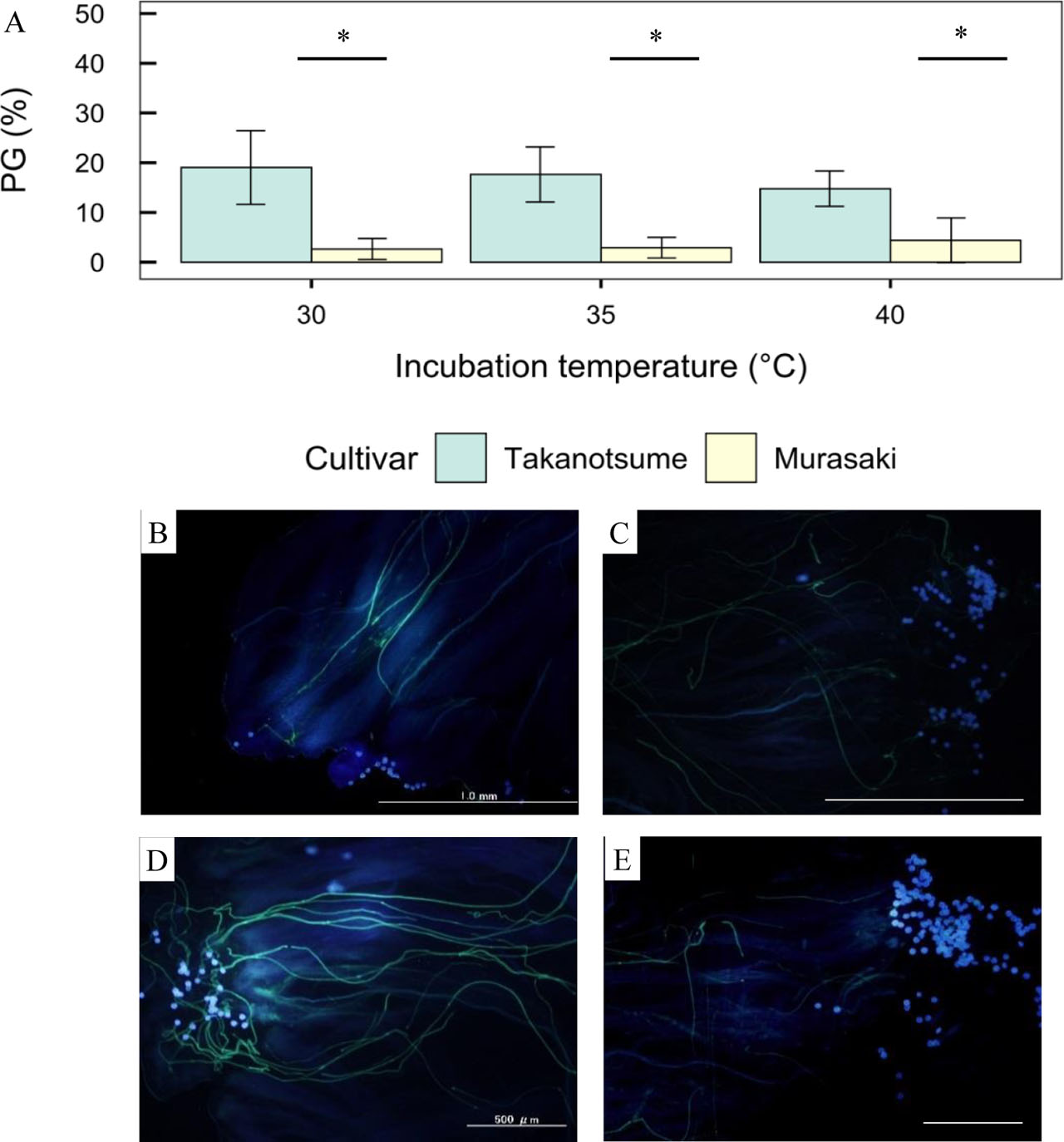
Figure 4
Germination of pollen of plants grown in the high-temperature incubator (A). Incubation temperatures were 25 °C, 30 °C, 35 °C, and 40 °C. The asterisks indicate 5% level of significance obtained with t-test. (B), (C), (D), and (E) show pollen tube elongations in the pistils of ‘Takanotsume’ pollinated by ‘Takanotsume’ (B) and ‘Takanotsume’ pollinated by ‘Murasaki’ (C). Pollen tube elongations in the pistils of ‘Murasaki’ pollinated by ‘Takanotsume’ (D) and ‘Murasaki’ pollinated by ‘Murasaki’ (E). Scale bars are 1 mm in (B) and (C), and 500 μm in (D) and (E)