
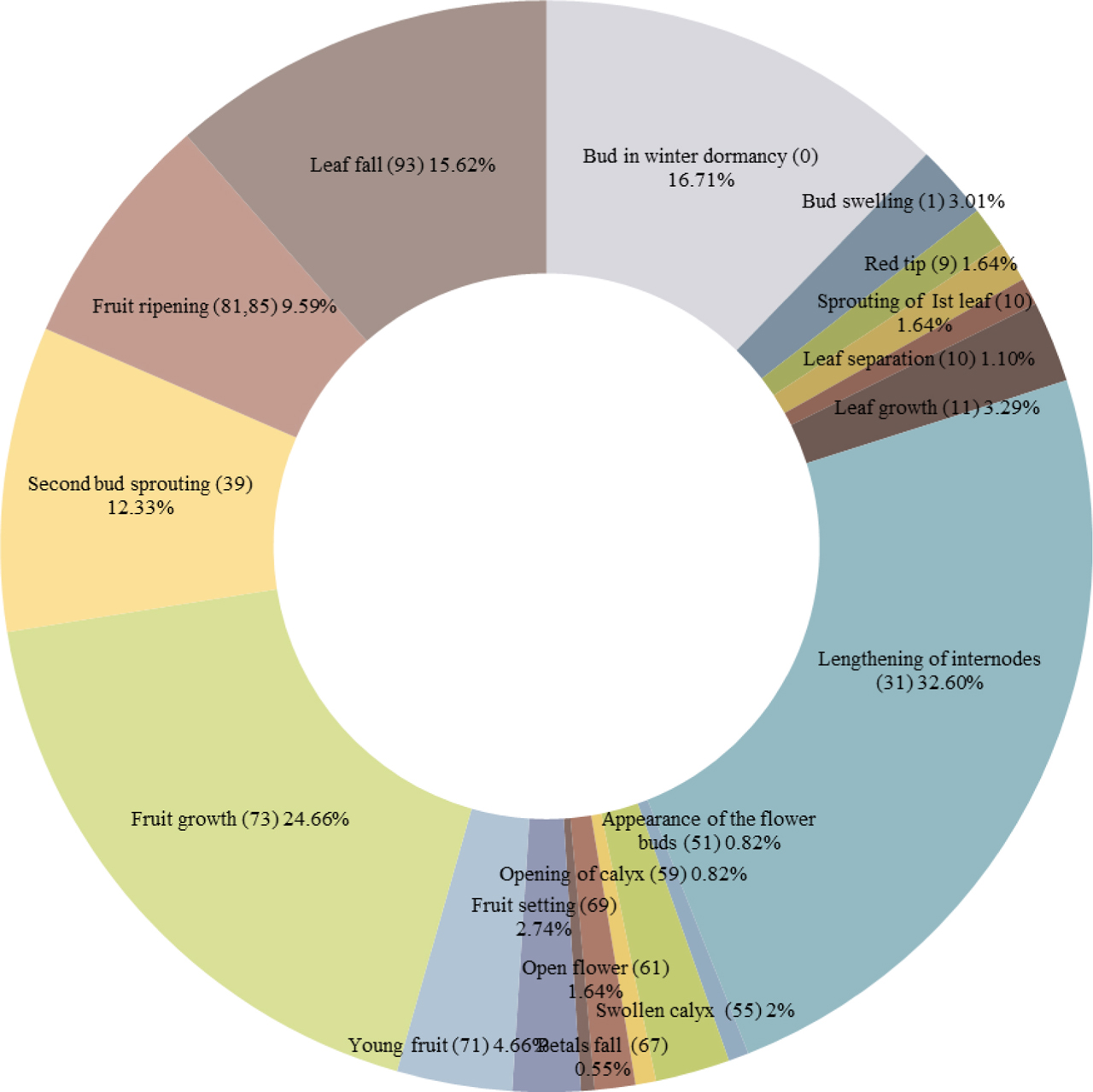
Figure 1
Growth stages, BBCH phenological codes, and duration percentage (of annual growth cycle) of the pomegranate trees in a Mediterranean climate characterized by hot and dry summers and mild and rainy winters
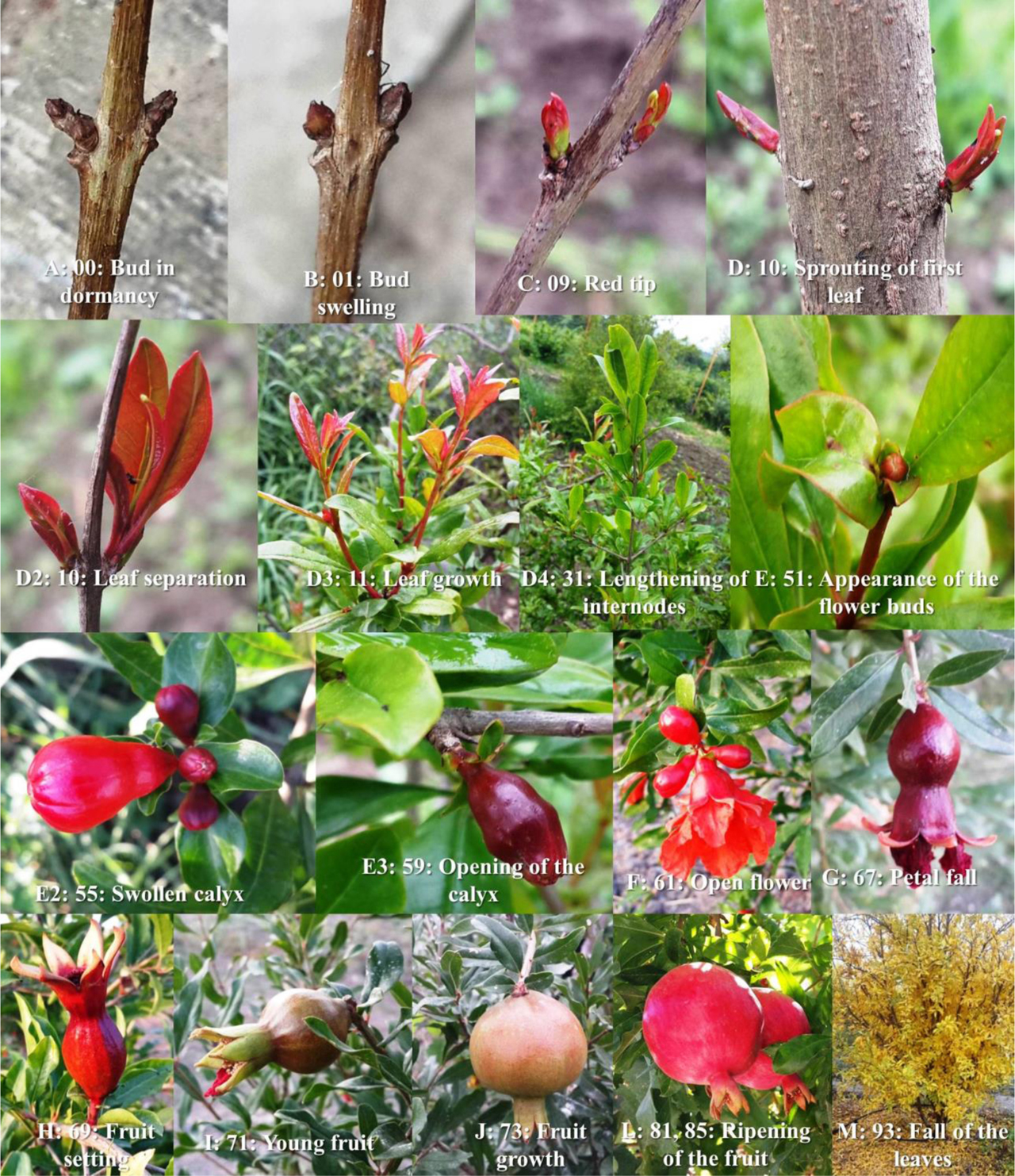
Figure 2
Different phenophases of pomegranate development
Table 1
Description of growth stages with BBCH phenological codes of pomegranate trees in a Mediterranean climate
| BBCH code | Growth stage | Description |
|---|---|---|
| 0 | Bud in winter dormancy | Bud color grayish brown, entirely closed, connected to the twig, tip sharply pointed |
| 1 | Bud swelling | Bud begins to swell, later turns paler and round |
| 9 | Red tip | Bud opens with a spear-shaped new shoot with a red tip |
| 10 | Sprouting of the first leaves | First furled bright red leaves with pale green midrib appear |
| 10 | Leaf separation | New leaves begin to separate |
| 11 | Leaf growth | Leaves grow up in size and change color from bright red to light green |
| 31 | Lengthening of internodes | Internodes elongate and steadfast shoot growth |
| 51 | Appearance of the flower buds | Sepals are visible and close together. Greenish flower buds turn into red color |
| 55 | Swollen calyx | Buds swelling, attain pear shape; differences between male and hermaphrodite flowers noticeable in the shape and the color of the calyx |
| 59 | Opening of the calyx | Sepals unfold and exhibit the folded red petals within. Petals open and the pistil/anthers become visible toward the end of this stage |
| 61 | Open flower | Calyx unfolds entirely and the protruding petals, which are folded and purple, unfold over the sepals. The petals appear inserted between every two sepals on their inner side, thereby giving the impression of alternating petals and sepals. The anthers of the stamen change to deep yellow when the pollen is ripe, capable of fertilizing, and pollination occurs |
| 67 | Petal fall | Petals fall following drying and shriveling; the calyx color changes from red to orange-red; stamens curved toward the longitudinal axis of the flower and the anthers turn grayish-yellow. The terminal part of the style withers |
| 69 | Fruit setting | The fertilized ovary and the base of the calyx swells; the stamens are dried up and shriveled and the fruit color changes from orange-red to greenish-brown |
| 71 | Young fruit | Fruit size increases rapidly and the color turns from greenish-brown to green |
| 73 | Fruit growth | Fruit attains nearly its final size; the sepals form a crown, the dry stamen being inside |
| 39 | Second bud sprouting | The recommencement of shoot growth |
| 81, 85 | Fruit ripening | The fleshy seeds turn white to pinkish-red or red; the peel of the fruit changes from green to greenish-yellow and to brownish-yellow with reddish patches |
| 93 | Leaf fall | Leaves become yellowish and fall; onset of winter dormancy |
Table 2
Comparison of different flowering seasons
| Flowering season | Spring flowering | Autumn flowering | Rainy season flowering |
|---|---|---|---|
| Preferences | Preferable if irrigation facilities are available | Rarely taken, although suitable for export, preferred in areas infected with bacterial blight (Xanthomonas axonopodis pv. punicae) | Preferable under drought-prone areas |
| Remarks | More flowering and high yields, the limited incidence of pests and diseases due to dry weather | Fewer incidences of insect pests and diseases, high-quality fruits (attractive rind with dark-colored arils), fetch higher market price due to limited availability of the fruits during this season, optimum water stress cannot be developed as withholding of irrigation happens together with the rainy season, poor flowering, and yield | More chances of insect pests and disease attack, poor fruit quality (fungal fruit spots and cracking in dry regions where diurnal temperature variation is high), should be avoided in areas with heavy rainfall during monsoon season |
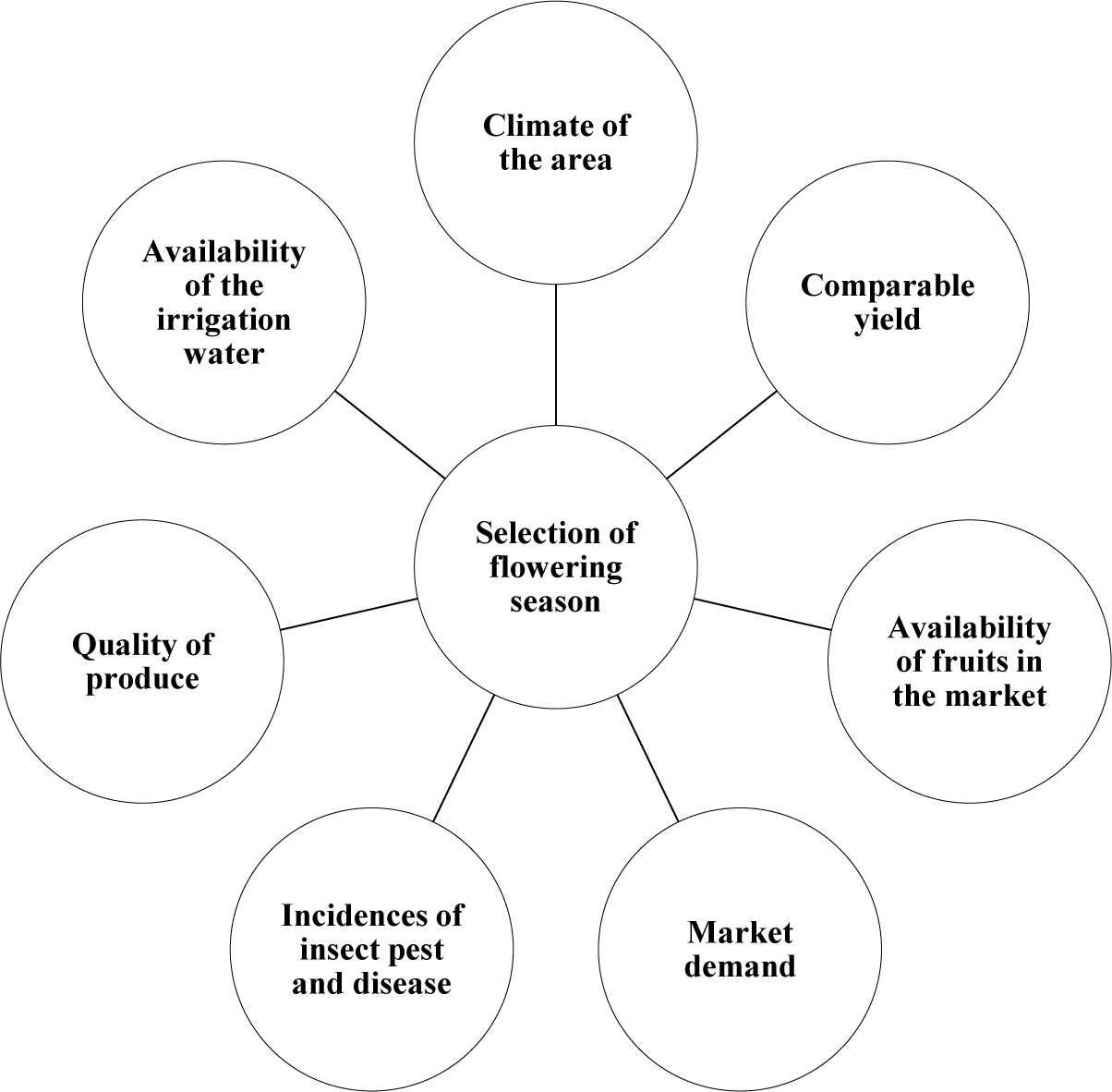
Figure 3
Factors responsible for the selection of the flowering season
Table 3
Flowering seasons of pomegranates
| Seasons of flowering | Jan | Feb | Mar | Apr | May | Jun | Jul | Aug | Sept | Oct | Nov | Dec |
|---|---|---|---|---|---|---|---|---|---|---|---|---|
| Spring | Flowering | |||||||||||
| Harvesting | ||||||||||||
| Rainy | Flowering | Harvesting | ||||||||||
| Harvesting | ||||||||||||
| Autumn | Flowering | |||||||||||
| Harvesting | ||||||||||||
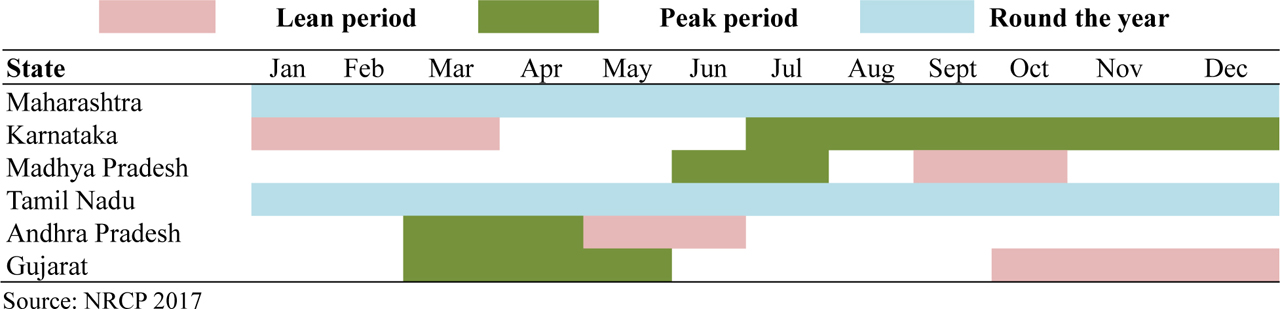
Figure 4
Period of availability of pomegranate fruits in the market (lean period: when availability is low, prices are higher for the produce; peak period: when availability is high, prices are lower)
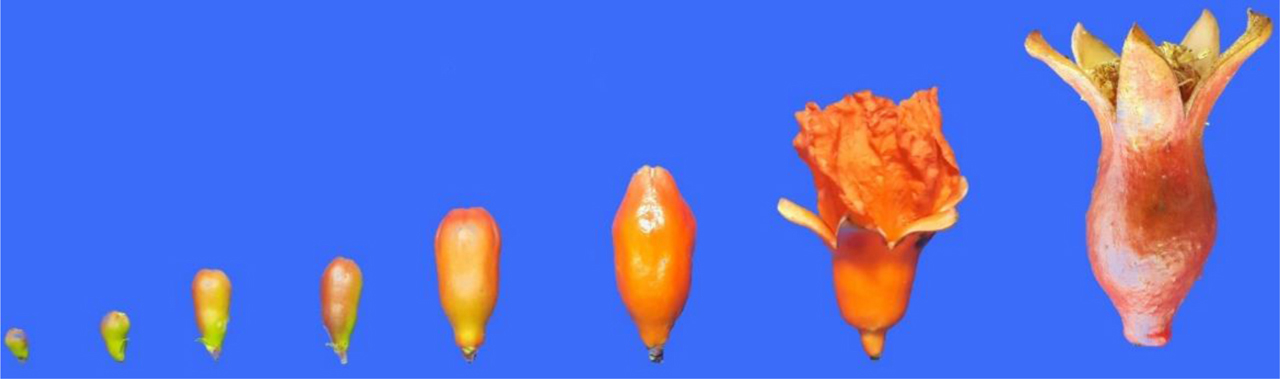
Figure 5
Developmental stages of flower buds in pomegranate
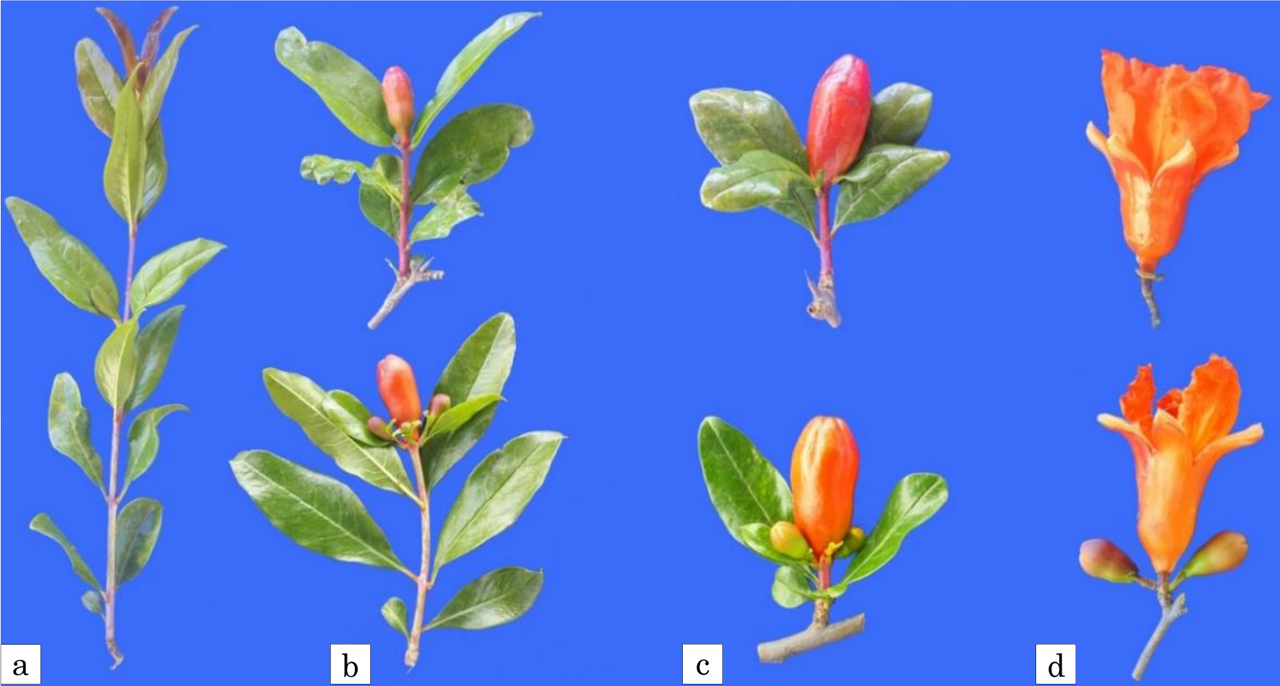
Figure 6
Different types of shoots in pomegranate: (a) the long vegetative shoot, with expanded leaves, (b) relatively long vegetative-reproductive branch with one terminal or more flower buds, (c) median vegetative-reproductive branch with one terminal or more flower buds, (d) very short reproductive branch with one terminal flower or more buds without leaves
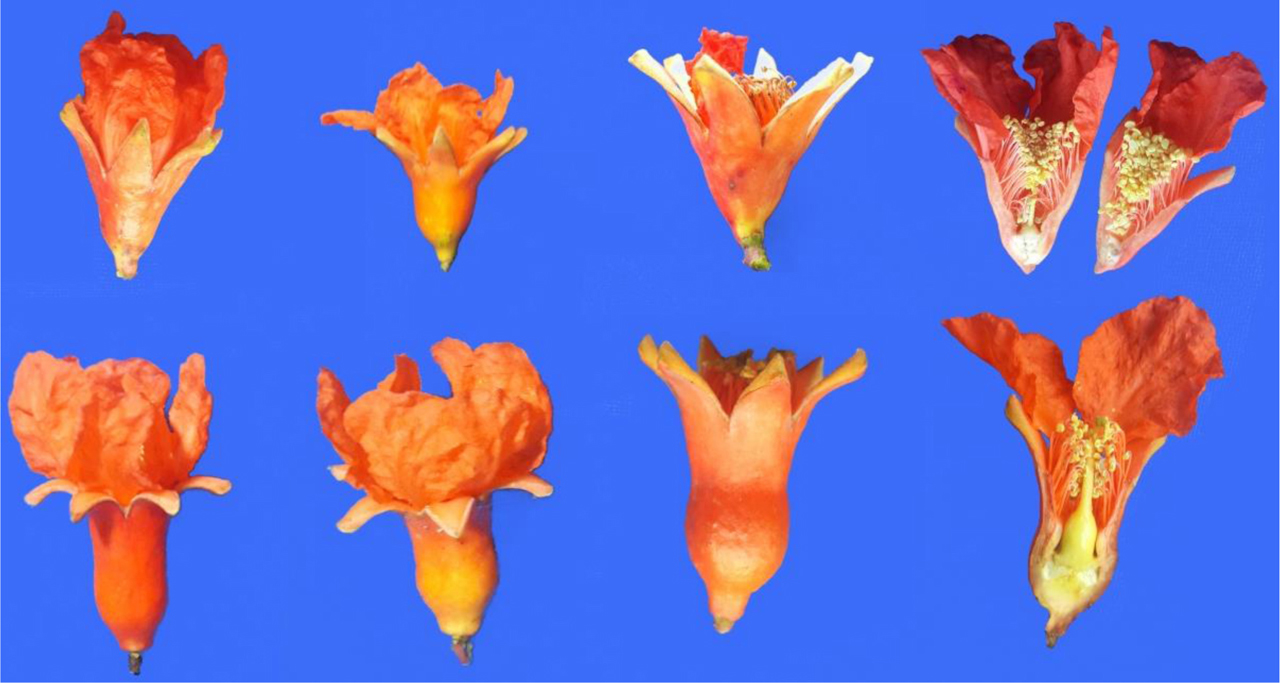
Figure 7
Two major types of flowers in pomegranate: the V-shape, functionally male flowers (top), and the U-shape hermaphrodite flowers (bottom); the male flowers shed few days after full bloom, while the bisexual flowers develop to pomegranate fruit following pollination and fertilization
Table 4
The flowering period of pomegranate in different parts of India
| Region/state | Flowering period | Reference |
|---|---|---|
| Central and Western India | Spring (Jan–Feb); rainy (June–July); autumn (Sept–Oct) | Singh et al. (1967); Singh (1969); Mann & Pareek (1974); Phadnis (1974); Patil & Karale (1985) |
| Karnataka | June–August; March; September | Nalawadi et al. (1973) |
| Punjab | April–June | Josan et al. (1979) |
| Delhi | once or twice a year | Nath & Randhawa (1959) |
| Uttar Pradesh, Bihar | February–March; July–August | Singh et al. (1967); Singh (1969) |
| Rajasthan | rainy (June–July) | Mann & Pareek (1974) |
| Himachal Pradesh | April–May | Parmar & Kaushal (1982) |
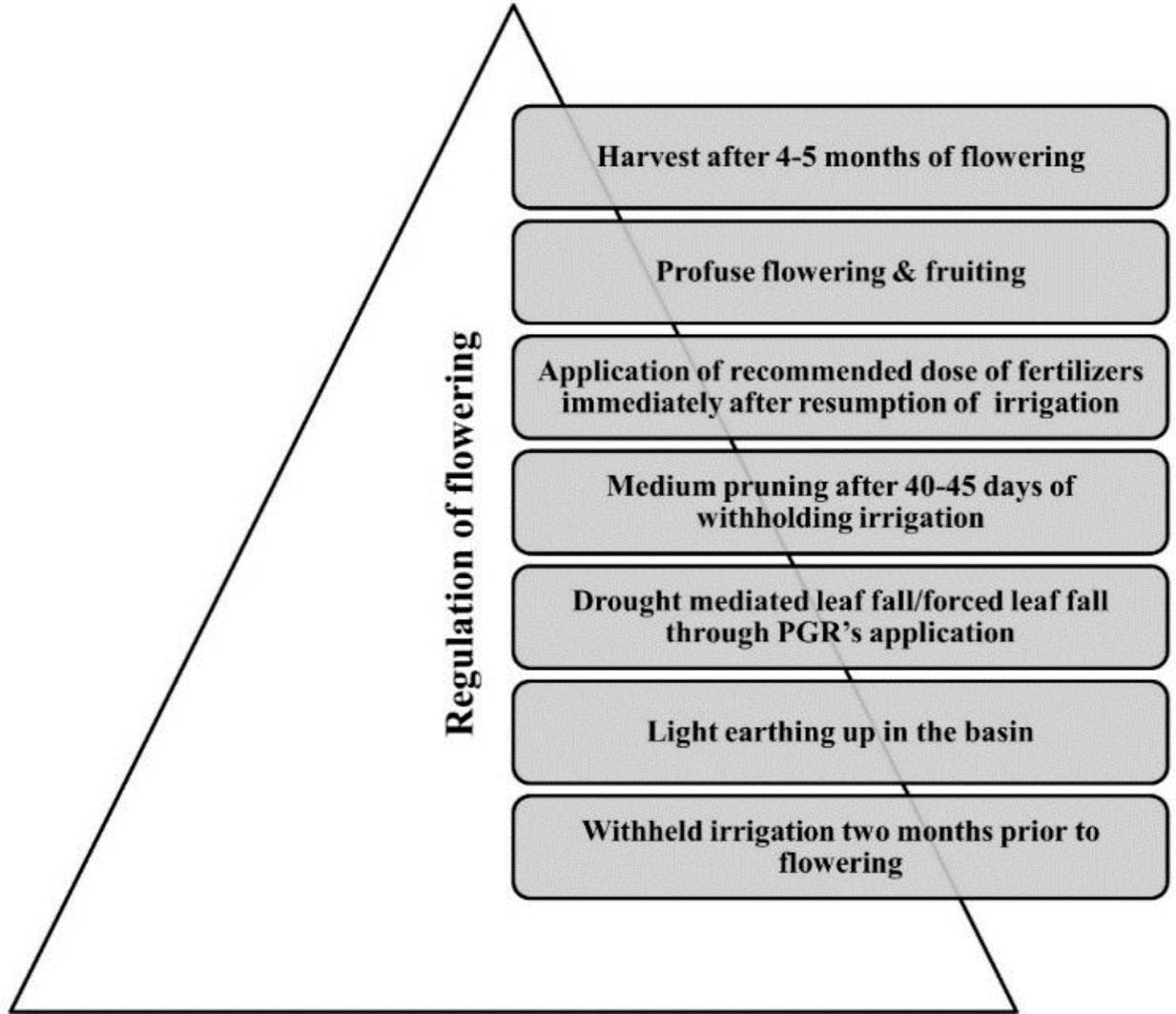
Figure 8
Cultural practices to be followed for flowering regulation in pomegranate