
Introduction
Body composition evaluation constitutes a central pillar in modern health assessment, moving beyond simple anthropometric scales to define the exact physiological proportions of fat and fat-free mass. The precision in quantifying these compartments is essential, as the mere measurement of body weight or body mass index (BMI) cannot distinguish between lean tissue and adipose deposits [1]. Consequently, determining the specific distribution of these tissues provides clinicians with a much clearer picture of an individual’s actual physiological status [2].
Excessive accumulation of body fat, particularly when distributed viscerally, is a primary driver of metabolic dysfunction. High adiposity is deeply linked to the development of cardiometabolic conditions, including insulin resistance, type 2 diabetes, and heart failure [3, 4]. Therefore, identifying the exact percentage of body fat is a critical first step in stratifying patient risk and preventing the onset of chronic non-communicable diseases [5].
Furthermore, body composition imbalances heavily influence long-term survival and overall functional independence. Increased fat mass has been established as a definitive risk factor for site-specific cancers and elevated all-cause mortality across different populations [6, 7]. Concurrently, the progressive loss of metabolically active muscle tissue accelerates physiological decline, increasing the risk for sarcopenia, osteoporosis, and impaired renal function [8].
To quantify these bodily compartments, science relies on a variety of measurement techniques. Traditional methods, such as skinfold calipers and circumference measurements, offer high portability but generally suffer from lower accuracy due to human error [9, 10]. In contrast, laboratory-based standards like dual-energy X-ray absorptiometry (DXA) and hydrostatic weighing provide exceptional precision but are severely restricted by high financial costs, lack of mobility, and the requirement for specialized technicians [11, 12].
As a highly effective middle ground, bioelectrical impedance analysis (BIA) has become globally ubiquitous in both clinical and epidemiological settings [13]. By measuring the opposition to alternating electrical currents as they pass through body water, BIA can rapidly estimate total body compartments [14]. Modern multifrequency BIA analyzers enhance this process by using multiple current frequencies, enabling a highly sensitive differentiation between intracellular and extracellular hydration states [15, 16].
A crucial evolution in BIA technology has been the integration of the phase angle as a qualitative, rather than just quantitative, metric. The phase angle reflects the structural integrity of cellular membranes and is currently recognized as a highly sensitive biomarker of cellular health [17]. Independent of total muscle volume, high phase angle values consistently correlate with superior muscle quality, adequate cellular hydration, and enhanced physical performance [18, 19].
Recently, electrical impedance myography (EIM) has emerged as an alternative technological approach for body composition analysis. Unlike whole-body BIA, portable EIM devices (such as the Skulpt AIM) apply high-frequency currents directly over specific muscle bellies to evaluate localized tissue architecture [20]. These handheld tools use proprietary algorithms to estimate segmental body fat percentages and generate specific muscle quality scores based on the electrical properties of the targeted tissue [21].
Despite the accessibility of portable EIM, current literature lacks definitive consensus regarding its precision and functional validity compared to established multifrequency BIA methods [22, 23]. Furthermore, while some authors have attempted to bridge the gap regarding EIM validity and its relationship with physiological and morphological variables, findings remain mixed [24]. Specifically, it remains unclear if the muscle quality index provided by EIM accurately reflects real mechanical force. Therefore, the objective of this study was to evaluate the agreement between EIM and BIA for body fat estimation, and to determine how their respective muscle quality markers correlate with physical strength measured by dynamometry.
Materials and methods
Type of study
An observational, cross-sectional, and correlational study was conducted to analyze the diagnostic agreement and functional validity of two body composition analyzers. The primary outcome was de agreement in BF% between EIM and BIA. Secondary outcomes were correlations with dynamometry and MQ.
Population and sample
A convenience sample of 53 students from the Universidad de Caldas (Colombia) was recruited via email; 32 women and 21 men volunteered. Each participant provided consent for the measurements to be taken.
Inclusion and exclusion Criteria
Subjects were instructed to arrive with a minimum of two hours of fasting, wearing light athletic clothing without metallic elements, and to empty their bladders immediately prior to testing. Individuals presenting with metallic prostheses, pacemakers, missing limbs, or those who failed to follow the fasting protocol were completely excluded from the study.
Measurements
Basic anthropometric data (body mass and height) were recorded initially. Body composition was subsequently evaluated using two distinct technologies:
Biody Expert ZM II (BIA):
A portable multifrequency bioimpedance device. Participants were seated on a stool with a straight back, strictly adhering to the manufacturer’s operational guidelines for this specific device. The skin behind the right ankle, the fingers of the right hand, and the four electrodes of the device were slightly moistened. The participants held the device in their right hand as if holding a tennis racket, with the thumb on the top contact button and two or three fingers wrapping around the lower electrode. The right leg was pulled back with the heel lifted and the toes remaining in contact with the floor. The V-shaped section of the device was placed in contact with the skin behind the ankle, just below the malleoli. The participant pressed and held the thumb button until a second beep was emitted, and the green LED flashed continuously, indicating the measurement was complete. Variables analyzed included body fat percentage, phase angle, active cell mass, and raw muscle mass.
Skulpt AIM (EIM):
A portable electrical impedance myography scanner. With the participant standing in a relaxed anatomical position, the device’s sensors and the targeted skin areas were moistened with water using a spray bottle to optimize conductivity. To ensure inter-subject reproducibility, the scanner was positioned using standardized anatomical landmarks: the right triceps brachii, the right abdomen, and the right anterior thigh. The scanner was pressed against the muscle until the light ring changed color and the measurement was registered on the mobile application. The device provided total body fat percentage and a proprietary Muscle Quality score based on these three specific measurement sites.
Dynamometry:
A Jamar Digital Hand Dynamometer was used, without warm-up, and with three attempts. Maximum manual grip strength was recorded using a hydraulic hand dynamometer to assess objective functional capacity. Following a standardized general warm-up, participants were tested in a seated position with the shoulder adducted, the elbow flexed at 90 degrees, and the forearm in a neutral position. Three maximal isometric contractions were performed with the dominant hand, with a 60-second rest between trials, and the highest value was recorded.
Physical Activity:
Self-reported physical activity was quantified using the International Physical Activity Questionnaire to estimate the total minutes of physical activity per week.
Statistical Analysis
A minimum sample size of 46 participants was estimated, assuming an expected correlation of r=0.5 between BIA-derived muscle mass and dynamometry, alpha=0.05, and power=80%. Final sample (n=53) exceeded this requirement. Data normality was tested utilizing the Shapiro-Wilk test (n=53), which indicated non-parametric data distributions. Descriptive statistics were presented as means and standard deviations (SD). The Spearman rank correlation coefficient was utilized to determine associations between dynamometry, physical activity, and body composition variables. To analyze the agreement between the SKULPT and BIA devices for body fat percentage, Lin’s Concordance Correlation Coefficient (CCC) was applied, followed by a Bland-Altman plot to identify systematic bias and define the 95% Limits of Agreement (LoA). Significance was set at p < 0.05. Data processing was conducted in IBM SPSS Statistics 25.0.
Informed consent
Informed consent has been obtained from all individuals included in this study.
Ethical approval
All subjects voluntarily signed an informed consent form. The study adhered strictly to the ethical principles of the Declaration of Helsinki [25] and the Colombian Ministry of Health regulations (Resolution 8430 of 1993) [26].
Results
The descriptive profile of the 53 participants is outlined in Table 1. The data highlights expected physiological variations between genders, with men exhibiting higher values in height, body mass, physical activity volume, and dynamometry strength compared to women.
Table 1.
General morphofunctional and cellular integrity measurements (Mean ± SD).
| Variable | Women (N = 32) | Men (N = 21) | p-value |
|---|---|---|---|
| Age (years) | 21.00 ± 2.99 | 22.14 ± 2.92 | 0.176 |
| Height (m) | 1.59 ± 0.06 | 1.71 ± 0.05 | < 0.001 |
| Body mass (kg) | 60.86 ± 8.30 | 67.85 ± 11.66 | 0.022 |
| Dynamometry (kg) | 27.62 ± 3.83 | 43.97 ± 9.73 | < 0.001 |
| Physical activity (min/week) | 169.53 ± 219.40 | 522.14 ± 437.60 | 0.001 |
| Total MQ SKULPT | 43.02 ± 7.34 | 53.26 ± 18.55 | 0.022 |
| Total BF% SKULPT | 34.68 ± 5.78 | 19.63 ± 4.54 | < 0.001 |
| Phase angle (º) [BIA] | 6.78 ± 0.62 | 7.86 ± 0.65 | < 0.001 |
| Body fat (%) [BIA] | 30.93 ± 4.35 | 16.34 ± 6.51 | < 0.001 |
| Muscle mass (kg) [BIA] | 21.05 ± 2.02 | 30.41 ± 4.58 | < 0.001 |
| Active cell mass (kg) [BIA] | 24.91 ± 1.98 | 35.35 ± 3.85 | < 0.001 |
As detailed in Table 2, Spearman’s correlation analysis demonstrated robust, highly significant positive associations between mechanical grip strength (dynamometry) and BIA-derived mass compartments. Specifically, raw muscle mass (rho = 0.821, p < 0.001) and active cell mass (rho = 0.804, p < 0.001) strongly predicted functional output. Conversely, there was a total absence of correlation between grip strength and the total Muscle Quality estimated by the SKULPT device (p = 0.745).
Table 2.
Spearman correlation matrix for morphological and functional variables.
| Independent Variable | Dependent Variable | Coefficient (ρ) | p-value |
|---|---|---|---|
| Dynamometry | Muscle mass (kg) [BIA] | 0.821 | <0.001 |
| Dynamometry | Active cell mass (kg) [BIA] | 0.804 | <0.001 |
| Dynamometry | Phase angle (º) [BIA] | 0.630 | <0.001 |
| Dynamometry | Total MQ SKULPT | 0.046 | 0.745 |
| Physical activity | Body Fat (%) [BIA] | −0.566 | <0.001 |
| Physical activity | Total BF% SKULPT | −0.534 | <0.001 |
Regarding device agreement for body fat percentage, Lin’s CCC resulted in a value of 0.810. The subsequent Bland-Altman analysis isolated a systematic bias of 3.65%. This indicates that, on average, the SKULPT device overestimates total adiposity by 3.65% when compared directly to the multifrequency BIA. Additionally, the 95% Limits of Agreement demonstrated vast individual dispersion, extending from an inferior limit of −5.20% to a superior limit of 12.51% (Figure 1).
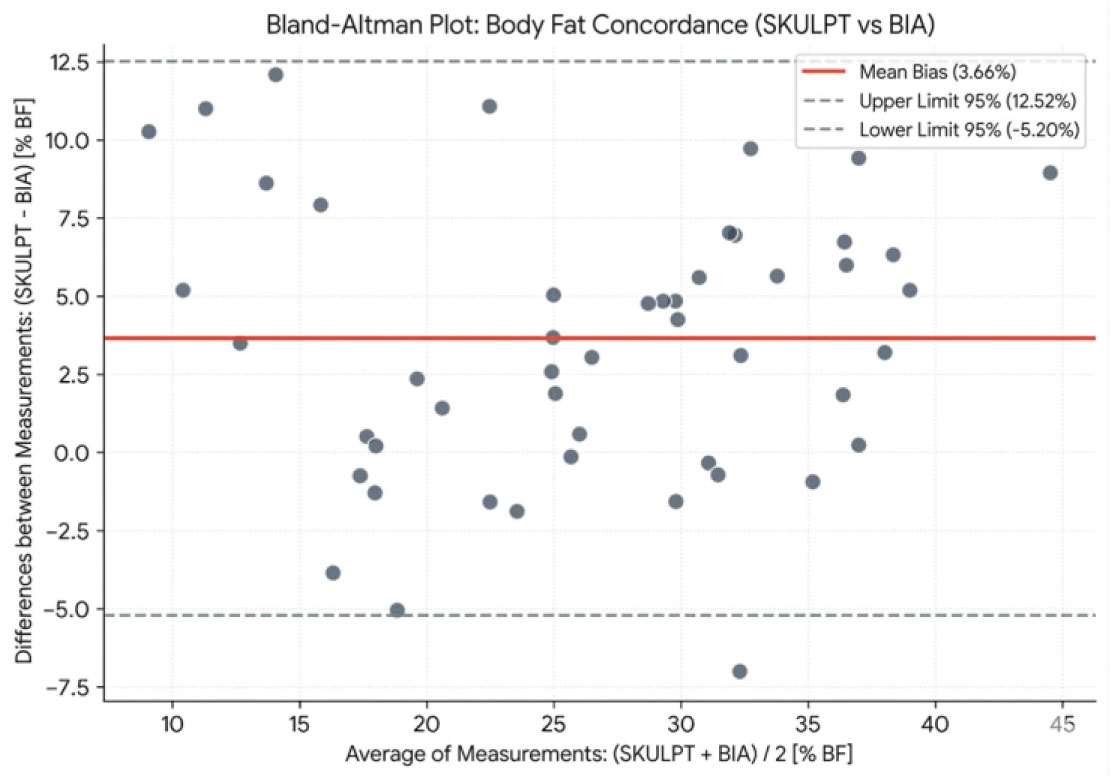
Figure 2.
Bland & Altman graph.
Discussion
The primary findings of this investigation reveal a significant lack of clinical agreement between segmental electrical impedance myography and whole-body multifrequency BIA. The comprehensive Bland-Altman analysis established that the Skulpt device reports systematically higher body fat percentage values than BIA. While a mathematical correlation exists, the magnitude of the bias clearly demonstrates that the data output from these two technological platforms diverges significantly.
This tendency of the EIM device to report higher values is consistent with previously documented literature comparing EIM to other established methods [21, 22]. However, since DXA is generally considered the gold standard for body composition assessment, it cannot be definitively concluded which device is closer to true biological values. In fact, McLester et al. [20] reported that EIM showed stronger agreement with DXA than BIA did.
The root of this discrepancy lies primarily in the profound technological and algorithmic differences between the two methods. Multifrequency BIA utilizes a wide spectrum of currents across the entire body, coupled with anthropometric data (height, weight, gender), to effectively differentiate between intracellular and extracellular water spaces [27, 28]. Conversely, the Skulpt EIM scanner performs calculations based purely on the electrical resistance of targeted segmental tissues, completely disregarding total body mass variables [29].
The clinical consequences of these technological differences are visualized in the extremely wide 95% limits of agreement found in this study (−5.20% to 12.51%). For body composition assessment, acceptable inter-device variability should ideally not exceed 5% [30]. A potential individual error margin exceeding 12% means that while EIM might be useful for population averages, it is highly unsuitable for individualized clinical diagnosis or exact therapeutic interventions [31].
A critical and novel aspect of this study was the functional validation of muscle quality metrics using dynamometry. The data robustly confirmed that absolute muscle mass, active cell mass, and phase angle parameters derived from multifrequency BIA are excellent, highly significant predictors of actual mechanical grip strength [32]. This validates the phase angle and cell mass as true physiological markers of functional tissue [33]. However, as noted by Longo et al., grip strength is fundamentally non-specific; Consequently, it is expected that it does not correlate with the Muscle Quality index provided by the Skulpt scanner [24].
In stark contrast, the proprietary “Muscle Quality” score generated by the Skulpt scanner exhibited absolutely no statistical correlation with dynamometry performance. This strongly suggests that consumer-grade EIM algorithms may not adequately reflect true contractile capacity of the muscle. This lack of functional correlation is heavily supported by Albano et al., who utilized Skulpt EIM in sarcopenic patients and found only trivial correlations with MRI-derived muscular cross-sections and validated SARC-F functional scores [34, 35].
Despite these analytical limitations regarding absolute accuracy, portable EIM devices still retain practical value. Their low economic cost, extreme portability, and noninvasive nature make them highly accessible tools for general fitness tracking. As such, EIM is most appropriately utilized for longitudinal, intra-subject monitoring—tracking relative changes within the same individual over time—rather than cross-sectional diagnostic assessment [36].
This investigation possesses limitations that must be acknowledged. The absence of a recognized criterion standard (such as DXA or MRI) prevents the absolute verification of which device was definitively closer to true biological values. Furthermore, the findings are linked to specific brands (Skulpt AIM and Biody Expert ZM II) and may not apply to all EIM or BIA equipment. The Biody Expert ZM II measures impedance from the palm of the hand to the Achilles tendon; its measurements might not align with a more conventional BIA device, as they are likely influenced by the high impedance of the Achilles tendon (in series with the wrist). Finally, the cohort was entirely composed of healthy young university students. Future research must involve broader demographic populations and employ criterion imaging methods to fully define the operational limits of portable impedance myography.
Conclusions
Segmental electrical impedance myography (Skulpt AIM) reports systematically higher total body fat percentages when compared to a specific multifrequency BIA (Biody Expert ZM II). Due to the exceedingly wide limits of agreement, the measurements from these two specific devices are not clinically interchangeable at the individual level. Importantly, BIA-derived active cell mass and muscle mass strongly correlate with functional physical strength, whereas proprietary EIM muscle quality scores fail to predict handgrip mechanical force, likely due to the non-specific nature of the test. Consequently, portable EIM devices remain useful for longitudinal intra-subject monitoring rather than absolute cross-sectional diagnostic assessment.