
Table 1
Participant demographics (mean ± SD).
| Men (n=16) | Women (n=22) | Total (N=38) | |
|---|---|---|---|
| Age (years) | 24.2 ± 3.9 | 22.8 ± 4.3 | 23.4 ±4.1 |
| Height (cm) | 177.7 ± 4.7 | 167.7 ± 9.0 | 171.9 ± 8.9 |
| Body Mass (kg) | 78.9 ± 10.2 | 65.0 ± 12.1 | 70.9 ± 13.2 |
| Body Mass Index (kg/m2) | 25.0 ± 4.6 | 23.1 ± 1.5 | 23.8 ± 3.3 |

Fig. 1
Effect of time since transitioning from a vertical to a supine position on resistance (A), and reactance (B) over 15 minutes as assessed via the RJL Quantum Legacy analyzer (N=38). Open circles represent individual responses. *Denotes a statistically significant increase from baseline over the course of 15-minutes resting in a supine position (p<0.05).
Table 2
Average bioelectrical variables as assessed by the RJL Quantum Legacy device (N=38)
| Variable | Time since transitioning from a vertical to a supine position | |||
|---|---|---|---|---|
| 0 min | 5 min | 10 min | 15 min | |
| R (Ω) | 553.2±90 | 554.1±91 | 556.9±92 | 560.4±93* |
| Xc (Ω) | 68.2±7.8 | 68.4±8.1 | 68.9±8.1* | 69.6±8.1* |
| ICW (L) | 20.9±4.8 | 20.9±4.8 | 20.8±4.8* | 20.7±4.8* |
| ECW (L) | 16.5±2.9 | 16.5±2.9 | 16.4±2.9* | 16.3±2.9* |
| TBW (L) | 37.4±7.5 | 37.4±7.6 | 37.2±7.6* | 37.0±7.6* |
| PhA (°) | 7.13±0.9 | 7.14±0.9 | 7.16±0.9 | 7.18±0.9 |
| BF (%) | 22.4±6.8 | 22.4±6.8 | 22.5±6.8* | 22.5±6.8* |
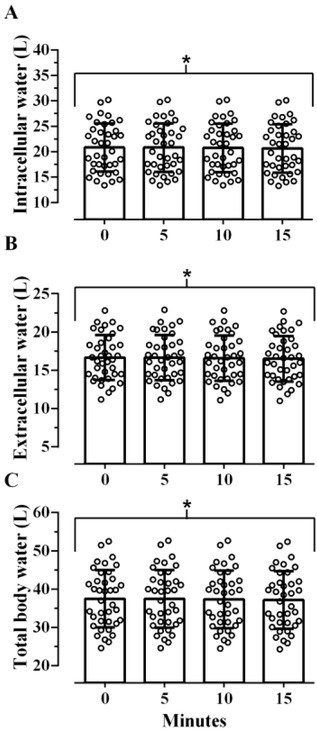
Fig. 2
Effect of time since transitioning from a vertical to a supine position on intracellular water (A), extracellular water (B), and total body water (C) over 15 minutes as assessed via the RJL Quantum Legacy analyzer (N=38). Open circles represent individual responses. *Denotes a statistically significant decrease from baseline over the course of 15-minutes resting in a supine position (p<0.05).
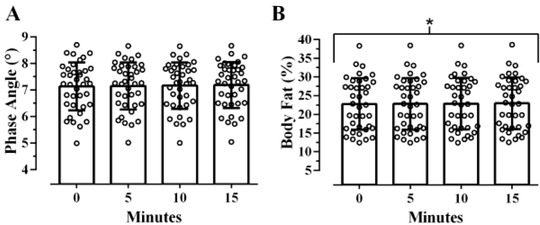
Fig. 3
Effect of time since transitioning from a vertical to a supine position on phase angle (A), and body fat percentage (B) over 15 minutes as assessed via the RJL Quantum Legacy analyzer (N=38). Open circles represent individual responses. *Denotes a statistically significant increase from baseline over the course of 15-minutes resting in a supine position (p<0.05).
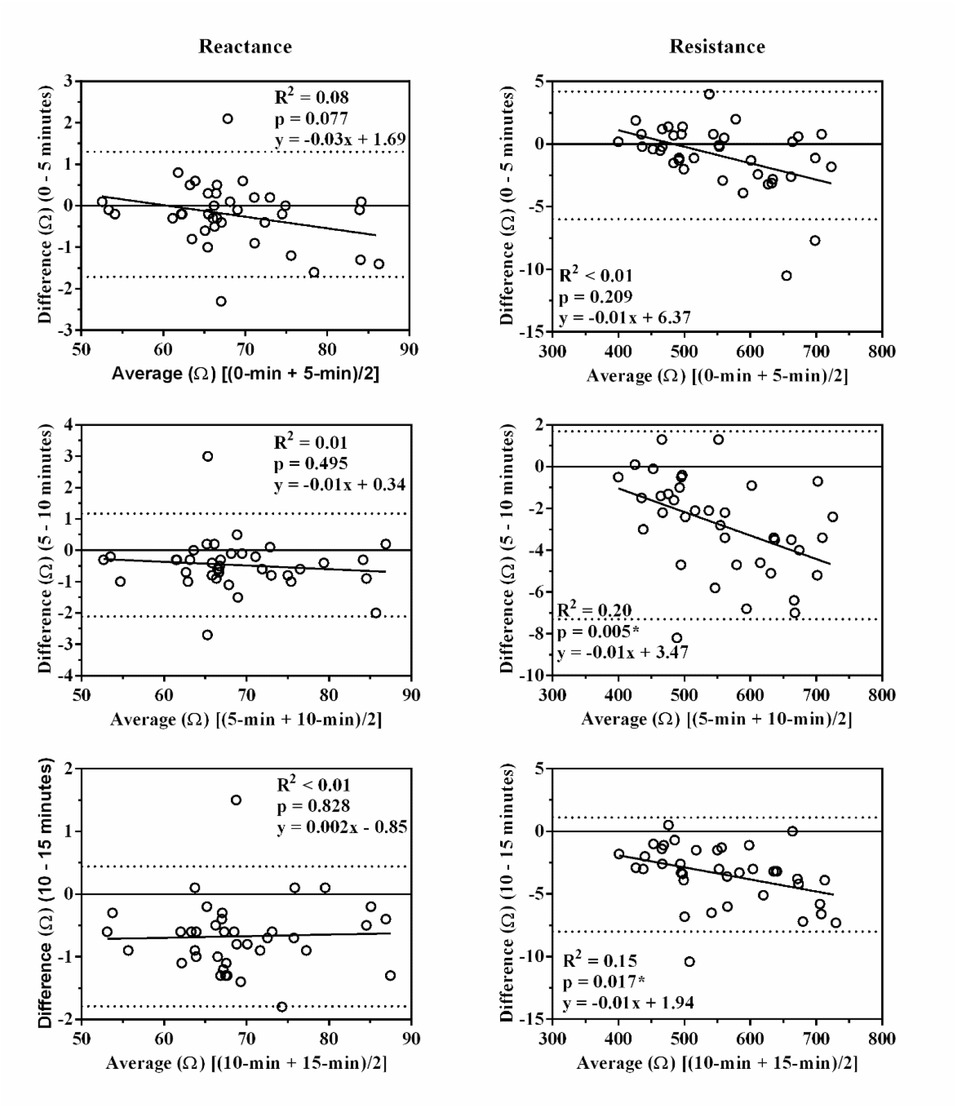
Fig. 4
Bland and Altman plots of individual differences for the effect of time since transitioning from a vertical to a supine position on reactance (left side) and resistance (right side) (N = 38). The solid line represents a mean difference (bias) of zero. The dashed lines denote the upper and lower limits-of-agreement (bias ± [1.96×SD of the bias]). R2 represents the amount of variance explained by the average resistance or reactance. *p<0.05 significant systematic bias.
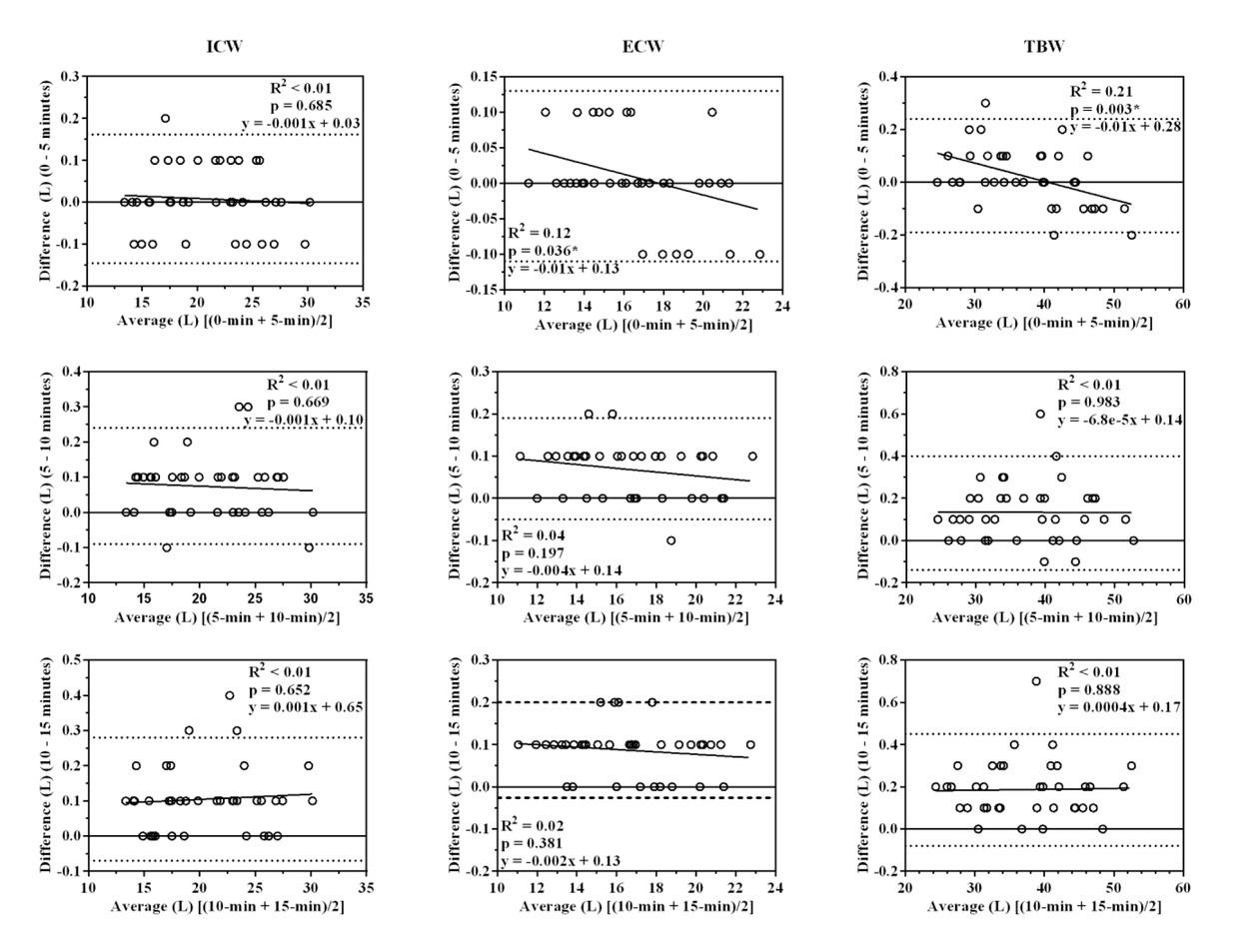
Fig. 5
Bland and Altman plots of individual differences for the effect of time since transitioning from a vertical to a supine position on intracellular water (ICW: left side), extracellular water (ECW: middle), and total body water (TBW: right side) (N = 38). The solid line represents a mean difference (bias) of zero. The dashed lines denote the upper and lower limits-of-agreement (bias ± [1.96×SD of the bias]). R2 represents the amount of variance explained by the average ICW, ECW, or TBW. *p<0.05 significant systematic bias.
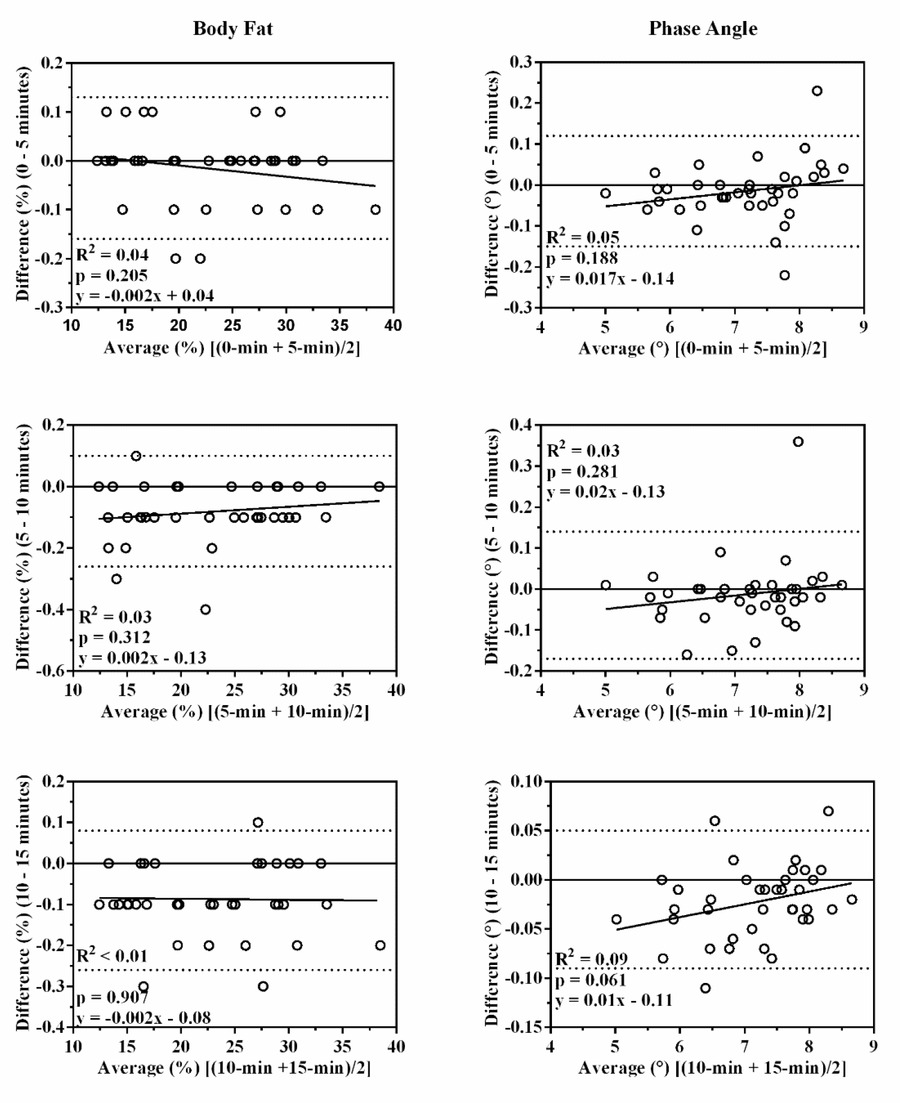
Fig. 6
Bland and Altman plots of individual differences for the effect of time since transitioning from a vertical to a supine position on body fat (left side) and phase angle (right side) (N = 38). The solid line represents a mean difference (bias) of zero. The dashed lines denote the upper and lower limits-of-agreement (bias ± [1.96×SD of the bias]). R2 represents the amount of variance explained by the average value. *p<0.05 significant systematic bias.