
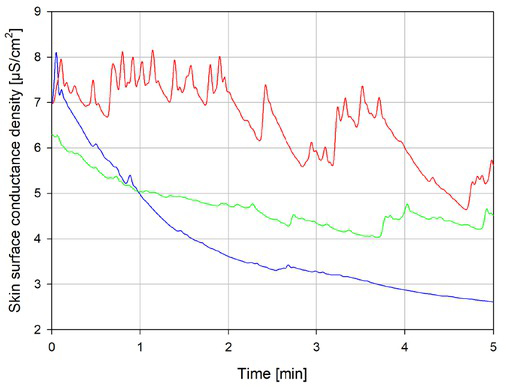
Figure 1
Example measurement of low frequency skin conductance. Person being highly stressed (red curve), moderately stressed (green curve), and totally relaxed (blue curve).
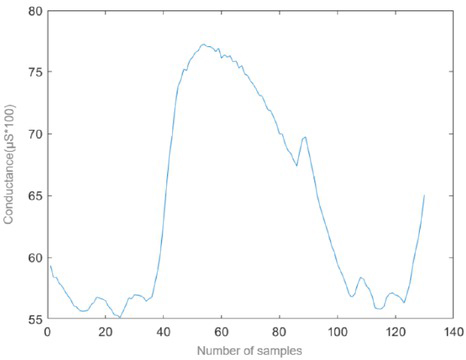
Figure 2
Conductance measurement. Example of data reported as disgust.
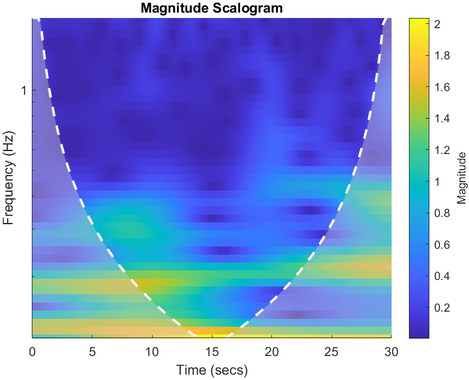
Figure 3
CWT treated conductance measurement. The same example (Figure 2) of data reported as disgust with CWT applied.
Table 1
Category of emotion and how many times the emotion was reported.
| Emotion | Number of samples |
|---|---|
| Amusement | 20 |
| Anger | 9 |
| Disgust | 24 |
| Fear | 5 |
| Neutral | 15 |
| Sadness | 26 |
| Tenderness | 1 |
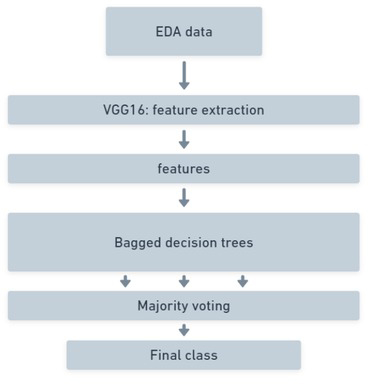
Figure 4
Architecture of the machine learning process.
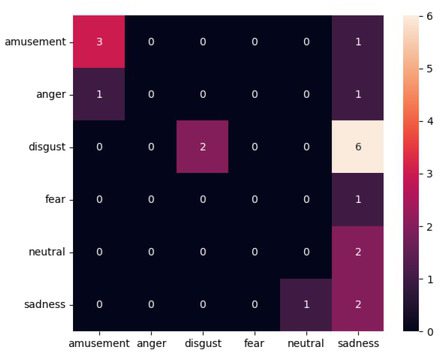
Figure 5
Confusion matrix for the first results produced by the model using the full dataset.
Table 2
Results using the CWT treated EDA data with test size = 20 and trees = 100.
| test size = 20 | trees = 100 | ||||
|---|---|---|---|---|---|
| precision | recall | f1-score | support | ||
| amusement | 0.75 | 0.75 | 0.75 | 4 | |
| anger | 0.00 | 0.00 | 0.00 | 2 | |
| disgust | 1.00 | 0.25 | 0.40 | 8 | |
| fear | 0.00 | 0.00 | 0.00 | 1 | |
| neutral | 0.00 | 0.00 | 0.00 | 2 | |
| sadness | 0.15 | 0.67 | 0.25 | 3 | |
| accuracy | 0.35 | 20 | |||
| macro avg | 0.32 | 0.28 | 0.23 | 20 | |
| weighted avg | 0.57 | 0.35 | 0.35 | 20 | |
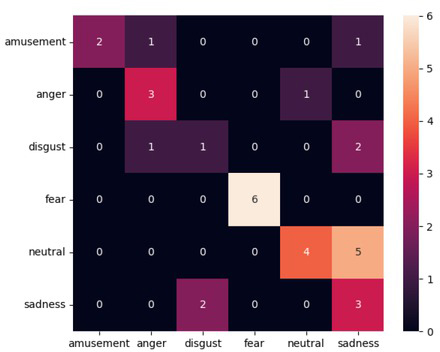
Figure 6
Confusion matrix for the first results produced by the model using the full data set with SMOTE data added.
Table 3
Results using the full CWT applied EDA dataset with synthetic data. The parameters are set to: test size = 20 and trees = 100.
| test size = 20 | trees = 100 | ||||
|---|---|---|---|---|---|
| precision | recall | f1-score | support | ||
| amusement | 1.00 | 0.50 | 0.67 | 4 | |
| anger | 0.60 | 0.75 | 0.67 | 4 | |
| disgust | 0.33 | 0.25 | 0.29 | 4 | |
| fear | 1.00 | 1.00 | 1.00 | 6 | |
| neutral | 0.80 | 0.44 | 0.57 | 9 | |
| sadness | 0.27 | 0.60 | 0.37 | 5 | |
| accuracy | 0.59 | 32 | |||
| macro avg | 0.67 | 0.59 | 0.59 | 32 | |
| weighted avg | 0.70 | 0.59 | 0.61 | 32 | |
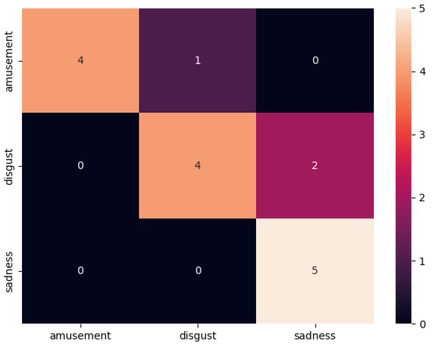
Figure 7
Confusion matrix for the results produced by the model using the three category data set with SMOTE data added.